Complete Guide to the History and Highlights of Yato Castle Ruins | A Thorough Explanation of the Mountain Castle Where the Kai Genji Clan Originated
What is Yato Castle? Basic Information and Overview
Yato Castle (Yato-jo) is a medieval mountain castle located in Yato, Oizumi-cho, Hokuto City, Yamanashi Prefecture. Also known as Chausuyama Castle or Hemi Castle, it is a historically important castle said to have been built by Kuro Genta Kiyomitsu, the ancestor of the Kai Genji clan. It was registered as a national historic site in 1993 and is currently maintained as a historical park.
Located at an altitude of approximately 850 meters at the foot of the Yatsugatake Mountains, this castle was built on a ridge formed by a landslide of the Yatsugatake Mountains, and is a natural stronghold sandwiched between the Higashi-Kinugawa and Nishi-Kinugawa rivers to the east and west. The northern side continues along the ridge, and the castle’s layout is characterized by its robust terrain, surrounded by steep cliffs on three sides.
Location and Access
- Location: Yato, Oizumi-cho, Hokuto City, Yamanashi Prefecture
- Access: Approximately 10 minutes by car from JR Chuo Main Line Nagasaka Station, approximately 15 minutes from Chuo Expressway Nagasaka IC
- Parking: Free parking available (approximately 20 cars)
- Visiting Hours: Open all year round
- Admission Fee: Free
History of the Kai Genji and Yato Castle
The Founder of the Kai Genji, Minamoto no Kiyomitsu, and the Construction of Yato Castle
The history of Yato Castle dates back to the late Heian period. Minamoto no Kiyomitsu, considered the founder of the Kai Genji, was a warrior known as the grandson of Shinra Saburo Yoshimitsu. After Minamoto no Yoshikiyo, the second son of Minamoto no Yoshimitsu, was exiled from Hitachi Province to Kai Province, his son Kiyomitsu established his power base in Hemi-sho, Kai Province (present-day Hokuto City area).
Kiyomitsu, known by his nickname “Kurogenta,” is said to have built Yato Castle, with Hemmi Manor as his base. His descendants, based in this area, gave rise to numerous branch families, including the Hemmi, Takeda, Kagami, and Yasuda clans, expanding their influence throughout Kai Province. The Takeda clan, in particular, would later become a powerful Sengoku daimyo (feudal lord).
Yato Castle and the Hemmi Clan in the Kamakura Period
During the Kamakura period, the Hemmi clan, descendants of Kiyomitsu, were active, with Yato Castle as their base. The *Azuma Kagami* records that when Minamoto no Yoritomo raised an army, Hemmi generals joined forces alongside Takeda Nobuyoshi of the Kai Genji clan.
The Hemmi clan maintained their power by deepening their relationships with the Imperial Court and the Kamakura Shogunate, based around Mount Hemmi (the area around present-day Yato Castle). As a branch of the Kai Genji clan, they had a cooperative relationship with Takeda Nobuyoshi, who had gained the trust of Minamoto no Yoritomo, and functioned as a powerful samurai group in Kai Province. ### Yato Castle and the Takeda Clan during the Sengoku Period
From the Muromachi period to the Sengoku period, Kai Province came under the control of the Takeda clan. The influence of the Hemmi clan was absorbed by the Takeda clan, and it is believed that Yato Castle also came under Takeda control. Although detailed records of Yato Castle during this period are scarce, it is presumed to have functioned as part of the Takeda clan’s territorial management.
The Tensho-Jingo War and Renovations by the Later Hojo Clan
Yato Castle reappears on the historical stage during the Tensho-Jingo War, which occurred after the Honnoji Incident in 1582. After the death of Oda Nobunaga, Tokugawa Ieyasu, Hojo Ujinao (Later Hojo clan), and Uesugi Kagekatsu fiercely fought over Kai Province, the former territory of the Takeda clan.
During this war, the Later Hojo clan’s forces are believed to have deployed at Yato Castle and carried out large-scale renovations. Many of the remains visible today, such as the ring-shaped enclosures, earthworks, and dry moats, are thought to be the result of renovations carried out by the Later Hojo clan during this period. The Later Hojo clan excelled in castle construction techniques in the Kanto region, and these characteristics are strongly reflected in Yato Castle.
Ultimately, the Tensho-Jingo War ended in victory for Tokugawa Ieyasu, and Kai Province came under the control of the Tokugawa clan. Afterward, Yato Castle is believed to have lost its strategic importance and was abandoned.
Characteristics of Yato Castle’s Layout and Remains
Structure of the Ring-Shaped Enclosures
The most distinctive feature of Yato Castle is its concentrically arranged ring-shaped enclosures. This structure, where the second and third enclosures surround the central main enclosure (honmaru), is a characteristic layout often seen in castles of the Later Hojo clan.
By skillfully utilizing the terrain, the main enclosure was positioned on a high point on the ridge, and surrounded by enclosures that gradually descend, its defensive capabilities were enhanced. Earthen ramparts and dry moats were constructed between each enclosure, creating a structure that effectively prevented enemy intrusion.
Remains of Earthen Ramparts and Dry Moats
The most impressive remains at the Yato Castle site are the earthen ramparts and dry moats that separate each enclosure. The ramparts around the second enclosure, in particular, are 2-3 meters high and several meters wide, demonstrating the advanced castle-building techniques of the time.
The dry moats were dug along the ramparts, and while their depth varies, they reach over 3 meters in the deepest parts. These ramparts and dry moats have been partially restored after archaeological excavations as part of the historical site preservation efforts, bringing them back to life in their original state.
Structure of the Main Enclosure (Honmaru)
The main enclosure, the central part of the castle, is located at the highest elevation. From here, one can see a panoramic view of the surrounding mountains, including the Yatsugatake Mountains, Mount Fuji, and Mount Kai-Komagatake, indicating its function as a military lookout post.
The flat area of the main enclosure is relatively large, and flat areas believed to be the remains of buildings have also been confirmed. Excavations have uncovered postholes and carbonized remains, confirming the existence of a building.
Second and Third Enclosures
The second enclosure, surrounding the main enclosure, is where the best-preserved remains are located. Earthworks and moats are clearly visible, making it an important area for understanding the castle’s structure.
The third enclosure is located further out, forming the overall defensive line of the castle. These multi-layered defensive structures clearly demonstrate the characteristics of the Hojo clan’s castle-building techniques.
Location and Topographical Features of Yato Castle
A Fortress Utilizing the Topography of the Yatsugatake Mountains
Yato Castle is built on a unique terrain formed by a landslide on the Yatsugatake Mountains. Located at an altitude of approximately 850 meters, yet situated on a relatively flat ridge, it was a suitable location for building a castle.
It is bordered to the east and west by two rivers, the Higashi-Kinugawa and Nishi-Kinugawa, and the south, east, and west sides are steep cliffs. By making maximum use of this natural terrain, the castle was built to be a stronghold that was easy to defend even with a small force.
Strategic Location in Kai Province
Yato Castle is located in the northwestern part of Kai Province, particularly near the border with Shinano Province (present-day Nagano Prefecture). This location was of great importance as a base for the Kai Minamoto clan’s expansion into Kai Province, and as a key point for expansion into and defense of Shinano.
The southern foothills of the Yatsugatake Mountains have been a vital transportation hub since ancient times, and Yato Castle, located on the route connecting Kai and Shinano Provinces, is thought to have been a strategically and economically important base.
Yato Castle as a National Historic Site
History and Significance of Historic Site Designation
Yato Castle ruins were designated as a national historic site in 1993. The designation was based on its historical importance as the birthplace of the Kai Minamoto clan, the well-preserved traces of renovations by the Later Hojo clan, and its distinctive circular enclosure layout.
Following its designation as a national historic site, a full-scale preservation and development project has commenced, with planned excavation surveys, preservation of remains, and restoration work progressing systematically.
Historical Site Development and Restoration Efforts
After the historic site designation, Hokuto City (then Oizumi Village) has carried out historic site development in stages. Based on the locations of earthworks and dry moats revealed by excavation surveys, some remains have been restored.
The development project prioritizes the preservation of remains, while also installing information boards and explanatory signs to help visitors understand the castle’s structure, and developing walking paths. Safety has also been considered, with fences installed on dangerous cliffs.
Highlights and How to Enjoy Yato Castle Ruins
Earthworks and Moats of the Second Enclosure
The most noteworthy feature when visiting Yato Castle Ruins is the earthworks and dry moats around the second enclosure. The high earthworks and deeply dug moats are well-preserved, allowing visitors to experience the defensive structure of a medieval mountain castle. Walking along the earthen ramparts allows you to experience the perspective of soldiers from that era.
View from the Main Enclosure
The view from the main enclosure is one of the major attractions of Yato Castle Ruins. On a clear day, you can enjoy a 360-degree panorama, including the majestic Yatsugatake Mountains, Mount Fuji in the distance, and Mount Kai-Komagatake in the Southern Alps. This excellent view speaks to its function as a military lookout post.
Strolling along the Outer Garden Promenade
A promenade encircles the outer garden of Yato Castle Ruins, allowing you to see the entire castle site in about 30 minutes. From the promenade, you can clearly see the layout of each enclosure and the terrain, which helps in understanding the overall structure of the castle.
The scenery visible through the trees is also beautiful, especially during the seasons of fresh greenery and autumn leaves.
Yato Castle as a Cherry Blossom Spot
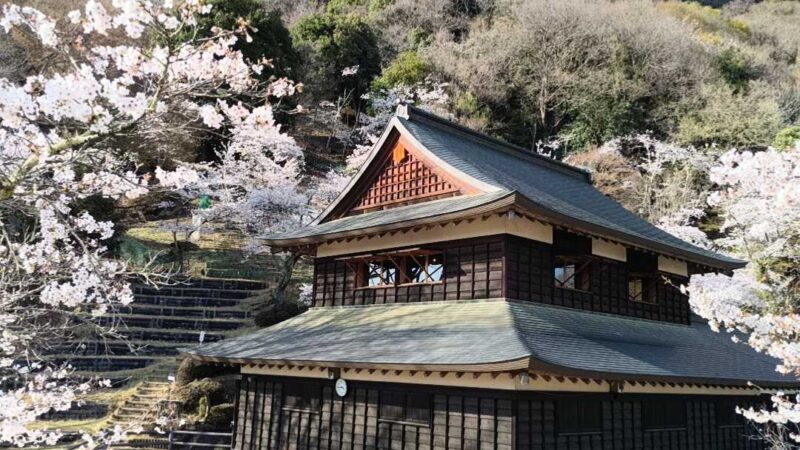
Yato Castle Ruins are also known as a famous cherry blossom spot. In spring, approximately 400 Somei Yoshino and double-flowered cherry trees bloom throughout the mountain in staggered stages, creating a magnificent landscape. Somei Yoshino cherry trees reach their peak from early to mid-April, while double-flowered cherry trees are at their best from late April to early May, allowing visitors to enjoy the cherry blossoms for an extended period.
During cherry blossom season, many tourists visit, making it a popular spot where visitors can enjoy both history and nature.
Hokuto City Archaeological Museum (formerly Yato Castle Hometown History Museum)
Museum Overview and Exhibits
Located very close to the Yato Castle ruins is the Hokuto City Archaeological Museum (formerly known as the Yato Castle Hometown History Museum). This museum displays artifacts unearthed during the excavation of Yato Castle and materials related to the castle’s history.
Of particular note is the reconstructed model of Yato Castle. This model allows for a three-dimensional understanding of the castle’s overall structure and the layout of each enclosure, which is difficult to discern at the actual site. Furthermore, the museum features comprehensive explanatory panels on the history of the Kai Genji clan and the Tensho-Jingo War, allowing for a deeper understanding of Yato Castle by visiting beforehand.
Opening Hours
- Opening Hours: 9:00 AM – 5:00 PM (Last entry at 4:30 PM)
- Closed: Mondays (or the following day if Monday is a public holiday), New Year holidays
- Admission Fee: 200 yen for adults, 100 yen for elementary and junior high school students
- Inquiries: Cultural Properties Division, Hokuto City Board of Education
The museum also regularly holds special exhibitions, covering various themes related to the history of the Kai Genji clan and Hokuto City.
Tourist Attractions Around Yato Castle
Seikoji Temple
Seikoji Temple, considered the family temple of Minamoto no Seiko, who built Yato Castle, is located in Nagasaka-cho, Hokuto City. As a temple associated with the Kai Genji clan, it preserves historical materials related to Seiko and the Hemmi clan.
Mount Kai-Komagatake
Mount Kai-Komagatake, a famous peak in the Southern Alps, can be admired from the ruins of Yato Castle. Access to Kitazawa Pass, a base for climbing, is also from Hokuto City, allowing you to combine mountain sightseeing with historical sightseeing.
Yatsugatake Resort Area
Oizumi Town, where the Yato Castle ruins are located, is known as a highland resort area at the southern foot of the Yatsugatake Mountains. Pensions, restaurants, art museums, and hot spring facilities are scattered throughout the area, making it an ideal base for sightseeing.
Sanbuichi Spring Water
Sanbuichi Spring Water, a famous spring water spot in Hokuto City, is about a 15-minute drive from the Yato Castle ruins. It is said to be a water distribution facility built by Takeda Shingen to resolve water disputes, and has been selected as one of Japan’s 100 best waters.
Practical Guide to Visiting Yato Castle
Best Time to Visit
While Yato Castle ruins can be visited year-round, the following times are particularly recommended.
- Spring (April-May): Cherry blossom season. Somei Yoshino and double-flowered cherry blossoms bloom in succession, providing a long period of enjoyment.
- Early Summer (May-June): Beautiful fresh greenery and pleasant weather. The view of the Yatsugatake Mountains is superb.
- Autumn (October-November): Beautiful autumn foliage, clear air, and excellent long-distance views.
Summer is relatively cool due to the high altitude, but winter can bring snow and treacherous footing, so caution is advised.
Estimated Time and Sightseeing Route
The following time allocation is recommended for visiting the Yato Castle Ruins.
- Castle Ruins Only: Approximately 40 minutes to 1 hour
- Castle Ruins + Hokuto City Archaeological Museum: Approximately 1 hour 30 minutes to 2 hours
- Including a Stroll Through the Surrounding Area: Approximately 2 hours to 3 hours
For a more in-depth understanding, it’s recommended to first visit the Hokuto City Archaeological Museum to gain some background information before visiting the castle ruins. A standard route at the castle ruins involves starting from the parking lot, proceeding to the main enclosure, viewing the earthworks and moat of the second enclosure, and then walking around the outer garden’s promenade.
Clothing and Items to Bring
Yato Castle Ruins is a mountain castle; the following preparations are recommended.
- Shoes: Comfortable sneakers or trekking shoes
- Clothing: Comfortable clothing, appropriate warm clothing for the season
- Items to bring: Drinks, hat, sunscreen, insect repellent (summer)
- Camera: For photographing views and ruins
The walking paths are well-maintained, but there are some steps and slopes, so please watch your step.
The Historical Significance of Yato Castle and the Kai Genji
Importance as the Birthplace of the Kai Genji
Yato Castle is not merely a medieval mountain castle, but holds historical significance as the birthplace of the Kai Genji clan, including the Takeda clan, who later rose to prominence as Sengoku daimyo.
Minamoto no Kiyomitsu established this base and expanded his descendants, giving rise to many samurai groups such as the Takeda, Hemmi, Kagami, Yasuda, and Asari clans. These families were active not only in Kai Province but throughout Japan from the Kamakura period to the Sengoku period.
The Lineage of the Takeda Clan
The Takeda clan, in particular, is a prestigious family that began with Takeda Nobuyoshi, son of Kiyomitsu, and continued through to Takeda Shingen of the Sengoku period. Takeda Shingen, feared as the “Tiger of Kai,” led the strongest cavalry army of the Sengoku period, and his military strategies continue to be studied today.
Considering that Yato Castle was the origin of the Takeda clan, and that the Takeda clan’s prosperity was built upon the foundation laid by Kiyomitsu, the historical value of this castle site becomes clear.
Remains Demonstrating the Castle Construction Techniques of the Later Hojo Clan
The renovations carried out by the Later Hojo clan during the Tensho-Jingo War are valued as valuable remains demonstrating the castle construction techniques of the Sengoku period in the Kanto region. The Later Hojo clan built numerous strong castles, including Odawara Castle, and developed their own unique castle construction techniques.
The ring-shaped enclosures, earthworks, and dry moats found at Yato Castle clearly demonstrate the characteristics of the Later Hojo clan’s castle construction techniques, and it occupies an important position in the study of castles in the Kanto and Koshin regions. ## Summary: The Charm and Value of Visiting Yato Castle
Located in Yato, Oizumi-cho, Hokuto City, Yamanashi Prefecture, the Yato Castle ruins are a valuable nationally designated historical site that conveys the history of the Kai Genji clan. Built by Minamoto no Kiyomitsu and renovated by the Later Hojo clan, this castle tells the story of a long history spanning from the Heian period to the Sengoku period.
With its well-preserved earthworks and dry moats, the beautiful natural environment at the foot of the Yatsugatake Mountains, and its charm as a spring cherry blossom viewing spot, it’s a recommended spot not only for castle enthusiasts but also for general tourists, offering a chance to enjoy both history and nature.
Visiting it in conjunction with the Hokuto City Archaeological Museum allows you to learn more about the history of the Kai Genji clan and the structure of medieval mountain castles. Taking advantage of its location in a highland resort area at the southern foot of the Yatsugatake Mountains, it’s also a good idea to plan a trip that combines it with sightseeing in the surrounding area.
Yato Castle ruins offer a chance to trace the roots of Takeda Shingen and feel the spirit of the Sengoku period. Please experience its historical value and natural beauty firsthand.