The Complete Guide to Onnemoto Chashi Ruins: History, Highlights, and Access
The Onnemoto Chashi Ruins, located on a cape overlooking Onnemoto Bay in Nemuro City, Hokkaido, are a valuable archaeological site that conveys the history and culture of the Ainu people. Among the Nemuro Peninsula Chashi ruins, this site is particularly well-preserved and has been selected as one of Japan’s 100 Famous Castles. It is not merely a tourist destination, but a significant place where the lives of Japan’s indigenous people intersect with historical events of the early modern period.
This article comprehensively explains everything you need to know before visiting the Onnemoto Chashi Ruins, from its historical background to specific highlights and access methods.
What are the Onnemoto Chashi Ruins?
Basic Concept of Chashi
Chashi (Chashikotsu) is a general term for facilities built by the Ainu people. While generally translated as “fortress” or “castle,” their uses were diverse. Beyond its function as a military defensive structure, it is believed that these fortifications served multiple purposes in peacetime, including as sacred sites for rituals and ceremonies, meeting places for discussions and negotiations, and watchtowers.
The structure of a Chashi (fortified settlement) is characterized by its skillful use of natural terrain, creating partitioned spaces through earthworks and ditches (moats). Approximately 700 Chashi have been identified in Hokkaido, but many are difficult to discern from the surface.
Location of Onnemoto Chashi
The Onnemoto Chashi site is located on a protruding cape on the western shore of Onnemoto Bay, facing the Sea of Okhotsk on the northern side of the Nemuro Peninsula. 32 Chashi sites still exist within Nemuro City, and 24 of them were designated a National Historic Site in 1983 and 1984 as the “Nemuro Peninsula Chashi Site Group.”
Onnemoto Chashi is a representative example among the Chashi ruins of the Nemuro Peninsula. Because its shape is well-preserved, walking paths and stairs have been constructed for visitors. Looking up from Onnemoto Fishing Port, its distinctive shape, resembling an “offering of mochi rice cakes,” can be seen, and its beautiful silhouette captivates many visitors.
History of Onnemoto Chashi Ruins
Construction Period and Origin
Onnemoto Chashi is estimated to have been constructed by the Ainu people between the 16th and 18th centuries. The Nemuro Peninsula has a rugged natural topography formed by the eruption of an underwater volcano, and many Chashi were built utilizing this terrain.
The area around Onnemoto Bay has been a place of human habitation since ancient times. Near the Onnemoto Chashi ruins, the remains of pit dwellings from the Okhotsk culture period, approximately 1,300 years ago, have also been discovered, indicating that this area has been used by people throughout a long history. Within the continuity from the Okhotsk culture to the Ainu culture, this bay functioned as an important strategic point.
Connection to the Kunashiri-Menashi War
The Onnemoto Chashi site has deep ties to the “Kunashiri-Menashi War,” which occurred in 1789 (Kansei 1). This war was an uprising by the Ainu people of Kunashiri Island and Menashi (present-day Nemuro region) against the oppression of merchants and officials under the control of the Matsumae Domain.
Initially, the Ainu side had the upper hand, but they were ultimately suppressed by the Matsumae Domain. Records show that Onnemoto Chashi was not only a battlefield but also used as an execution ground for captured Ainu people. Due to this historical fact, Onnemoto Chashi is not merely a ruin, but an important site that conveys the history of Ainu resistance, making it academically valuable.
Preservation and Development in the Modern Era
Since the Meiji era, many Chashi (fortified settlement) sites have been lost as Hokkaido has been developed. However, the Chashi sites on the Nemuro Peninsula have been preserved in relatively good condition.
The designation as a National Historic Site in 1983 and 1984 was a significant event that officially recognized the value of these ruins. Subsequently, in 2006, the Nemuro Peninsula Chashi sites were selected as the first of the “100 Famous Castles of Japan” by the Japan Castle Association, and Onnemoto Chashi became widely known as a representative example.
Currently, the Nemuro City Board of Education is leading efforts to preserve and utilize the sites, taking care to ensure the safety of visitors.
Structure and Characteristics of Onnemoto Chashi Site
Design Utilizing the Topography
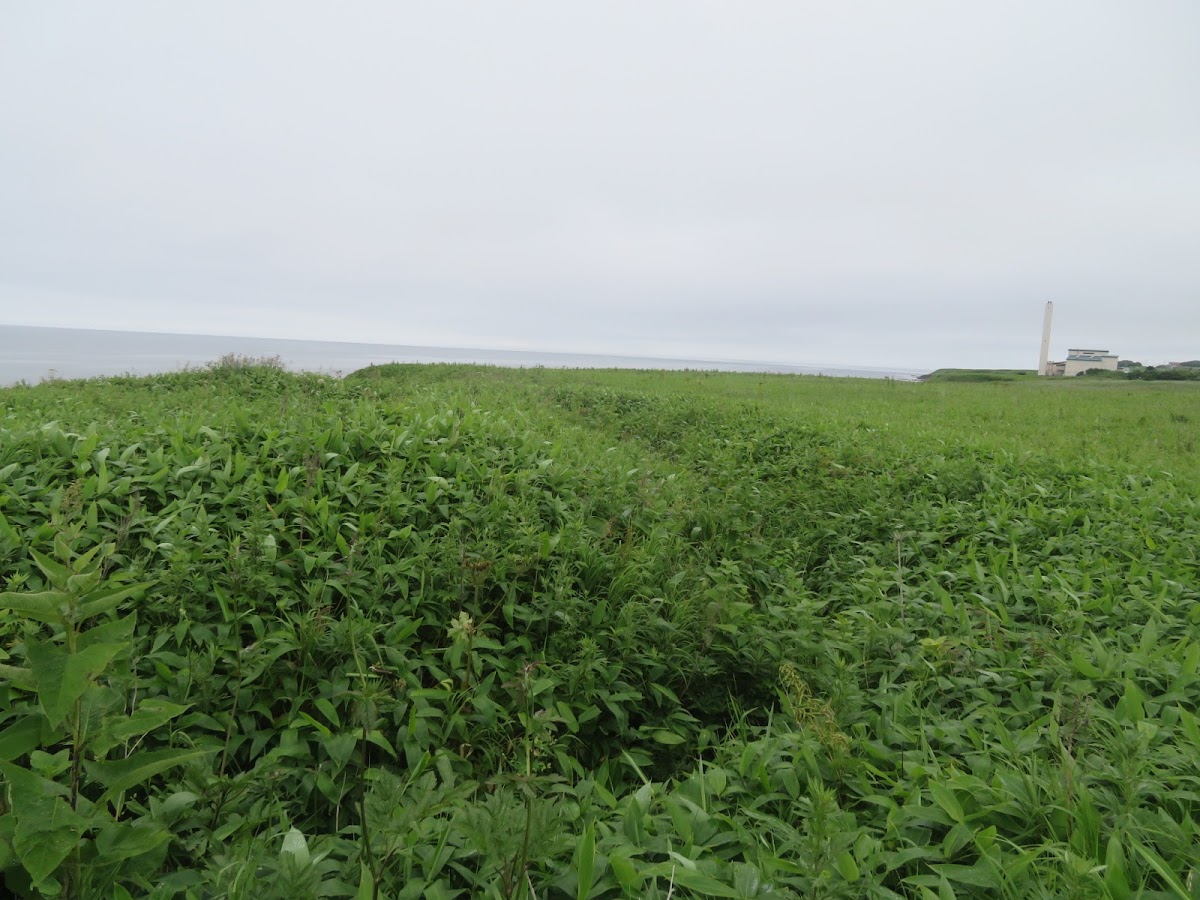
The most distinctive feature of Onnemoto Chashi is its structure, which skillfully utilizes the natural cape topography. On a cape jutting out into Onnemoto Bay, an embankment was constructed, and a U-shaped or semicircular trench (ditch) was added to enhance its defensive capabilities.
Two flat areas were created at the top of the embankment, which are thought to have been used as places for rituals and gatherings. Its location facing the sea was ideal for lookouts, offering a vast view of the Sea of Okhotsk.
A Chashi with Strong Warfare Elements
Onnemoto Chashi is considered to have particularly strong warfare elements among the Chashi of the Nemuro Peninsula. The arrangement of the trenches and the shape of the embankment suggest that it was not merely a ceremonial site, but a structure designed with defense in mind.
This characteristic aligns with its history as an actual battlefield during the Kunashiri-Menashi War. The design, which prevented intrusion from the sea and prepared for attacks from land, demonstrates the advanced fortification techniques of the Ainu people at that time.
The Shape of the “Offering Rice Cake”
Looking up from Onnemoto Fishing Port, Onnemoto Chashi has a distinctive shape resembling an “offering rice cake.” This beautiful silhouette is due to the two-tiered earthen mound, allowing the Chashi to be seen even from a distance.
The excellent condition of this shape indicates its good state of preservation, making it a valuable historical site that conveys its appearance from the 16th to 18th centuries.
Highlights of the Onnemoto Chashi Site
Observing the Earthen Mound and Moat
Upon actually visiting Onnemoto Chashi, the first thing that catches the eye is the clearly preserved earthen mound and moat. You can observe these structures up close while climbing the well-maintained footpath.
The earthen mound was artificially created by piling soil onto the natural terrain, and its height and angle allow us to imagine the scale of the labor force at the time. The moat is a defensive ditch, and its depth and width reveal its importance as a defensive feature.
View from the Summit
Standing on the summit of Onnemoto Chashi, a magnificent view of the Sea of Okhotsk unfolds. This view is the moment you truly understand why the chashi (fortified site) functioned as a lookout post.
On a clear day, you can even see the islands of the Northern Territories in the distance. The Nemuro Peninsula is the easternmost point of Japan, and the sunrise viewed from this location is exceptional. Beyond its historical significance, the beauty of its natural landscape is a major attraction of Onnemoto Chashi.
Surrounding Pit Dwelling Sites
Near the Onnemoto Chashi site, there are remnants of pit dwellings from the Okhotsk culture period, approximately 1,300 years ago. Visiting these sites together allows you to understand the long historical continuity of this region.
The Okhotsk culture flourished in northeastern Hokkaido and Sakhalin from the 5th to the 13th centuries and is believed to have influenced the formation of Ainu culture. The remains of pit dwellings can be seen as depressions in the ground, allowing us to imagine what life was like at that time.
Well-maintained viewing paths
Onnemoto Chashi is particularly well-maintained among the Nemuro Peninsula Chashi sites, making it easy to visit. A walking path is provided from the parking lot, and you can climb to the top using stairs.
Information boards and explanatory signs are also installed, allowing you to learn about the structure and history of the Chashi while you visit. However, since it is a site that utilizes the natural terrain, comfortable shoes are recommended.
Understanding the Nemuro Peninsula Chashi Sites as a Whole
Chashi concentrated on the Nemuro Peninsula
The Nemuro Peninsula is a region with a particularly high concentration of Chashi within Hokkaido. In Nemuro City alone, 32 Chashi sites remain visible above ground, a number that stands out even when considering the entire prefecture.
The reason for this concentration is the geographical and strategic importance of the Nemuro Peninsula. As a gateway to the Kuril Islands and the Northern Territories, and a region blessed with abundant fishing resources, it is believed that many people gathered here from ancient times, and that various groups constructed Chashi (fortified settlements).
Value as a National Historic Site
The designation of 24 Chashi sites on the Nemuro Peninsula as a National Historic Site signifies recognition of their value as Ainu cultural heritage. These Chashi are valuable physical evidence that tells the story of the Ainu people’s history, for which written records are scarce.
In particular, Onnemoto Chashi and Notsukamafu Chashi (Nokkamafu Chashi) are in excellent condition and exhibit typical Chashi forms. Through these ruins, it is possible to study the social structure, defense techniques, and relationship with nature of the Ainu people.
Significance as the No. 1 of Japan’s Top 100 Castles
In 2006, when the Japan Castle Association selected “Japan’s Top 100 Castles,” the Nemuro Peninsula Chashi Sites were chosen as the No. 1 site. This is not simply a matter of numerical order; it also holds symbolic significance as it formally positions the Ainu Chashi (fortified settlements) within the history of Japanese castles.
Traditionally, Japanese castles were primarily those built by samurai south of Honshu, featuring keeps and stone walls. However, the inclusion of Chashi in the list of Japan’s 100 Famous Castles allows for a broader perspective on Japanese castle culture. Onnemoto Chashi, as a representative example, serves as the starting point for a stamp rally and attracts many castle enthusiasts.
Access and Visiting Information
Location and Basic Information
Address: Onnemoto, Nemuro City, Hokkaido 087-0166
Visiting Hours: 24 hours (however, daytime visits are recommended for safety)
Admission Fee: Free
Parking: Available (Free)
Access from Nemuro City Center
Onnemoto Chashi Ruins are located approximately 15km northeast of Nemuro city center, about a 20-minute drive.
Access by Car:
- From Nemuro Station, take National Route 44 towards Cape Nosappu.
- Follow the signs towards Onnemoto and head north.
- Head towards Onnemoto Fishing Port.
- There is a signpost and parking lot near the fishing port.
Public Transportation:
Direct public transportation from Nemuro city to Onnemoto Chashi is limited. Since there are few bus routes, using a rental car or taxi is the most practical option.
Points to Note When Visiting
When visiting Onnemoto Chashi, please note the following:
- Clothing: Although the walkways are well-maintained, you will be walking on natural terrain, so comfortable shoes and clothing are necessary.
- Weather: As it is a seaside location, it can be windy. Take adequate precautions against the cold and wind.
- Season: During Hokkaido’s winter, there is snowfall, which may make visiting difficult. Spring to autumn is the most suitable time to visit.
- Estimated Time Required: Please allow approximately 30 minutes to 1 hour for the round trip from the parking lot to the top of the chashi.
- Japan’s Top 100 Castles Stamp: The stamp is located at the Nemuro City Museum of History and Nature (209 Hanasaki Port, Nemuro City). Please note that it is not available at the chashi site itself.
Nearby Tourist Spots
In addition to visiting Onnemoto Chashi, we recommend visiting the following nearby spots:
Notsukamafu Chashi Ruins: Another representative chashi site located about 10km east of Onnemoto Chashi. It contains Notsukamafu No. 1 and No. 2 chashi, both of which are well-preserved.
Nosappu Cape: The easternmost cape in Japan. Offering close-up views of the Northern Territories, it is one of the highlights of Nemuro sightseeing.
Nemuro City Museum of History and Nature: A facility where you can learn about Nemuro’s history, nature, and Ainu culture. The stamp for Japan’s 100 Famous Castles is also located here.
Hanasaki Port: A port famous for Hanasaki crab. You can enjoy fresh seafood here.
Higashi-Nemuro Station: Known as the easternmost JR station.
Cultural Significance of Onnemoto Chashi
Heritage that Conveys the History of the Ainu People
Onnemoto Chashi is an important heritage site that conveys the history and culture of the Ainu people to the present day. In Ainu society, where written records were limited, physical evidence like the chashi provides valuable clues to understanding their lifestyle, social organization, and technological level.
In particular, as the site of the Kunashiri-Menashi War, it is significant as a place that conveys the historical fact of how the Ainu people resisted Japanese rule.
From the Perspective of Multicultural Coexistence
In modern Japanese society, correctly understanding and respecting the culture and history of the Ainu, the indigenous people, is an important issue. Visiting archaeological sites like Onnemoto Chashi and learning about their history provides an opportunity to cultivate a multicultural perspective.
In 2019, the “Act on the Promotion of Measures to Realize a Society Where the Pride of the Ainu People is Respected” (Ainu Policy Promotion Act) was enacted, clearly establishing the promotion and dissemination of Ainu culture as a national responsibility. Onnemoto Chashi is an important educational resource within this initiative.
Movement Towards World Heritage Registration
Within Hokkaido, there is a movement to register Ainu cultural heritage as a World Heritage site. The Nemuro Peninsula Chashi Sites also have the potential to become a component of a World Heritage site in the future.
Globally, protecting the heritage of indigenous peoples and recognizing its value is an important theme. Onnemoto Chashi has the potential to attract international attention as a representative example of indigenous heritage in Japan.
The Cutting Edge of Chashi Research
Results of Archaeological Surveys
Recent archaeological surveys have deepened our understanding of Chashi. Through archaeological excavations and surveys, the structure, construction period, and usage of the Chashi (fortified settlements) have been revealed.
Detailed surveys have also been conducted at Onnemoto Chashi, and construction methods are being studied through cross-sectional investigations of the embankments. Furthermore, investigations into its relationship with surrounding pit dwelling sites are underway.
Classification and Function of Chashi
Researchers have classified Chashi into several types based on their form and location. The main classifications include:
- Cliff-faced type: A type where a moat is created to demarcate the area on top of a cliff.
- Isolated hill type: A type built on an isolated hill.
- Ridge type: A type built on a ridge.
- Plain type: A type where a moat surrounds the area on a plain.
Onnemoto Chashi is classified as a cliff-faced type, utilizing the topography of a cape.
Regarding its function, multiple uses are envisioned, including military defense facilities, ritual sites, watchtowers, and meeting places, suggesting that it may have been used for different purposes depending on the era and circumstances.
Utilization of Digital Technology
Recently, aerial photography using drones and 3D scanning technology are being used for record-keeping. This allows for the detailed shape of the chashi (fortified site) to be preserved as digital data, making it possible to utilize it for future research and education.
Record-keeping using these latest technologies is also progressing for Onnemoto Chashi, aiming to balance the preservation and utilization of the site.
Significance of Visiting Onnemoto Chashi
As a Place for Historical Education
Onnemoto Chashi is an important educational site for learning about Japan’s diverse history. Visitors can experience living history that cannot be learned from textbooks alone, such as the Ainu people’s castle-building techniques, which differ from those of castles on Honshu, their lifestyle in harmony with nature, and their relationship with the Japanese in the early modern period.
It is also used in school education as a site for school trips and social studies field trips, playing a role in passing on Ainu culture to the next generation.
Value as a Tourism Resource
Its position as the first of Japan’s 100 Famous Castles gives it significant value as a tourism resource. Castle enthusiasts from all over Japan visit Nemuro for the stamp rally, contributing to the local economy.
Furthermore, combined with the magnificent natural scenery of the Nemuro Peninsula, it has become an attractive destination where visitors can enjoy both historical and natural sightseeing simultaneously. The unique experience of Nemuro, the city closest to the sunrise, leaves a deep impression on visitors.
Confirmation of Cultural Identity
For the Ainu people, chashi (fortified sites) are places built and used by their ancestors, and are important sites for confirming their cultural identity. The proper preservation of sites like Onnemoto Chashi and the accurate transmission of their history are essential for the continuation of Ainu culture.
In recent years, the Ainu cultural revival movement has become active, and chashi have become symbolic of this movement.
Summary: What Onnemoto Chashi Tells Us
The Onnemoto Chashi site is not merely an ancient ruin. It encompasses a multi-layered narrative, encompassing the wisdom and technology of the Ainu people, their social organization, their harmonious relationship with nature, and even the historical tragedy that arose from contact with the Japanese.
Standing on the cape overlooking Onnemoto Bay, feeling the breeze of the Sea of Okhotsk, imagining the people who lived, prayed, and fought here from the 16th to the 18th centuries teaches us much.
As a representative of the Nemuro Peninsula Chashi ruins, a nationally designated historical site, and the first of Japan’s 100 Famous Castles, Onnemoto Chashi will continue to be visited by many people, and its value will continue to be re-evaluated. When visiting Hokkaido, and Japan in general, be sure to visit this historical site and experience a part of Japan’s diverse culture.
Thanks to the preservation and maintenance efforts of Nemuro City and the local people, we can now visit this precious cultural heritage. When visiting, it is necessary to treat the ruins with care, keep its historical and cultural significance in mind, and view it with respect.
Listening to the voice of history that Onnemoto Chashi conveys and passing on its value to future generations is our responsibility as people of the modern age.