Complete Guide to Tedori Castle (Wakayama Prefecture): The Tamaki Clan’s Residence and One of the Largest Mountain Castle Remains in Kishu
What is Tedori Castle?
Tedori Castle is a medieval mountain castle located in Wasa, Hidaka-gawa Town, Hidaka District, Wakayama Prefecture. Built on the summit of Shiroyama Mountain at an altitude of 171 meters, this castle is known as the residence of the Tamaki clan, local lords who ruled the Hidaka region of Kii Province from the Nanboku-cho period to the Sengoku period.
It features multiple baileys, including the main bailey, eastern bailey, second bailey, and western bailey, and its defensive structures such as stone walls, earthworks, and moats are well-preserved. As one of the largest mountain castle remains in Kishu, it holds an important position in castle research. Built on a strategic location overlooking the middle reaches of the Hidaka River, this castle developed alongside the expansion of the Tamaki clan’s power and functioned as a base for regional control until its fall in 1585 during the conflicts surrounding Hashiba Hideyoshi’s conquest of Kishu.
History of Tetori Castle
Nanboku-cho Period: The Tamaki Clan’s Expansion and Castle Construction
The exact date of Tetori Castle’s construction is unclear, but it is believed to have been built by Tamaki Ōnobu during the Nanboku-cho period. The Tamaki clan was originally based in Yamato Province (present-day Nara Prefecture) and sided with the Northern Court during the turbulent Nanboku-cho period, expanding their power into the upper reaches of the Hidaka River.
Tamaki Ōnobu built Tsuruga Castle in the eastern part of Hidaka County and controlled the area from Yamato Province to the upper reaches of the Hidaka River. To further expand his power, he advanced into the lower reaches of the Hidaka River. At that time, Kawakami Noriaki (Kawakami Hyoe Noriaki), who was based at Yamazaki Castle in the lower reaches of the Hidaka River, was attacked and destroyed, and Tetori Castle was built on the summit of the present-day Shiroyama mountain, east of Yamazaki Castle. This location was a strategic point overlooking the Hidaka River, and held strategic importance as it controlled both water and land routes.
The Tamaki clan ruled over seven villages in Ryujin Village (Yamaji-sho), and it is said that their relatives advanced down the Hidaka River to Kamiwasa. By building this castle in Bessho Valley, they established a solid base in the Hidaka region.
Sengoku Period: Balance of Power with the Yukawa Clan
During the Sengoku period, the Tamaki clan, based at Tetori Castle, grew to become a leading local lord in the Hidaka region. In particular, during the time of Tamaki Naokazu, they strengthened their relationship with the Yukawa clan by marrying the daughter of Yukawa Naoharu, lord of Kameyama Castle, and expanded their power to the point of dividing the Hidaka region in two.
The Yukawa clan was a powerful local lord in southern Kii Province, and together with the Tamaki clan, they stood as one of the two major powers in the Hidaka region. While sometimes forming marital alliances, the two clans maintained their respective spheres of influence and built a complex political relationship. During this period, Tetori Castle was being developed as the Tamaki clan’s base, evolving into a sturdy mountain castle with stone walls.
The Tensho Conquest of Kii and the Fall of the Castle
In 1585 (Tensho 13), Tetori Castle faced a major turning point in its history. When Hashiba Hideyoshi (later Toyotomi Hideyoshi) began his conquest of Kii Province, the Tamaki clan decided to side with Hideyoshi. On the other hand, Yukawa Naoharu, the lord of Kameyama Castle, showed resistance to Hideyoshi, and the two clans, once bound by marital ties, became enemies.
The forces of Yukawa Naoharu, who resisted Hideyoshi, attacked Tetori Castle, held by the Tamaki clan who sided with Hideyoshi. After a fierce battle, Tetori Castle fell. This battle marked the end of the Tamaki clan’s rule over the Hidaka region, which had continued since the Nanboku-cho period.
After its fall, Tetori Castle was abandoned and never functioned as a castle again. However, its remains have been well-preserved to this day, making it a valuable historical site that conveys the appearance of a mountain castle from the Sengoku period.
Structure of Tetori Castle
Layout and Overall Structure
Tetori Castle is a typical mountain castle built around the summit of Shiroyama Mountain, at an elevation of 171 meters (relative height approximately 160 meters). Located about 1.5 kilometers east of the Hidaka River, it is a strategically advantageous fortress that cleverly utilizes the river and the surrounding terrain.
The castle grounds consist of multiple enclosures, including the main enclosure (Honmaru), the East Enclosure, the Second Enclosure, and the West Enclosure, with the enclosures arranged along the ridgeline. Each enclosure is clearly demarcated by moats and earthworks, demonstrating defensive features throughout. It has also been suggested that the entire castle was constructed of stone walls, and traces of stonework can still be seen in key areas.
Main Enclosure (Honmaru)
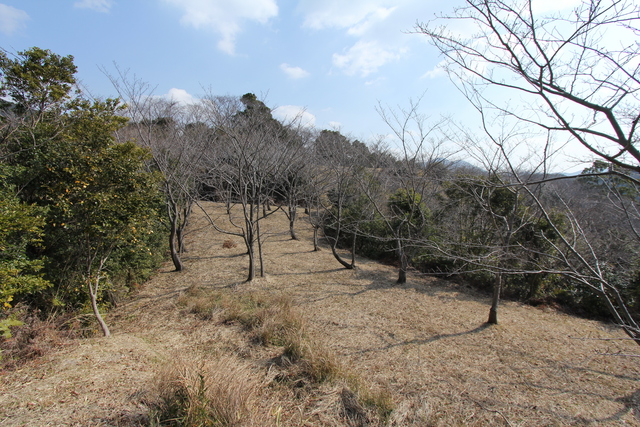
The main enclosure, the heart of the castle, is located at the highest point of the castle mountain and boasts a robust structure surrounded by earthworks and stone walls. From the main enclosure, one can see a panoramic view of the Hidaka River basin, suggesting it served both as a military surveillance point and as the lord’s residence.
The main enclosure is relatively large for a mountain castle, indicating its importance as the Tamaki clan’s base. Even today, the bases of the stone walls and fallen stones can be seen on the ground surface, evoking its former grandeur.
Enclosure Groups and Demarcation Structure
One of the characteristics of Tetori Castle is its organically arranged structure of multiple enclosures. The Higashi-no-maru (Eastern Enclosure) is located east of the main enclosure and served as an important defensive stronghold protecting it. Currently, a paved forest road leads to Higashi-no-maru, making access relatively easy.
The baileys, such as Ninomaru and Nishi-no-maru, function as independent defensive units, yet together they form a single castle system. Moats are provided between each bailey to prevent enemy intrusion and to allow for continued resistance in the event of one bailey’s fall.
Stone Wall Remains
One of the greatest highlights of Tetori Castle is its stone wall remains. Traces of stonework remain in the main sections, suggesting the possibility that the entire castle was once constructed of stone. Although many sections have collapsed, the remaining stonework demonstrates advanced stonework techniques.
Examples of stone walls of this scale are rare in mountain castles in Kii Province, serving as evidence of the Tamaki clan’s economic power and technical prowess. The construction of the stone walls is thought to have progressed during the late Sengoku period, and it is speculated that the reinforcement with stone walls was undertaken to enhance the castle’s defenses amidst the power struggle with the Yukawa clan. ### Moats and Earthworks
Multiple moats are constructed along the ridges, dividing the castle grounds. Moats are defensive structures designed to cut off enemy incursions by severing the ridges, and at Tetori Castle, particularly deep moats are located along the main ridges.
Earthworks surround each enclosure, forming a defensive line alongside the stone walls. The height and shape of the earthworks suggest that the castle was developed in stages, providing valuable historical insights into its development.
Dry Moats
Dry moats are strategically placed between enclosures and at the boundaries of the castle grounds. These moats served not only defensive purposes but also controlled movement between enclosures. The clearly visible remains of these dry moats are important historical artifacts demonstrating the skillful design of the castle’s layout.
Highlights of Tetori Castle
One of the Largest Mountain Castle Remains in Kishu
Tetori Castle is known as one of the largest mountain castles in the Kishu region. The vast castle grounds, with their numerous baileys, stone walls, and moats, preserve a typical image of a medieval mountain castle, making it an unmissable historical site for castle enthusiasts.
Exploring the entire castle grounds allows you to truly appreciate how mountain castles of the Sengoku period were constructed and what kind of defensive systems they possessed. The stone wall remains around the main bailey, in particular, are an important highlight that speaks to the power of the Tamaki clan.
Good Preservation
The remains of Tetori Castle are still relatively well-preserved, even more than 400 years after its fall. In recent years, some areas have been improved, enhancing access to the main remains.
In particular, a paved forest road leads to Higashi-no-maru, making it accessible even by regular cars. This makes Tetori Castle one of its attractions, as it offers relatively easy access to the main areas, which is unusual for a mountain castle.
Views
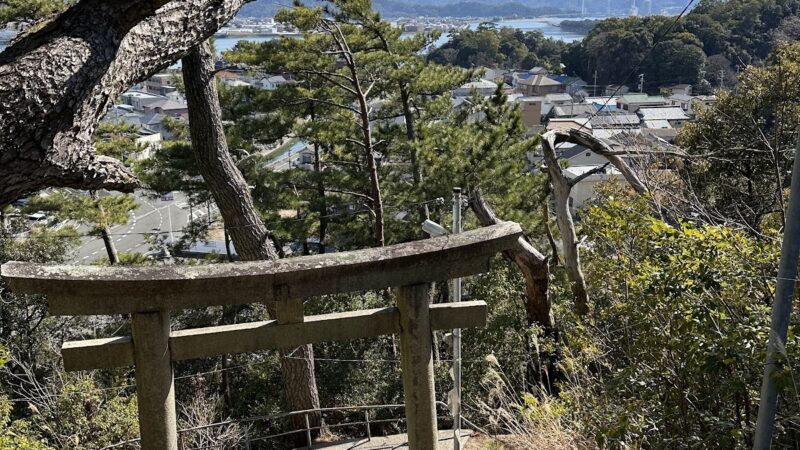
The views from the summit of the castle mountain are another major attraction of Tetori Castle. From the main enclosure at an altitude of 171 meters, you can enjoy a panoramic view of the Hidaka River basin, giving you a real sense of why this location was chosen as a strategic military point. On a clear day, you can even see the mountains of the Kii Mountains in the distance, allowing you to imagine the view the Tamaki clan once had as they surveyed their territory from this spot.
Access and Visiting Information
Location
- Address: Wasa, Hidaka-gawa Town, Hidaka District, Wakayama Prefecture
- Castle Type: Mountain Castle
- Altitude: 171 meters (Relative height approximately 160 meters)
Access Method
Access by Car
Access to Tetori Castle is convenient by car. A signpost for “Tetori Castle Entrance” is located along the road running south of the castle mountain; from there, you enter a forest road. This forest road is paved and approximately 2 meters wide, continuing to Higashi-no-maru. While it is passable for regular cars, caution is needed when passing oncoming vehicles.
The nearest interchanges are the Arita IC on the Hanwa Expressway or the Gobo IC on the Yuasa-Gobō Expressway. From there, it’s about a 30-40 minute drive via National Route 424 and other routes.
Access by Public Transportation
Public transportation access is limited. The nearest stations are Dojoji Station or Gobo Station on the JR Kisei Main Line, but you will need to take a bus or taxi from there. A community bus service operates in Hidaka-gawa Town, but the number of services is limited, so it is recommended to check the timetable in advance.
Points to Note When Visiting
- As this is a mountain castle, comfortable shoes and clothing are recommended.
- Insect repellent and long sleeves are advisable during the summer months.
- Bring drinking water with you.
- Be careful as the ground can be slippery depending on the weather.
- To protect the remains, please do not climb on the stone walls or earthworks.
- Please be aware that cell phone reception may be poor in some areas.
Estimated Visiting Time
If you access Higashi-no-maru by car, it will take approximately 1-2 hours to see the main remains. If you want to thoroughly explore the entire castle grounds, allow 2-3 hours.
Nearby Tourist Attractions
Historical Sites in Hidaka-gawa Town
Around Tedori Castle, there are numerous historical sites related to the Tamaki and Yukawa clans. Several other medieval castle ruins exist within Hidaka-gawa Town, and those interested in the history of medieval Japan are encouraged to visit them as well.
Dojoji Temple
Located about 20 minutes by car from Tetori Castle, Dojoji Temple is an ancient temple known for the legend of Anchin and Kiyohime. It houses many cultural artifacts, including the National Treasure, a standing statue of the Thousand-Armed Kannon, making it an important temple for understanding the culture of Kii Province during the medieval period.
Hidaka River
The Hidaka River, flowing below Tetori Castle, is known for its clear waters and is a popular spot for ayu (sweetfish) fishing. There are many scenic spots along the river, making it ideal for a scenic drive.
Historical Significance of Tetori Castle
Center for Regional Control
Tetori Castle functioned as the base of control for the Tamaki clan in the Hidaka region from the Nanboku-cho period to the Sengoku period. By controlling the Hidaka River basin, a crucial transportation hub, the Tamaki clan established economic and military superiority, growing to a power comparable to the Yukawa clan.
The Conquest of Kishu and the End of the Middle Ages
The fall of Tetori Castle in 1585 (Tensho 13) holds significance beyond the mere demise of a single castle. Hashiba Hideyoshi’s conquest of Kishu marked the end of medieval rule by local lords in Kii Province and symbolized the transition to the early modern period. The fall of Tetori Castle embodied this historical turning point.
Value in Mountain Castle Research
Tetori Castle holds an important position in castle research as a typical example of a mountain castle from the Sengoku period in Kii Province. The well-preserved remains of stone walls, moats, and baileys make it a valuable resource for studying the structure and development of medieval mountain castles.
In particular, the use of stone walls is an important indicator of the technological level and economic power of the time, and the stone wall remains of Tetori Castle are indispensable for considering the history of castles in the Kishu region.
Summary
Tedori Castle, located in Hidaka-gawa Town, Wakayama Prefecture, is one of the largest mountain castle ruins in Kishu (Wakayama Prefecture). Built by Tamaki Taizen during the Nanboku-cho period, it developed into the residence of the Tamaki clan, who wielded considerable power in the Hidaka region during the Sengoku period. Although it fell during the conflicts surrounding Hashiba Hideyoshi’s conquest of Kishu in 1585, its remains are still well-preserved.
The abundant remains, including the main keep, eastern bailey, second bailey, western bailey, stone walls, moats, and earthworks, are a valuable historical site that conveys the appearance of a mountain castle from the Sengoku period. Its relatively accessible location is also appealing, making it a highly worthwhile castle site for castle enthusiasts and history buffs.
Surrounded by the beautiful nature of the Hidaka River basin, Tedori Castle is a spot where you can enjoy both historical romance and the charm of nature. If you are interested in the medieval history of Kii Province or enjoy exploring mountain castles, why not visit it at least once?