Complete Guide to Tatebayashi Castle (Gunma Prefecture): The History and Highlights of Obiki Castle, Built by Sakakibara Yasumasa, One of the Four Heavenly Kings of Tokugawa
What is Tatebayashi Castle?
Tatebayashi Castle (Tatebayashi-jo) is a flatland castle located in Shiromachi, Tatebayashi City, Gunma Prefecture, that existed from the Sengoku period to the Edo period. Also known as “Obiki Castle,” it is known for its unique layout, cleverly utilizing Jōnuma (castle marsh) as a natural moat.
Currently designated as a Tatebayashi City historical site, part of the castle ruins, along with Jōnuma, have blended into the urban area. However, remnants and historical sites, including the reconstructed Dobashi Gate, are scattered throughout, evoking its former appearance. In particular, the history of Sakakibara Yasumasa, one of the Four Heavenly Kings of Tokugawa, who carried out large-scale renovations and transformed it into a modern castle with stone walls and a keep, is arguably the most distinctive feature of Tatebayashi Castle.
The Construction of Tatebayashi Castle and the Legend of “Obiki Castle”
The Mystery of the Construction Period and Builder
There are no reliable historical records regarding the construction period or builder of Tatebayashi Castle, and several theories exist. The most widely known theory is that it was built in the mid-15th century (around 1471) by Akai Terumitsu. The Akai clan were influential samurai in the Tatebayashi and Oura regions who served the Maigi clan, important retainers of the Koga Shogunate.
However, this theory, based on records compiled during the Edo period, lacks historical evidence, and it has been suggested that the actual construction period may be even earlier. One theory suggests that it was built in 1530 (Kyoroku 3), and the origins of Tatebayashi Castle remain shrouded in history.
The Origin of the “Obiki Castle” Legend
The origin of Tatebayashi Castle being called “Obiki Castle” is attributed to a famous legend involving a fox. Akai Terumitsu, the lord of Obukuro Castle on the south shore of Jōnuma Marsh, rescued a young fox on his way to pay his New Year’s greetings to his lord, Maigi Castle, one year. In return, the parent fox guided him to a strategically important location on the north shore of Jōnuma Marsh, leading the way by dragging its tail. After finishing the trek before dawn, it disappeared, saying, “My master, Inari-sama, will forever protect the castle town, so when you build the castle, construct a shrine there.”
From this legend, Tatebayashi Castle came to be known as “Obiki-jō” (Tail-Dragging Castle), and an Inari shrine was built within the castle grounds. Furthermore, the castle’s shape—approximately 800 meters east-west and 200 meters north-south—resembling an animal’s tail, also contributed to this alternative name.
Tatebayashi Castle in the Sengoku Period: Conflicts between the Hojo, Uesugi, and Takeda Clans
The Akai Clan’s Era
Initially, Tatebayashi Castle functioned as the residence of the Akai clan. However, it is believed to have fallen in 1471, and its rulers changed rapidly thereafter. The Kanto region during the Sengoku period was a fierce battleground where three major powers—the Later Hojo clan based in Odawara, the Uesugi clan (later the Nagao clan) of Echigo, and the Takeda clan of Kai—competed for supremacy.
The Rule of the Nagao and Hojo Clans
After the Akai clan, Tatebayashi Castle came under the influence of the Nagao clan (later the Uesugi clan) of Echigo for a period. Nagao Kagetora (Uesugi Kenshin), who succeeded the Kanto Kanrei Uesugi clan, considered Tatebayashi Castle an important base for his expansion into Kanto.
However, in the late Sengoku period, the Hojo clan of Sagami expanded their power, and Tatebayashi Castle also came under Hojo control. The Hojo clan positioned Tatebayashi, a strategic point in the Kanto Plain, as an important military base and proceeded with the construction of the castle. During this period, Tatebayashi Castle served as a frontline base for the Hojo clan’s control of northern Kanto.
The Siege of Odawara and the Fall of the Castle
In 1590, when Toyotomi Hideyoshi’s siege of Odawara began, Tatebayashi Castle was caught in the fighting. It resisted as a branch castle of the Hojo clan, but ultimately fell to the Toyotomi forces. This siege of Odawara led to the downfall of the Hojo clan, and the Kanto region came under the control of Tokugawa Ieyasu.
Sakakibara Yasumasa and the Major Renovation of Tatebayashi Castle
The Entry of Sakakibara Yasumasa, One of the Four Heavenly Kings of Tokugawa
In 1590, when Tokugawa Ieyasu entered the Kanto region by order of Toyotomi Hideyoshi, Sakakibara Yasumasa, one of the Four Heavenly Kings of Tokugawa, entered Tatebayashi Castle with a stipend of 100,000 koku. Yasumasa Sakakibara was a senior retainer of the Tokugawa family since the Mikawa period, and was known as a brilliant general excelling in both military prowess and strategic brilliance.
Yasumasa Sakakibara extensively renovated Tatebayashi Castle, which had previously had a medieval structure, transforming it into a modern fortress with stone walls and a keep. This renovation elevated Tatebayashi Castle from a mere provincial castle to one befitting the residence of a daimyo ruling northern Kanto.
Transformation into a Modern Castle
The renovation by Yasumasa Sakakibara involved the following large-scale construction:
Construction of Stone Walls: Tatebayashi Castle, which had previously relied on earthen ramparts for defense, was given full-fledged stone walls. Stone walls were strategically placed in key areas of the main keep and second bailey, significantly improving its defensive capabilities.
Construction of a Keep: A keep was built at Tatebayashi Castle. While its detailed structure is unknown, it is believed to have served as a symbol of the castle, boasting an imposing presence overlooking the castle town.
Construction of the Enclosures: Centered around the main enclosure (Honmaru), second enclosure (Ninmaru), and third enclosure (Sanmaru), multiple enclosures such as the Hachiman enclosure, South enclosure (Nanmaru), Inari enclosure (Inarimaru), outer enclosure (Sotomaru), and outer enclosure (Sōmaru) were systematically arranged to establish a multi-layered defensive structure.
Construction of the Castle Town: In parallel with the construction of the castle, the construction of a castle town, with samurai residences and merchant districts systematically arranged, also progressed.
The Rule of the Sakakibara Clan
Sakakibara Yasumasa ruled this area until his death in Tatebayashi in 1606 (Keichō 11). After Yasumasa’s death, his son Yasumasa succeeded him, but in 1616 (Genna 2), he was transferred to the Himeji Domain, marking the end of the Sakakibara clan’s rule over Tatebayashi.
Subsequently, the Sakakibara clan returned as lords of the Tatebayashi Domain in 1624 (Kanei 1), and then underwent further complex changes, including another transfer in 1644 (Shoho 1).
The Golden Age of Tokugawa Tsunayoshi and the Tatebayashi Domain
Tsunayoshi’s Time in Tatebayashi
A particularly noteworthy period in the history of Tatebayashi Castle is the time when Tokugawa Tsunayoshi, who would later become the 5th Shogun of the Edo Shogunate, was the lord of the Tatebayashi Domain. Born in 1661 (Kanbun 1) as the fourth son of the 3rd Shogun Iemitsu, Tsunayoshi resided at Tatebayashi Castle as the lord of the 250,000-koku Tatebayashi Domain until he was adopted by his older brother, the 4th Shogun Ietsuna, in 1679 (Enpo 7).
Relationship with the Shogunate and Castle Development
During Tsunayoshi’s time, as the younger brother of the Shogun, Tatebayashi Castle underwent extensive development with generous support from the Shogunate. As the castle’s fortifications and buildings were expanded, the Tatebayashi Domain strengthened its role as an important base for the shogunate in northern Kanto.
Even after Tsunayoshi became shogun, Tatebayashi maintained close ties with the Tokugawa shogunate. The Tatebayashi Domain was considered important as a shogunate-affiliated domain, and successive lords were often from the Matsudaira clan (a branch of the Tokugawa clan).
Successive Castle Lords and Domain Administration during the Edo Period
The Matsudaira Clan Era
After Tokugawa Tsunayoshi became shogun, the Matsudaira clan took control of the Tatebayashi Domain. Matsudaira Kiyotake, Matsudaira Takemoto, and other members of the Tokugawa clan served as lords for generations, and the Tatebayashi Domain played a crucial role in supporting the shogunate system as a shogunate-affiliated domain.
The Akimoto Clan’s Rule
In the 18th century, the Akimoto clan also ruled the Tatebayashi Domain. As a fudai daimyo (hereditary vassal daimyo), the Akimoto clan dedicated themselves to stabilizing the domain’s administration and developing the territory.
The Return of the Sakakibara Clan
In the latter half of the 18th century, the Sakakibara clan returned as the lords of Tatebayashi Domain. The Sakakibara clan ruled Tatebayashi until the end of the Edo period, working on domain reforms and the promotion of education. They are particularly known for their emphasis on cultural and educational policies, including the establishment of a domain school.
Structure: A Unique Layout Utilizing the Castle Marsh
Overall Structure and Layout
The most distinctive feature of Tatebayashi Castle is its unique layout, which utilizes the Castle Marsh as an outer moat on the east side. The Castle Marsh is a large marsh, approximately 2 kilometers north-south and 600 meters east-west, and this natural moat greatly enhanced the castle’s defensive capabilities.
The castle grounds were long and narrow, approximately 800 meters east-west and 200 meters north-south, with the following baileys arranged from east to west.
Major Baileys
Honmaru: Located in the center of the castle, this was where the main buildings such as the keep and palace were built. This was the most heavily fortified section, reinforced with stone walls.
Ninokuruwa: Located adjacent to the west of the Honmaru (main enclosure), it housed buildings for the lord’s administrative affairs and the offices of senior retainers.
Sannomaru: Further west, it contained residences for retainers and government offices. The currently restored Dobashi Gate is a remnant of this Sannomaru.
Hachiman-kuruwa: Located on the east side of the Honmaru, facing the castle pond, it derives its name from the Hachiman Shrine that was enshrined there.
Nan-kuruwa: Located south of the Honmaru, it was a crucial defensive enclosure.
Inari-kuruwa: An enclosure where the Inari Shrine, originating from the legend of the fox’s tail, was enshrined, and it was considered important as the guardian deity of the castle.
Gai-kuruwa/Sō-kuruwa: Arranged to surround these main enclosures, it formed a multi-layered defensive structure.
Defensive Structures
Tatebayashi Castle’s defenses consisted of a natural moat called Jōnuma, as well as artificially dug moats, earthworks, and stone walls. Especially around the main keep, high stone walls were constructed, creating a strong structure that was difficult to capture.
Gates were strategically placed in each enclosure and featured defensive structures such as masugata koguchi (square-shaped gate). The Dobashi Gate is a prime example, designed to lure attackers into a narrow space for ambush.
Changes Since the Meiji Era and its Current State
Abolition of the Castle and Demolition of Buildings
After the Meiji Restoration, the Tatebayashi Domain was abolished in 1871 (Meiji 4) with the abolition of the feudal domains and establishment of prefectures, and Tatebayashi Castle ceased to serve its purpose. In 1874 (Meiji 7), the castle abolition order was issued, and many buildings, including the keep, were demolished.
The castle site land was sold off to private individuals, and urbanization progressed. Much of the castle’s remains were rapidly lost, with many stone walls removed and moats filled in.
Existing Remains
Currently, only a limited number of remains remain at the Tatebayashi Castle site, but the following historical sites can be seen:
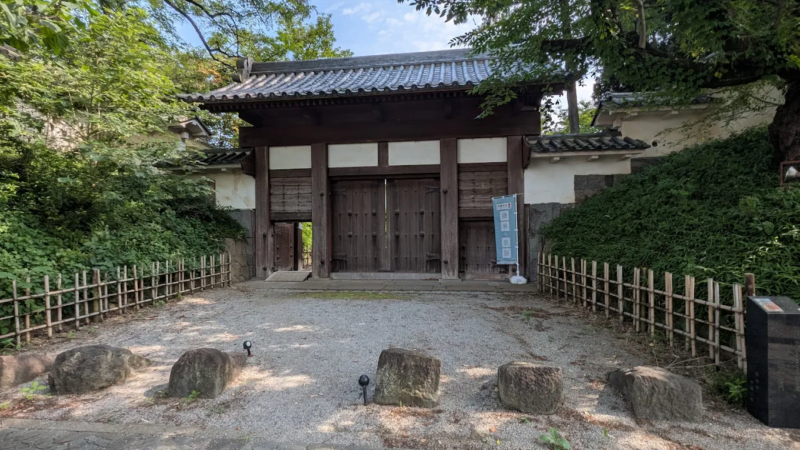
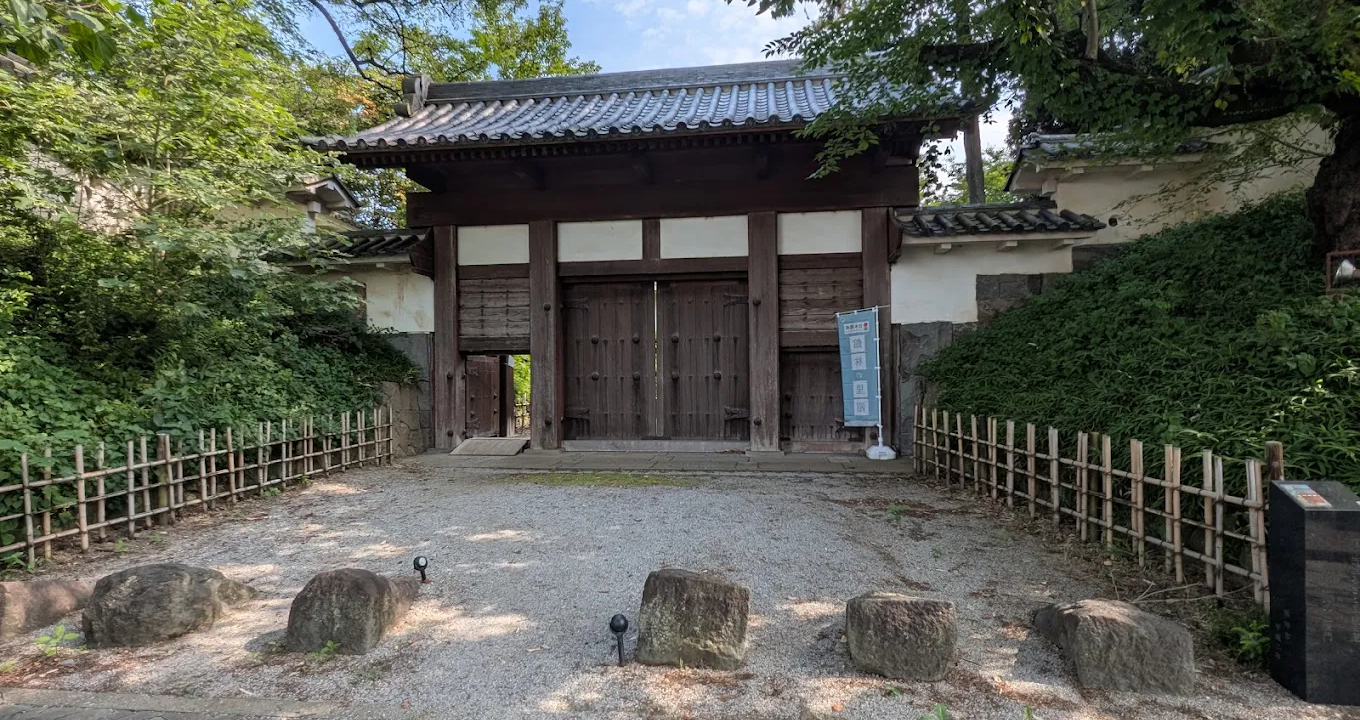
Dobashi Gate (Reconstructed): The Dobashi Gate, located in the third bailey, was reconstructed in the Heisei era. This wooden reconstruction is a valuable structure that evokes the appearance of the time.
Earthworks: Traces of earthworks remain in some of the bailey sites, allowing us to confirm the former defensive structure.
Part of the Stone Wall: A small portion of the stone wall remains, conveying the appearance of a modern castle built by Sakakibara Yasumasa.
Jōnuma Pond: Jōnuma Pond, which was used as the castle’s outer moat, is still present, allowing us to appreciate the unique location of Tatebayashi Castle. A promenade has been built along the pond, making it a place of relaxation for citizens.
Development as a Historic Site
Tatebayashi City protects the castle ruins as a city-designated historical site, and is working to preserve the remains by installing explanatory signs. The area around the castle ruins has been developed as a “Historical Trail,” allowing visitors to stroll around with old maps in hand.
Furthermore, the Tatebayashi City Museum displays materials and models related to Tatebayashi Castle, allowing visitors to learn about the castle’s history. Historical events are held annually at the castle ruins, making it a beloved local historical heritage site.
Highlights of Tatebayashi Castle and Surrounding Historic Sites
Restored Dobashi Gate
The most noteworthy highlight of the Tatebayashi Castle ruins is the restored Dobashi Gate. Located at the entrance to the third bailey, this gate features a masugata koguchi (square-shaped gate) structure, showcasing defensive ingenuity throughout. The faithfully reproduced wooden gate is a popular spot for photography.
Castle Pond and Surrounding Landscape
Castle Pond is both a key defensive feature of Tatebayashi Castle and contributes to its beautiful scenery. Especially in spring, the area is known as a popular spot for cherry blossom viewing. Walking along the promenade beside the marsh, you can truly appreciate the scale of the former castle.
Inari Shrine
The Inari Shrine, which originates from the Obiki legend, still stands near the castle ruins. Revered as the guardian deity of Tatebayashi Castle, it is an indispensable part of the castle’s history.
Zendo-ji Temple (Temple associated with Tokugawa Tsunayoshi)
Located in the castle town of Tatebayashi, Zendo-ji Temple was a temple deeply revered by Tokugawa Tsunayoshi during his time as lord of the Tatebayashi domain. Items associated with Tsunayoshi remain, making it an important historical site for understanding the relationship between the shogun and Tatebayashi.
Former Akimoto Residence
The former residence of the Akimoto family, who served as chief retainers of the Tatebayashi domain, is preserved here, allowing visitors to see late Edo period samurai architecture. It is a valuable building that conveys the samurai culture of the Tatebayashi castle town.
Access: How to get to Tatebayashi Castle Ruins
Access by Train
Nearest Station: Tatebayashi Station, Tobu Isesaki Line
It’s about a 13-minute walk from Tatebayashi Station to the Tatebayashi Castle Ruins (Dobashi Gate). Exit the station and head east; after passing through the city center, you’ll arrive at the castle ruins area.
From Tokyo: Approximately 1 to 1.5 hours by Tobu Isesaki Line (Tobu Skytree Line) express or rapid train.
From Gunma: Approximately 15 minutes from Ota Station on the Tobu Isesaki Line.
Access by Car
Tohoku Expressway: Approximately 10 minutes from Tatebayashi IC
National Route 354: Towards Tatebayashi city center
Parking is available around Jōnuma Pond and in public parking lots within the city. However, since the area around the castle ruins is residential, please avoid street parking.
Estimated Time Required for Sightseeing
To visit the main sights of Tatebayashi Castle Ruins, approximately 1-2 hours is recommended. Including a stroll around the castle pond and other nearby historical sites, a half-day visit is recommended.
Tatebayashi Castle and Surrounding Tourist Spots
Tsutsujigaoka Park
A representative tourist attraction of Tatebayashi City, located within walking distance of the castle ruins. From late April to early May, approximately 10,000 azalea bushes of about 100 varieties bloom, making it known as “Japan’s best azalea spot.”
Gunma Prefectural Tatebayashi Museum of Art
A museum primarily exhibiting contemporary art, also renowned for its beautiful architecture. It is approximately a 10-minute drive from Tatebayashi Castle Ruins.
Morinji Temple (Bunbuku Chagama Legend)
A temple famous for the legend of the “Bunbuku Chagama” (a magical tea kettle). Located approximately a 10-minute walk from Tatebayashi Station, its unique approach lined with tanuki (raccoon dog) statues is popular.
Tatebayashi City Museum
This museum allows you to learn about the history of Tatebayashi Castle and the Tatebayashi Domain. It displays castle models, ancient documents, and armor, and visiting before or after your castle visit will deepen your understanding.
Points to Note and Recommendations When Visiting Tatebayashi Castle
Clothing and Preparation
Tatebayashi Castle is a flatland castle, and since your visit will mainly involve walking around the city, comfortable walking shoes such as sneakers are sufficient. However, if you plan to walk along the promenade around Jōnuma Pond, insect repellent spray may be useful depending on the season.
Best Season
Spring (Late March to May): Cherry blossoms and azaleas are beautiful, making it the best season for sightseeing. Visiting in conjunction with Tsutsujigaoka Park is especially recommended.
Autumn (October to November): The autumn foliage is beautiful, and it’s a pleasant season for strolling around Jōnuma Pond.
Summer/Winter: Summer is hot and winter is cold, but there are fewer tourists, allowing for a more relaxed visit.
A Guide to Exploring with Old Maps
Tatebayashi City has established a walking route called the “Historical Trail,” where you can explore the castle town with old maps featured in a leaflet. Comparing Edo-period maps with the current streetscape is fascinating, as you can discover remnants of the past. Leaflets are available at tourist information centers and museums.
Summary: The Historical Value of Tatebayashi Castle
Tatebayashi Castle holds a significant place in the history of Japanese castles, having witnessed the turbulent history of the Sengoku period, undergone modernization by Sakakibara Yasumasa (one of the Four Heavenly Kings of Tokugawa), and served as the birthplace of Tokugawa Tsunayoshi, a future shogun.
Tatebayashi Castle is full of charm, from its unique layout cleverly utilizing the castle pond, to the intriguing legend of its construction (the fox’s tail legend), and its deep connection to the Tokugawa shogunate. While the remaining structures are limited, exploring the reconstructed Dobashi Gate, the scenery of the castle pond, and the historical sites remaining in the castle town allows you to fully imagine its former glory.
Tatebayashi Castle occupies an important position in the history of Japanese castles, having weathered the turbulent Shiro-numa Pond, undergone modernization, and produced Tokugawa Tsunayoshi, a future shogun. When you visit Gunma Prefecture, be sure to stop by the Tatebayashi Castle ruins and experience the history of this magnificent castle built by one of the Four Heavenly Kings of Tokugawa. Combining your visit with nearby attractions such as Tsutsujigaoka Park and Morinji Temple will make for a fulfilling historical exploration.