Takatori Castle (Takaichi, Nara Prefecture) Complete Guide: History, Highlights, and Visiting Information for One of Japan’s Three Great Mountain Castles
Table of Contents
- Overview of Takatori Castle
- History and Development of Takatori Castle
- Structure and Features of the Castle
- Highlights and Tourist Spots
- Access and Visiting Routes
- Annual Events and Activities
- Surrounding Tourist Information
- Frequently Asked Questions (FAQ)
Overview of Takatori Castle
Takatori Castle is one of Japan’s leading mountain castles, located in Takatori, Takaichi-gun, Nara Prefecture. Also known as “Takatori-yama Castle” and “Fuyo Castle,” it functioned as the administrative center of the Takatori Domain during the Edo period. Currently designated a national historical site, it is a popular destination for many castle enthusiasts and history buffs.
One of Japan’s Three Great Mountain Castles
Takatori Castle is counted as one of Japan’s “Three Great Mountain Castles,” along with Mino Iwamura Castle in Gifu Prefecture and Bitchu Matsuyama Castle in Okayama Prefecture. Notably, the relative elevation difference from the foot of the mountain to the main keep reaches approximately 390 meters, boasting one of the largest elevation differences among Japanese castles. Built on the summit of Mount Takatori at an altitude of 583.6 meters, the castle grounds extend for approximately 3 kilometers, a scale truly befitting its title as “Japan’s finest mountain castle.”
Location and Geographical Characteristics
Takatori Castle is built on the summit of Mount Takatori, approximately 4 kilometers southeast of the town of Takatori. Taking advantage of the rugged terrain—with an altitude of 583 meters and a relative elevation of 350-390 meters—it served as a natural fortress, an important military base from the Sengoku period to the Edo period. Its strategic location, connecting the Yoshino area and the Yamato Basin, was strategically positioned to facilitate cooperation with Yoshino, the base of the Southern Court.
History and Background of Takatori Castle
Founding Period: Genkō Era (1332)
The history of Takatori Castle dates back to the second year of the Genkō era (1332), during the Nanboku-chō period. It is believed that Ochi Kunizumi, a powerful local lord who ruled the Yamato-Takaichi area at the time, built a fort-like castle on the summit of Mount Takatori as a base for the Southern Court. The Ochi clan’s main base was Kaibukiyama Castle, located about 10 kilometers northwest of Takatori Castle, and Takatori Castle functioned as a subsidiary castle.
The Ochi clan, belonging to the Southern Court, needed to coordinate with their main base in Yoshino during times of conflict. By positioning Takatori Castle at an intermediate point, they created a strategic defensive network. At this time, Takatori Castle was a simple mountain castle known as a “kakiage-jiro” (a castle with a raised platform), lacking structures such as a keep or turrets.
Sengoku Period: The Era of Tsutsui Junkei
From the Muromachi period to the Sengoku period, Takatori Castle was at the center of power struggles within Yamato Province. In particular, during Tsutsui Junkei’s unification of Yamato Province, Takatori Castle became one of its important strategic points. Under the control of the Tsutsui clan, the castle’s defensive capabilities were strengthened, and it developed its characteristics as a Sengoku-era mountain castle.
Tensho Period: Full-Scale Construction by Honda Toshihisa (1585)
Takatori Castle transformed into the magnificent, modern castle with its impressive stone walls that it is today in Tensho 13 (1585). When Toyotomi Hidenaga became the lord of Koriyama Castle in Yamato Province, his senior retainer, Honda Tarozaemon Toshihisa (with a stipend of over 15,000 koku), was appointed lord of Takatori Castle, and full-scale construction began.
Toshihisa Honda employed a unique castle construction method for the time, combining mountain castle techniques with those of flatland castles, resulting in a magnificent fortress with a keep, stone walls, and numerous turrets. Many of the stone walls built during this period still remain today, forming the core of Takatori Castle’s attractions.
Edo Period: As the Takatori Domain’s Government Office
During the Edo period, Takatori Castle functioned as the government office of the Takatori Domain. During the Kan’ei era, the Uemura family became the lords of the castle, and they ruled the Takatori Domain until the Meiji Restoration. In the Edo period, Takatori Castle formed a complex castle system consisting of the main castle on the mountaintop, the castle town at the foot of the mountain, and a secondary residence.
The phrase “Tatsumi Takatori Yuki” (Snow on Tatsumi Takatori) exists, describing the beautiful sight of Takatori Castle covered in snow, a winter tradition of Yamato Province. The beauty of Takatori Castle was widely known even at that time.
After the Meiji Era: Abandonment and Designation as a Historic Site
In the Meiji era, Takatori Castle was abandoned due to the Meiji government’s decree abolishing castles. The keep and other structures were demolished or relocated. However, the magnificent stone walls remained in the mountains, preserving a valuable legacy for future generations.
In the Showa era, the historical value of the Takatori Castle ruins was re-evaluated, and it was designated a national historic site. Currently, preservation and restoration work on the stone walls is continuously carried out, protecting it as a valuable cultural asset.
Structure and Characteristics of the Castle
Overall Layout
Takatori Castle’s perimeter extends approximately 3 kilometers, and its complex layout features the main keep at its center, surrounded by the second and third baileys, and numerous other enclosures (kuruwa). Despite being a mountain castle, its unique structure, incorporating techniques from flatland castles, represents the pinnacle of castle construction technology.
The entire castle complex has the main keep at its highest point on the mountaintop, with the enclosures arranged in stages along the ridges and valleys. This three-dimensional defensive system was designed to effectively prevent enemy intrusion.
Main Enclosure and Keep Base
The main enclosure is located at the highest point of Mount Takatori, and a three-story keep once stood there. Currently, only the stone walls of the keep base remain, but its scale and intricate stonework allow us to imagine the imposing presence of the keep at that time. From the keep base, one can enjoy a panoramic view of the Yamato Basin, and on a clear day, one can even see as far as Osaka.
High stone walls surround the main enclosure, reaching heights of over 15 meters in some places. These walls exhibit various construction methods, including rough-hewn, fitted, and cut stonework, reflecting the changes over time in the castle’s construction.
Features of the Stone Walls
The greatest highlight of Takatori Castle is undoubtedly its magnificent stone walls. With a total length of several kilometers, it boasts an exceptional scale for a mountain castle. The stone walls were constructed using local granite, and even after more than 400 years, much of them retain their original appearance.
Particularly noteworthy are the stone walls at the remains of the Second Gate, the Kunimi Watchtower, and the Taiko Watchtower. The sight of these towering stone walls, exceeding 10 meters in height, is truly impressive. These walls skillfully utilize the natural terrain to form an artificial defensive line, demonstrating the high level of castle construction technology.
Enclosures and Watchtower Remains
Takatori Castle is believed to have had more than 30 enclosures of varying sizes. Major enclosures included the Honmaru (main keep), Ninomaru (second enclosure), Sannomaru (third enclosure), as well as numerous defensive strongholds such as the Shin-yagura (new watchtower), Kunimi Watchtower, Taiko Watchtower, Matsu-no-mon (pine gate), and Yoshinoguchi-mon (Yoshino entrance gate).
These enclosures served various functions beyond mere defense, including soldier garrisons, supply storage, and command posts. Even today, the stone walls and foundation stones of each enclosure remain, allowing visitors to experience the scale of the castle at that time.
Monkey Stone and Stone Structures
A distinctive feature of Takatori Castle is a stone structure called the “Monkey Stone.” This mysterious stone statue, believed to have been created during the Asuka period, is incorporated into part of the castle’s stone walls. While the reason for the use of such an ancient stone structure in the castle is unclear, it is a relic that conveys the historical depth of Takatori Castle.
Highlights and Tourist Attractions
Spectacular Views from the Main Enclosure
From the main enclosure, at an altitude of 583 meters, you can enjoy a 360-degree panoramic view. You can see the entire Yamato Basin, and if the weather is good, you can even see the Ikoma Mountains beyond the Nara Basin, and even the Osaka Plain. The view is especially spectacular in the early morning and at dusk, and sometimes a sea of clouds forms, creating a fantastical sight.
Magnificent Stone Walls
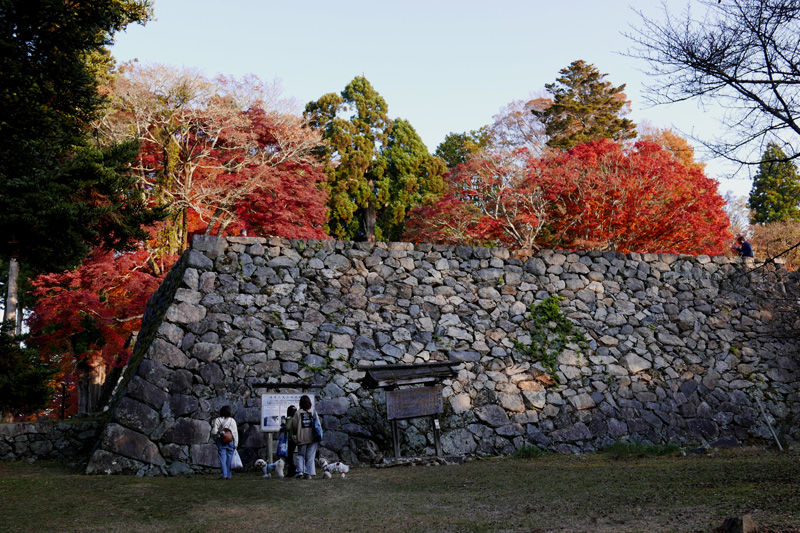
The greatest highlight of Takatori Castle is undoubtedly its stone walls. As you proceed along the path to the castle, the towering stone walls that appear one after another overwhelm visitors. The series of stone walls from the Second Gate to the Main Keep is particularly magnificent, with its continuous high walls sometimes referred to as the “Machu Picchu of the East.”
Observing the details, such as the construction methods, stone selection, and drainage systems, reveals the astonishing level of castle-building technology of the time. Furthermore, the moss and plants growing on the stone walls vary with the seasons, allowing visitors to enjoy the changing scenery throughout the year.
Second Gate and Kunimi Turret Site
The Second Gate site was a crucial defensive point leading to the Main Keep, with stone walls over 10 meters high towering on either side. The experience of passing between these walls is one of the most impressive at Takatori Castle.
The Kunimi Turret site, as its name suggests, was the location of a turret used for overlooking the surrounding area. The stone walls and bailey remain well-preserved today. The view from here is also superb and an important point for understanding the castle’s defensive system. ### Sites of the Shin-yagura (New Turret) and Taiko-yagura (Drum Turret)
The sites of the Shin-yagura and Taiko-yagura (New Turret) are impressive, with well-preserved stone walls. The Taiko-yagura was a turret that housed a drum used to announce the time, and was an important facility that kept the rhythm of life within the castle. Visiting these turret sites allows you to understand the overall structure and function of the castle.
Sites of the Castle Town and Lower Residence
At the foot of the mountain lies the former castle town. The current Takatori town center retains traces of the town layout and samurai residences from that time, making it a great place for a historical walk. The site of the lower residence was the lord’s residence, where government affairs were conducted during peacetime.
The Tosa Kaido (Tosa Highway) runs through the castle town, and it once flourished as a route for trade with the Tosa Domain. Even today, old townscapes and temples and shrines are scattered throughout, allowing you to feel the atmosphere of the Edo period.
Access and Ascent Route
Access by Public Transportation
By Train:
- Get off at Tsubosakayama Station on the Kintetsu Yoshino Line
- Take the Nara Kotsu bus bound for Tsubosakadera-mae from the station and get off at Tsubosakadera-mae (approx. 10 minutes)
- Walk from the bus stop to the ascent route (approx. 15 minutes)
By Bus:
- Since the number of Nara Kotsu buses is limited, it is recommended to check the timetable in advance.
- Please note that there are fewer buses running on weekends and holidays.
Access by Car
From Osaka:
- Approximately 30 minutes from Katsuragi IC on the Minami-Hanna Expressway via National Route 169
From Nara City:
- Head south on National Route 169, approximately 40 minutes
Parking:
- Free parking is available around Tsubosakadera Temple
- There is also parking space at the Hachimanguchi trailhead (a few cars)
- A forest road leads close to the castle ruins, and it’s possible to drive part of the way (however, the road is narrow in places, making it difficult for vehicles to pass each other).
Ascent Routes
There are several routes to Takatori Castle.
1. Tsubosaka-dera Route (Most Common)
- Distance: Approx. 2.5km
- Time Required: Approx. 60-90 minutes on foot
- Difficulty: Intermediate
- Features: Well-maintained hiking trail with signposts along the way.
2. Hachiman-guchi Route
- Distance: Approx. 1.5km
- Time Required: Approx. 40-60 minutes on foot
- Difficulty: Intermediate
- Features: Shortest route, but includes some slightly steep climbs.
3. Five Hundred Arhats Route
- Distance: Approx. 3km
- Time Required: Approx. 90-120 minutes on foot
- Difficulty: Advanced
- Features: A charming route where you can climb while viewing stone Buddha statues.
Using the Forest Road:
- A forest road runs from Hachiman-guchi to near the castle ruins, allowing you to drive to the vicinity of Nanamagari.
- However, the road is narrow in places, making it difficult to pass oncoming vehicles. Those unsure of their driving skills are advised to walk from the foot of the mountain.
- If you use the forest road, you can reach the main keep in about 15-20 minutes on foot.
Points to Note When Visiting the Castle
- Clothing and Equipment: As it is a mountain castle, comfortable shoes and clothing are essential. Hiking boots or trekking shoes are ideal.
- Drinking Water: There is no water source within the castle grounds. Please bring plenty of drinking water.
- Time Required: Please allow at least 2-3 hours for climbing and sightseeing.
- Season: In summer, take precautions against the heat; in winter, take precautions against the cold. There is a possibility of snow, especially in winter.
- Insect Repellent: Insect repellent spray is useful from spring to autumn.
- Toilets: There are toilets at Tsubosaka-dera Temple and the Hachiman-guchi trailhead, but none within the castle grounds.
Annual Events and Festivals
Takatori Castle Festival
The “Takatori Castle Festival,” held every autumn, is a major event where you can experience the history and culture of Takatori Castle. Various events will be held, including a samurai procession, armor try-on experiences, and sales of local specialty products. There will also be events at the castle ruins, allowing you to enjoy Takatori Castle in a different light.
Castle Lighting Event
In recent years, an event has been held where the stone walls are illuminated at night. The fantastically lit stone walls present a completely different appearance from the daytime, captivating many tourists. Since the event dates are limited, please check the Takatori Town Tourism Association website in advance.
Cherry Blossom and Autumn Foliage Season
In spring, cherry blossoms bloom along the path to the castle, and in autumn, the mountains are colored with autumn leaves. The contrast between the stone walls and the autumn leaves is particularly stunning, making it a popular spot for photography enthusiasts.
Surrounding Tourist Information
Tsubosaka-dera Temple (Nan-Hokke-ji Temple)
Located at the foot of Takatori Castle, Tsubosaka-dera Temple is an ancient temple known as the sixth temple on the Saigoku Thirty-Three Kannon Pilgrimage. This temple is revered as a place of healing for eye diseases, and its grounds offer many sights to see, including a large stone statue of Kannon and a large stone statue of the reclining Buddha. It’s an ideal stop before or after visiting Takatori Castle.
Townscape of the Tosa Road
In the town of Takatori, the Edo period townscape remains along the Tosa Road. You can enjoy a historical walk visiting samurai residences, merchant buildings, temples, and shrines. There are also townhouse cafes and souvenir shops where you can spend your time at a leisurely pace.
Takatori Town Tourist Information Center “Yumesokan”
This facility provides tourist information for Takatori Town, and also features exhibits on Takatori Castle and sales of local specialty products. It’s recommended to stop by and gather information before visiting the castle.
Asuka Village
Asuka Village, adjacent to the north of Takatori Town, is a center of ancient Japanese history with many historical sites from the Asuka period. You can visit globally valuable historical sites such as the Ishibutai Tumulus, Takamatsuzuka Tumulus, and Kitora Tumulus. Visiting Takatori Castle in conjunction with this location allows you to experience the rich history of Nara.
Other Information
Why Takatori Castle was selected as “Japan’s Strongest Castle”
In the NHK General TV program “You’ll Definitely Want to Visit! Japan’s ‘Strongest Castle’ Special,” Takatori Castle was brilliantly selected as “Japan’s Strongest Castle.” The reasons for this selection are as follows:
- Relative Height of 390 Meters – One of the largest elevation differences among Japanese castles
- Stone Walls with a Total Length of Several Kilometers – An exceptionally large scale for a mountain castle
- Three-Dimensional Defensive System – A complex layout with over 30 baileys
- Preservation Status – Stone walls that remain in good condition even after more than 400 years
- Strategic Location – A strategic location controlling a key point in Yamato Province
Takatori Castle and “Tatsumi Takatori Snow”
“Tatsumi Takatori Snow” is a term that describes a winter tradition in Yamato Province. “Tatsumi” refers to the southeast direction, and this poem describes the beautiful sight of Takatori Castle, located southeast of the Nara Basin, covered in snow. Since the Edo period, the snowy scenery of Takatori Castle has been beloved by many. Even today, Takatori Castle after a snowfall in winter presents exceptional beauty.
Photo Spots
Takatori Castle is a popular photo spot among castle photography enthusiasts. Particularly recommended photo spots include:
- Honmaru Tenshudai – Stone walls with the Yamato Basin as a backdrop
- Ninokumon-ato – High stone walls towering on both sides
- Kunimi Yagura-ato – Panoramic view of the baileys and stone walls
- Early Morning Sea of Clouds – A fantastical sea of clouds can be seen under the right conditions
Preservation Activities of Takatori Castle
The preservation and maintenance of the Takatori Castle ruins are continuously carried out, primarily by the Takatori Town Board of Education. Efforts are ongoing to ensure visitors can safely enjoy the historical site, including construction work to prevent the collapse of stone walls, maintenance of the access routes, and installation of information boards. Local volunteers also regularly conduct cleaning and grass cutting activities.
Cultural Value
Takatori Castle Ruins are legally protected as a nationally designated historical site. The remains, such as stone walls and baileys, are valuable resources illustrating the development process of early modern castles and hold high academic value. Furthermore, as a castle that retains characteristics of the transitional period from mountain castles to early modern castles, it occupies an important position in castle research.
Frequently Asked Questions (FAQ)
Q1: Is there an entrance fee to visit Takatori Castle?
A: Visiting Takatori Castle Ruins is free. As a nationally designated historical site, it is open to the public and can be visited freely at any time. However, as it is a mountain castle, climbing requires a certain level of physical fitness and time.
Q2: Can beginners climb the castle?
A: Yes, it is possible to climb the castle if you have average physical fitness. However, there is a significant difference in elevation, and the path to the castle is a mountain trail, so preparations similar to those for mountain climbing are necessary. We recommend bringing comfortable shoes, drinking water, a towel, etc., and visiting on a day with good weather. Please allow approximately 2-3 hours for the round trip.
Q3: Is there a keep remaining at Takatori Castle?
A: Unfortunately, the keep and other structures were demolished due to the castle demolition decree during the Meiji era. Currently, only remnants such as stone walls and baileys remain. However, the magnificent stone walls fully convey the atmosphere of the time, and you can enjoy a landscape that is sometimes called the “Machu Picchu of the East.”
Q4: What is the best season to visit Takatori Castle?
A: Spring (March-May) and autumn (October-November) are recommended. Cherry blossoms are beautiful in spring, and autumn leaves are beautiful in fall, and the temperature is suitable for climbing the castle. In summer, heat protection is essential, and in winter, there is a possibility of snowfall. However, the winter snowscape is exceptionally beautiful, and you may be able to see the spectacular scenery known as “Tatsumi Takatori Snow.”
Q5: Can I drive close to the castle ruins?
A: A forest road leads from Hachimanguchi to near the castle ruins, and you can drive as far as the vicinity of Nanamagari. However, the road is narrow in places, making it difficult for oncoming vehicles to pass each other, so we recommend that those who are not confident drivers or those with large vehicles park in the parking lot at the foot of the mountain and climb to the castle on foot.
Q6: Are there places to eat around Takatori Castle?
A: There are restaurants and cafes in the town of Takatori and around Tsubosaka-dera Temple. There are no dining facilities within the castle ruins, so we recommend eating before climbing or bringing your own lunch. There are also restaurants that serve dishes using local specialties, which you can enjoy along with sightseeing.
Q7: Are there guided tours?
A: The Takatori Town Tourism Association offers guided tours by reservation. A professional guide will provide detailed explanations of the castle’s history and highlights, allowing for a deeper understanding of Takatori Castle. Please contact the Takatori Town Tourism Association for details.
Q8: What other tourist spots should I visit along with Takatori Castle?
A: Tsubosaka-dera Temple, the castle town of Takatori, and the ancient burial mounds of Asuka Village are recommended. Asuka Village, in particular, is home to a concentration of historical sites from the Asuka period, including the Ishibutai Kofun and Takamatsuzuka Kofun, which are globally valuable historical sites. A popular option is a one-day tour visiting both Takatori Castle and Asuka Village.
Summary
Takatori Castle, as one of Japan’s three greatest mountain castles and one of the largest mountain castles in Japan in terms of relative height, is a historical site that anyone, not just castle enthusiasts, should visit at least once. The magnificent stone walls built on a mountaintop at an altitude of 583 meters convey the grandeur of that time, even after more than 400 years.
From its founding in 1332, through its full-scale construction in 1585, its role as the administrative center of the Takatori Domain during the Edo period, and its subsequent abandonment in the Meiji era, Takatori Castle is now a nationally designated historical site, beloved by many.
Climbing to the castle requires considerable physical strength, but the rewards are well worth the effort. The breathtaking views from the main keep, the continuous towering stone walls, the intricate layout, and the natural beauty that changes with the seasons—Takatori Castle is truly one of Japan’s representative mountain castles, where history and nature are seamlessly intertwined.
When visiting Nara Prefecture, be sure to include a visit to Takatori Castle in your plans. You will experience the overwhelming scale and historical weight befitting its title as “Japan’s strongest castle.”