Takatenjin Castle Complete Guide: The History and Highlights of the Impregnable Mountain Castle Fighted Between Tokugawa and Takeda
What is Takatenjin Castle?
Takatenjin Castle is a Sengoku period mountain castle located in Kamitokata and Shimotsuchikata, Kakegawa City, Shizuoka Prefecture. Built around Mt. Tsuruo, which is 132 meters above sea level, this castle, as the saying goes, “He who controls Takatenjin controls Tōtōmi,” was a crucial point for controlling Tōtōmi Province (present-day western Shizuoka Prefecture) and became the stage for fierce battles between Tokugawa Ieyasu and Takeda Katsuyori during the Sengoku period.
Also known as “Tsurumai Castle,” this castle is located at the tip of a ridge extending southeast from Mt. Ogasa, boasting an excellent location with panoramic views from the eastern countryside to the Enshū Sea to the south. Its strategic value, particularly its ability to control the Tōkaidō road that runs north of Mt. Ogasa, made it an extremely important base for Sengoku daimyo.
Currently preserved as a nationally designated historical site, it is a representative historical tourist spot in Kakegawa City, attracting many history enthusiasts and mountain climbing lovers.
History of Takatenjin Castle
Origin of Construction and the Imagawa Clan Era
There is a tradition that Takatenjin Castle was built during the Jisho-Juei War (Genpei War), but no reliable documents or archaeological evidence to support this have been found. The oldest surviving document with reliable records dates back to the early 16th century, and is the first mention of Fukushima Sukeharu, a vassal of the Imagawa clan, being stationed at “Hijikata Castle” (Hijikata is a place name in the area where Takatenjin Castle is located) as the castle lord.
During the Muromachi period, the Imagawa clan, who were the shugo daimyo of Suruga Province, are said to have developed this castle as a base for their invasion of Totomi Province. Under the Imagawa clan’s rule, the Fukushima clan served as the castle lords for generations, and it functioned as the western base of the Imagawa forces in Totomi Province.
The Decline of the Imagawa Clan and the Domination of the Tokugawa Clan
After Imagawa Yoshimoto’s defeat by Oda Nobunaga at the Battle of Okehazama in 1560 (Eiroku 3), the Imagawa clan’s power rapidly declined. During this period of turmoil, Tokugawa Ieyasu (then Matsudaira Motoyasu), who ruled Mikawa Province, began his expansion into Tōtōmi Province.
In 1568 (Eiroku 11), Tokugawa Ieyasu launched a full-scale invasion of Tōtōmi Province, and Takatenjin Castle came under Tokugawa control. At this time, the castle lord changed from a vassal of the Imagawa clan to a vassal of the Tokugawa clan, with Ogasawara Nagatada and others serving as castle governors. For Tokugawa Ieyasu, Takatenjin Castle held an extremely important position as a key point in his control of Tōtōmi Province and as a defensive base against the Takeda clan to the west.
The First Battle of Takatenjin Castle (1574)
In 1574 (Tensho 2), Takeda Katsuyori of Kai Province led a large army to attack Takatenjin Castle. This was the First Battle of Takatenjin Castle.
Takeda Katsuyori succeeded his father, Takeda Shingen, as head of the Takeda clan and was actively engaging in military actions to demonstrate his military might. Takatenjin Castle was a crucial stronghold located in the heart of Tokugawa territory, and he judged that capturing it would inflict a major blow on Tokugawa Ieyasu.
At the time, the lord of Takatenjin Castle was Ogasawara Nagatada, and the castle’s defenders numbered only about 1,000. In contrast, Takeda Katsuyori mobilized a massive army, said to number 20,000, and besieged the castle. Tokugawa Ieyasu attempted to send reinforcements, but the Takeda army was too powerful to approach.
After fierce fighting, Takatenjin Castle fell in just a few days. Many of the castle’s defenders, including Ogasawara Nagatada, surrendered to the Takeda forces, and Takatenjin Castle came under Takeda control. This defeat was a major blow to Tokugawa Ieyasu, severely damaging the prestige of the Tokugawa power in Tōtōmi Province.
Takeda Katsuyori appointed Okabe Motonobu as the castle lord and utilized Takatenjin Castle as a “wedge” driven deep into Tokugawa territory.
Tokugawa Ieyasu’s Counterattack and the Construction of Six Fortresses
After losing Takatenjin Castle, Tokugawa Ieyasu did not immediately attempt to recapture it. Recognizing the formidable military power of Takeda Katsuyori, Ieyasu planned the castle’s recapture from a long-term perspective.
After the Oda-Tokugawa allied forces achieved a great victory over the Takeda army at the Battle of Nagashino in 1575 (Tenshō 3), the Takeda clan’s power gradually began to decline. Seizing this opportunity, Tokugawa Ieyasu intensified preparations for the recapture of Takatenjin Castle.
The strategy employed by Ieyasu was not a direct attack, but a “siege by starvation.” Between 1578 (Tensho 6) and 1580 (Tensho 8), Ieyasu constructed six forts (the Six Forts) around Takatenjin Castle, creating a siege network that completely cut off the castle’s supply lines.
The Six Forts are as follows:
- Yokosuka Castle: A major stronghold located south of the castle
- Mitsuiyama Fort: Blockading the northeast of the castle
- Shishigahana Fort: Blockading the northwest of the castle
- Nakamura Fort: Blockading the east of the castle
- Higamine Fort: Blockading the west of the castle
- Ogasayama Fort: Blockading the north of the castle
These forts completely isolated Takatenjin Castle. Takeda Katsuyori attempted to send reinforcements several times, but due to conflicts with Oda Nobunaga and internal problems, he was unable to provide effective relief. ### The Second Battle of Takatenjin Castle and its Fall (1581)
Around 1580 (Tensho 9), food shortages had become severe within Takatenjin Castle. The Tokugawa forces’ tight siege completely cut off supplies from the outside, and starvation spread throughout the castle.
The castle lord, Okabe Motonobu, repeatedly requested reinforcements from Takeda Katsuyori, but the Takeda clan, under pressure from the Oda-Tokugawa alliance, no longer had the resources to send effective reinforcements. Takeda Katsuyori was forced into a situation where he had no choice but to abandon Takatenjin Castle.
On the night of March 22, 1581 (Tensho 9), Takatenjin Castle finally fell. The approximately 700 Takeda soldiers, led by Okabe Motonobu, launched a final desperate charge, but were annihilated by the overwhelming Tokugawa army. Okabe Motonobu himself was killed in battle, and Takatenjin Castle returned to the hands of Tokugawa Ieyasu.
This fall of the castle decisively damaged the prestige of the Takeda clan. The reputation spread that “Takeda Katsuyori abandoned his allies,” accelerating unrest and defection among the Takeda retainers. Just one year after the fall of Takatenjin Castle, in March 1582 (Tensho 10), the Takeda clan was destroyed by the invasion of the Oda-Tokugawa allied forces.
After the Fall and Abandonment
Although Tokugawa Ieyasu recaptured Takatenjin Castle, he did not maintain it. The threat from the Takeda clan had already passed, its strategic value had decreased, and maintaining a mountain castle required considerable expense and effort. Therefore, Ieyasu decided to abandon Takatenjin Castle.
By around 1582 (Tensho 10), Takatenjin Castle was completely abandoned and had lost its function as a castle. Afterward, Takatenjin Castle was never reused throughout the Edo period, and its remains were buried in nature.
Structure and Characteristics of Takatenjin Castle
Impregnable Layout Utilizing the Topography
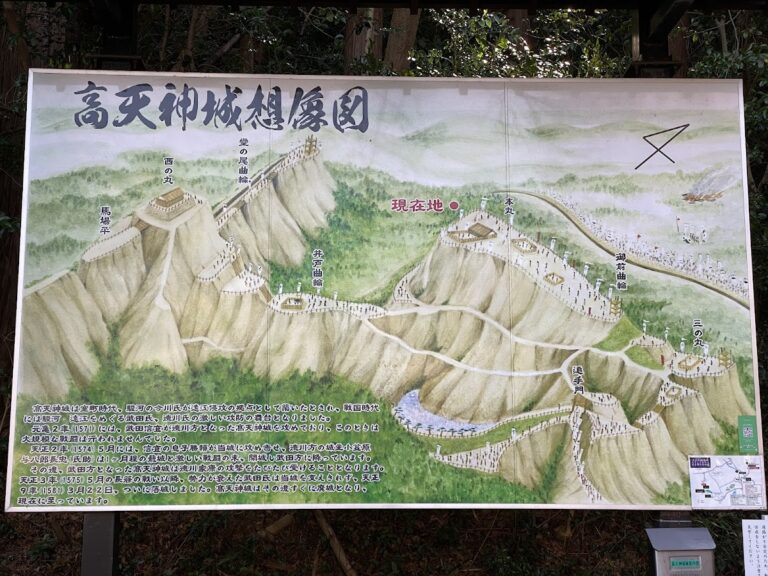
The reason Takatenjin Castle was called “impregnable” and “the strongest castle in the Tokai region” lies in its ingenious layout. Maximizing the use of the rugged terrain of Tsuruoyama Mountain (132 meters above sea level), the structure, which reinforced natural fortifications with artificial defensive structures, represented the pinnacle of castle-building technology at the time.
The castle extends approximately 500 meters east-west and 300 meters north-south, centered around the main keep. The steep terrain, with its complex network of ridges and valleys, presented an extremely difficult obstacle for attacking forces.
The “Dog’s Return, Monkey’s Return” Difficult Passage
The narrow ridge extending into the mountain range outside the castle is known as the “Dog’s Return, Monkey’s Return” difficult pass. This name reflects the ruggedness of the terrain, so much so that even dogs and monkeys would give up and turn back.
In reality, this ridge path was narrow, with steep slopes on both sides, making it impossible for large armies to advance. It was a terrain that was easy for defenders to protect with a small number of soldiers, and extremely difficult for attackers to conquer.
Layout of the Main Enclosure and Other Enclosures
The central part of Takatenjin Castle was the main enclosure (honmaru), where the lord’s residence and important defensive facilities were located. The other enclosures, such as the second and third enclosures, were arranged concentrically around the main enclosure, forming a multi-layered defensive structure.
Each enclosure was separated by earthworks and trenches, ensuring that even if one enclosure was breached, the next could provide defense. Furthermore, the communication routes between the enclosures were intentionally designed to be complex, hindering the advance of attackers.
Wells and Water Supply
A weakness of mountain castles is water supply, but Takatenjin Castle had several wells. However, it is said that one of the ultimate causes of the castle’s fall was a water shortage, suggesting that there were limits to a prolonged siege.
Highlights of Takatenjin Castle Ruins
Main Enclosure Ruins
The main enclosure ruins, which still remain today, were the heart of Takatenjin Castle and are its most important point of interest. From the main enclosure, you can see as far as Kakegawa city and the Enshu Sea, allowing you to appreciate the strategic value of this castle.
The remains of earthworks are still visible at the main enclosure ruins, allowing you to imagine the scale of the former defensive facilities. Furthermore, it is possible to imagine the layout of the buildings from the foundation stones and post holes.
Moats and Earthworks
The moats and earthworks remaining throughout the castle grounds are important remains for understanding the defensive structure of Takatenjin Castle. In particular, the large moats separating the main enclosures demonstrate the advanced civil engineering technology of the time.
While some of the earthworks have collapsed due to wind and rain, many parts remain that allow us to infer their original height and shape.
Well Remains
Several well remains have been identified within the castle grounds. These wells were vital lifelines for the castle’s defenders and crucial facilities during sieges. Seeing the well remains, still visible as depressions, gives a real sense of the difficulty of securing water in a mountain castle.
Stone Monuments and Information Boards
Within the castle ruins, there are information boards explaining the history of Takatenjin Castle and stone monuments commemorating the battle at the time of its fall. Reading these while exploring the site allows for a deeper understanding of history.
In particular, the stone monument commemorating the final charge of Okabe Motonobu and his defenders is an important monument that conveys the way of life of samurai during the Sengoku period.
Views
The views from the Takatenjin Castle ruins are magnificent, and on clear days, you can even see Mount Fuji. To the east lie the city of Kakegawa and its rural landscape, to the south the Enshu Sea, and to the west the Ogasa Mountains, offering a 360-degree panoramic view.
This view speaks volumes about why Takatenjin Castle was considered a strategic point for controlling Tōtōmi Province.
Access to Takatenjin Castle Ruins
Location
Kamitokata-Minemukai, Kakegawa City, Shizuoka Prefecture
Access by Public Transportation
From JR Kakegawa Station
- By Bus: Take the Shizutetsu Justline “Tokata Line” from platform 2 at the north exit of Kakegawa Station, get off at the “Tokata” bus stop, and walk for approximately 20 minutes.
- By Taxi: Take a taxi from the taxi stand at the south exit of Kakegawa Station (approximately 15 minutes, fare approximately 2,500 yen).
Public transportation services are limited, so it is recommended to check the timetable in advance. Particular caution is needed on holidays, as there are fewer services.
Access by Car
From the Tomei Expressway
- Approximately 15 minutes from the Tomei Kakegawa Interchange
- Take National Route 1, then head north on Prefectural Route 37 (Kakegawa-Daito Line)
- Follow the signs to the parking lot on the rear gate side or the main gate side.
Parking
There are two free parking lots at Takatenjin Castle Ruins, one on the rear gate side and one on the main gate side. Each can accommodate approximately 10 regular-sized cars. It can get crowded during peak tourist seasons and weekends, so early arrival is recommended.
Precautions for Visiting the Castle
- The path to the castle is well-maintained, but since it is a mountain trail, we recommend wearing comfortable shoes.
- The estimated time required is approximately 20-30 minutes one way to the main keep. If you wish to see the entire castle ruins, please allow 2-3 hours.
- In summer, we recommend bringing insect repellent and drinking water.
- There are toilets near the parking lot, but none inside the castle, so please use the facilities beforehand.
Takatenjin Castle Ruins Hiking Course
Takatenjin Castle Ruins is popular not only for historical walks but also as a hiking course. The well-maintained hiking trails are safe even for beginners, allowing you to enjoy both history and nature.
Recommended Course
Standard Course (Estimated Time: Approximately 2 Hours)
- Parking Lot near the Rear Gate → Rear Gate Ruins → Nishinomaru → Main Keep → Ninomaru → Otemon Gate Ruins → Parking Lot near the Otemon Gate
This course efficiently covers the main sights of the castle and is ideal for first-time visitors.
Course for those with strong legs (estimated time: 3-4 hours)
- Parking lot on the rear gate side → Tour of all baileys → Dog-returning, monkey-returning route → Main bailey → Parking lot on the main gate side
This course is for those who want to explore the castle ruins in more detail or who are confident in their physical fitness.
Nearby Tourist Spots
Kakegawa Castle
Located about 20 minutes by car from Takatenjin Castle, Kakegawa Castle is known as Japan’s first fully reconstructed wooden castle tower. In contrast to Takatenjin Castle, visiting Kakegawa Castle, built as a hilltop castle, allows you to learn about the diversity of castle architecture.
Yokosuka Castle Ruins
You can also visit the ruins of Yokosuka Castle, one of the six fortresses built by Tokugawa Ieyasu to conquer Takatenjin Castle. We recommend visiting both to gain a deeper understanding of the history of the battles for Takatenjin Castle.
Kakegawa City Ninomaru Museum
This museum, located within Kakegawa Castle Park, primarily exhibits modern Japanese paintings. After exploring the historical sites, taking a break with some art appreciation would be a great idea.
Best Season to Visit Takatenjin Castle
Takatenjin Castle ruins are accessible year-round, but each season offers a different charm.
Spring (March-May)
The area around the castle ruins is beautifully colored during cherry blossom season. The fresh greenery is also lovely, and the weather is perfect for hiking.
Autumn (October-November)
The autumn foliage is beautiful, and the temperature is pleasant, making this the most popular season. Early to mid-November is especially beautiful.
Summer (June-August)
The greenery is lush, and the castle ruins are enveloped in forest. However, temperatures are high and there are many insects, so adequate preparation is necessary.
Winter (December-February)
With fewer visitors, you can quietly experience history. The air is clear, making this a particularly wonderful season for viewing the scenery.
The Cultural Value of Takatenjin Castle
Takatenjin Castle ruins were designated a National Historic Site in 1975. As a valuable historical site that well preserves the structure of a mountain castle from the Sengoku period, it receives high academic acclaim.
In recent years, the city of Kakegawa has been carrying out preservation and maintenance projects, including improving the access roads, installing information boards, and protecting the remains. Local volunteer groups are also actively engaged in cleaning and guiding visitors, maintaining the site as a beloved historical landmark for the citizens.
AR/VR Restoration Project
Kakegawa City is also developing AR (Augmented Reality) and VR (Virtual Reality) content that allows users to experience Takatenjin Castle in its heyday using the latest technology. This initiative, which allows users to view the former buildings and the castle’s soldiers through smartphones and tablets, is attracting attention as a new form of historical education and tourism promotion.
The Impact of Takatenjin Castle on Sengoku History
The battles for Takatenjin Castle were not merely a struggle for control of a single castle, but had a significant impact on the course of Sengoku history.
Prelude to the Downfall of the Takeda Clan
The victory in the First Battle of Takatenjin Castle was praised by Takeda Katsuyori as a military achievement surpassing that of his father, Shingen. However, the defeat in the Second Battle of Takatenjin Castle and the abandonment of the castle’s defenders resulted in a decisive loss of trust from the Takeda retainers.
This event was a crucial turning point that can be considered a prelude to the downfall of the Takeda clan. After the fall of Takatenjin Castle, defections by Takeda retainers followed one after another, and the Takeda clan was destroyed just one year later.
The Growth of Tokugawa Ieyasu
On the other hand, for Tokugawa Ieyasu, the battles for Takatenjin Castle were an important experience that demonstrated his growth as a strategist. Learning from his defeat in the first battle, Ieyasu’s judgment in choosing a strategy of siege rather than direct attack, and his ability to execute a patient siege that lasted for several years, foreshadowed his later path to unifying Japan.
Summary
Takatenjin Castle, as the saying goes, “He who controls Takatenjin controls Tōtōmi,” was the most important stronghold in Tōtōmi Province during the Sengoku period. The history of this castle, where two great Sengoku daimyo, Tokugawa Ieyasu and Takeda Katsuyori, fought fiercely for control, is full of drama that can be considered a microcosm of the Sengoku period.
Even this seemingly impregnable castle ultimately succumbed to the strategy of siege by starvation. This history demonstrates that not only military strength but also strategy and perseverance determine victory or defeat.
The current Takatenjin Castle ruins remain in a quiet mountain setting, preserving traces of its former glory. The remains such as earthworks and moats, along with the magnificent views, allow visitors to feel the spirit of the Sengoku period.
Whether you’re interested in history or simply want to enjoy hiking and nature walks, Takatenjin Castle Ruins is a fascinating place. When you visit Kakegawa City, be sure to check out this historic mountain castle. You’ll have a valuable experience, feeling the atmosphere of the Sengoku period and reflecting on the era when Ieyasu and Katsuyori clashed.