Takasaki Castle (Gunma Prefecture, Takasaki City) Complete Guide | History, Highlights, and Access Explained in Detail
Located in the heart of Takasaki City, Gunma Prefecture, Takasaki Castle is a historical flatland castle built by Ii Naomasa, one of the Four Heavenly Kings of Tokugawa, at the command of Tokugawa Ieyasu. Although urbanization is progressing, the Inui Turret (the only remaining castle structure in the prefecture), the East Gate, and the earthen ramparts and moats surrounding the third bailey remain, conveying the atmosphere of its former glory. This article comprehensively explains everything you need to know before visiting Takasaki Castle, from its history and highlights to access methods.
Basic Information on Takasaki Castle
Takasaki Castle (Takasaki-jo) was a Japanese castle located in Takamatsu-cho, Takasaki City, Gunma Prefecture, and is classified as a flatland castle. Its former name was Wada Castle (Wada-jo), and it played an important role as the administrative center of the Takasaki Domain during the Edo period.
Location: Takamatsu-cho, Takasaki City, Gunma Prefecture
Castle Structure: Flatland Castle (Hilltop Castle)
Year of Construction: Keicho 3 (1598)
Builder: Ii Naomasa (by order of Tokugawa Ieyasu)
Main Lords: Ii clan, Suwa clan, Ando clan, Matsudaira clan, Okouchi clan, etc.
Cultural Property Designation: Takasaki City Historic Site, Gunma Prefecture Important Cultural Property (Inui Turret), Takasaki City Important Cultural Property (East Gate)
History of Takasaki Castle
From Wada Castle to Takasaki Castle
The site on which Takasaki Castle was built originally had a castle called Wada Castle. Wada Castle was built by the Wada clan during the Sengoku period, and in 1590, during Toyotomi Hideyoshi’s siege of Odawara, it was besieged and fell to a combined force of Maeda Toshiie and Uesugi Kagekatsu. In this battle, Wada Castle was abandoned, and Takasaki Castle was built on its site.
Construction by Ii Naomasa
In 1598, Tokugawa Ieyasu, who had entered the Kanto region, decided to build a new castle in this strategically important location controlling the Nakasendo and Mikuni Kaido roads. Ieyasu ordered Ii Naomasa, lord of Minowa Castle and one of the Four Heavenly Kings of Tokugawa, to construct Takasaki Castle adjacent to the Wada Castle ruins.
Ii Naomasa designed a sturdy flatland castle surrounded by moats and earthen ramparts, serving as a key defensive point for the Usui Pass and controlling a crucial transportation hub leading from the north to Kanto. During construction, townspeople and merchants from Minowa Castle town were relocated to Takasaki, simultaneously developing a castle town. This forms the foundation of present-day Takasaki City.
Takasaki Castle in the Edo Period
Takasaki Castle was a vast fortress, spanning over 50,000 tsubo (approximately 165,000 square meters) within its grounds alone, and boasted a large structure including the main keep, second bailey, and third bailey. Throughout the Edo period, it functioned as the administrative center of the Takasaki Domain, and several daimyo families served as its lords.
Of particular note is the incident in 1633 (Kanei 10), when Tokugawa Tadanaga (Suruga Dainagon), the third son of the second shogun Tokugawa Hidetada and younger brother of the third shogun Tokugawa Iemitsu, was imprisoned in Takasaki Castle for alleged madness. Tadanaga was subsequently ordered to commit suicide within the castle, dying at the young age of 28. This tragic event remains one of the most famous episodes in the history of Takasaki Castle.
In the late Edo period, the Ando, Matsudaira, and Okouchi families served as lords of the castle, and it remained so until the Meiji Restoration.
Changes Since the Meiji Era
After the Meiji Restoration, Takasaki Castle was abandoned in 1871 (Meiji 4) due to the abolition of the feudal domains and establishment of prefectures. During the Meiji era, many of the castle’s buildings were demolished, and public facilities such as the Takasaki City Hall and schools were constructed on the sites of the main keep and second bailey.
However, fortunately, the Inui Turret and the East Gate were spared demolition and have been preserved to this day. Furthermore, the earthen ramparts and moats surrounding the third bailey remain in good condition, allowing us to imagine the scale of the castle in its heyday.
Structure and Layout of Takasaki Castle
Overall Structure of the Castle
Takasaki Castle is a flatland castle with a concentric layout, centered around the main keep and surrounded by the second and third baileys. The total area within the baileys alone exceeded 50,000 tsubo (approximately 165,000 square meters), and including the outer baileys, it boasted an even larger scale.
The castle’s defenses primarily consisted of moats and earthen ramparts; stone walls were rarely used. This is a common feature of flatland castles in the Kanto region, and Takasaki Castle is a typical example.
Honmaru and Ninomaru
The Honmaru (main enclosure) did not have a keep; instead, a three-story turret was built. The Honmaru Palace housed the lord’s residence and where administrative affairs were conducted. The Ninomaru (second enclosure) contained the residences of senior retainers and important facilities of the domain.
Currently, the sites of the Honmaru and Ninomaru are occupied by Takasaki City Hall and Takasaki Central Library, and very few remains of the original structure remain. However, information boards have been installed around City Hall, allowing visitors to learn about the former layout of the castle.
Sannomaru and Outer Enclosure
The Sannomaru (third enclosure) surrounded the Honmaru and Ninomaru, and housed samurai residences, armories, and food storage facilities. An earthen embankment and outer moat surrounded the outside of the Sannomaru, forming the castle’s defensive line.
The earthen ramparts and moats surrounding the outer bailey of the third bailey remain well-preserved and are designated as a historical site by Takasaki City. The outer moat was approximately 1,400 meters long and originally 15-16 meters wide, but due to road widening, it is now about 10 meters wide.
Highlights of Takasaki Castle
Inui Yagura (Northwest Turret)
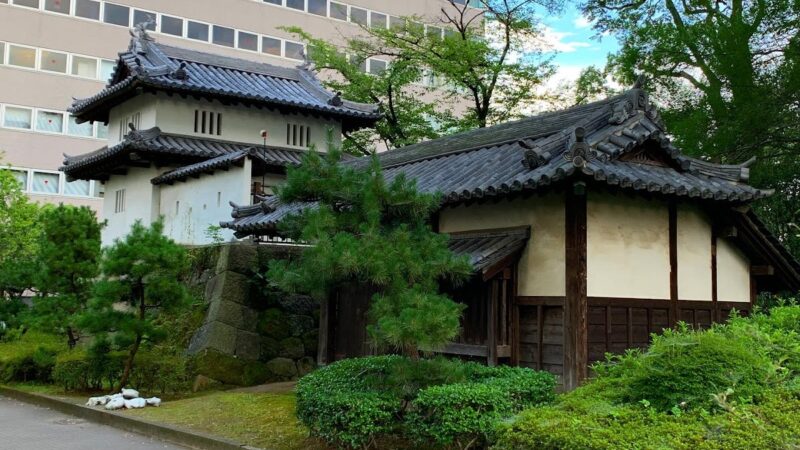
The most important highlight of Takasaki Castle is the Inui Yagura, the only surviving castle structure in Gunma Prefecture. Located northwest (northwest direction) of the third bailey, the Inui Yagura was used as a storage facility for weapons and food. In times of emergency, it also functioned as a defensive base from which arrows and guns could be fired at the enemy.
The Inui Yagura is a two-story, two-tiered turret, with a beautiful exterior featuring white plaster walls and a black tiled roof. It is currently designated as an important cultural property of Gunma Prefecture and is a symbolic structure of Takasaki Castle.
The interior of the turret is usually closed to the public, but there are opportunities to visit on special opening days. Inside, you can see exhibits of weapons and castle-related materials from the period, allowing you to observe the structure of Edo-period castle architecture up close.
East Gate
The East Gate is a castle gate located on the east side of the third bailey, and along with the Inui Turret, it is a valuable surviving structure of Takasaki Castle. It is designated as an important cultural property of Takasaki City and retains many characteristics of Edo-period castle gate architecture.
The East Gate is a Korean-style gate, characterized by its simple yet sturdy construction. It has now been relocated and preserved in another location within Takasaki City, so it is recommended to check the location before visiting.
Earthen Embankment and Moat of the Third Bailey
The most extensive remaining structure at the Takasaki Castle site is the earthen embankment (earthwork) and moat surrounding the third bailey. Designated as a Takasaki City historical site, it is an important structure for understanding the scale and structure of Takasaki Castle.
The Doi are earthen ramparts several meters high that still remain in a continuous stretch within the city. There are places where you can walk on top of the Doi, allowing you to experience the castle’s defenses in its heyday.
The outer moat still holds water in some areas, offering a beautiful sight when cherry blossoms bloom in spring. A promenade runs along the moat, making it a popular walking course for residents.
Takasaki Castle Ruins Park
Part of the former main keep site has been developed into Takasaki Castle Ruins Park, a place of relaxation for residents. The park features information boards explaining the history of Takasaki Castle and maps showing the castle’s layout.
Cherry trees are planted within the park, making it a popular spot for cherry blossom viewing in spring. Furthermore, Takasaki City Hall and Takasaki Central Library are located near the park, making it convenient to combine a visit with sightseeing.
Stone Monuments and Information Boards
Throughout the Takasaki Castle ruins, information boards and stone monuments explaining the castle’s history and structure are installed. Following these allows you to understand the former extent of the castle grounds and the locations of various facilities, enabling you to enjoy a stroll while imagining its former appearance.
In particular, the stone monument marking the site of the main keep and the monument commemorating the construction by Ii Naomasa are must-see points for history enthusiasts.
Changes in the Lords of Takasaki Castle
Throughout the Edo period, Takasaki Castle was ruled by several daimyo families. Here is a brief overview of the main changes in its lords.
Ii Clan (1598-1600): Ii Naomasa, the castle’s builder, was the first lord. However, Naomasa was wounded in the Battle of Sekigahara in 1600 and died in 1602. Afterward, the Ii clan was transferred to the Hikone Domain in Omi Province.
Suwa Clan (1601-1616): Suwa Yorimizu entered the castle. The Suwa clan ruled Takasaki Castle as a daimyo with a 30,000 koku domain.
Sakai Clan (1616-1619): Sakai Ietsugu entered the castle with a 50,000 koku domain, but was transferred after a short period.
Toda Clan (1619-1623): Toda Yasunaga entered the castle, but his tenure was also short.
Ando Clan (1624-1633): Ando Shigenobu entered the castle. The Tokugawa Tadanaga imprisonment incident occurred during this period.
Matsudaira Clan (1633-1695): Matsudaira Nobuyoshi entered the castle, and the Matsudaira clan subsequently ruled Takasaki Castle for a long period.
Ando Clan (1695-1702): Ando Shigehiro re-entered the castle.
Manabe Clan (1702-1711): Manabe Akifusa entered the castle, but was overthrown and dispossessed during the Shotoku Reforms.
Matsudaira Clan (1711-1749): Matsudaira Terusada entered the castle, and the Matsudaira clan ruled again.
Okouchi Clan (1749-1871): Okouchi Terusada entered the castle, and the Okouchi clan served as lords of Takasaki Domain until the Meiji Restoration.
As you can see, Takasaki Castle saw frequent changes in its lords throughout the Edo period, indicating the importance of this area as a transportation hub.
Takasaki Castle and Ii Naomasa
When discussing Takasaki Castle, it is essential to mention its builder, Ii Naomasa. Naomasa was known as one of the Four Heavenly Kings of Tokugawa and enjoyed the absolute trust of Tokugawa Ieyasu.
In 1590, following Ieyasu’s entry into the Kanto region, Naomasa became the lord of Minowa Castle with a 120,000 koku domain. However, Minowa Castle was a mountain castle and had many inconveniences for functioning as a modern castle, so Ieyasu ordered Naomasa to build a new castle.
Naomasa chose the present-day Takasaki area, a strategically important location on a plain with potential for the development of a castle town, and began construction in 1598. Naomasa also focused on developing the castle town by relocating merchants and craftsmen from Minowa Castle to Takasaki.
However, Naomasa was wounded by a gunshot during the Battle of Sekigahara in 1600, and died in 1602 at the young age of 41 from that injury. After Naomasa’s death, the Ii clan was transferred to Hikone Domain in Omi Province with an increased stipend of 180,000 koku, and they left Takasaki Castle.
Although Naomasa resided at Takasaki Castle for only a few years, the castle and castle town he built formed the foundation for Takasaki’s subsequent development. It can be said that the current prosperity of Takasaki City is largely due to the achievements of Ii Naomasa.
The Imprisonment of Tokugawa Tadanaga
One of the most famous incidents in the history of Takasaki Castle is the imprisonment of Tokugawa Tadanaga. Tokugawa Tadanaga was the third son of the second shogun, Tokugawa Hidetada, and the younger brother of the third shogun, Tokugawa Iemitsu. From a young age, he was intelligent and skilled in martial arts, earning his father Hidetada’s favor, and at one point he was even considered a contender for the shogunate.
Tadanaga became a daimyo ruling over Suruga, Totomi, and Kai provinces with a stipend of 550,000 koku, and was known as “Suruga Dainagon” (Grand Councilor of Suruga). However, after his older brother Iemitsu became shogun, Tadanaga’s eccentric behavior became increasingly noticeable, and he engaged in violent acts such as killing his retainers without reason.
In 1633, Tadanaga’s misconduct became a problem for the shogunate, and he was ordered to be dismissed from his position and placed under house arrest. He was confined to Takasaki Castle, and on December 6, 1634, he was ordered to commit suicide, ending his life at the young age of 28.
This incident illustrates one aspect of the power struggles within the Tokugawa shogunate and illustrates the political importance of Takasaki Castle. While there are various theories about the location of Tadanaga’s confinement, it is considered certain that it was within Takasaki Castle.
Access Method
Access by Train
The most convenient way to access Takasaki Castle Ruins is on foot from JR Takasaki Station.
From JR Takasaki Station: Approximately 15 minutes on foot from the West Exit
Joetsu Shinkansen/Hokuriku Shinkansen: Get off at Takasaki Station
JR Takasaki Line: Get off at Takasaki Station
JR Joetsu Line: Get off at Takasaki Station
JR Shin’etsu Main Line: Get off at Takasaki Station
Takasaki Station is a major station where the Shinkansen also stops. It is accessible from Tokyo Station in about 50 minutes by Shinkansen and from Ueno Station in about 1 hour and 40 minutes by JR Takasaki Line.
The route from the station to the castle ruins passes through the central urban area of Takasaki City, allowing you to stroll through shopping streets and other sights along the way.
Access by Car
Kan-Etsu Expressway: Approximately 20 minutes from Takasaki Interchange
Joshin-Etsu Expressway: Approximately 30 minutes from Fujioka Interchange
There are several paid parking lots around Takasaki City Hall. However, since the city hall parking lot is prioritized for official use, we recommend using nearby private parking lots for sightseeing purposes.
Access by Bus
The city loop bus “Gururin” operates from Takasaki Station. Getting off at the “City Hall” bus stop will bring you closer to Takasaki Castle Ruins. Since the number of buses is limited, we recommend checking the timetable in advance.
Visiting Information
Opening Hours and Fees
Takasaki Castle Ruins is maintained as a park and is generally open 24 hours a day for free viewing. Admission is free.
Regarding the Inui Turret, normally only the exterior can be viewed, but the interior can be viewed on special opening days a few times a year. The dates for special openings can be checked on the Takasaki City official website.
Estimated Visiting Time
To see all the main sights at Takasaki Castle Ruins, it takes approximately 1-2 hours. If you plan to take a leisurely stroll through the Inui Turret, the earthen ramparts and moat, and the castle ruins park, allow about 2-3 hours.
Photography
Photography is generally permitted within the castle ruins. You can freely photograph the exterior of the Inui Turret, the earthen ramparts, and the moat. The cherry blossom season in spring and the autumn foliage season offer particularly beautiful opportunities for photography.
Nearby Tourist Attractions
Takasaki City Hall Observation Lobby
The 21st floor of Takasaki City Hall has a free observation lobby offering panoramic views of Takasaki city. On clear days, you can see distant mountains such as Mount Asama, Mount Akagi, and Mount Haruna. It’s also an ideal spot to get an overview of Takasaki Castle as a whole.
Opening Hours: Weekdays & Saturdays 8:30 AM – 10:00 PM, Sundays & Public Holidays 10:00 AM – 8:00 PM
Admission Fee: Free
Shorinzan Daruma-ji Temple
Takasaki City is famous as a production center for “Daruma” dolls, and Shorinzan Daruma-ji Temple is known as the birthplace of the auspicious Daruma doll. It is about a 20-minute drive from Takasaki Castle Ruins and attracts many tourists.
Haruna Shrine & Lake Haruna
Haruna Shrine is located on the slopes of Mt. Haruna in western Takasaki City and is a popular power spot. Lake Haruna is a beautiful lake at an altitude of 1,100 meters, where you can enjoy boating and strolling along the lakeshore. It is about a 40-minute drive from Takasaki Castle Ruins.
Gunma Prefectural Museum of History
Located within Gunma no Mori Park, next to Takasaki City, this history museum offers a chance to learn about the history and culture of Gunma Prefecture. It also displays materials related to Takasaki Castle, making it ideal for those who want to gain a deeper understanding of the castle’s history.
Minowa Castle Ruins
The ruins of Minowa Castle, the residence of Ii Naomasa before he built Takasaki Castle, are also located within Takasaki City. Selected as one of Japan’s Top 100 Castles, the remains of this mountain castle are remarkably well-preserved. It’s approximately a 30-minute drive from Takasaki Castle Ruins.
Points to Note When Visiting Takasaki Castle
Best Time to Visit
Takasaki Castle Ruins can be visited throughout the year, but the following times are particularly recommended:
Spring (Late March to Early April): The cherry blossoms along the moat and in the castle park are in full bloom, offering a beautiful view. It’s one of Takasaki City’s most famous cherry blossom viewing spots.
Autumn (late October to mid-November): The autumn foliage is beautiful, and the area around the earthen ramparts and moats is ablaze with color. The weather is mild, making it ideal for a stroll.
Summer: The greenery is lush, and the water-filled moats create a cool atmosphere. However, precautions against the heat are necessary.
Winter: There are fewer tourists, allowing for a peaceful visit. The snow-covered Inui Turret also has a charming appearance.
Clothing and Items to Bring
Takasaki Castle Ruins are located in the city center, and many paths are paved, so no special equipment is needed. However, if you plan to walk on the earthen ramparts, there are some steps and slopes, so comfortable walking shoes are recommended.
In summer, the sun is strong, so bring a hat, sunscreen, and drinks. In winter, be sure to dress warmly.
Photography Tips
The Inui Turret can be photographed from various angles. In particular, photographing the castle from across the moat creates beautiful images of the turrets reflected in the water.
The earthen ramparts and moat, when combined with cherry blossoms in spring or autumn foliage, make for seasonally evocative photographs.
From the observation lobby of Takasaki City Hall, you can take panoramic photos of the entire Takasaki Castle.
Estimated Time Required
- Quick Visit: 30 minutes to 1 hour (Inui Turret and major remains only)
- Standard Visit: 1 to 2 hours (A leisurely stroll through the entire castle site)
- In-Depth Visit: 2 to 3 hours (Including visits to surrounding facilities)
Cultural Property Designation of Takasaki Castle
The cultural property designations related to Takasaki Castle are as follows:
Gunma Prefecture Designated Important Cultural Property: Inui Turret (Designated 1974)
Takasaki City Designated Important Cultural Property: East Gate (Designated 1973)
Takasaki City Designated Historic Site: Takasaki Castle Ruins (Earthen embankment and moat surrounding the third bailey) (Designated 1973)
These cultural properties are protected as valuable historical remains for understanding the history of castles in Gunma Prefecture.
Summary
Takasaki Castle is a historical castle built by Ii Naomasa at the command of Tokugawa Ieyasu. Valuable remains such as the Inui Turret, East Gate, and the earthen embankment and moat still remain today. The Inui Turret, the only existing castle structure in Gunma Prefecture, is a must-visit spot for castle enthusiasts.
Its convenient location within walking distance of Takasaki Station is also a major attraction, making it an ideal base for sightseeing in Takasaki. Be sure to visit Takasaki Castle Ruins, which shows different expressions in each season, such as cherry blossoms in spring and autumn leaves in fall.
The surrounding area boasts numerous attractive tourist spots, including the observation lobby of Takasaki City Hall, Shorinzan Daruma-ji Temple, and Haruna Shrine. Why not enjoy a trip centered around Takasaki Castle, experiencing the history and culture of Gunma Prefecture?