Takamine Castle: A Thorough Explanation of the History and Highlights of the Last Mountain Castle of the Ouchi Clan
Takamine Castle (Konomine-jo) is a mountain castle built on the summit of Mt. Konomine, at an altitude of 338 meters, located in Takamine, Kamiunorei, Yamaguchi City, Yamaguchi Prefecture. Known as the castle built by Ouchi Yoshinaga, the last head of the Ouchi clan, it is now designated as a national historic site. Recorded under multiple spellings such as Konomine Castle, Konomine Castle, Konomine Castle, and Takamine Castle, this castle is a typical example of a mountain castle from the Sengoku period and an important historical site that tells the story of the rise and fall of the Ouchi clan, making it popular with many history enthusiasts and hikers.
History of Takamine Castle
Background of Construction and Ouchi Yoshinaga
The history of Takamine Castle is closely related to the battles that determined the survival of the Ouchi clan during the turbulent Sengoku period. Ouchi Yoshinaga was born as the younger brother of Otomo Yoshishige (Sorin), a Sengoku period daimyo of Bungo Province. After the “Dainei-ji Incident” of 1551 (Tenbun 20), in which his vassal Sue Takafusa (Harukata) assassinated his lord, Ouchi Yoshitaka, Yoshinaga was welcomed by Sue Takafusa and became the head of the Ouchi clan.
However, when Sue Harukata was defeated and killed by Mori Motonari in the “Battle of Itsukushima” in October 1555 (Koji 1), the Ouchi clan’s power rapidly declined. To prepare for an invasion by the Mori clan, Yoshinaga began construction of Takamine Castle on Kono-mine overlooking the town of Yamaguchi between 1556 and 1557 (Koji 2 to 3).
Fall of the Castle and Renovation by the Mori Clan
Construction of Takamine Castle proceeded rapidly, but the Mori army invaded Yamaguchi before its completion. In April 1557 (Kōji 3), the Mōri army, led by Mōri Motonari, attacked Yamaguchi. Ōuchi Yoshinaga escaped from Takamine Castle and fled to Katsuyama Castle in Nagato Province. Later, Yoshinaga was cornered and committed suicide, marking the end of the Ōuchi clan, a prestigious family in western Japan.
The Mōri clan, having acquired Takamine Castle, positioned it as a crucial base for their control of Suō Province and undertook renovations and expansions. Ichikawa Tsuneyoshi was appointed as the castle’s commander, and the castle began to function as a Mōri clan stronghold. Many of the stone walls visible today are believed to have been built during this Mōri period.
The Road to Abandonment
Takamine Castle, a key strategic point in Suō Province under Mōri rule, saw its situation change during the Edo period. In the Battle of Sekigahara in 1600 (Keichō 5), the Mōri clan sided with the Western Army and suffered defeat, resulting in a significant reduction in their territory. Subsequently, in 1615 (Genna 1), the Tokugawa Shogunate issued the “One Castle Per Province” decree, obligating each domain to demolish castles other than its own.
Since the Mori clan’s residence became Hagi Castle, Takamine Castle became subject to demolition. The actual demolition took place in 1638 (Kanei 15), bringing an end to its approximately 80-year history. Afterward, Takamine Castle entered a long period of slumber, and its remains have been preserved to this day, standing quietly in the mountains.
Structure and Layout of Takamine Castle
Characteristics as a Mountain Castle
Takamine Castle is a typical mountain castle built around the summit of Konomine, at an altitude of 338 meters. The main enclosure (honmaru) is located at the highest point, and multiple baileys (kuruma) are arranged along the ridges extending in all directions from there, creating a linear layout.
castles on flat land, mountain castles are characterized by their defenses utilizing the steep terrain. Takamine Castle also skillfully utilized the natural terrain of Mount Kōnomine, designed to make enemy attacks difficult. Its location, offering a panoramic view of Yamaguchi town, served both a military surveillance function and as a fortified outpost (emergency refuge) for the Ōuchi clan residence (Yamaguchi city).
Structure of the Main Enclosure (Honmaru)
The main enclosure is the central part of Takamine Castle, located on the highest point of Mount Kōnomine, on the north side. It is fortified with stone walls, with the southern and northern walls being particularly well-preserved. Stone steps are located on the south side of the main enclosure, allowing us to still see a part of the original access route.
The main enclosure is relatively compact, a common issue for mountain castles due to the difficulty of securing a vast flat area. Nevertheless, it is believed to have functioned adequately as a command center for the lord and his retainers during sieges, as well as a storage area for supplies.
Features of the Stone Walls
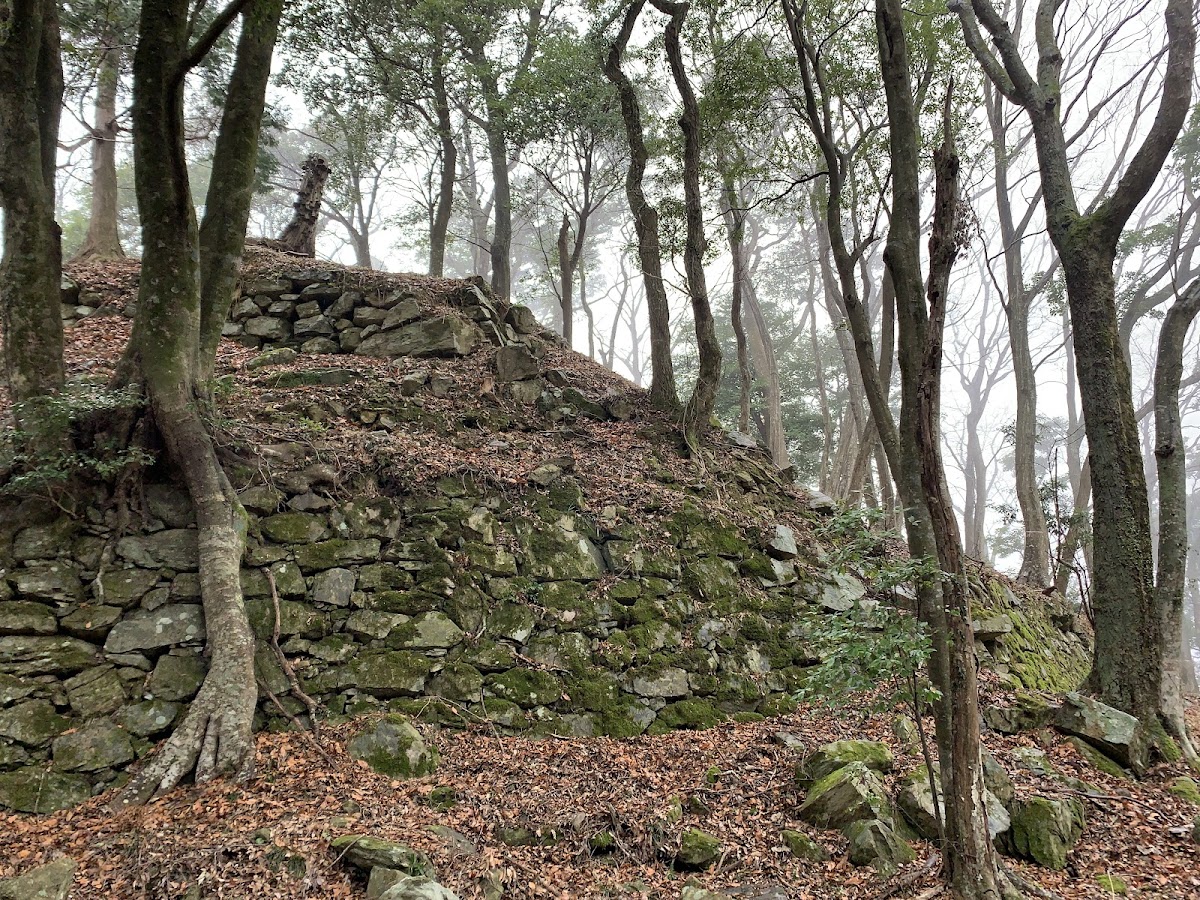
One of the highlights of Takamine Castle is its stone walls, believed to have been built during the Mori clan’s era. As a valuable archaeological site showcasing stonework techniques from the Sengoku period to the early Edo period, it holds significant importance.
The stone walls remain in various locations, primarily around the main enclosure, and are constructed using a technique called “nozurazumi” (rough stone masonry). Nozurazumi is a method of stacking natural stones with minimal processing, a technique commonly seen in stone walls from the Sengoku period. It has the advantage of good drainage due to the large gaps between the stones, making it resistant to collapse.
Arrangement of the Enclosures
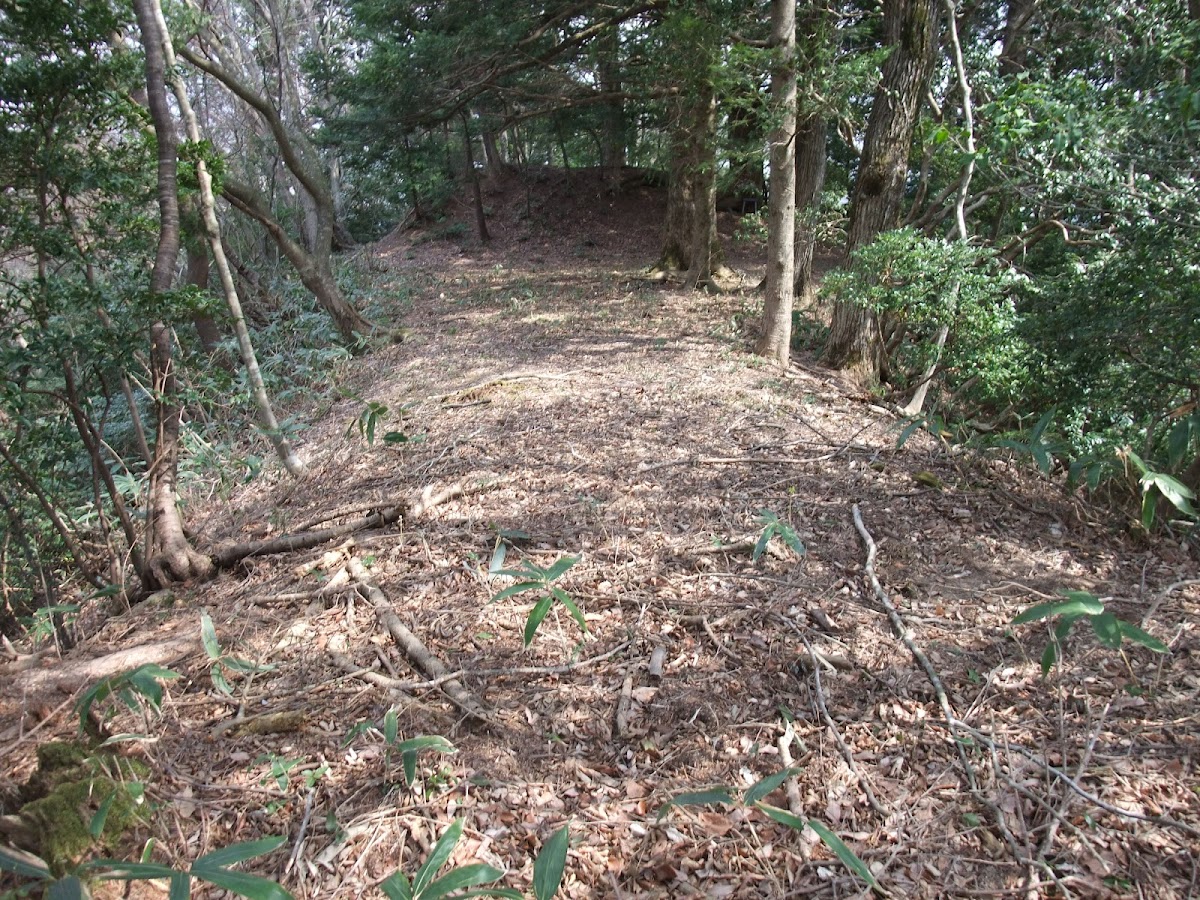
Multiple enclosures are arranged along the ridges extending in all directions from the main enclosure. These enclosures functioned as a defensive line protecting the main enclosure, with a structure designed to gradually halt enemy advances. Each enclosure was positioned along the ridge’s terrain, creating an efficient defensive system.
It is believed that trenches (dry moats cutting across ridges) and earthworks were constructed between the baileys, and traces of these can still be seen in the undulations of the terrain today.
Highlights of Takamine Castle
Stone Walls and Stone Stairs
When visiting Takamine Castle, the stone walls around the main bailey are a must-see. The southern stone wall, in particular, is well-preserved, allowing for close observation of Sengoku period stonework techniques. The stone stairs also retain their original appearance, and imagining the castle lord and samurai ascending and descending these stairs evokes a sense of historical romance.
The northern stone wall is also impressive; the stone walls surrounding the main bailey are evidence that the Mori clan developed Takamine Castle as an important base. Observing the construction method and the types of stones used will allow you to appreciate the high level of castle-building technology of the time.
View from the Main Bailey
From the main bailey, you can enjoy a panoramic view of Yamaguchi city. On a clear day, a spectacular view unfolds, encompassing the ruins of the Ouchi clan’s residence, the townscape of Yamaguchi, and even the surrounding mountains. This view is likely one of the reasons Takamine Castle was chosen as a fortified stronghold.
The scenery is particularly beautiful at sunset, offering a view of the sun setting over the Yamaguchi Basin. However, it gets dark very quickly after sunset, so be sure to pay close attention to the time you descend.
Traces of Enclosures and Fortifications
As you walk along the mountain trail, one of the pleasures is searching for traces of the remaining flat areas, earthworks, and moats of the enclosures. Understanding the layout of the mountain castle allows you to learn about the construction techniques and defensive ingenuity of the Sengoku period.
As you walk, observing the undulations of the terrain, you will notice the skillful castle design that utilized the natural landscape. You will see how the steep slopes and ridge shapes functioned as defensive structures.
Connection to the Ouchi Clan Ruins
Takamine Castle, along with the Ouchi Clan Residence Ruins, Tsukiyama Residence Ruins, and Ryounji Temple Ruins, is designated as a National Historic Site as part of the “Ouchi Clan Ruins.” Visiting Takamine Castle and these related historical sites together will allow for a deeper understanding of the Ouchi clan’s history and culture.
In particular, the Ouchi Clan Residence Ruins are located in Yamaguchi city and can be overlooked from Takamine Castle. Experiencing the relationship between the residence during peacetime and the mountain castle during emergencies from their actual locations is a valuable experience.
Access and Guide to Visiting Takamine Castle
Access Methods
To reach Takamine Castle, the main route is via the hiking trail from Kido Shrine. Kido Shrine has a park parking lot and restrooms (it is recommended to use the restrooms beforehand, as there are no restrooms at the summit or along the hiking trail).
If using public transportation, get off at the “City Health Center” bus stop on the Bocho Bus and walk approximately 35 minutes to Kido Shrine. Alternatively, you can take a taxi from JR Yamaguchi Station.
If traveling by car, head north on National Route 9 from Yamaguchi city center and follow the signs for Kido Shrine. Parking is free, but spaces are limited, so early arrival is recommended on weekends.
Hiking Route and Estimated Time
The hike from Kido Shrine to the main enclosure of Takamine Castle takes approximately 50 to 60 minutes. While the trail is well-maintained, it is a mountain castle climb, so a certain level of physical fitness is required.
Characteristics of the Hiking Route:
- First Half: Relatively gentle ascent. The climb from the Kido Shrine side has few steep sections, making it easy even for beginners.
- Middle Section: Once you reach the ridge, there are some steep slightlyer sections. Be careful of slippery areas due to fallen leaves.
- Later Section: As you approach the main enclosure, stone walls and remnants of baileys begin to appear. The historical atmosphere intensifies, making you forget the fatigue of the climb.
The descent is typically along the same route as the ascent, and takes approximately 40 minutes.
Precautions When Visiting Takamine Castle
When visiting Takamine Castle, please note the following:
Clothing and Equipment:
- Wear comfortable clothing and non-slip trekking shoes or hiking boots.
- Prepare appropriate warm clothing and rain gear for the season.
- Always bring drinking water (there are no vending machines or water sources on the mountain).
- Insect repellent, a hat, and a towel are essential during the summer months.
Safety Measures:
- Be careful in grassy areas as snakes such as pit vipers may be present.
- It gets dark very quickly after sunset, so it is recommended to start climbing by 3 PM at the latest.
- Avoid climbing alone; try to climb in groups whenever possible.
- Cell phone reception is relatively good, but consider submitting a climbing plan as a precaution.
Manners:
- As this is a national historical site, please do not damage the remains or take any stones.
- Always take your trash with you.
- The use of fire is strictly prohibited.
Alternative Route: Hiking Trail from Yamaguchi Grand Shrine
Besides Kido Shrine, there is also a hiking trail from Yamaguchi Grand Shrine. This route is slightly longer, but offers different scenery. Those confident in their physical fitness may consider choosing different routes for the outward and return journeys.
Nearby Tourist Attractions
Ouchi Clan Residence Ruins (Ryufuku-ji Temple)
The Ouchi Clan Residence Ruins were the peacetime residence of the Ouchi clan, separate from the outer fort of Takamine Castle. Currently, it is Ryufuku-ji Temple, with remnants of the garden and pond remaining. It is an important historical site that allows us to reflect on the glory of the Ouchi clan, and we recommend visiting it in conjunction with Takamine Castle.
Rurikoji Five-Storied Pagoda
The Rurikoji Five-Storied Pagoda, a representative tourist attraction of Yamaguchi City, is a building associated with the Ouchi clan. Designated a National Treasure, this five-storied pagoda is considered one of Japan’s three most famous pagodas, and its elegant form is a must-see. It is approximately a 15-minute drive from Takamine Castle.
Yamaguchi City Historical and Folk Museum
If you’d like to see detailed information about Takamine Castle and the Ouchi clan, a visit to the Yamaguchi City Historical and Folk Museum is recommended. You can learn about the history of Takamine Castle and the culture of the Ouchi clan through the exhibits and explanatory panels. Visiting before climbing the castle is also a good idea.
Kido Shrine
Kido Shrine, which serves as the trailhead, is itself a historical shrine. The grounds have a quiet and peaceful atmosphere, making it ideal for worship before or after climbing. A park is also attached, which can be used as a rest area.
Takamine Castle and Yamaguchi Prefecture’s 100 Famous Mountains
Konomine, where Takamine Castle was built, is one of Yamaguchi Prefecture’s 100 Famous Mountains. Although it’s a relatively low mountain at 338 meters, its proximity to Yamaguchi city makes it a popular and easily accessible climb.
The appeal of Konomine lies in the fact that you can both ruin castles and mountain climbing at the same time, making it popular not only with history enthusiasts but also with hikers and nature walkers. Enjoying the changing seasons while enjoying reflecting on the history of the Sengoku period makes for a truly luxurious mountain climbing experience.
Best Time to Visit Takamine Castle
Takamine Castle is accessible year-round, but each season offers a different charm.
Spring (March-May): The fresh greenery is beautiful, the weather is mild, and it’s ideal for climbing. During cherry blossom season, you can even enjoy views of the cherry blossoms in Yamaguchi city from above.
Summer (June-August): The greenery is lush, and while the shade is cool, there are many insects and it can be humid, so climbing early in the morning is recommended. Heatstroke prevention is essential.
Autumn (September-November): The autumn foliage is beautiful, making it the most suitable season for climbing. The temperature is comfortable, and climbing while crunching on fallen leaves is exceptional. However, be careful as the ground can be slippery due to the fallen leaves.
Winter (December-February): The air is clear and the views are excellent. Snow accumulation is rare, but cold weather precautions are necessary. Sunset is early, so plan your time carefully.
Historical Significance of Takamine Castle
Takamine Castle holds historical significance beyond mere ruin castles.
A Castle Symbolizing the End of the Ouchi Clan
As the last stronghold of the Ouchi clan, who flourished as the shugo daimyo (provincial governor) of western Japan, Takamine Castle symbolizes the glory and decline of the Ouchi clan. The fact that it fell while still unfinished speaks volumes about the rapid collapse of the Ouchi clan.
A Base for the Mori Clan’s Control of Suo Province
For the Mori clan, Takamine Castle was an important military base for controlling Suo Province. The remains show that the Mori clan valued Takamine Castle, as evidenced by the renovation of the stone walls and the placement of castle guards.
Valuable Historical Material for the Study of Sengoku Period Mountain Castles
Takamine Castle is a valuable resource for castle research, as it preserves the structure of a mountain castle from the Sengoku period to the early Edo period in excellent condition. It is an important site for learning about the evolution of stone wall technology and the layout techniques of mountain castles.
Summary: The Charm of Takamine Castle
Takamine Castle was a mountain castle built by Ouchi Yoshinaga, the last head of the Ouchi clan, to oppose the Mori clan, and later functioned as a base for the Mori clan’s control of Suo Province. Built on the 338-meter-high Kono-mine peak, it is a typical mountain castle with well-preserved remains such as stone walls and baileys.
This castle site, designated a national historic site, is attractive not only for its historical value but also as a hiking spot where you can enjoy panoramic views of Yamaguchi city and the changing seasons. Its accessibility—a roughly 50-minute hike from Kido Shrine—is another reason why it is popular with many people.
A visit to Takamine Castle allows you to experience firsthand the battles between the Ouchi and Mori clans during the turbulent Sengoku period, the techniques used in mountain castle construction, and the history and culture of Yamaguchi. It’s a recommended historical site not only for history buffs but also for those who enjoy mountain climbing and hiking.
When you visit Yamaguchi, be sure to climb Takamine Castle and enjoy the breathtaking view overlooking the Yamaguchi Basin while feeling the spirit of the Sengoku period. Visiting nearby historical sites such as the Ouchi Clan Residence Ruins and the Rurikoji Five-Storied Pagoda will allow you to gain a deeper understanding of Yamaguchi’s history.