Takami Castle (Tanba City, Hyogo Prefecture) Complete Guide: From a Fortress of the Nanboku-cho Period to the Conquest by Akechi Mitsuhide
What is Takami Castle?
Takami Castle is a medieval mountain castle located in Kashiwabara-cho, Tanba City, Hyogo Prefecture. Built on the summit of Mount Takami, at an altitude of 485 meters, it is a natural fortress. Also known as “Sano Castle,” it functioned as an important military base in the Tanba region from the Nanboku-cho period to the Sengoku period.
Located in a steep mountainous area, this castle straddles the former Kashiwabara-cho and Hikami-cho, and is known as an impregnable mountain castle that takes advantage of the rugged terrain with a relative height of approximately 380 meters. Currently preserved as a historical site by Tanba City, and with well-maintained hiking trails, it is a popular spot for history enthusiasts and castle fans.
History of Takami Castle
Nanboku-cho Period: Construction by Niki Yorishige
The construction of Takami Castle dates back to the second year of the Karyaku era (1327). It was built by Niki Yorishige, a retainer of Ashikaga Takauji and appointed governor of Tanba Province. Niki Yorishige was a warrior who played an active role during the turbulent Nanboku-cho period as a senior retainer of the Ashikaga clan, and he established this castle as a base for governing Tanba Province.
The 32nd volume of the *Taiheiki* also mentions Takami Castle. Records show that when Yamana Tokiuji and his son Moriuji invaded Kyoto from Tajima Province, the Niki clan, the governors of Tanba, holed up in this castle. This historical document indicates that Takami Castle was an important military base during the Nanboku-cho period.
The Niki clan maintained their power as governors of Tanba for a long time, but gradually lost influence as the Nanboku-cho period came to an end.
Muromachi Period: The Era of the Yamana and Hosokawa Clans
With the end of the Nanboku-cho period and the beginning of the Muromachi period, the rulers of Takami Castle changed hands. After the Niki clan, the position of Shugo (military governor) of Tanba Province passed to the Yamana clan, and then to the Hosokawa clan, with Takami Castle falling under the control of each respective power.
Especially during the Hosokawa clan’s rule, Tanba Province was considered a strategically important location close to Kyoto, and Takami Castle is thought to have played a key role in their control.
Sengoku Period: The Akai Clan’s Rule
With the arrival of the Sengoku period, Takami Castle came under the control of the local powerful Akai clan. The Akai clan were local lords who expanded their power in the Tanba region, and Takami Castle became the possession of Akai Kiyoshi, whose base was Ushiroya Castle.
After seizing Kuroi Castle, the stronghold of the related Ogino clan, the Akai clan further strengthened their power in the Tanba region. During this period, Takami Castle functioned as an important branch castle of the Akai clan, playing a role in protecting their sphere of influence in Tanba Province.
The Akai clan is known for producing Akai Naomasa, who was feared as the “Red Demon of Tanba,” and was a force that fiercely resisted Oda Nobunaga’s invasion of Tanba.
Tensho 7 (1579): Capture and Fall of Takami Castle by Akechi Mitsuhide
The biggest turning point in the history of Takami Castle came in Tensho 7 (1579). Akechi Mitsuhide, acting on orders from Oda Nobunaga, intensified his invasion of Tanba, and Takami Castle, where Akai Tadayoshi served as lord, became a target.
Akechi Mitsuhide’s retainer, Yomoda Masataka, commanded the attack on Takami Castle, and after a fierce battle, the castle fell. This fall significantly weakened the Akai clan’s power in Tanba.
Akechi Mitsuhide’s pacification of Tanba was an important part of Oda Nobunaga’s unification of Japan, and the capture of Takami Castle held significant importance within that strategy. While there are no clear records of how Takami Castle was used after its fall, it is believed to have been abandoned after the pacification of Tanba Province.
Structure and Layout of Takami Castle
Location and Topography
Takami Castle was built on Takami Castle Mountain, a 485-meter-high mountain located at the southwestern edge of Kashiwabara Town. Its steep terrain provided a natural stronghold, offering ideal defensive conditions that made enemy intrusion difficult.
From the summit, one could see the surrounding plains, serving as a surveillance function to detect enemy movements early. Furthermore, its location overlooking a key transportation hub in the Tanba region made it a strategically and militarily important point.
Arrangement of Enclosures
Because Takami Castle was built in a steep mountainous area, the areas where enclosures could be constructed were limited. Therefore, the castle was divided into four main sections, making maximum use of the terrain.
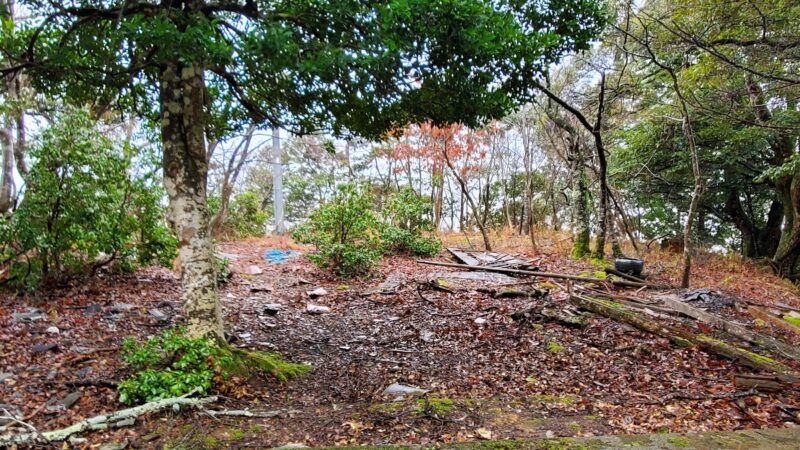
The main enclosure was located at the summit and functioned as the main keep. The main enclosure features four levels of flat land, each designed to function as a defensive line. It is presumed that the uppermost level served as the lord’s residence and command post, while the lower levels were used as soldiers’ quarters and supply storage.
Each enclosure is strategically positioned along ridges and valleys, creating a layout that allows for coordinated defense.
Defensive Structures
Takami Castle retains defensive structures typical of medieval mountain castles.
Earthworks were built around the enclosures, preventing enemy intrusion and serving as protective barriers against arrows and stones. Clear traces of these earthworks can still be seen in various places.
Stone walls are also visible in some areas, but these are more like stacks of natural stones rather than full-fledged stone walls. This indicates the castle’s early construction date and the difficulty of large-scale stone wall construction due to its mountainous terrain.
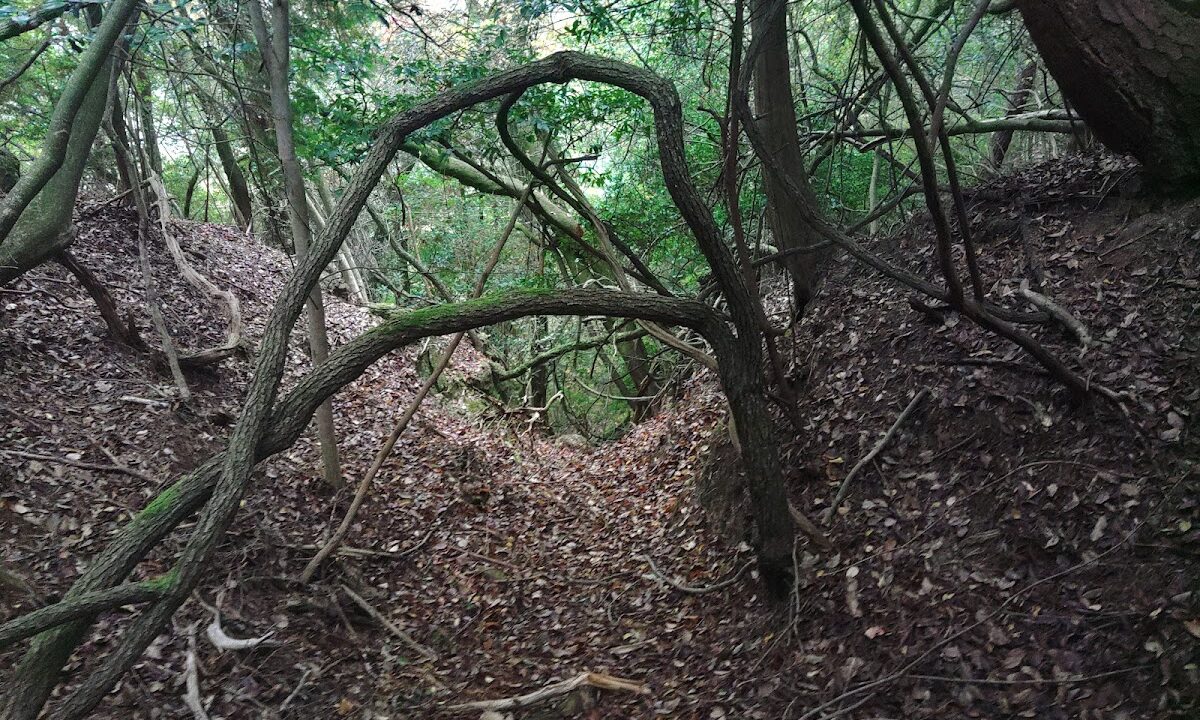
Defensive structures created by cutting into the terrain, such as horikiri (moats) and tatebori (vertical moats), can be seen, demonstrating ingenuity in preventing enemy incursions from the ridgeline.
Ascent Route
While it is believed that there were multiple ascent routes to the castle at the time, only a limited number of major routes can be confirmed today. The winding paths, utilizing the steep terrain, were designed to prevent large enemy armies from attacking all at once.
Highlights of Takami Castle
Remains of the Main Enclosure
The main enclosure at the mountaintop is the greatest highlight of Takami Castle. The four-tiered flat area remains clearly visible, allowing visitors to experience the structure of a medieval mountain castle. From the top tier, you can enjoy a panoramic view of Tanba city, and on clear days, a magnificent view stretches as far as Harima.
Remnants of earthworks remain around the main enclosure, allowing us to imagine the defensive system of the time.
Arrangement of the Enclosures
The arrangement of the enclosures along the ridge from the main enclosure is a valuable historical site for studying the layout of mountain castles. You can see firsthand how each enclosure coordinated and formed a defensive line.
Earthworks and Moats
The earthworks and moats remaining in various places are important historical remains that demonstrate medieval castle construction techniques. In particular, the moats blocking the ridge clearly show the ingenuity used to prevent enemy intrusion.
Panoramic View
The 360-degree panoramic view from the mountaintop is one of the greatest attractions of visiting Takami Castle. You can see the cityscape of Tanba, the surrounding mountains, and, on a clear day, even the Sea of Japan in the distance. This view truly makes you understand why Takami Castle was chosen as a strategically important military location.
Access Information
Access by Car
The most convenient way to access Takami Castle is from “Tanba Yuyu no Mori” (Tanba Forest of Leisure).
- From Kasuga IC on the Maizuru-Wakasa Expressway: Approximately 20 minutes
- From Takino-Yashiro IC on the Chugoku Expressway: Approximately 40 minutes
Tanba Yuyu no Mori has a large, free-to-use parking lot. The parking lot also has restrooms and rest facilities, making it ideal for preparing before climbing the castle.
Access by Public Transportation
- From Kashiwabara Station on the JR Fukuchiyama Line: Approximately 15 minutes by taxi, or by Shinki Green Bus
- Public transportation is limited, so it is recommended to check the timetable in advance.
Climbing Route
From Tanba Yuyu no Mori to Takami Castle Ruins (summit), it is a well-maintained hiking trail, approximately 40 minutes one way.
Trail Characteristics:
- While there are some steep sections, the trail is generally well-maintained.
- Some sections are overgrown with ferns, making it difficult to see your footing, so caution is necessary.
- Be careful of loose stones, tree roots, and fallen branches.
- Rest points are provided, so it is recommended to take breaks as needed.
Estimated Time:
- Ascent: Approximately 40-50 minutes
- Descent: Approximately 30-40 minutes
- Sightseeing and rest at the summit: 30 minutes to 1 hour
- Total: Approximately 2-3 hours
Notes for Visitors
- Clothing: Appropriate hiking clothing and shoes are essential. We especially recommend non-slip hiking boots.
- What to bring: Drinking water, towel, insect repellent (summer), rain gear
- Season: Spring to autumn is suitable for visiting, but be careful of the heat in summer and snow/ice in winter.
- Time: Plan with plenty of time to descend before sunset.
- Solo travel: It is safer to climb the mountain with multiple people if possible.
Nearby Tourist Spots
Kuroi Castle Ruins
Like Takami Castle, this castle is associated with the Akai clan and is famous as the residence of Akai Naomasa, the “Red Demon of Tanba.” It is designated as a national historic site, and visiting it along with Takami Castle will give you a complete understanding of the Akai clan’s rule over Tanba.
Kashiwabara Domain Jinya Ruins
These are the ruins of the Kashiwabara Domain’s jinya (fortified residence) from the Edo period, and are now the site of Kashiwabara High School. The main gate and nagaya-mon (long gatehouse) remain, allowing you to see early modern jinya architecture.
Tree Root Bridge
A popular tourist spot in Kashiwabara Town, this unique landscape features zelkova tree roots spanning a river like a bridge. Enjoy the beauty of natural formations.
Tanba City Ueno Memorial Museum of Art
A museum focusing on Japanese paintings, with a variety of special exhibitions. A great place to spend some cultural time after visiting the castle ruins.
Roadside Station Tanba Obaachan no Sato
A roadside station where you can purchase fresh local produce and specialty products. Enjoy seasonal delicacies such as Tanba black beans, chestnuts, and matsutake mushrooms.
Best Season to Visit Takami Castle
Spring (March-May)
The season of fresh greenery and mild weather makes it ideal for visiting the castle. Enjoy hiking while listening to the birdsong. However, insects increase from late April to May, so take precautions against insects.
Autumn (October-November)
The autumn foliage is particularly beautiful, and the view from the summit is exceptional. The temperature is also suitable for hiking, making it the most recommended season. It’s also a time to enjoy the autumn flavors of Tanba.
Summer (June-September)
The greenery is dense, and the view is slightly less impressive, but you can avoid the heat by climbing early in the morning. Sufficient hydration and heat protection are essential.
Winter (December-February)
Due to the possibility of snow and ice, winter mountain equipment and experience are necessary. However, the air is clear, offering excellent long-distance views, and the snow-covered mountain castle has a unique charm. This season is for advanced climbers.
Historical Significance of Takami Castle
Takami Castle is not merely a local mountain castle, but a fortress that embodies a crucial turning point in Japanese history.
During the Nanboku-chō period, it served as a base for the Ashikaga clan’s expansion; during the Muromachi period, it supported the rule of the shugo daimyo; and during the Sengoku period, it was a stage for the struggle between local powerful families and the Oda regime’s efforts to unify the country. Each era played a crucial role.
In particular, Akechi Mitsuhide’s conquest of Tanba was a vital part of Oda Nobunaga’s unification of Japan, and the fall of Takami Castle was a symbolic event in that process. Tracing the history of this castle allows us to understand the regional developments during the transition from the medieval to the early modern period.
Value in Castle Research
Takami Castle is a valuable historical site from the perspective of castle research.
As a mountain castle built relatively early, during the Nanboku-chō period, and used until the Sengoku period, it is a good example of the evolution of castle construction techniques. It is a typical example of a mountain castle built using civil engineering techniques before the widespread introduction of stone walls, and the arrangement of defensive structures such as earthworks and moats is textbook-worthy for medieval mountain castles.
Furthermore, the castle’s layout, which makes maximum use of the steep terrain, demonstrates ingenuity in castle construction techniques under limited conditions, allowing us to learn about the pursuit of practicality and defensiveness in castle architecture.
Efforts for Preservation and Utilization
Tamba City is working to preserve and utilize the Takami Castle ruins as a valuable cultural asset.
With the development of hiking trails, it has become safe for the general public to visit, and it is being used to promote tourism as a local historical resource. The development of a hiking course in conjunction with Tamba Yuyu no Mori (Tamba Leisure Forest) has created a valuable place where people can enjoy both nature and history simultaneously.
It is hoped that the castle will continue to be passed down to future generations while maintaining a balance between appropriate preservation, management, and utilization.
Summary
Takami Castle is a valuable medieval mountain castle ruin remaining in Tamba City, Hyogo Prefecture. With a history spanning approximately 250 years, from its construction by Niki Yorishige during the Nanboku-cho period, to the rule of the Akai clan during the Sengoku period, and finally to its capture and fall by Akechi Mitsuhide, this castle is an important historical site where one can experience Japanese medieval history.
The view from the 485-meter-high summit is magnificent, allowing you to relive the scenery seen by the castle’s lords of the time. Well-maintained hiking trails make it popular not only with history buffs but also with hikers.
When visiting Tanba City, be sure to stop by Takami Castle Ruins and experience the awe-inspiring presence of this steep mountain castle and the weight of history etched within. The fresh greenery of spring, the vibrant autumn foliage, and the panoramic views from the summit continue to captivate visitors.