
Complete Guide to Sugiyama Castle Ruins | The Full Picture of a National Historic Site Praised as a Masterpiece of Sengoku Period Castles
What is Sugiyama Castle? – One of Kanto’s Leading Sengoku Period Mountain Castles
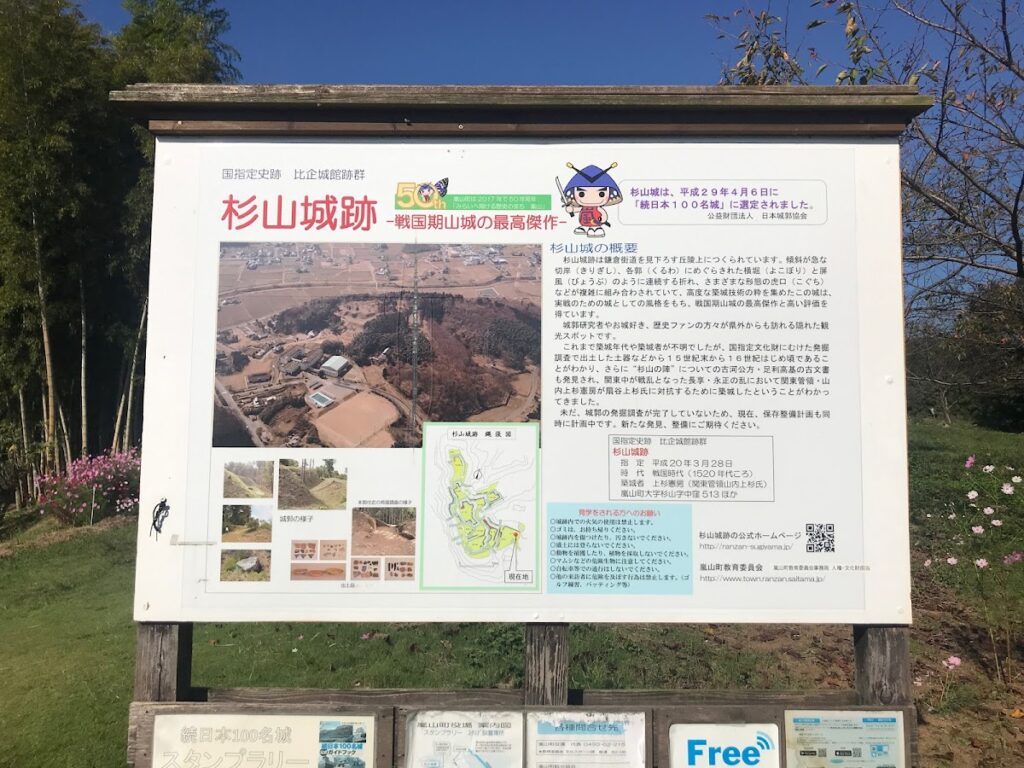
Sugiyama Castle is a Sengoku period mountain castle located in Ranzan-machi, Hiki-gun, Saitama Prefecture. Also known as Hatsukari Castle, it was built on a hill approximately 80 meters above sea level on the left bank of the Ichinogawa River.
Despite its relatively compact site of approximately 140,000 square meters, its highly refined layout has earned it praise from experts as a “textbook example of castle construction” and “one of the greatest masterpieces of Sengoku period castles.” In 2008, it was designated a national historic site as part of the Hiki Castle Ruins Group, and on April 6, 2017, it was selected as one of the “Continued Top 100 Japanese Castles.”
A major characteristic is that, as a Sengoku period mountain castle, its remains are preserved in almost perfect condition. The castle’s baileys, demarcated by earthen ramparts and dry moats, are cleverly positioned to utilize the mountain’s elevation differences, designing it as a practical fortress for defending against a large enemy force with a small number of troops.
History of Sugiyama Castle – The Mysterious Background of its Construction
Records from Legends and Historical Documents
The lord and construction date of Sugiyama Castle have long been shrouded in mystery. Local legends suggest that Sugiyama (Sho) Mondo, a vassal of the Ueda clan, lords of Matsuyama Castle, was the lord, but he does not appear in any reliable historical documents.
The only clue is the mention of “Sugiyama no Jin” (Sugiyama encampment) in a copy of a letter from Ashikaga Takamoto, the Koga Shogun. From this document, it is inferred that Sugiyama Castle functioned as some kind of military base around 1520.
The Sugiyama Castle Problem – Controversy Surrounding the Construction Date
Regarding Sugiyama Castle, there is an important controversy in the history of castle research known as the “Sugiyama Castle Problem.”
Traditionally, the prevailing view was that Sugiyama Castle, with its extremely meticulous and ingenious layout, was constructed during the era of the Later Hojo clan (mid-16th century onward), a period when castle construction techniques were highly advanced. The presence of sophisticated defensive techniques, particularly kinky structures and flanking fire, was considered the basis for this theory.
However, archaeological excavations conducted from 2002 onward completely changed the situation.
The Truth Revealed by the Excavations
The artifacts unearthed during the excavations dated to the late 15th to early 16th centuries. This archaeological finding suggests that the castle was built much earlier than the Later Hojo period.
Currently, it is considered highly probable that the castle was built by the Yamanouchi Uesugi clan to oppose the Ogigayatsu Uesugi clan after the Chokyo Rebellion (1487-1489), a conflict between the Ogigayatsu Uesugi and Yamanouchi Uesugi clans. This civil war was a large-scale conflict that engulfed the entire Kanto region, and it is presumed that Sugiyama Castle functioned as a frontline base.
The discovered remains and excavated artifacts also reveal that Sugiyama Castle was abandoned castle after a short period. This means that the strategic value of the was lost due to changes in the military situation.
From the Hojo Clan Era to Abandonment
Afterward, it is believed that Sugiyama Castle, along with the nearby Matsuyama Castle, became a subordinate castle of the Hojo clan. When the Hojo clan was destroyed in the “Siege of Odawara” by Toyotomi Hideyoshi in 1590, Sugiyama Castle is also believed to have been abandoned.
The Layout of Sugiyama Castle – A Structure Showcasing the Pinnacle of Castle Construction Technology
Overall Composition and Arrangement
The layout of Sugiyama Castle consists of the main enclosure (Honguruwa) at its center, with the second and third enclosures arranged in a stepped fashion in the north, east, and south directions, respectively. Approximately 10 enclosures are arranged the differences in elevation, forming a robust defensive system as a whole.
Facing the main entrance (Ote-guchi) are the outer enclosure (Sotoguruwa) and the outwork enclosure (Umadashiguruwa), while facing the well is the well enclosure, which provides protection from above. This arrangement effectively protects water sources and entrances, which could be weak points of the castle.
Features of the Main Enclosure
Standing in the main enclosure, the heart of the castle, one can fully experience the atmosphere of a Sengoku period castle. The main enclosure is the largest flat area within the castle and is thought to have housed the lord’s residence and command post. It is surrounded by earthen ramparts and clearly separated from other enclosures by dry moats.
Advanced Defensive Techniques
The most distinctive feature of Sugiyama Castle is the advanced defensive techniques seen throughout.
Bending and Distortion
The rampart lines (earthen rampart lines) frequently utilize bending and distortion, known as “orihizumi.” This is a technique designed to obstruct the enemy’s line of sight, making a direct attack difficult.
Flanking Arrows
Almost without exception, flanking arrows are positioned at the entrance (koguchi, the entrance to a bailey), allowing arrows to be fired from the side in the direction of entry. This structure allows for attacks on the flank of an enemy attacking from the front, and is designed for effective defense even with a small number of personnel.
Dry Moats and Earthworks
Mountain castles of the Sengoku period were composed of baileys separated by earthworks and dry moats, rather than stone walls. Sugiyama Castle’s dry moats are deep, and its earthworks are built high, creating a strong barrier that physically prevents enemy intrusion.
Evaluation of the Castle Layout
Because these techniques are efficiently arranged within a small area, Sugiyama Castle has come to be called a “textbook of castle construction.” Among researchers, it is highly regarded as the finest masterpiece of Sengoku period castles and is considered one of the most famous castles in the Kanto region.
Designation as a Historic Site and its Value as a Cultural Property
Sugiyama Castle as a National Historic Site
On March 28, 2008, the Sugiyama Castle ruins were designated a National Historic Site as part of the Hiki Castle Ruins Group. The Hiki Castle Ruins Group includes the Sugaya Castle Ruins, Matsuyama Castle Ruins, and Ogura Castle Ruins, in addition to the Sugiyama Castle Ruins.
These castle ruins are valued as an important group of ruins that show the development process of castles in the Kanto region from the Kamakura period to the Sengoku period. In particular, Sugiyama Castle stands out as a typical example of a Sengoku period mountain castle, possessing exceptional value due to its excellent state of preservation and the high level of perfection of its layout.
Selection as one of the Continued Top 100 Japanese Castles
On April 6, 2017, the Sugiyama Castle Ruins were selected as one of the “Continued Top 100 Japanese Castles.” This castle was selected by the Japan Castle Association, a public interest incorporated foundation, following the existing “100 Famous Castles of Japan,” and is an honor to have been chosen from among outstanding castles nationwide.
This selection has increased Sugiyama Castle’s national recognition, making it a tourist spot visited by researchers, castle enthusiasts, and history fans from outside the prefecture.
Preservation and Utilization
Arashiyama Town is actively working on the preservation and utilization of the Sugiyama Castle ruins. Based on the results of archaeological excavations, preservation and maintenance of the remains are progressing, and guide signs and explanatory panels have been installed, and walking paths have been improved to allow visitors to safely explore the castle ruins.
Highlights of Sugiyama Castle
View from the Main Enclosure
Standing in the main enclosure, you can enjoy a panoramic view of the surrounding landscape. You can see the flow of the Ichinogawa River and the surrounding plains, allowing you to imagine what the castle lord of the Sengoku period saw from this place.
Well-Preserved Remains
The greatest charm of Sugiyama Castle is the remains that have been preserved almost completely intact. The castle retains almost its original form from the time of its construction, including the height of the earthworks, the depth of the dry moats, and the arrangement of the enclosures, allowing visitors to experience the reality of a mountain castle from the Sengoku period.
Complex Gate Structure
Each enclosure’s gate (entrance) features a unique and ingenious design. Observing the details—the angle of the flanking fire, the arrangement of the earthworks, and their combination with the dry moats—offers the enjoyment of deciphering the intentions of the castle’s builder.
Outwork and Outer Enclosures
The outwork and outer enclosures on the main entrance side are crucial to the castle’s frontal defense. Their complex and intricate structure is a clever design intended to slow and confuse enemy advances.
Well Enclosure
The well enclosure, designed to protect the castle’s water source, is another highlight. The design, which protects the castle’s vital water source from above, is a rational placement based on the assumption of actual combat.
Discovered Structures and Excavated Artifacts
Results of the Excavation
Since 2002, the excavation has uncovered important structures and artifacts.
Discovered Structures
-Remains of a post-supported building
- Remains of a pit dwelling
-Earth pit
- Ditch remains
- Group of post holes
These structures are revealing aspects of life and military activities within the castle.
Excavated Artifacts
The excavated artifacts include the following:
- Ceramics: Bowls, plates, jars, etc., dating from the late 15th to early 16th centuries.
- Earthenware: Unglazed earthenware, pots with inner handles, and other everyday utensils.
- Metal Products: Iron nails, knives, coins, etc.
- Stone Products: Whetstones, millstones, etc.
These artifacts provided important clues to determining the construction date of Sugiyama Castle and greatly contributed to resolving the “Sugiyama Castle problem.”
Related Historical Sites in the Surrounding Area
Sugaya Manor Site
Located approximately 3 kilometers from Sugiyama Castle, the Sugaya Manor Site is known as the site of the manor of Hatakeyama Shigetada, a general of the Kamakura famous period. The “Azuma Kagami” (a historical chronicle) states that it was built in 1205, and it is designated as a national historic site. The remaining structures are thought to have been rebuilt by the Yamanouchi Uesugi clan during the Sengoku period.
Matsuyama Castle Ruins
Matsuyama Castle Ruins, one of the Hiki Castle Ruins, is a hilltop castle from the Sengoku period. Known as the residence of the Ueda clan, it was the site of battles between the Hojo and Uesugi clans. It became a subordinate castle of the Hojo clan around the same time as Sugiyama Castle, and was also abandoned during the Siege of Odawara.
Kokura Castle Ruins
Kokura Castle Ruins, another of the Hiki Castle Ruins, is also a mountain castle from the Sengoku period. Visiting these castle ruins allows for a comprehensive understanding of the history of the Hiki region from the medieval period to the Sengoku period.
Access Information
Access by Train and Bus
Using the Tobu Tojo Line
- Get off at Musashi-Arashiyama Station on the Tobu Tojo Line
- Approximately 25 minutes on foot from the west exit of the station
- Alternatively, take the Eagle Bus bound for Arashiyama Town Hall, get off at “Sugiyama Castle Ruins Entrance,” and walk for approximately 5 minutes.
Using the JR Takasaki Line
- Approximately 30 minutes by bus from Konosu Station on the JR Takasaki Line
Access by Car
Using the Kan-Etsu Expressway
- Approximately 15 minutes from Higashimatsuyama IC on the Kan-Etsu Expressway
- Approximately 10 minutes from Arashiyama-Ogawa IC on the Kan-Etsu Expressway
Parking
- Dedicated parking lot for Sugiyama Castle Ruins (free)
- Arashiyama Town Hall parking lot is also available
Visiting Hours and Precautions
Visiting Hours
- Open all day (however, not recommended after sunset due to safety concerns)
- Estimated time: Approximately 1-2 hours
Notes
- As it is a mountain castle, comfortable shoes and clothing are recommended.
- Insect repellent is necessary during summer.
- Be careful as the ground can be slippery during and after rain.
- It is recommended to prepare drinking water in advance.
- Toilets are located near the parking lot.
About the Castle Stamp
The castle stamp for Sugiyama Castle can be obtained at the Arashiyama Town tourist information center and nearby shops. A stamp for the Continued Top 100 Japanese Castles is also available, making it a memorable souvenir of your castle tour.
How to Enjoy Sugiyama Castle
From a Castle Fan’s Perspective
Those interested in castles are recommended to bring a castle layout map and compare it with the actual remains during their visit. Observing details such as the bends in the earthworks, the structure of the gate, and the depth of the dry moats offers the enjoyment of deciphering the intentions of the castle builder.
From a History Fan’s Perspective
Learning about the history of the Kanto region during the Sengoku period, particularly the conflict between the Yamanouchi-Uesugi and Ogigayatsu-Uesugi clans, before visiting Sugiyama Castle will allow you to more deeply understand its historical significance. Visiting the surrounding castle ruins in conjunction with the castle ruins will allow you to experience the Sengoku history of the Hiki region.
Enjoyment as a Nature Walk
Sugiyama Castle ruins are located on a hilly area rich in nature, offering beautiful scenery throughout the seasons. The fresh greenery in spring and the vibrant autumn foliage make it an attractive nature walk.
Photography Spots
The well-preserved earthworks and dry moats are ideal subjects for castle photography. The views from the main enclosure and the intricately intricate structure of the castle gates, in particular, offer opportunities for impressive photographs.
The Present and Future of Sugiyama Castle Research
Ongoing Research
While much has been revealed about Sugiyama Castle through archaeological excavations, some mysteries remain unsolved. Further research is expected to address issues such as identifying the castle lord, determining the exact construction date, and understanding the circumstances of its abandonment. ### Challenges in Preservation and Maintenance
As a nationally designated historical site, the proper preservation and maintenance of the Sugiyama Castle ruins is a crucial challenge. Efforts are ongoing from various angles, including managing the weathering of the remains, overseeing vegetation, and ensuring the safety of visitors.
Utilization as a Regional Resource
The Sugiyama Castle ruins are a valuable historical and cultural resource of Arashiyama Town. It is expected to continue playing an important role as a multifaceted entity with value in areas such as tourism promotion, educational activities, and the formation of the region’s historical identity.
Summary
Sugiyama Castle is one of the leading mountain castles in the Kanto region, hailed as a “textbook example of castle construction” and a “masterpiece of Sengoku period castles.” Its layout, skillfully utilizing elevation differences, advanced defensive techniques such as flank and flanking fire, and almost perfectly preserved remains represent the pinnacle of Sengoku period castle architecture.
The construction date of Sugiyama Castle, which had long been shrouded in mystery, has now been revealed through archaeological excavations, making it highly likely that it was a castle from the late 15th to early 16th century during the time of the Yamanouchi Uesugi clan. This has provided a resolution to the “Sugiyama Castle problem,” an important controversy in the history of castle research.
Designated a national historic site and one of the Continued Top 100 Japanese Castles, Sugiyama Castle ruins are widely recognized for their value and are recommended not only for enthusiasts but for anyone interested in history. When you visit Ranzan Town in Saitama Prefecture, be sure to experience the pinnacle of 500-year-old castle-building technology and the romance of history at this Sengoku period mountain castle.
