
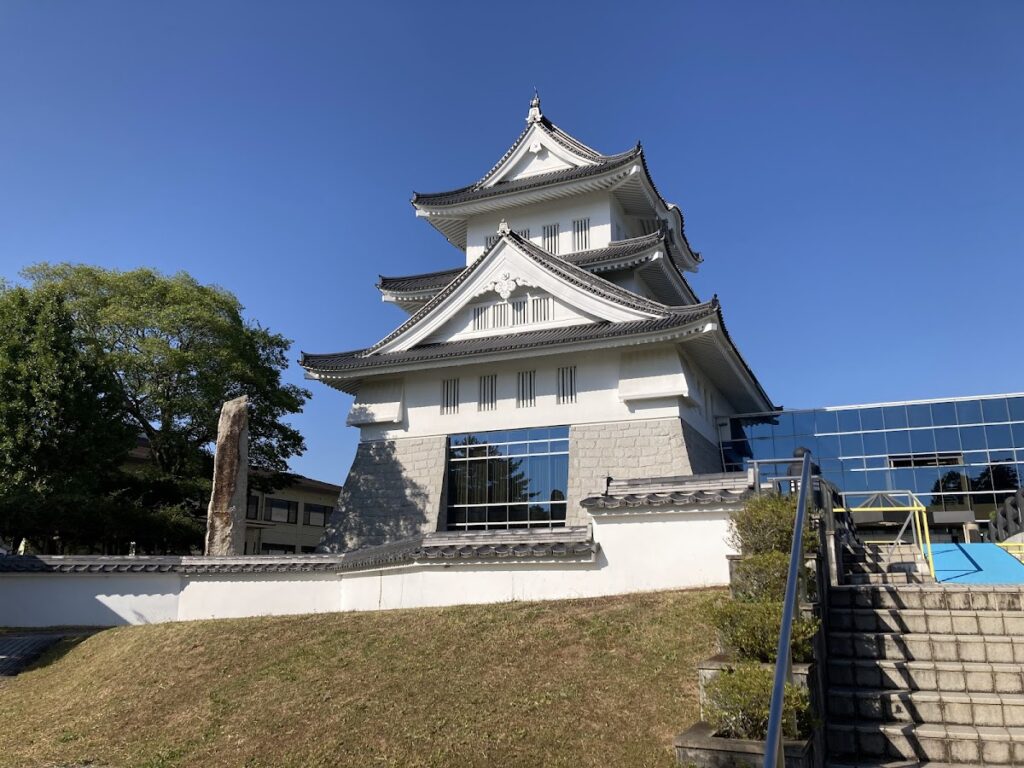
Sonobe Castle Complete Guide | History, Highlights, and Access Information for Japan’s Last Castle
What is Sonobe Castle? | Overview of Japan’s Last Castle
Sonobe Castle, located in Kozakura-cho, Sonobe-cho, Nantan City, Kyoto Prefecture, occupies a unique position in the history of Japanese castles. Known as “Japan’s last castle,” it holds significant historical importance as the newest castle in Japan, completed in 1869 (Meiji 2).
Currently, the main keep area of Sonobe Castle is the site of Kyoto Prefectural Sonobe High School, and some structures, such as the Tatsumi Turret and the Turret Gate (now the school gate), still exist. These structures are registered as “Provisional Registered Cultural Properties” by Kyoto Prefecture and are preserved as valuable historical heritage symbolizing the transition period from the Edo period to the Meiji period.
Basic Information on Sonobe Castle
- Location: Kozakura-cho, Sonobe-cho, Nantan City, Kyoto Prefecture
- Year of Construction: Founded as Sonobe Jinya (fortified residence) in 1619 (Genna 5), completed as a castle in 1869 (Meiji 2)
- Builder: Koide Yoshichika (fortified residence), Koide Hidehisa (castle construction)
- Castle Structure: Hilltop castle
- Current Status: Kyoto Prefectural Sonobe High School, some buildings still exist
- Cultural Property Designation: Kyoto Prefecture Provisional Registered Cultural Property
History of Sonobe Castle | A 250-Year Story from Jinya to Castle
Medieval Sonobe and the Hatano Clan Era
A castle existed in the Sonobe area from the medieval period. During the Sengoku period, this region was within the sphere of influence of the Hatano clan, who ruled Tanba Province, and it is believed that Araki Ujitsuna, a vassal of the Hatano clan, had his castle there. However, when the Hatano clan was destroyed in 1579 during Akechi Mitsuhide’s conquest of Tanba Province, the system of governance in this region changed dramatically.
The Arrival of Koide Yoshichika and the Establishment of the Sonobe Jinya
The history of Sonobe Castle in the early modern period begins in 1619. In that year, Koide Yoshichika was granted a fiefdom of 30,000 koku (later reduced to 29,000 koku) in Sonobe, establishing the Sonobe Domain. The Koide clan were hereditary vassals who served Toyotomi Hideyoshi, and after the Battle of Sekigahara, they were elevated to the status of daimyo under the Tokugawa family.
However, because the Sonobe Domain’s stipend was less than 30,000 koku, they were not permitted to construct a formal castle under the Tokugawa shogunate’s “One Castle Per Province” decree. Therefore, what Koide Yoshichika built was a facility called the “Sonobe Jinya.” A jinya was a facility used by the lords of small domains, who were not permitted to possess castles, to conduct their administrative affairs. Its defensive capabilities as a castle were limited.
Sonobe Jinya in the Edo Period
Throughout the Edo period, Sonobe functioned as a jinya. The Koide clan ruled Sonobe for ten generations, stabilizing the domain’s administration. The Sonobe Jinya had a structure centered around the main keep, housing the lord’s residence and the domain’s administrative offices. However, it was a simple structure lacking a full-fledged castle tower, stone walls, or turrets.
The Sonobe domain leveraged its proximity to Kyoto to develop an administration that emphasized relations with the Imperial Court. Furthermore, its strategic location on the San’in Road made it an important transportation hub.
The Turmoil of the Late Edo Period and Permission to Build a Castle
In 1867, during the late Edo period, the era reached a major turning point. With the end of the Tokugawa shogunate due to the Taisei Hokan (restoration of imperial rule) and the beginning of the Meiji Restoration, the Sonobe domain was forced to adapt to the new era. The feudal lord at the time, Koide Hidehisa, believed it necessary to strengthen the defenses in preparation for the turmoil of the Boshin War, and requested permission from the Meiji government to build a castle. In 1868 (Meiji 1), the Meiji government granted permission, and the fortification of the Sonobe Jinya (fortified residence) was officially recognized. This was a unique case in the transitional period between the collapse of the feudal system of the Edo period and the arrival of a new era.
Completion of Construction in 1869 | The Birth of Japan’s Last Castle
In 1869 (Meiji 2), the construction of Sonobe Castle was completed. Corner turrets such as the Tatsumi, Inui, and Kon turrets were built around the main keep, a turret gate was constructed, and the castle walls were improved. Sonobe Castle, completed at this time, became the “last castle built” in the history of Japanese castles.
Ironically, however, in the same year that Sonobe Castle was completed (Meiji 2), the return of feudal domains to the emperor took place, and the following year, Meiji 4 (1871), the Sonobe Domain was abolished due to the abolition of the feudal system and establishment of prefectures. In other words, Sonobe Castle ceased to function as a domain office after only two years of service.
Changes After the Meiji Era
After the abolition of the feudal system and establishment of prefectures, many of Sonobe Castle’s structures were demolished or relocated. The Taiko Yagura (drum tower) was relocated to Anraku-ji Temple in Yagi-cho and can still be seen there today. The site of the main keep was used as school grounds during the Meiji era, and this continues to the present day as Kyoto Prefectural Sonobe High School.
From the Taisho to Showa periods, some structures such as the castle gate and Tatsumi Yagura (southeast tower) were preserved and remain as the school gate and historical buildings within the high school grounds to this day.
Structure and Characteristics of Sonobe Castle
Basic Structure of the Castle
Sonobe Castle is classified as a flatland castle. The castle’s layout centered around the main enclosure (Honmaru), with the second and third enclosures (Ninmaru and Sannomaru) arranged around it. A keep (Tenshu) was not constructed; instead, a structure with turrets (Yagura) positioned at the four corners of the Honmaru was adopted.
The Honmaru, the central area of the castle, roughly corresponds to the current site of Kyoto Prefectural Sonobe High School. The Honmaru housed the lord’s residence (Goten) and served as the center of government affairs.
Stone Walls and Castle Walls
The stone walls of Sonobe Castle were built using techniques from the late Edo period to the early Meiji period, employing a neat and orderly cut-and-fitted stonework technique. The stone walls remaining around Kyoto Prefectural Sonobe High School today are valuable relics that convey the castle-building techniques of that time.
The castle walls were built surrounding the Honmaru, enhancing its defensive capabilities. Parts of the castle walls, renovated during the Meiji period, are still well-preserved today.
Arrangement of Turrets and Gates
During the renovations in 1869 (Meiji 2), the following turrets were erected at the four corners of the Honmaru.
- Tatsumi Yagura: Located in the southeast corner, the most important surviving structure.
- Inui Yagura: Located in the northwest corner (no longer exists).
- Hitsujisaru Yagura: Located in the southwest corner (no longer exists).
- Ushitora Yagura: Located in the northeast corner (no longer exists).
A magnificent turret gate was constructed at the entrance to the main keep, and this gate is currently used as the main gate of Kyoto Prefectural Sonobe High School. The two-story turret gate retains many characteristics of castle architecture, and many students pass through this historical structure every day on their way to school.
Remains from the Jinya Era
As for remains from the Jinya era of the Edo period, a guardhouse (security post) still exists. The guardhouse was a facility for guarding the castle gates and verifying visitors, and it is a valuable structure for understanding the security system of the domain at the time.
Highlights of Sonobe Castle | Existing Buildings and Remains
Tatsumi Turret
The most important existing building at Sonobe Castle is the Tatsumi Turret. Located in the southeastern corner of the main enclosure, this turret was constructed when the castle was built in 1869 (Meiji 2). It is a magnificent two-story building with a hipped roof and tiled roof.
The Tatsumi Turret retains its beautiful appearance even from the outside, with a striking contrast between the white walls and black tiles. The interior is usually closed to the public, but it may be possible to visit during special openings. From the turret, you can enjoy a panoramic view of Sonobe town, a view that the former feudal lords must have also enjoyed.
Yaguramon (Watchtower Gate) | Main Gate of Kyoto Prefectural Sonobe High School
The Yaguramon (watchtower gate) of Sonobe Castle is an extremely rare example of a building still in active use as the main gate of Kyoto Prefectural Sonobe High School. The two-story watchtower gate maintains the dignity of castle architecture while also functioning as the entrance to an educational institution.
Stone walls continue on both sides of the gate, conveying its castle gate’s grandeur. The sight of many high school students passing through this historic gate during school hours is a unique scene characteristic of Sonobe Castle.
When visiting as a tourist, please be considerate of the school grounds and refrain from visiting during class hours; visits are recommended during weekends or long holidays.
Bansho (Guardhouse)
The Bansho was a facility responsible for guarding the castle gate and is a valuable structure remaining from the Edo period at Sonobe Castle. Although small in scale, it is an important relic that tells the story of the security system of the time and provides insight into the practical aspects of castle architecture.
Stone Walls and Castle Walls
A walk around Kyoto Prefectural Sonobe High School reveals stone walls and castle walls that were constructed during the Meiji period. The stone walls on the south and east sides are particularly well-preserved, allowing visitors to observe the orderly stonework created using the kirikomi-tsugi technique.
The height of the stone walls varies depending on the location, but the highest points reach over 5 meters, providing a visual understanding of the castle’s defensive function.
Taiko Yagura (Relocated to Anraku-ji Temple)
The Taiko Yagura (drum tower) of Sonobe Castle was relocated to Anraku-ji Temple in Yagi-cho during the Meiji period and is still used as the temple’s bell tower. Although it is about 20 kilometers from Sonobe Castle, those wishing to see the structures of Sonobe Castle are advised to include Anraku-ji Temple in their itinerary.
Tourist Attractions Around Sonobe Castle
Nantan City Cultural Museum
The Nantan City Cultural Museum, within walking distance of the Sonobe Castle ruins, is a facility where visitors can learn about the history of the Sonobe Domain and the culture of the Nantan region. The museum houses approximately 9,200 items, including documents related to the Sonobe Domain and account books and commercial records from the late Edo period to the early Showa period of the Okumura family, a wealthy merchant family in Sonobe.
The special exhibition room regularly holds exhibitions on Sonobe Castle and the Koide clan, making it a valuable source of information for castle enthusiasts. When visiting Sonobe Castle, we highly recommend stopping by the museum to gain a deeper understanding of its history.
The Townscape of Sonobe
Sonobe has a history of flourishing as a post town on the San’in Road, and some parts of the townscape retain the atmosphere of a castle town. Old merchant houses and townhouses are scattered throughout, allowing visitors to enjoy a quiet stroll.
Miyama Thatched Village
Within Nantan City lies Miyama Thatched Village, which preserves the original landscape of Japan. Located about 40 minutes by car from Sonobe Castle, the settlement of thatched-roof houses has been designated a National Important Preservation District for Groups of Traditional Buildings. In conjunction with your visit to Sonobe Castle, you can experience the nature and traditional culture of Nantan.
About the Castle Stamp
At Sonobe Castle, you can obtain a popular “castle stamp” as a memento of your castle tour. A castle stamp is like a temple stamp (Goshuin) for castles, collected as a memento of your visit, and has become popular among castle enthusiasts in recent years.
How to Obtain a Castle Stamp
The Sonobe Castle stamp is sold at the Nantan City Cultural Museum and facilities related to “Forest of Kyoto.” The design expresses the characteristics of Sonobe Castle, featuring the words “Japan’s Last Castle” and an illustration of the Tatsumi Turret.
Collecting castle stamps deepens the enjoyment of castle tours and makes them valuable souvenirs of your visit. When you visit Sonobe Castle, be sure to get a castle stamp!
Access Information | How to Get to Sonobe Castle
Access by Train
Using the JR San’in Main Line (Sagano Line)
- Approximately 15 minutes on foot from JR Sonobe Station
- Approximately 40 minutes by rapid train from Kyoto Station to Sonobe Station
- From Osaka, transfer at Kyoto Station
Sonobe Station is a major station where the limited express trains “Kinosaki” and “Hashidate” also stop, making access relatively convenient. From the station to the Sonobe Castle ruins (Kyoto Prefectural Sonobe High School), you can walk by following the signs.
Access by Car
Using the Kyoto Jukan Expressway
- Approximately 5 minutes from the Kyoto Jukan Expressway “Sonobe IC”
- Parking: Parking is available at the Nantan City Cultural Museum (free).
It takes approximately 40 minutes by car from Kyoto city center, and approximately 1 hour from Osaka. Kyoto Prefectural Sonobe High School does not have a public parking lot, so we recommend parking at the Nantan City Cultural Museum parking lot and walking from there.
Map and Location Information
Sonobe Castle Ruins (Kyoto Prefectural Sonobe High School) are located in the center of Nantan City, approximately 1 kilometer northwest of JR Sonobe Station. Nearby are the Nantan City Cultural Museum and Sonobe Park, with many tourist attractions within walking distance.
You can find the exact location by searching for “Kyoto Prefectural Sonobe High School” or “Sonobe Castle Ruins” in your smartphone’s map app.
Notes for Visitors
Consideration for School Facilities
The main keep area of Sonobe Castle Ruins is located on the grounds of Kyoto Prefectural Sonobe High School, so please note the following points when visiting.
- Please refrain from entering the grounds during weekday school hours.
- Visiting on Saturdays, Sundays, holidays, and during long breaks is recommended.
- Avoid visiting on days with school events.
- Please observe quietly and respect the students’ learning environment.
- Photography is limited to the exterior only, and care should be taken to avoid including students or faculty members in the photos.
Focus on Exterior Viewing
Tatsumi Turret and Turret Gate are usually only viewable from the exterior. The interior is closed to the public except during special openings. Special openings may occur during cultural property events in Nantan City and Kyoto Prefecture, so it is recommended to check the information in advance.
Estimated Visit Time
Please allow approximately 30 minutes to 1 hour for an exterior view of Sonobe Castle Ruins. If visiting in conjunction with the Nantan City Cultural Museum, it is advisable to allow about 2 hours.
Cultural Value of Sonobe Castle
Historical Significance as Japan’s Last Castle
The greatest value of Sonobe Castle lies in its historical position as “Japan’s last castle.” Built at the turning point between the end of the Edo period and the Meiji Restoration, Sonobe Castle represents the culmination of Japanese castle history.
The fact that the tradition of Japanese castle architecture, which had continued since the Middle Ages, ended with Sonobe Castle in 1869 (Meiji 2), holds significant historical and cultural heritage importance.
Uniqueness of its Promotion from Jinya to Castle
The fact that Sonobe Castle existed as a “jinya” (fortified residence) for 250 years before being elevated to a “castle” during the Meiji Restoration, a period of significant political change, further highlights its unique character. Born between the Edo period’s social hierarchy and the Meiji era’s modernization, Sonobe Castle symbolizes a transitional period.
Value of Existing Structures
Existing structures such as the Tatsumi Turret, Turret Gate, and Guardhouse are valuable relics that convey the castle architecture of the early Meiji period. These structures, built in the Meiji period while inheriting Edo period castle construction techniques, are also important from the perspective of the transmission of traditional techniques.
While currently registered as a provisional cultural property of Kyoto Prefecture, there is a possibility of receiving higher cultural property designation in the future, making the balance between preservation and utilization a challenge.
Points to Enjoy Sonobe Castle
Recommended Point 1: The Tower Gate Used as the Main Gate of an Active High School
Looking across Japan, it is extremely rare to find a castle tower gate used as the main gate of an active school. The sight of high school students passing through this historical building every day is a unique charm of Sonobe Castle. You can truly experience the coexistence of history and modernity.
Recommended Point 2: The Beautifully Preserved Tatsumi Tower
Even after more than 150 years since its construction in 1869 (Meiji 2), the Tatsumi Tower retains its beautiful appearance. The contrast between the white walls and black tiles, and its dignified presence, makes it a great spot for photography.
Recommended Point 3: Meiji-era Stone Walls
The stone walls, which demonstrate castle construction techniques from the late Edo period to the early Meiji period, are historically interesting remains. You can observe the intricate stonework using the kirikomi-tsugi technique up close.
Recommended Point 4: A Hub of Nantan City’s History and Culture
Sonobe Castle is not just a standalone tourist spot; combining it with a visit to the Nantan City Cultural Museum or a stroll through the town offers a deeper historical experience. As a cultural center of the “Forest of Kyoto” area, it serves as a base for learning about the region’s history.
The Four Seasons of Sonobe Castle
Spring | Cherry Blossoms and the Castle in Harmony
In spring, cherry blossoms bloom around Sonobe Castle, allowing you to enjoy the beautiful interplay of castle architecture and cherry blossoms. The combination of the Tatsumi Turret and cherry blossoms is a particularly excellent photo spot.
Summer | Castle Ruins Surrounded by Greenery
In summer, the surrounding trees are lush and green, creating a beautiful contrast between the stone walls and the surrounding greenery. Although it’s a hot time of year, resting in the shade of the trees is a pleasant experience.
Autumn | Autumn Leaves and Historic Buildings
In autumn, the castle ruins are adorned with colorful autumn leaves. The contrast between the trees ablaze with red and yellow and the white walls of the turrets and gates is a scene unique to autumn.
Winter | Snow-Covered Sonobe Castle
When it snows in winter, Sonobe Castle presents a fantastical appearance. The snow-covered Tatsumi Turret and stone walls show a different face than usual, conveying a sense of historical weight in the silence.
Summary | Rediscovering the Charm of Sonobe Castle
Sonobe Castle is a castle with multifaceted charm, possessing historical significance as “Japan’s last castle,” existing Meiji-era buildings, and its unique current status as an active high school facility.
Located in the “Forest of Kyoto” area of Nantan City, Kyoto Prefecture, and relatively easily accessible, Sonobe Castle is a historical site worth visiting not only for castle enthusiasts but also for anyone interested in Japanese history and architecture.
Through its 250-year history, from an Edo-period encampment to a Meiji-era castle, the existing structures such as the turret gate and Tatsumi turret, and learning opportunities at the Nantan City Cultural Museum, you can experience firsthand Japan’s transition from the early modern to the modern era.
When visiting Sonobe Castle, please remember that it is a school facility and observe proper etiquette. Obtain a castle stamp and enjoy the history and culture of Nantan City to the fullest, along with other nearby tourist attractions.
Why not spend a special time at Sonobe Castle, the culmination of Japanese castle history, where the romance of history intersects with the spirit of the modern age?

