Complete Guide to Sone Castle Ruins | A Thorough Explanation of History and Highlights, from Inaba Ittetsu’s Residence to a Base in the Battle of Sekigahara
Located in Sone-cho, Ogaki City, Gifu Prefecture, Sone Castle Ruins are known as the castle built by Inaba Ittetsu, a leading warlord of the Sengoku period. It was the residence of Inaba Ittetsu, one of the “Three Lords of Western Mino,” who served Oda Nobunaga and Toyotomi Hideyoshi, and is also associated with Kasuga no Tsubone, famous as the wet nurse of Tokugawa Iemitsu. During the Battle of Sekigahara, it served as an important base for the Eastern Army, playing a significant role in a turning point in Japanese history. Currently, it is maintained as Kakeiji Temple and Sone Castle Park, popular with history buffs and tourists.
Overview and Location of Sone Castle
Sone Castle is located on a bend in the Noigawa River, a tributary of the Ibigawa River, and is a flatland castle built utilizing a natural levee. Located approximately 3 kilometers northwest of the center of Ogaki City, it had a defensive structure that took advantage of the unique topography of the waterside region.
The castle was a full-fledged flatland castle, centered around the main keep and second bailey, with inner and outer moats, and a surrounding moat enclosing the castle town. According to the “Map of the Ancient Sone Castle Site in Mino Province” owned by Kakei-ji Temple, the second bailey was located east of the main keep, and it can be seen that the residences of the chief retainers, samurai residences, and townhouses were neatly arranged.
Currently, Kakei-ji Temple stands on the site of the main keep, and the surrounding area has been developed into Sone Castle Park, covering approximately 21,800 square meters. The park, including Sone Pond (approximately 6,200 square meters), is a place of relaxation where history and nature harmonize, featuring a lawn area, a pond with Hariyo fish, and a beautiful ring-shaped embankment lined with cherry trees.
History of Sone Castle
Construction and the Inaba Clan Era
Sone Castle was constructed during the Eiroku era (1558-1569) by Inaba Yoshimichi, also known as Inaba Ittetsu. Inaba Ittetsu, as one of the “Three Great Lords of Western Mino,” held real power in Mino Province along with Ujiie Bokuzen and Ando Morinari.
The Inaba clan used this castle as their residence for generations, making it an important base in Mino Province. Ittetsu served Oda Nobunaga and achieved great merit in numerous battles, including the Battle of Anegawa and the Battle of Nagashino. His military strategy and political skills were highly regarded, and it is said that he is the origin of the phrase “stubborn and unyielding.”
After the Honnō-ji Incident, Inaba Ittetsu began the suspicion of Toyotomi Hideyoshi and retreated to Shimizu, present-day Ibigawa-cho, Ibi-gun, around 1583. During this period, Ittetsu temporarily withdrew from the political stage.
The Era of Nishio Mitsunori and the Battle of Sekigahara
In 1588, Nishio Mitsunori became the lord of Sone Castle with a 20,000 koku domain. Mitsunori was a hereditary vassal of Tokugawa Ieyasu and was entrusted with governing this area.
The Battle of Sekigahara in 1600 dramatically changed the fate of Sone Castle. Because Nishio Mitsunori sided with the Eastern Army, Ishida Mitsunari of the Western Army ordered neighboring generals to destroy Sone Castle. Although it was temporarily in danger of being attacked by the Western Army, the situation changed dramatically when the Eastern Army advanced to Akasaka. Matsudaira Yasunaga and Mizuno Katsunari entered Sone Castle, making it a crucial base for the Eastern Army. It functioned as a frontline base for attacks against the Western Army defending Ogaki Castle, becoming a strategically important location that determined the outcome of the Battle of Sekigahara.
Abandonment and Aftermath
After the Battle of Sekigahara, Nishio Mitsunori was transferred to Ibi Castle (Ibigawa-cho, Ibi-gun) with a 30,000 koku stipend for his service in the siege of Ogaki Castle. In 1601, Sone Castle, now without a lord, was abandoned, ending its role.
After its abandonment, the Kakei-ji Temple, built by Inaba Ittetsu to commemorate his mother, was relocated to the site of the former main keep. While the castle’s remains gradually disappeared, the history of Sone Castle lived on in the memories of the local people.
Relationship with Kasuga no Tsubone
Sone Castle is also important as a place associated with Kasuga no Tsubone, known as the wet nurse of Tokugawa Iemitsu. Kasuga no Tsubone was the granddaughter of Inaba Ittetsu, the daughter of Inaba Shigemichi and Saito Toshimitsu.
Kasuga no Tsubone was born in 1579 and is believed to have spent her childhood at Sone Castle. After her father, Saito Toshimitsu, was defeated while serving Akechi Mitsuhide in the Honnoji Incident, she went through a period of hardship. However, she later served the Tokugawa family and, as the wet nurse of the third shogun Iemitsu, became a powerful figure in the Ooku (women’s quarters of the Edo Castle).
The relationship between the Inaba family, from which Kasuga no Tsubone originated, and Sone Castle holds significant meaning in the history of the Edo shogunate. Kakeiji Temple also preserves historical materials related to Kasuga no Tsubone, making it a must-see point for history enthusiasts.
Highlights of Sone Castle Ruins
Kakei-ji Temple (Main Enclosure Site)
Kakei-ji Temple, built on the site of the main enclosure of Sone Castle, was established by Inaba Ittetsu as a memorial temple for his mother. A stone monument and information board marking “Sone Castle Ruins Main Enclosure Site” and “Sone Castle Site” are placed in front of the gate, indicating that this is a historical castle site.
A portion of the stone wall unearthed during archaeological excavations is preserved on the north side of the main hall. While the stone walls and paving remains of the main enclosure were discovered during the excavation, they have been backfilled for preservation. However, the stone walls and earthworks visible north of Kakei-ji Temple are not from the original castle but were constructed in later periods.
The temple grounds are elevated, allowing visitors to feel the topography of the former main enclosure. The quiet grounds exude a sense of history, creating a space where one can reflect on the Sengoku period (Warring States period).
Sone Castle Park
Located north of Kakeiji Temple, Sone Castle Park is a popular recreational spot for local residents. Within its approximately 21,800 square meter grounds, there are lawns and two ponds, allowing visitors to enjoy the changing seasons.
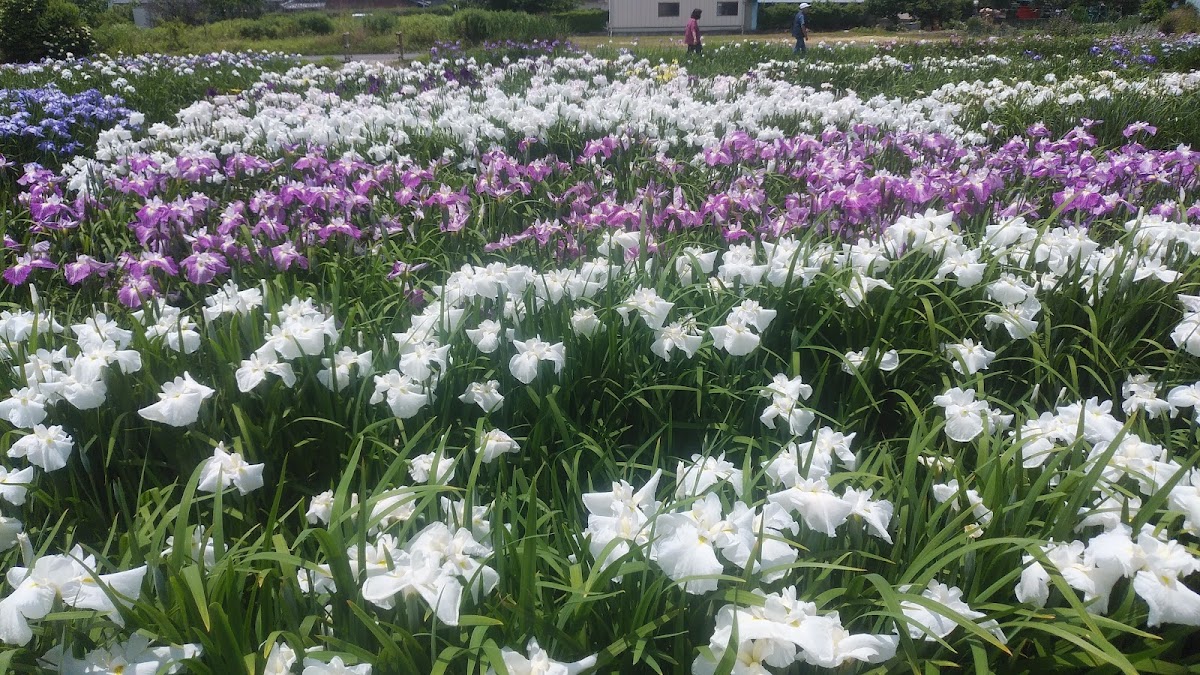
Sone Pond covers approximately 6,200 square meters and is a popular fishing spot. In early June, the irises at the Iris Pond are in full bloom, attracting many tourists.
Hariyo Pond is a protected habitat for the Hariyo, a freshwater fish designated as an endangered species. The Hariyo is a rare fish that only inhabits clear streams and is designated as a natural monument of Ogaki City. This is a valuable place to observe the Hariyo in its crystal-clear waters.
Ogaki Ring-Dike Embankment
Adjacent to Sone Castle Park is the Ogaki Ring-Dike Embankment, the largest and oldest ring-dike embankment in Ogaki. The cherry tree-lined avenue is magnificent, creating a stunning tunnel of blossoms in spring. A cycling path is also maintained, making it a course where you can enjoy nature while exploring history.
The ring-shaped embankment is an important legacy that tells the history of Ogaki, a water-rich area, and allows you to appreciate how Sone Castle utilized its water resources.
Archaeological Excavations and Remains
Multiple archaeological excavations have been conducted at the Sone Castle site, gradually revealing the castle’s structure. The discovery of stone walls and paving remains of the main keep provides valuable information about the castle construction techniques of the Sengoku period.
An explanatory sign about the excavation is located north of Kakeiji Temple, where you can learn more about the findings. The unearthed artifacts offer a glimpse into life at the castle and the culture of the time.
Unfortunately, most of the remains of Sone Castle have been lost due to development after its abandonment, and very few structures remain today. However, ancient documents and drawings such as the “Map of the Old Sone Castle Site in Mino Province” allow us to imagine the castle’s former appearance.
The Life of Inaba Ittetsu
Inaba Yoshimichi (Ittetsu) was a Sengoku period samurai born in 1516 and died in 1588 at the age of 73. He served the Toki and Saito clans of Mino Province, then followed Oda Nobunaga, and later Toyotomi Hideyoshi.
Ittetsu’s most distinctive characteristic was his cautious and stubborn personality. He is said to be the origin of the Japanese idiom “ganko ittetsu” (stubborn and unyielding), possessing a strong will that never wavered once a decision was made. He also possessed great military talent and was highly trusted by Oda Nobunaga.
During the Honnoji Incident, Ittetsu followed Toyotomi Hideyoshi, but later, due to Hideyoshi’s suspicions, he was forced to leave Sone Castle. He spent his later years in Shimizu (present-day Ibigawa Town), where he ended his life.
Ittetsu’s descendants continued as daimyo during the Edo period and maintained close ties with the Tokugawa shogunate through Kasuga no Tsubone. The Inaba family became a prestigious family that continued until the end of the Edo period, and Sone Castle was an important castle that marked its beginning.
The Three Lords of Western Mino and the Sengoku History of Mino
The Three Lords of Western Mino, to which Inaba Ittetsu belonged, is a collective term for three powerful warlords who controlled the western part of Mino Province.
In 1567, when Oda Nobunaga attacked Inabayama Castle (later Gifu Castle), the defection of the Three Lords of Western Mino played a decisive role. For this service, the three were granted their territories by Nobunaga and became an important group of retainers in Mino Province.
Sone Castle, as one of the bases of the Three Lords of Western Mino, held an important position in the politics and military of Mino Province. They supported the system of control over this region by coordinating with castles such as Ogaki Castle and Ibi Castle.
Access and Basic Information
Location
1-chome, Sone-cho, Ogaki City, Gifu Prefecture 503-2213
Transportation Access
- Train: Approximately 10 minutes by car or bus from JR Tokaido Main Line “Ogaki Station”
- Car: Approximately 15 minutes from Meishin Expressway “Ogaki IC”
- Parking: Free parking available at Sone Castle Park (ample parking space available)
Visiting Information
- Visiting Hours: Open all day (Park is always open, Kakeiji Temple is open only during the daytime)
- Admission Fee: Free
- Estimated Time Required: Approximately 30 minutes to 1 hour
Nearby Facilities
- Ogaki Castle: Approximately 10 minutes by car, a central tourist spot in Ogaki City
- Sumomata Ichiyajo Castle: Approximately 15 minutes by car, a associated castle with Toyotomi Hideyoshi
- Sekigahara Battlefield: Approximately 30 minutes by car, the main battlefield of the Battle of Sekigahara
How to Enjoy Sone Castle Ruins
Historical Walking Course
When visiting Sone Castle Ruins, first check the historical overview at the stone monument and information board in front of the gate of Kakei-ji Temple. Visit the stone wall north of the main hall and the excavation survey explanation board, and reflect on the structure of the castle during the Sengoku period.
Afterward, stroll through Sone Castle Park to experience the former extent of the castle grounds. Walking around the park’s pond and lawn area, imagining the castle town is also a pleasure.
Walking along the adjacent Ogaki Ring-shaped Embankment will help you understand the relationship between the topography of the waterside area and the castle’s location. The cherry blossom season in spring and the iris season in early June are especially recommended.
Seasonal Highlights
Spring (late March to early April): The cherry trees along the Ogaki Ring-shaped Embankment are in full bloom, creating a magnificent tunnel of cherry blossoms. It’s a popular season for cherry blossom viewing.
Early Summer (Early June): The irises in the Iris Pond are in full bloom. Purple and white flowers adorn the pond, creating an elegant landscape.
Summer: Families enjoy picnics on the lush lawn. Rare fish can be observed in the Hariyo Pond.
Autumn/Winter: Immerse yourself in history in a tranquil atmosphere. It’s the perfect season for a peaceful stroll.
Photo Spots
- Stone monument marking the “Sone Castle Ruins Main Enclosure Site” in front of the gate of Kakeiji Temple
- Stone wall north of the main hall (exhibition of excavated remains)
- Sone Pond and surrounding natural scenery
- Iris Pond (early June)
- Cherry blossom trees along the Ogaki ring levee (spring)
- Hariyo Pond (highly transparent water and rare fish)
Related Historical Spots
Ogaki Castle
Ogaki Castle, located about 10 minutes by car from Sone Castle, was the base of Ishida Mitsunari’s forces in the Battle of Sekigahara. While Sone Castle was the base of the Eastern Army, Ogaki Castle was the center of the Western Army. Understanding the relationship between the two castles will give you a clearer overall picture of the Battle of Sekigahara.
Sekigahara Battlefield
The Sekigahara Battlefield, located about 30 minutes by car, is the site of the largest battle in Japanese history. Visiting Sone Castle with an understanding of its history as a forward base for the Eastern Army’s attack on Ogaki Castle provides a much better grasp of the strategic developments of the battle.
Ibi Castle Ruins
The ruins of Shimizu, where Inaba Ittetsu spent his later years, and Ibi Castle, to which Nishio Mitsunori was transferred, are deeply intertwined with the history of Sone Castle. Ibigawa Town is dotted with historical sites related to Inaba Ittetsu, making historical tours tracing his footsteps possible.
Local Initiatives and Preservation Activities
Ogaki City protects the Sone Castle ruins as a city-designated historical site and strives to preserve its historical value. The development of Sone Castle Park balances its function as a place of relaxation for local residents with its value as a historical heritage site.
Efforts to protect the Hariyo fish are also actively underway, utilizing the site for conservation of endangered species and environmental education. Local elementary schools visit, providing opportunities to learn about local history and nature.
Further archaeological excavations and the collection of historical materials are expected to reveal the full extent of Sone Castle. Efforts are underway to pass on this historical asset to future generations.
Summary
Sone Castle ruins were built by Inaba Ittetsu, a renowned general of the Sengoku period, and played a crucial role as a key base for the Eastern Army during the Battle of Sekigahara, a turning point in history. It is also known as a place associated with Kasuga no Tsubone and is an important historical site connected to the history of the Edo Shogunate.
Currently, the site has been developed as Kakeiji Temple and Sone Castle Park, offering a place to enjoy historical walks and nature. While few remains of the castle exist, stone monuments, information boards, and displays of excavation results allow visitors to imagine the castle’s former appearance.
Sone Castle ruins, where you can feel the rich history and culture of Ogaki City, are recommended not only for history buffs but also for families and nature lovers. Visiting it in conjunction with the nearby Ogaki Castle and the Sekigahara battlefield provides a valuable opportunity to experience the flow of history from the Sengoku period to the Edo period.