Complete Guide to Shinyama Castle (Shinyama Castle): The Full Picture of a Mountain Castle that Tells the Story of Izumo’s Sengoku History
Shinyama Castle (also known as Shinyama Castle) is a Sengoku period mountain castle located in Hōyoshi-chō, Matsue City, Shimane Prefecture. Built on a 256-meter-high mountaintop in the Kitayama mountain range, this castle was a strategically important location with a wide view stretching from Lake Shinji to Lake Nakaumi, and was the stage for fierce battles between the Mōri and Amago clans. This article will provide a detailed explanation of Shinyama Castle’s history, remains, and current situation.
Overview of Shinyama Castle
Shinyama Castle was one of the important strongholds of the Sengoku period in Izumo Province (present-day Shimane Prefecture). It is written as both Shinyama and Shinyama, and both names appear in historical documents. The most distinctive feature of this castle is that it functioned as a forward base (mukaijiro) for attacking Shiraka Castle, an important branch castle of the Amago clan.
Basic Information
Location: Hōyoshi-chō, Matsue City, Shimane Prefecture
Former Province: Izumo Province
Classification/Structure: Mountain Castle
Elevation: 256 meters
Other Names: Mayama Castle, Shinyama Castle
Year of Construction: Late Heian period (tradition), effectively Eiroku 6 (1563)
Builder: Taira no Tadanori (tradition)
Renovator: Kikkawa Motoharu
Main Lords: Taga Motonobu, Amago Katsuhisa (for a period)
Year of Abandonment: Keichō era
Location and Geographical Importance
Shinyama Castle is located in the mountains of the Kitayama mountain range, and its location is militarily advantageous. From the mountaintop, one can see not only Shiraka Castle at the foot of the mountain, but also a vast area stretching from Lake Shinji to Lake Nakaumi. This excellent view was essential for monitoring enemy movements and quickly communicating with allies. Located in the heart of the Izumo region, Shinzan Castle held immense strategic value as a base for invading the sphere of influence of the Amago clan, whose base was Gassan-Toda Castle, and as a central hub for controlling Izumo.
History of Shinzan Castle
Legend from the Late Heian Period
Regarding the origins of Shinzan Castle, there is a legend that it was built in the late Heian period by Taira no Tadanori. Taira no Tadanori was the half-brother of Taira no Kiyomori and a well-known warrior of the Taira clan. However, this legend lack reliables historical evidence, and it has been suggested that it may be a later fabrication.
The history of Shinzan Castle from the late Heian period to the Sengoku period is unclear, and its role during this time is uncertain.
Eiroku 6 (1563): Renovations by the Mori Clan and the Attack on Shiraga Castle
Shinzan Castle first appears on the historical stage during Mori Motonari’s invasion of Izumo Province in Eiroku 6 (1563). During this period, the Mori and Amago clans were fiercely opposed to each other for supremacy in the Chugoku region.
Mori Motonari sought to expand into Izumo Province and, in order to capture Gassan-Toda Castle, the Amago clan’s stronghold, he planned to capture Shiraga Castle, an important subsidiary castle. Shiraga Castle was a formidable fortress and could not be easily captured by a frontal attack.
Therefore, Kikkawa Motoharu, acting on orders from Mori Motonari, focused on Shinzan Castle as a counter-fortress to Shiraga Castle and carried out extensive renovations. Kikkawa Motoharu was Mori Motonari’s second son and a renowned general who achieved numerous military successes as a senior retainer of the Mori family. Motoharu established his camp at Shinyama Castle and used it as a base to increase pressure on Shiraga Castle.
Many of the remains of Shinyama Castle visible today are thought to have been formed by the renovations carried out by Kikkawa Motoharu at this time. The construction of stone walls and the arrangement of baileys demonstrate the castle-building techniques of the Sengoku period.
Establishment as a Base After the Capture of Shiraga Castle
After successfully capturing Shiraga Castle, the Mori clan positioned Shinyama Castle as an important base for controlling the Izumo region. Taga Motonobu was appointed as the castle lord, responsible for governing the region and maintaining its strategic military location.
Taga Motonobu was a senior retainer of the Mori clan and was entrusted with the Izumo region. Using Shinyama Castle as his base, he consolidated the control system of the surrounding area and played a role in monitoring the movements of the managing the remnants of the Amago clan.
Occupation by the Amago Restoration Army
In 1566, Gassan-Toda Castle fell to the Mori clan, and the Amago clan was temporarily destroyed. However, the remaining retainers of the Amago clan did not give up on restoration.
The Amago Restoration Army, centered around Amago Katsuhisa and Yamanaka Shikanosuke, planned a counterattack against the Mori clan. Yamanaka Shikanosuke was a loyal retainer known for his famous quote, “I pray that you grant me seven trials and eight hardships,” and a warrior who dedicated his life to the restoration of the Amago clan.
The Amago Restoration Army succeeded in occupying Shinyama Castle for a time. This was a major threat to the Mori clan and meant that their control over Izumo Province was unstable. Amago Katsuhisa and Yamanaka Shikanosuke used Shinyama Castle as a base to regain power in the surrounding area.
However, the Amago restoration army’s occupation of Shinyama Castle did not last long. Following a counterattack by the Mori clan, it returned to Mori control.
Abandonment during the Keicho Era
After the Battle of Sekigahara (1600), Horio Yoshiharu was appointed to Izumo Province and built Matsue Castle. It is believed that Shinyama Castle was abandoned during the Keicho era due to the castle’s development during this period.
With the influence of the “One Castle Per Province” decree (1615), many mountain castles were abandoned, and Shinyama Castle also ceased to function. Since then, it has lost its function as a castle, and only its remains remain.
Remains of Shinyama Castle
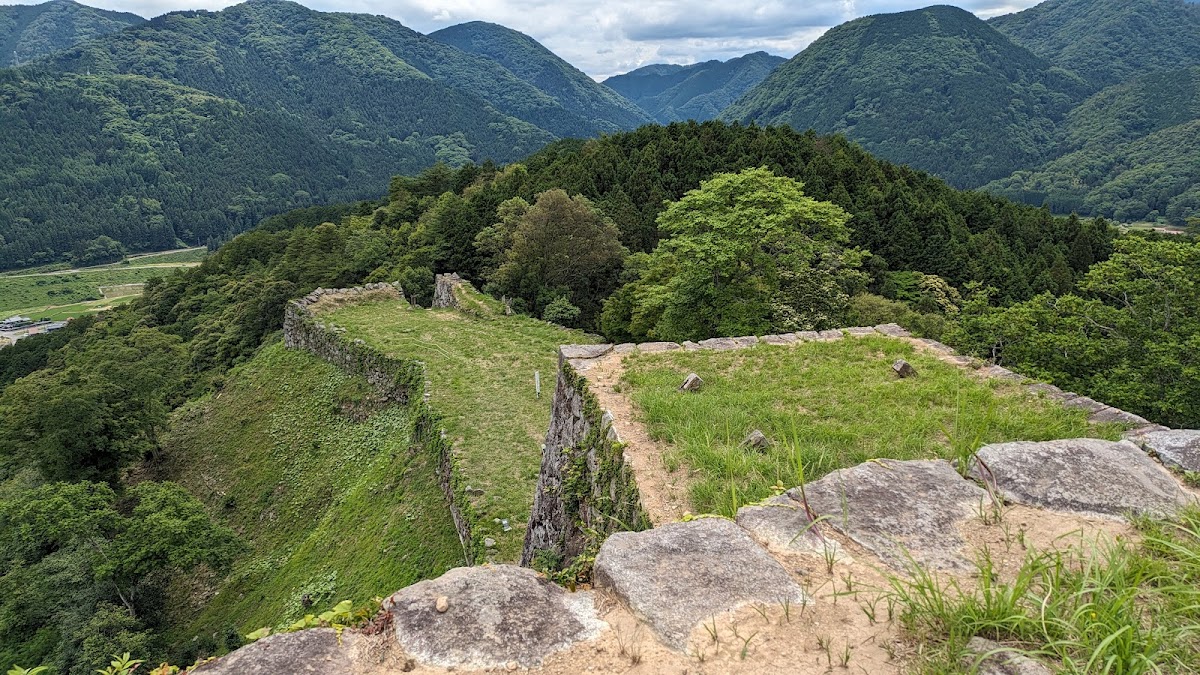
Shinyama Castle retains many valuable remains that demonstrate the characteristics of mountain castles from the Sengoku period. The series of baileys arranged in a stepped fashion from the mountaintop at an altitude of 256 meters speaks to the high level of castle-building technology of the time.
Structure of the Baileys
The most distinctive feature of Shinyama Castle is the series of baileys arranged in a stepped fashion from the mountaintop. From the summit upwards, the baileys known as “Ichino-toko,” “Nino-toko,” and “Sanno-toko” were arranged in sequence, each functioning as a defensive stronghold.
Summit (Main Bailey): This was the most important bailey, the center of the castle, and is believed to have been the residence of the lord and commanders. The view from here was magnificent, overlooking the surrounding area.
Ichino-toko: This was the second most important bailey after the main bailey, and played a role in defending the main bailey.
Nino-toko: This bailey was located on a lower level, forming a tiered defensive line.
Sanno-toko: This was the outermost bailey, and its role was to stop enemy incursions.
This stepped arrangement of baileys is a typical defensive structure for mountain castles, designed so that the enemy would encounter fierce resistance each time they advanced to a higher level.
Stone Walls
Among the remains of Shin-Yamashiro Castle, the most noteworthy are the Nozura-zumi (rough-stone masonry) stone walls. Nozurazumi is a technique of stacking natural stones with minimal processing, and is commonly seen in stone walls from the Sengoku period (Warring States period).
These stone walls, believed to have been constructed during renovations by Kikkawa Motoharu, still stand today, more than 400 years later. The well-preserved condition of the stone walls makes them valuable historical materials that convey the castle-building techniques of that time.
The stone walls were mainly placed along the edges of the baileys and at important defensive points, forming a strong defensive line in combination with earthworks.
Moats and Earthworks
Traces of moats (horikiri), an important defensive structure for mountain castles, can also be found. Moats are dry moats dug to cut across ridges, serving as crucial defensive structures to prevent enemy intrusion.
Earthworks also remain in various places, surrounding the baileys and enhancing their defensive capabilities. These remains demonstrate how meticulously designed mountain castles were during the Sengoku period.
Ascent Route and Gate
You can trace the remains of the ascent route, the path leading to the castle. The remains of the castle gate, known as a “koguchi,” can also be seen, demonstrating various measures taken to restrict enemy intrusion.
Current Preservation Status
The Shinzan Castle ruins are still well-preserved within the forest. However, some preparation and caution are necessary for ascent. Some parts of the mountain path are not maintained, requiring appropriate equipment and physical fitness.
While the preservation of the remains is relatively good, some areas are affected by natural erosion and vegetation. Proper preservation and management will continue to be crucial to maintaining its value as a cultural property.
Shinzan Castle and the Surrounding Castle Network
Understanding Shinzan Castle is crucial to its relationship with the surrounding castles. This castle did not exist in isolation but functioned as part of the Izumo region’s castle network.
Relationship with Shiraka Castle
The most important relationship of Shinzan Castle is its location to Shiraga Castle. Shiraga Castle was an important branch castle of the Amago clan, and Niiyama Castle was remodeled as a counter-castle to attack it. The two castles were close together, allowing Niiyama Castle to directly relative monitor Shiraga Castle.
A counter-castle is a castle built near an enemy castle to serve as a base for siege during an attack. Niiyama Castle functioned as a typical counter-castle, cutting off the supply lines to Shiraga Castle and lowering the morale of the castle’s defenders.
Relationship with Gassan-Toda Castle
Gassan-Toda Castle was the Amago clan’s stronghold and the most important base in Izumo Province. The Mori clan’s ultimate goal was the capture of Gassan-Toda Castle, and Niiyama Castle was a crucial base in the preliminary battles.
The distance from Niiyama Castle to Gassan-Toda Castle was approximately 20 kilometers, placing them in a strategically important location. Securing Niiyama Castle was part of the siege network surrounding Gassan-Toda Castle.
Relationship with Matsue Castle
With the arrival of the Edo period and the construction of Matsue Castle by Horio Yoshiharu, Shinyama Castle ceased to serve its purpose. Matsue Castle became the center of the Izumo region as a modern castle, while Shinyama Castle, a medieval mountain castle, faded into history.
Currently, Matsue Castle is designated a National Treasure and is a famous castle visited by many tourists. When visiting Shinyama Castle, being aware of its relationship with Matsue Castle and the changes over time will lead to a deeper understanding.
Shinyama Castle and Izumo in the Sengoku Period
The history of Shinyama Castle symbolizes the turmoil in the Izumo region during the Sengoku period. This region became the stage for clashes between the two major powers, the Mori and Amago clans, and numerous battles were fought here.
Mori Clan’s Invasion of Izumo
Mori Motonari planned an invasion of Izumo Province in order to become the ruler of the Chugoku region. The Amago clan had built a powerful force in the San’in region, centered on Izumo, and were the Mori clan’s greatest rival. Motonari skillfully combined strategy and military force to gradually weaken the Amago clan. The renovation and utilization of Shinzan Castle was part of this strategy. He stationed the excellent general Kikkawa Motoharu there, establishing a system to ensure the capture of Shiraga Castle.
The Amago Clan’s Resistance and Downfall
The Amago clan, a prestigious family of Izumo, had ruled this region for generations. However, they were gradually cornered by the pressure of the Mori clan.
In 1566, Gassan-Toda Castle finally fell, and Amago Yoshihisa surrendered. This marked the temporary demise of the Amago clan, but the movement for their restoration by their surviving retainers continued.
The Amago Restoration Movement and Yamanaka Shikanosuke
The activities of the Amago restoration army, centered around Yamanaka Shikanosuke, are recounted to posterity as a story of loyalty in the Sengoku period. The temporary occupation of Shinzan Castle was one of the highlights of this movement.
Shikanosuke prayed for “seven hardships and eight sufferings” and worked tirelessly for the restoration of his lord’s family, but ultimately his wish was not granted. However, his spirit of loyalty moved many people and is still recounted today.
Access and Visiting Information for Shinyama Castle
When visiting Shinyama Castle, prior preparation and planning are important. As it is a mountain castle, there are points to note that differ from typical tourist destinations.
Access Method
Location: Hōyoshi-chō, Matsue City, Shimane Prefecture
Nearest Station: Approximately 15 minutes by car from JR Matsue Station
Parking: There is some space near the trailhead, but there is no designated parking area.
Public Transportation: It is possible to take a bus from Matsue Station, but the number of buses is limited, so it is recommended to check the timetable in advance.
Precautions for Visiting the Castle
- Clothing and Equipment: Since you will be walking on mountain paths, appropriate clothing and shoes for hiking are necessary. Particular caution is needed after rain, as the ground can become slippery.
- Estimated Time Required: Allow approximately 1.5 to 2 hours round trip from the trailhead to the summit.
- Season: Spring to autumn is the best time to visit. Winter is not recommended for those without experience due to the possibility of snow and ice.
- Wild Animals (Bears, etc.): As this is a mountainous area, there is a possibility of encountering wild animals. Taking precautions such as using bear bells is recommended.
- Avoiding Solo Activities: It is best to visit in groups to be prepared for any unforeseen circumstances.
Points to Note When visiting Shinzan Castle
When visiting Shinzan Castle, please pay attention to the following points:
- Observation of Stone Walls: The rough-hewn stone walls are a valuable historical relic that allows you to directly see the castle-building techniques of the Sengoku period.
- View: The view from the summit is magnificent, offering a panoramic view of Lake Shinji and Lake Nakaumi. Imagining the warlords of that time gazing upon this view evokes a sense of historical romance. – Layout of Enclosures: By actually walking through the stepped arrangement of enclosures, you can experience the defensive structure of a mountain castle.
- Harmony with Nature: The beautiful scenery, where the ruins and nature harmonize, is one of the charms of Shin-Yama Castle.
Historical Significance of Shin-Yama Castle
Shin-Yama Castle has historical significance beyond being just a mountain castle.
Witness to Sengoku Period Castle Construction Techniques
The remains of Shin-Yama Castle, formed through renovations by Kikkawa Motoharu, are valuable historical materials that convey the castle construction techniques of the Sengoku period. The methods of stacking stone walls, the layout of enclosures, and the structure of defensive facilities provide important information for understanding the technological level of the time.
Stage of the Conflict between the Mori and Amago Clans
The conflict between the Mori and Amago clans for hegemony in the Chugoku region was a significant historical event of the Sengoku period. Shin-Yama Castle was one of the important stages of that conflict and is indispensable for understanding the strategies and tactics of both clans.
Importance in Local History
Shinzan Castle holds a significant position in the history of the Izumo region. The rise and fall of this castle reflect changes in the region’s political and military situation, making it important material for local history research.
Current Status and Challenges of Shinzan Castle Research
Research on Shinzan Castle has been gradually progressing in recent years, but many aspects remain unclear.
The Need for Archaeological Excavation
Full-scale archaeological excavation could potentially provide more detailed information about the structure and changes of Shinzan Castle. In particular, the veracity of the legend of its construction by Taira no Tadanori and the specific details of the renovations by Kikkawa Motoharu could be revealed through excavation.
Re-examination of Historical Documents
Local history books, including the “Un’yōshi,” contain descriptions of Shinzan Castle. Re-examining these documents from a modern perspective could potentially yield new insights.
Balancing Preservation and Utilization
How to preserve Shinzan Castle as a cultural property while simultaneously utilizing it as a tourist and educational resource is a crucial challenge for the future. Proper maintenance and preservation are essential to passing on this valuable heritage to future generations.
Summary
Shinzan Castle (also known as Shinzan Castle) is a Sengoku period mountain castle located in Matsue City, Shimane Prefecture. It was the stage for a significant historical event in the Chugoku region: the conflict between the Mori and Amago clans. From the legend of its construction by Taira no Tadanori, to its renovation by Kikkawa Motoharu, its occupation by the Amago restoration army, and finally its abandonment, this castle survived a turbulent era.
Valuable remains, such as the arrangement stepped of baileys and the rough-hewn stone walls, remain in excellent condition, conveying the castle-building techniques of the Sengoku period. The magnificent view from the mountaintop still shows us the scenery that the warlords of that time saw.
Visiting Shinzan Castle is not simply about viewing ruins; it’s an opportunity to experience the rich historical background, including the history of Izumo during the Sengoku period, the conflict between the Mori and Amago clans, and the story of Yamanaka Shikanosuke’s loyalty. With proper preparation and equipment, you can enjoy both the romance of history and the beauty of nature at the same time.
I hope that Shinzan Castle will become known to more people in the future and be properly preserved and utilized. Passing on this valuable historical heritage to future generations is our important responsibility.