
Shengcheng Castle: A complete overview of the history and highlights of the castle fort of the southern feudal lords, and one of the most beautiful stone fortresses in the East and North.
Shengji Castle is located in the center of Iwate, Shengji City, and is a flat castle fortress on a flat land.For generations, it has been the residence of the Nanbu clan. As of today, the scenic spot of Chengdu Hot Gate – Shengji Castle Park (Iwate Park). It is a beautiful stone tomb with white flowers and rocks, honored as one of the three great castles in the North. Full text summary of the castle, the history of its construction, the construction of the castle, and the attraction of the park since its inception.
Shengji Castle overview and geographical location
The castle is a flat castle fortress with many castles, and a rocky hill with a mountain of flowers on the Kitakami River and Nakatsugawa River. Shengcheng’s skillful use of land covers an area of approximately 143 meters, the altitude of the area is approximately 15 meters, the main fort is centered on two forts and three forts, and is constructed as a solid defense system.
Geographic location and geographic expedition
Shengji Castle is located in Iwate, Shengji City Marumachi, right in the center of Shengji City. The Kitakami River (Kitakami Furukawa) flows through the vicinity of Seiyuan in the city of Shengshu, and is located at the Nakatsugawa River. Shengcheng was built on the encroachment plateau of Yuhe River Jiaohui.
The use of the fortress in the west of the Kitakami River, east and south of the Nakatsu River, the construction of the natural castle river, the construction of a fortified fortification system, and the construction of a fortified fortress in both directions. This area is not an important military fortification, it also has excellent waterway transportation, and promotes the castle town.
Origin of the other name “Kozukata Castle”
The original name of this place is “Kozukata”, and the other name of this place is Shengjie Castle.关于” Ancient Way” Place name origin There are many different interpretations, but it is universally recognized as the source of this name Yu Shengjie Castle was built on the former site of Ancient Way Castle (also known as Awaji 馆 or 庆前馆). The Fukushi clan, which was a vassal of the Nanbu clan in ancient times, was established in a new manner.
History of the construction of Shengji Castle
Nanbu Nobunao’s decision to build a castle
The construction of Shengji Castle began in ancient times, where the feudal general of the Nanbu domain lived. The first feudal lord of the Seiji domain, Nobunao Nambu, established the capital in ancient times, and the focus was on local cooperation and political harmony.
Established in 1597 (2nd year of the Emperor’s reign), Nambu Nobunao started construction of the castle, and his son Toshinao Nambu (the second lord of the domain) was in charge of the castle. It was also recorded in 1598 (the 3rd year of the Emperor’s reign), however, there is no doubt that the construction of the castle began at the end of the 16th century.
Construction and design by Chosei Asano
The public noticed that the castle-like construction was completed, and the construction of the five vassals of Hideyoshi and Asano Chosei was recorded. Chomasa Asano was the number one builder of castle forts, and was the number one builder of castles in modern times.
Influenced by Chosama Asano, the construction techniques of the Japanese fort were fully developed, and the final construction of the fort was completely completed. Among the most popular forts in the North East area, people who are attracting attention are those who are not considered to be the most famous stone forts in the world.
Long construction cycle
The construction period of the castle was around 90 years. Construction began in 1597 (2nd year of Wulong), construction began in 1686 (3rd year of Shang to Tokyo), and continued to be built continuously.
In 1633 (Kane’aga 10), Nambu Nobunao became the chief owner of the castle, and after that, the Nanbu clan continued to live in the capital. However, the restoration and construction of the castle was still in progress, and it was finally completed at the end of the 17th century.
As the long-term construction cycle does not change, it also reflects the economical and technical difficulties of the current situation, which also reflects the high importance placed on the area-centered construction of castles in the southern part of Japan.
Shengcheng’s structure and distribution station
Main castle, second castle, third castle distribution
The development of Shengcheng City, the main city center, the surrounding area, two castles and three castles. In addition, the construction of the northern castle, eastern castle, and other foreign castles was completed, and a solid defense system was constructed.
Honjo This is the core of the fort, the highest point in Jianyu. However, the main castle tower was built inside the main castle, but the three-tiered tower of the famous “Goshan Kaitou” was built and replaced.
Second Castle Located north of Umoto Castle, this is the castle’s main residence and other construction locations. This is the administrative and administrative center of the castle, and the construction of the building is established.
Three Castles Locations outside of the city, residences of vassals and other administrative locations. After completing the construction of the Sannomaru area, the castle town was formed.
Ishijou’s characteristic Yobikan
The most famous special attack on Shengji Castle was the construction of the stone tomb, which was made of white flower rock after the departure of Yumori Castle. It is the largest stone tomb north of the eastern region, which is a common land quality castle fort in the eastern region.
Hana Rock, also known as “Makeishi”, is a hard and durable stone. The beauty of the white fort is that the stone fortress of Shengcheng is the most beautiful, and the beauty of the white fortress is the beauty of the “white fortress”.
The method of making stone crocks differs from time to time, from the early coarse-grained method (noshu-kaku) to the later fine-grained stone crockery (kirikomi-hagi). This reflects the history of the eternal construction of Shengcheng, and it is also a treasure trove for the exhibition of the stone tombs.
Water use of the Kajo River
The Kitakami River, the Nakatsu River, and the other rivers used by the castle are natural outer castle rivers, protected areas westward, eastward and southward.
Outside of this, the inner part of the castle was expanded, and the two-tiered castle tower, the second-tiered castle tower, and the third-tiered castle tower were separated. When the river water is drawn into the river, it has a constant water level, which increases its defensive ability.
Due to the lack of water availability, water is an important function during defense, and water is also provided in daily life within the city. The water supply system of a fortress in the early modern era is highly developed.
History of the Nambu clan and the Yomori clan
Origin of the Nanbu clan
The Nambu clan is a samurai family that originated in Nanbu, Kai Province, U.K. At that time, other forces were employed in the Northern Dynasty, which was due to the fact that they were in the midst of the Oshu War, which was due to be granted to them in the northern part of the country.
The Nanbu clan was the main force in the Numayan area, and during the time of the war, its location was the King of Usan. The 26th head of the Nambu clan, Nobunao Nambu, his subordinate Hideyoshi Atsutada, was stationed there.
Established in the Morihan domain (200,000 koku)
During the War of Ibara, Tokugawa Ieyasu’s eastern army joined Nanbu Toshinao. After the war, the Seiji domain officially became a domain worth 200,000 koku. This means that during the Edo period, the Nanbu clan’s work was carried out by foreign feudal lords.
The lords of the Nanbu clan during the Edo period were from the north to the Aomori region, from the north to the Iwate region. The Nanbu clan’s rule extended to the end of the Edo period, and the beginning of the Meiji era.
Yomori Castle, lord of the Hamashiro domain
The first lord of the domain, Nobunao Nanbu, and the last lord of the domain, Toshiyuki Nanbu, resided in Moriwa Castle. Each first-rank feudal lord’s capital city was built with power, and the castle town was built with great power.
Of course, during the reign of the third feudal lord Shigenao Nambu, the castle town became the center of a prosperous and prosperous castle town. During the period of extermination, there was internal turmoil as the so-called “Kingbun no change” occurred, and the Nanbu clan’s rule remained strong.
Shengji Castle during the Meiji period and the beginning of the new era
Removal of castle fortress and construction
After the beginning of the Meiji period, the feudal domain of Yuyu was removed and the prefectures of Japan were established. In 1874 (Meiji 7), the construction of the castle was completed, and the castle was put on hold.
Comprehensive three-tiered tower The construction of many buildings within the tower is a huge loss, but from the perspective of protecting the culture and the world, it is a huge loss. Of course, since Yuyu’s stone coffin has been preserved, we can still imagine the appearance of ancient times.
Birth of Iwate Park (Seiji Castle Ruins Park)
In 1906 (Meiji 39), the site of Seiji Castle was opened and became “Iwate Park”. The park was designed by the long-time designer Kohei, and is one of the pioneers of contemporary Japanese parks.
Kohei Cho was the number one sightseeing planner, and the other planners were Hita Park in Hokkaido’s northern region, and Kanzan Park in Sapporo. Other uses include a Japanese stone burial ground, a modern-day park where Masamori’s castle ruins were remodeled and served by citizens and residents.
During the Showa era, the name “Shenji Castle Park” was also first used, and now the name is widely known. ### Designated National History
In 1937, Shengjie Castle was designated as a national historical monument. This is officially approved by its history, and the envoys will be able to assist you in protecting your location.
At present, in Shengjie City, there is ongoing maintenance work, comprehensive stone tomb repair and archaeological excavation. In 2006, Shengji Castle was recognized as one of the “Japan’s 100 Greatest Castles”, and has been recognized as one of the most famous castles in Japan.
Shengjie Castle Site Park Liang Point
Main castle ruins and stone tombs
Nowadays, there is no doubt that the most impressive scenic spot in Shengjie City Park is the stone tombs of the main city and surrounding area. The ruins of the main city are now one square, and the ruins of the three towers in front of Yuhara, and a panoramic view of the thriving city.
There is a stone mound in the ruins of the main castle, with a height of more than 10 meters on a certain ground. In particular, the stone tombs on the north side are perfectly preserved, and the construction techniques can be seen from a distance. ### Double Castle Ruins and Noto Stone
This is the first place to build a castle in the middle of the double castle ruins. This is one natural megalith, and the first construction of the fort has been put on hold. Its name is similar to that of a Japanese hat.
This is the owner’s residence. Nowadays, all kinds of activities are happening in the city in the four seasons of the year.
Mie Castle Ruins and Ishikawa Takuboku, Miyasa Takaharu Literary Memorial Monument
Literary memorial monument to Takuboku Ishikawa, Kazuyoshi Saikanji, the second-ranked writer of the Mie Castle ruins, and the second-ranked writer of Yomori Castle Sokan.
Ishikawa Takuboku poem commemorative monument Famous tanka engraved on the top plate: “On the grassy ground of the castle on the side of the castle, the heart of the 15th place turns to the sky.” When Takuboku finished drawing the tanka while he was still attending junior high school, and when Usheng Castle was still in use, Kariya was a hot spot for many literary lovers.
The poem of the cure, which was engraved on the memorial monument of the poem of the cure, was the source of the poem of the cure. During his youth, he was employed at the Shengjie High School of Agricultural Sciences (currently Iwate University’s Faculty of Agricultural Sciences).
This is a small literary memorial monument, and it is not a literary monument, nor is it a literary monument.
Sculpture Memorial Monument
A memorial monument commemorating the eradication of literature and a memorial monument with various sculptures scattered in the park. There are bronze statues of the Nanbu clan, memorial monuments of the history of the school, and local history that visitors can see at the same time.
The attraction of the park is the traces of the people who traced their path back to Shengshu, such as the monument to his grandfather, Takashi Nito, and the bronze statue of Takashi Hara.
Winning land charm
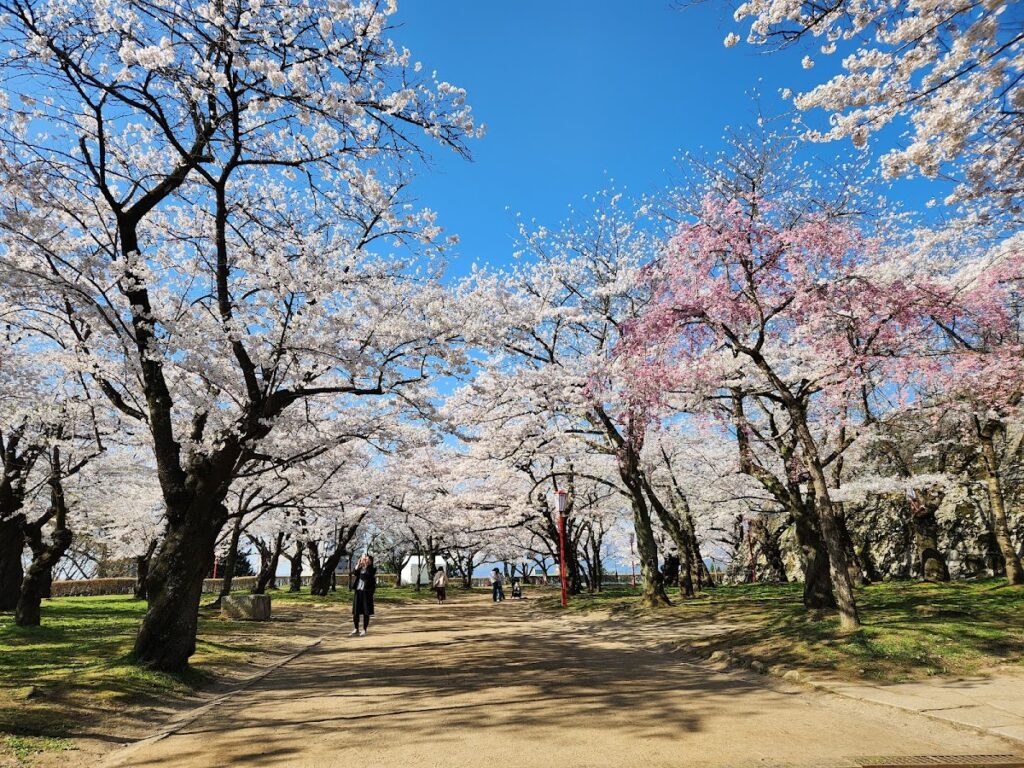
Shengjie Castle Park is one of the most famous sites in Iwate. There are approximately 200 Japanese maple trees planted in the garden, including Yoshino, Yoshino, Kawae, Higan, and other products, which are usually in full bloom from late April to early May.
The white stone wall and the tree flowers interact with each other, the beauty is not won, and the attraction is good for many visitors. At night, the light of the cherry blossoms shines brightly, and the sight of the lost man in the evening when the curtain falls and the cherry blossoms bloom.
Autumn color beauty
Autumn, the park is also a good place to leave. A beautiful autumn-colored picture book with a combination of silver and silver color, a combination of colors, and a beautiful autumn-colored painting. The view from the castle tower is particularly spectacular, and the tower is a prime autumn sightseeing spot.
History of Shengju Castle Park
Opening of modern park
Since its opening in 1906 (Meiji 39), Iwate Park has been a popular place for citizens to enjoy recreational activities. During the Taisho and Showa eras, parks were maintained to perfection, comprehensive sports education was provided, and children’s play was provided.
After the war, the park was built, the city park was opened and constructed, and improvements were also made to improve the scenery, beautify the scenery, and remodel walking paths. During the Showa era, Japan was in a period of high speed expansion, the importance of the city’s construction, civil leisure activities, daily profit growth, and various employment activities.
Opening and protection of the historical site
During the Heisei era, the policy of expansion was changed, and the history of the city was established. After repairing the stone tombs, the archaeological excavation work was fully developed, and the ancient Japanese appearance of the castle was restored.
Recognized as one of Japan’s 100 most famous castles in 2006, the number of visitors to all parts of the country has increased sharply, and the number of visitors has increased dramatically since the arrival of the envoy, making it one of the most representative tourist attractions in the city.
In front of us, the basic planning of the Shengji City Castle Site Development, the conservation and utilization of the historical site of the Effort Equilibrium.
Park scenic spots and installation guide
Shengjuku History and Culture Museum
The “Shengchen History and Culture Museum” was opened in 2011 in the Shengchengcheng City Castle Park. The exhibition details include the history and culture of Shengcheng, the original model of Shengcheng, and the materials of the Nanbu clan.
Visiting the hotel is centered around customer information, which is the ideal place to visit. This is a scenic spot that is impossible to see when you walk around the castle.
Kayama Shrine
To the north of the park is Kakuyama Shrine, dedicated to the guardian deity of the Nanbu clan. The shrine has been worshiped by the feudal lords of the Umushiro clan, and is still popular among citizens. Every New Year, Wuda believers visit the metropolitan area.
Transportation/Stop
It takes about 20 minutes to walk to JR Shengjie Station, and it takes about 10 minutes to get there. Park Park “Shengji Castle Ruins Park” Bashi Station.
There are public parking lots within the park, but there are several parking lots nearby. During the season when the cherry blossoms are opened, there are other tourist attractions, which can be visited in the park, and where public transportation tools are built.
Activity guide
Shengshu 樱花节
The shengbang flower festival is the biggest activity in the shengbang castle park area, which runs from mid-April to the beginning of May every year. The season when the cherry blossoms are in full bloom, the light shining on the cherry blossom festival at night, and the variety of delicious food available.
The cherry blossoms have been absorbed by many visitors, and the activities of the spring season have been successful.
Other activities
Shengjie City Park has all kinds of activities in the city all year round, such as the summer festival in Shengjie City Park and the red leaf festival in the Japanese and autumn seasons. The local community club’s regular activities include a historical review of the museum’s history.
Surrounding scenic spots and sightseeing spots
Nakatsugawa walk
The Nakatsugawa River is a scenic and beautiful walk to the east of the castle park. Spring sky, riverbanks and lily flowers blooming, addressed to Ruichijo Flower Sea Tunnel. Autumn, the fish and fish are flowing backwards, and it’s also a great highlight.
Memories of Seiji Castle Town
The appearance of a castle town in the olden days, which is a big attraction for traveling to Moriha. It is located in Nyogoya-cho, Wasaka-na-cho, and other famous old-fashioned districts, and is home to many old-fashioned merchants and tourist resorts.
The Three Great Famous Masks of Seiji
When the game is shearing, the “Three Great Famous Men of Shengji”: Wanzi Ling-mai-mian, Sheng-Feng-reng-mian, and Sheng-Feng-chan-mian. The famous restaurant is located near the ruins of Yucheng Fortress, where you can enjoy delicious food at the same time, and also explore the history of the city.
Natural environment and life system
The park is located in the Ucheng city area, which is a rich natural environment. Shigeshige Tsurugi, also a famous bird-watcher.
It is possible to observe small bird species such as large mountain sparrows and small-eyed birds, and large bird species such as small-eared parrots. The charm of this park is also there.
Abstract: The history of Shengcheng and its current meaning
Morijo Castle is the residence of the Nanbu domain, and the territory of the Nanbu domain is worth 200,000 koku. Shengji Castle is one of the most beautiful stone castles in the Northeast, and was built around 1990. It is a beautiful white flowered rock castle, which is a completely beautiful stone-built castle fort in the North East area, and is currently not allowed to be visited by visitors.
Since the Meiji period, the castle has been named Iwate Park (Shengji Castle Park), Chengdu’s favorite place to build, a place to visit, a literary center, a place for Japanese history, and so on. During his youth, writers and artists such as Takuki Ishikawa and Takaharu Miyazaki and other literary figures and artists continued to draw the works of other artists.
Nowadays, the construction of Shengjie City and Park is a national historical record, and it is still possible to achieve reasonable protection and harmony. Worked in one of Japan’s top 100 famous castles, it has attracted many fans and tourists from all over the country. The park is located in the center of Yu Shengjie City, the geographical location is excellent, and it is the ideal starting point for exploring Shengjie City.
The history of Shengji Castle and Park, the interaction between nature and literature, the changes that occur from season to season, and the emergence of disparate appearances. You can enjoy the beautiful scenery in each season: spring sky full of cherry blossoms, summer sky green trees growing, autumn sky red leaves like fire, winter sky white snow.
Arriving at the prosperous city, always leaving the castle park, experiencing the historical culture of the southern domain, and experiencing the unique charm of the city. The historical events under Shiroishi Castle are still moving.
