Sasao Castle (Sasao Fort) Complete Guide: History and Highlights of the Border Castle Built by Takeda Nobutora
What is Sasao Castle?
Sasao Castle is a Sengoku period mountain castle located in Shimosasao, Kobuchizawa-cho, Hokuto City, Yamanashi Prefecture. Also known as “Sasao Fort” or “Sasao Ruin,” it is currently designated as a historical site by Hokuto City. Built on a hill approximately 760 meters above sea level, this castle was constructed in 1531 by Takeda Nobutora, the father of Takeda Shingen.
Located at the southwestern foot of the Yatsugatake Mountains, this castle sits on the border between Kai and Shinano Provinces and functioned as an important defensive base against the Suwa clan’s influence. This mountain castle skillfully utilizes the natural terrain with a relative elevation of approximately 100 meters, and even today, remnants such as baileys, earthworks, moats, gates, dry moats, and earthen bridges can be clearly seen.
History of Sasao Castle
Background of Construction: Takeda Nobutora and the Unification of Kai Province
Sasao Castle was built against the backdrop of Takeda Nobutora’s ambition to unify Kai Province. Nobutora was steadily pacifying the local lords within Kai Province, aiming for unification, but at the same time, his conflict with the Suwa clan of neighboring Shinano Province was also escalating.
In 1531, Nobutora built Sasao Castle on a strategically important location on the border between Kai and Shinano. This castle played a crucial role as a “border castle” to prepare for invasions by the Suwa clan, and was responsible for the northern defense of Kai Province. At that time, Kai Province was surrounded by powerful Sengoku daimyo: the Hojo clan to the east, the Suwa clan to the north, and the Imagawa clan to the west, making border defense a matter of life and death.
Role during the Takeda Shingen Era
Even after Takeda Shingen, son of Takeda Nobutora, inherited the family headship, Sasao Castle remained an important military base. After expelling his father, Nobutora, Shingen actively launched an invasion of Shinano Province, and in 1542, he destroyed the Suwa clan, further advancing his control over Shinano.
After Shingen brought Kai and Shinano under his control, the military importance of Sasao Castle relatively declined, but it was never completely abandoned. During this period, Sasao Castle is thought to have shifted its role from a frontline castle to a rear fort or signal fire station, continuing to function as a base for information transmission and surveillance.
The Fall of the Takeda Clan and the Tensho-Jingo War
In 1582, the Takeda clan was destroyed by the invasion of the combined forces of Oda Nobunaga and Tokugawa Ieyasu. Records confirm that Sasao Castle was used as a fort until the fall of the Takeda clan.
However, the history of Sasao Castle did not end there. During the Tensho-Jingo War, which occurred after the fall of the Takeda clan, Tokugawa Ieyasu, Hojo Ujimasa, and Uesugi Kagekatsu fiercely fought over the former Takeda territories. It is believed that the Hojo clan used Sasao Castle as a fortified camp during this time. The Hojo clan utilized the existing castle facilities as a base for their expansion into Kai and Shinano provinces.
After the Tensho-Jingo War ended with Tokugawa Ieyasu’s victory, Sasao Castle completely ceased its military role and was abandoned.
Structure and Layout of Sasao Castle
A Mountain Castle Utilizing the Topography
Sasao Castle is a typical mountain castle built on a hill at the southwestern foot of the Yatsugatake Mountains. It features a layout that makes maximum use of the natural terrain, with an elevation of approximately 760 meters and a relative height of approximately 100 meters. It possesses a practical and robust defensive structure, common to Takeda-related castles in Yamanashi Prefecture.
The castle’s location, overlooking the road connecting Kai and Shinano provinces, clearly demonstrates its strategic importance as a military stronghold. The surrounding terrain is steep, creating a natural fortress that is difficult for attackers to approach.
Arrangement of Enclosures (Kuruwa)
Sasao Castle features multiple enclosures, forming a tiered defensive line centered around the main enclosure. Each enclosure is positioned along the terrain, allowing for mutual support.
The main enclosure is located in the center of the castle, built on the highest point. From here, one can overlook the surrounding terrain, making it an ideal location for monitoring enemy movements. Belt-shaped enclosures are arranged around the main enclosure, forming a multi-layered defensive structure.
Earthworks and Moats
The most impressive remains of Sasao Castle are the earthworks and moats. These structures, still clearly visible today, convey the defensive philosophy of the time of the castle’s construction.
The earthworks surround the enclosures, preventing enemy intrusion and also serving as a foothold for defensive fire from within the castle. Some of the earthworks still maintain a height of over 2 meters, giving a glimpse into the scale of the castle at the time.
The moats were dug to cut off the ridgeline, limiting enemy incursions. Deep moats were particularly strategically placed behind the castle (on the mountain side) to prepare for attacks from the most dangerous directions.
Entrance and Earthen Bridge
The entrance to the castle, the “koguchi,” was a defensive weak point and therefore designed with particular care. Sasao Castle’s entrance was defended by a horizontal moat and earthworks, making it difficult for the enemy to easily breach.
The earthen bridge was a bridge made of earth crossing the moat, functioning as a passageway during normal times. During wartime, it could be destroyed to prevent enemy incursions. Traces of the earthen bridge can still be seen today, making it an important historical site for understanding the castle’s structure at the time.
Horizontal Moat (Dry Moat)
Sasao Castle is surrounded by horizontal moats (dry moats), arranged to encircle the baileys. These moats are dry moats, a defensive feature unique to mountain castles.
The horizontal moats effectively prevented enemy lateral movement, limiting their attack routes. Furthermore, the elevation difference between the moat bottom and the defending troops on the baileys created a structure that gave the defenders an advantage in battle.
Highlights of Sasao Castle
Remains Developed as a Castle Park
Currently, Sasao Castle ruins have been developed as a castle park, providing an environment where visitors can easily view the remains. Thanks to proper management by Hokuto City, it remains a valuable historical site where visitors can experience the appearance of a mountain castle from the Sengoku period.
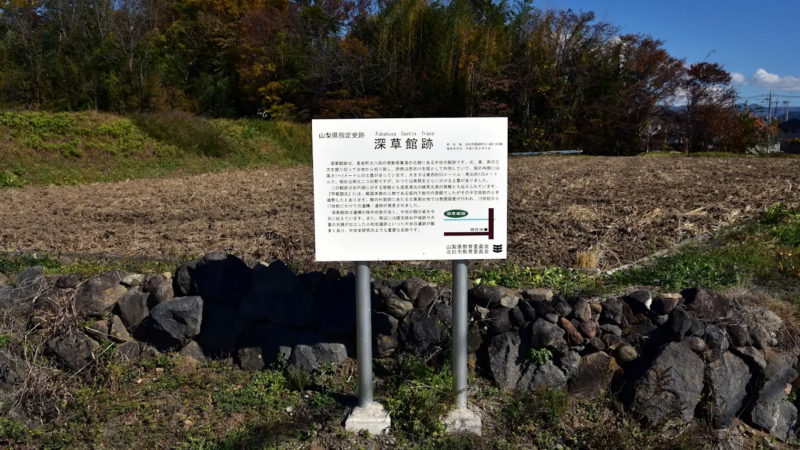
Information boards are installed within the park, allowing visitors to learn about the castle’s history and structure. Walking paths are also maintained, making it possible to safely explore the remains.
Clearly Preserved Earthworks
One of the most noteworthy remains of Sasao Castle is the well-preserved earthworks. The earthworks surrounding the main enclosure are particularly clear, and even after approximately 490 years since its construction, they have largely maintained their original height.
Walking along the top of the earthworks allows you to experience the perspective of the castle’s defenders and appreciate its function as a defensive structure. Furthermore, the cross-section of the earthworks allows you to observe the civil engineering techniques of the time, such as rammed earth construction.
The Impressive Moat
The moat, which cuts off the rear of the castle, is a representative structure of Sasao Castle. Reaching several meters in depth, the moat still retains its impressive presence, demonstrating the high level of castle-building technology during the Sengoku period.
Standing at the bottom of the moat, you can truly appreciate the height of the earthworks towering on both sides, experiencing the castle’s defensive strength. It’s also a popular spot for photography, attracting many castle enthusiasts.
Views and Surrounding Environment
The views from the main enclosure are another of Sasao Castle’s attractions. With the Yatsugatake Mountains in the background, you can enjoy a panoramic view of the border region between Kai and Shinano provinces. This view clearly demonstrates why Sasao Castle was chosen as a border castle.
The castle ruins are especially beautiful during the autumn foliage season and in the winter snowscape. You can enjoy a landscape where the changing seasons and historical remains harmonize.
Access Information
Access by Public Transportation
If using JR:
- Get off at Kobuchizawa Station on the JR Chuo Main Line
- Take the Hokuto City Bus Kobuchizawa/Nagasaka Line
- Get off at the Shimosasao Community Center bus stop and walk for about 10 minutes.
While access by public transportation is possible, the number of buses is limited, so it is recommended to check the timetable in advance.
Access by Car
From Tokyo:
- Approximately 10 minutes from the Kobuchizawa Interchange on the Chuo Expressway
- Accessible via National Route 20
From Nagoya:
- Approximately 10 minutes from the Kobuchizawa Interchange on the Chuo Expressway
There are a few parking spaces near the castle ruins park. However, parking for large vehicles is difficult, so please be careful.
Location
408-0041 Shiroyama, Shimosasao, Kobuchizawa-cho, Hokuto City, Yamanashi Prefecture
Visiting Information
- Visiting Hours: Always open (daytime visits recommended)
- Admission Fee: Free
- Estimated Time Required: Approximately 30 minutes to 1 hour
- Difficulty Level: Beginner to Intermediate (Street shoes recommended as you will be walking on mountain paths)
Nearby Castles Related to the Takeda Clan
Numerous castles related to the Takeda clan exist around Sasao Castle. When touring castles, visiting these castles as well will give you a deeper understanding of the Takeda clan’s territorial management and defense strategies.
Shinpu Castle (approx. 13.6km)
The last stronghold of the Takeda clan, built by Takeda Katsuyori. Constructed in 1581, it was abandoned unfinished due to the fall of the Takeda clan the following year. Designated a National Historic Site, its magnificent layout remains.
Yato Castle (approx. 9.7km)
A castle said to have been the residence of Takeda Nobushige, the younger brother of Takeda Shingen. Also known as the Kawakubo Fortress, it functioned as a base for the invasion of Shinano Province. Currently designated a Historic Site by Hokuto City.
Wakagami Castle (approx. 8.7km)
A castle located on the front lines of the conflict between the Takeda and Uesugi clans. It played an important role during the Battle of Kawanakajima. Remains such as earthworks and moats are well-preserved.
Shishiku Castle (approx. 3.8 km)
One of the castles closest to Sasao Castle. Though small in scale, it was a mountain castle built on a strategically important location and is thought to have functioned in conjunction with Sasao Castle.
Enjoying Your Visit to Sasao Castle
Clothing and Equipment
Since Sasao Castle is a mountain castle, the following equipment is recommended:
- Shoes: Athletic shoes or trekking shoes
- Clothing: Comfortable clothing, long sleeves and long pants (for protection against plants and insects)
- Items to Bring: Drinking water, towel, insect repellent spray (summer)
- Camera: For photographing the ruins
Precautions for Visiting
- As you will be walking on mountain paths, the ground can become slippery during and after rain.
- In summer, there are many insects, so insect repellent is recommended.
- In winter, there is a possibility of snow, so please check the weather beforehand.
- To protect the ruins, please be careful not to damage the earthworks or moats.
Photo Opportunities
- View from the main enclosure (with the Yatsugatake Mountains in the background)
- Panoramic view of the moat (including the earthworks on both sides)
- Cross-section of the earthwork (areas where the rammed earth construction is visible)
- The Structure of the Enclosure (Combination of a Horizontal Moat and Earthen Embankment)
Sasao Castle and the Takeda Clan’s Castle Strategy
Sasao Castle held a crucial position in the Takeda clan’s castle network. For three generations, from Takeda Nobutora to Shingen and Katsuyori, this castle played a vital role in the defense of Kai Province, making it essential for understanding the Takeda clan’s territorial management.
Built as a border castle, Sasao Castle was not designed to repel enemies alone, but rather as part of a “castle network” that coordinated with surrounding castles for comprehensive defense. Through the organic cooperation of multiple castles—including information transmission via smoke signals, dispatch of reinforcements, and securing supply lines—a powerful defensive system was constructed.
This Takeda clan castle strategy influenced later Sengoku-era daimyo and holds a significant place in the history of Japanese castles. Visiting Sasao Castle will allow you to experience firsthand the military strategies and castle-building techniques of the Sengoku period.
Summary
Sasao Castle (Sasao Fort) played a crucial role in the defense of Kai Province as a border castle built by Takeda Nobutora. Currently, it is maintained as a historical site by Hokuto City, and its remains, such as earthworks, moats, and baileys, are well-preserved.
Located in the naturally rich environment of Hokuto City, Yamanashi Prefecture, Sasao Castle offers a glimpse into the appearance of a Sengoku period mountain castle. It is a historical site worth visiting not only for castle enthusiasts but for anyone interested in history. Those interested in the history of the Takeda clan or Sengoku period castle architecture should definitely consider visiting.