
Sami Castle: A Thorough Explanation of Nara’s Mountain Castle with One of the Most Unique Layouts in Japan
What is Sami Castle?
Sami Castle is a medieval mountain castle located in Sami, Gose City, Nara Prefecture. Built on Mt. Sami, approximately 300 meters above sea level, this castle is known among castle researchers for its unique layout (castle design and structure), which is quite rare even on a national level.
There are various theories regarding the builder and construction date, and because no definitive historical records remain, it remains a mysterious castle that attracts the interest of many researchers and castle enthusiasts. However, based on its complex layout and the state of its remains, it is considered certain that it was built during the Sengoku period by a force with advanced castle-building technology.
History of Sami Castle
The Mystery of the Construction Period and Builder
There are several theories regarding the construction period and builder of Sami Castle. The main theories are as follows:
Theory that Sami Castle was built by Kizawa Nagamasa
One of the most widely accepted theories is that the castle was built by Kizawa Nagamasa, a warlord of the Sengoku period. Kizawa Nagamasa was a warlord based in Kawachi Province, but he also extended his influence into Yamato Province. If Sami Castle is identified with Biwao Castle, it is suggested that Kizawa Nagamasa may have built it. Kizawa Nagamasa was known for his excellent castle-building skills, and the connection between this and the complex layout of Sami Castle is attracting attention.
Theory related to the Hatakeyama clan
Another theory suggests that Sami Castle was Koda Castle, which was attacked by the Hatakeyama clan and the Negoro clan in 1567 (Eiroku 10). During this period, the conflict between Matsunaga Hisahide and Tsutsui Junkei intensified in Yamato Province, and castles were being built throughout the region. The possibility of the Hatakeyama clan’s involvement cannot be completely ruled out.
Theory of Local Clan Construction
Another theory suggests that the castle was built by a local clan that controlled the Sami area. There were local forces that existed around Sami since the Middle Ages, and it’s possible they built the castle for self-defense.
Yamato Province and Sami Castle in the Sengoku Period
During the Sengoku period, Yamato Province was a region where temple and shrine forces centered around Kofuku-ji Temple, local lords, and invading forces from outside were intricately intertwined. Especially from the mid-16th century onward, the conflict between Matsunaga Hisahide and Tsutsui Junkei intensified, leading to the construction of many castles within Yamato Province.
The area around Gose City, where Sami Castle is located, was a strategic point in southern Yamato Province, controlling important transportation routes to Kii Province and Kawachi Province. Therefore, it’s thought that multiple forces were interested in this strategically valuable location.
Date of Abandonment
The exact date of the abandonment of Sami Castle is unclear, but it is estimated to have been abandoned around 1585 (Tensho 13), after Toyotomi Hideyoshi’s unification of Yamato Province, or during the early Edo period when the “One Castle Per Province” decree (1615) was enacted. Currently, the castle remains are preserved as a valuable local cultural asset.
Structure and Layout Characteristics of Sami Castle
Unique Layout Unusual Nationwide
The most distinctive feature of Sami Castle lies in its unique layout. While typical mountain castles arrange their baileys (flat areas within the castle) along ridgelines, Sami Castle has a complex, intricate arrangement.
Among castle researchers, various interpretations exist regarding the uniqueness of this layout. One theory suggests it was a design choice to maximize defensive capabilities within limited terrain, while another theory suggests it strongly reflects the individuality of a particular castle builder.
Major Remains
Main Enclosure (Honmaru)
The main enclosure (honmaru), the heart of Sami Castle, is located on the mountaintop. A relatively large, flat area is secured, suggesting that the lord’s residence and important facilities were located here. Traces of earthworks are visible around the main enclosure, indicating a strong defensive structure.
Enclosure Group
Several enclosures (kuruma) are arranged surrounding the main enclosure. These enclosures are arranged in a stepped pattern, serving to hinder enemy incursions. Cut slopes (kirigishi: artificially carved steep slopes) are provided between each enclosure, enhancing defensive capabilities.
Moat
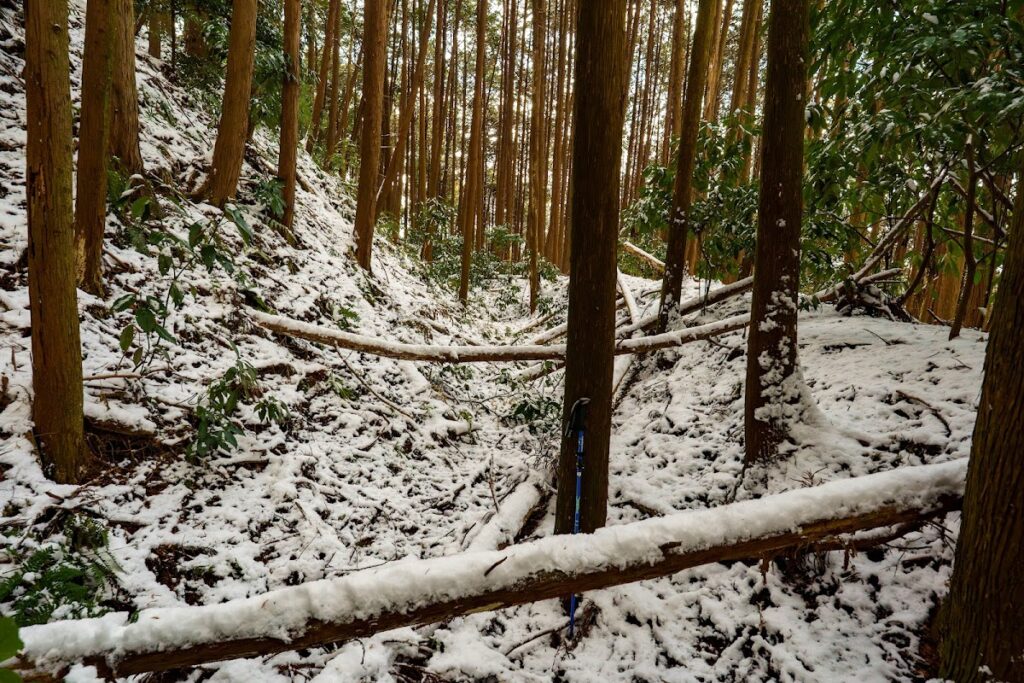
Several moats (horikiri) dividing the ridgeline can be identified. Moats are important defensive structures that blocked enemy entry routes, and Sami Castle retains particularly large moats. Some moats are double or triple-layered, demonstrating a strong emphasis on defense.
Earthworks
Earthworks were constructed around the baileys and along the ridges. These earthworks were defensive walls made of piled earth, preventing enemy intrusion and also functioning as attack bases from within the castle. Some sections of the earthworks at Sami Castle remain over 2 meters high, giving a glimpse into their original appearance.
Vertical Moats
Vertical moats dug along the slopes have also been confirmed. These moats restricted the movement of enemies climbing the slopes and made lateral movement difficult. At Sami Castle, multiple vertical moats are arranged radially, demonstrating a defensive strategy for the entire slope.
Presence or Absence of Stone Walls
No substantial stone walls have been confirmed at Sami Castle. This indicates that the castle was built before stone wall technology became widespread, or that it was constructed as an earthen castle. During the Sengoku period in Yamato Province, castles with stone walls were limited; it is known that most castles were made of earth.
Highlights of Sami Castle
Well-Preserved Remains
The greatest highlight of Sami Castle is its well-preserved remains. Even more than 400 years after its abandonment, major remains such as baileys, moats, and earthworks remain clearly visible. The moats, in particular, retain their depth and width, making them valuable relics that allow visitors to experience the castle-building techniques of the Sengoku period.
Hands-on Experience of the Unique Layout
Another major attraction of Sami Castle is the opportunity to actually walk through and experience the “unique layout” described in historical documents. Following the arrangement of baileys and movement paths, which differ from typical mountain castles, offers the enjoyment of imagining the intentions and strategies of the castle’s builder. For castle enthusiasts, this will be a unique experience unlike any other.
Views
From near the main bailey, you can enjoy a panoramic view of Gose city and the southern part of the Yamato Basin. On a clear day, you can even see the distant Kongo Mountains, allowing you to imagine how the castle monitored the surrounding area during the Sengoku period. This view clearly demonstrates the strategic importance of Sami Castle’s location.
Harmony with Nature
The castle ruins are surrounded by abundant nature, offering beautiful scenery throughout the seasons. In spring, the fresh greenery, and in autumn, the vibrant autumn leaves, create a place where you can enjoy both historical exploration and nature observation. However, in summer, the vegetation can make observing the remains somewhat difficult.
Access to Sami Castle
Access by Public Transportation
Using Train and Bus
- Get off at “Gosho Station” on the Kintetsu Gosho Line
- Transfer to a Nara Kotsu bus and get off at the “Sami” bus stop (approx. 10 minutes)
- Approximately 20 minutes’ walk from the bus stop to the castle entrance
- Approximately 15-20 minutes’ walk from the entrance to the main enclosure
Since bus services are limited, it is recommended to check the timetable in advance.
Access by Car
Nearest Interchange
- Approximately 15 minutes from the Minami-Hanna Expressway “Katsuragi IC”
- Approximately 20 minutes from the Nishi-Meihan Expressway “Kashiba IC”
Parking Information
There is no dedicated parking lot for the castle ruins, but there are a few parking spaces near the entrance to the castle. However, since this is also a local road, please avoid parking on the street and be considerate of the neighbors.
Precautions When Visiting the Castle
Clothing and Equipment
- As it is a mountain castle, comfortable walking shoes (trekking shoes recommended) are essential.
- Wear long sleeves and long pants (to protect yourself from plants and insects).
- In summer, bring a hat, drinking water, and insect repellent.
- In winter, take precautions against the cold.
Conditions of the Path
The path to the castle is an unmaintained natural mountain trail. It can become slippery during and after rain, so caution is necessary. Also, since signposts are limited, it is recommended to check your location in advance using a map or GPS app.
Estimated Time Required
Allow approximately 15-20 minutes one way from the castle entrance to the main enclosure, 30 minutes to 1 hour for exploring the castle grounds, and about 15 minutes for descending. If you plan to carefully observe the remains, it is recommended to allow even more time.
Nearby Tourist Attractions
Takakamo Shrine
Located about 10 minutes by car from Sami Castle, Takakamo Shrine is an ancient shrine considered the head shrine of all Kamo (or Kamo) shrines nationwide. The shrine grounds are lined with centuries-old trees, creating a solemn atmosphere. It is also known as a famous spot for cherry blossoms in spring and autumn foliage in fall.
Katsuragi Ancient Road
The Katsuragi Ancient Road, an ancient transportation route, runs through the area around Sami Castle. Ancient burial mounds and temples are scattered along the road, making it an ideal course for historical walks. While strolling leisurely, you can feel the layered history spanning from ancient times to the medieval and early modern periods.
Gose City Historical and Cultural Museum
Located near Gose Station, the Gose City Historical and Cultural Museum features exhibits on the history and culture of Gose City. It also displays materials related to castles within the city, including Sami Castle, making a visit before or after your castle visit a valuable opportunity to deepen your understanding.
Mount Kongo
Mount Kongo, visible southeast from Sami Castle, is a 1,125-meter-high mountain located on the border of Osaka and Nara Prefectures. A popular spot for mountain climbing and hiking, the summit offers panoramic views of the Osaka Plain and the Yamato Basin. You can enjoy a full-fledged mountain hike in conjunction with your visit to Sami Castle.
Research and Future of Sami Castle
Position in Castle Research
Sami Castle occupies an important position in castle research due to its unique layout. Its distinctive structure, which doesn’t fit into typical mountain castle categories, is noteworthy as a valuable example demonstrating the diversity of castle construction techniques during the Sengoku period.
Recent research has led to the precise creation of layout maps and surveying, gradually revealing the structure of Sami Castle. Further archaeological excavations may yield new insights into the castle’s construction period and builder.
Challenges of Preservation and Utilization
Currently, Sami Castle is not designated as a historical site, and preservation efforts are being carried out by local volunteers and castle enthusiasts. While the remains are relatively well-preserved, they may gradually change due to natural erosion and tree growth.
It is hoped that its cultural value will be widely recognized and appropriate preservation measures will be taken. Simultaneously, its potential as a tourist resource is anticipated, potentially contributing to regional revitalization.
Connections with the Community
Sami Castle is an important historical heritage site for the local community. It is used as a subject for local history education and local studies, providing children with opportunities to learn about local history. Furthermore, interactions with castle enthusiasts who visit the castle ruins have fostered connections with people outside the region.
Manners When Visiting Sami Castle
Sami Castle ruins are not a park-like facility, but are located close to the living area of local residents. Please observe the following manners when visiting:
- Do not trespass on private property: Areas other than the castle approach may be private property.
- Always take your trash with you: Taking your trash with you is essential to protect the natural environment.
- Do not damage the ruins: Do not dig earthworks or moats, or leave graffiti.
- Be considerate of noise: Please refrain from loud conversations and stroll quietly.
- Do not collect plants: Collecting wild plants and other plants is prohibited.
- No open flames: Smoking and the use of fire are strictly prohibited to prevent forest fires.
Summary
Sami Castle is a mountain castle with a unique layout that is rare nationwide, attracting attention from castle enthusiasts and history buffs. While the builder and construction date remain shrouded in mystery, the complex remains of Sami Castle are a valuable cultural asset that conveys the advanced castle-building techniques of the Sengoku period.
The well-preserved moats, earthworks, and unique layout of the baileys can only be truly appreciated by visiting and experiencing them firsthand. When you visit Gose City, be sure to stop by Sami Castle and feel the spirit of the Sengoku period.
Sami Castle, shrouded in historical mystery, is a fascinating castle ruin that stimulates the imagination of visitors and ignites a sense of romance for the Sengoku period. Enjoy a safe historical walk with appropriate equipment and preparation.

