Complete Guide to Sakamoto Castle (Minokubi Castle) | A Thorough Explanation of its History and Highlights in Yamamoto Town, Miyagi Prefecture
What is Sakamoto Castle?
Sakamoto Castle (Sakamoto-jo) is a flatland castle located in Sakamoto, Yamamoto Town, Watari District, Miyagi Prefecture. Also known as Minokubi Castle, it is protected as a designated historical site of Yamamoto Town. Built in 1572 by Sakamoto Toshihisa (Sakamoto Mikawa), a branch of the Watari clan, it played an important role as the Sakamoto stronghold of the Date territory during the Edo period.
The plateau behind the current Sakamoto Elementary School is the site of the main keep, where Sakamoto Shrine is located. This plateau was formerly called “Minokubi-yama,” which is the origin of the castle’s alternative name. The castle ruins retain the remains of baileys and moats, and the existing gate can still be seen, making it a valuable historical site.
Table of Contents
- History and Background of Sakamoto Castle
- Background of Castle Construction and the Sakamoto Clan
- Changes in Successive Castle Lords
- The Era of the Ojo Clan
- Castle Structure and Layout
- Highlights of Sakamoto Castle
- Access and Visitor Guide
- Related Historical Sites in the Surrounding Area
History and Background of Sakamoto Castle
Pre-Construction History: The Fall of Atagoyama Castle
Before Sakamoto Castle was built, Atagoyama Castle stood in this area. In 1571 (Genki 2), Sakamoto Daizen (father of Sakamoto Toshihisa), the lord of Atagoyama Castle, was killed in an attack by the Soma clan. This tragic event became the impetus for the construction of a new castle.
The Watari clan was a powerful family serving the Date clan, and the Sakamoto clan, a branch of the Watari clan, played an important role in the defense of the southern part of Watari County. This region, close to the border with the Soma clan, was always a frontline area of high military tension.
Construction of the castle in 1572
After his father’s death, Sakamoto Mikawa Toshihisa built Sakamoto Castle as a new base to replace Atagoyama Castle, choosing a more defensible location. Utilizing a plateau called Minokubiyama, the castle was surrounded by a moat, making it difficult to attack.
In its initial stages, Sakamoto Castle functioned as a defensive base against the Soma clan during the tense situation at the end of the Sengoku period. Sakamoto Toshihisa, as a vassal of the Watari clan, dedicated himself to the security of this region.
Edo period: Transformation into Sakamoto Fortress
Following Toyotomi Hideyoshi’s pacification of Oshu in 1590 and the Battle of Sekigahara in 1600, Date Masamune established himself as a daimyo of the Sendai Domain with a 620,000 koku stipend. During this process, Sakamoto Castle transformed from a frontline base in the Sengoku period to the Sakamoto Fortress of the Edo period.
A fortress was a facility strategically located at a military stronghold in a feudal domain during the Edo period. In peacetime, it served administrative functions, while in times of conflict, it acted as a defensive stronghold. Sakamoto Fortress was positioned as an important base in the southern part of the Sendai domain, and successive castle lords were stationed there.
Changes in Successive Castle Lords
Sakamoto Clan Era (1572-)
The first lord, Sakamoto Mikawa Toshihisa, built Sakamoto Castle and ruled the area as a member of the Watari clan. However, the Sakamoto clan’s rule was relatively short-lived.
Goto Clan Era
After the Sakamoto clan, Goto Sonbei Nobuyasu became the lord of Sakamoto Fortress with a stipend of 2,500 koku. The Goto clan was a powerful family within the Date clan’s retainers, and this placement demonstrated the importance of Sakamoto Fortress.
Kuroki Clan Era (1604-)
In 1604, Kuroki Hizen Munemoto became the lord of the castle. The Kuroki clan were also important retainers of the Date family and a family trusted enough to be entrusted with guarding the southern border.
Tsuda Clan Era
Later, Tsuda Buzen Kageyasu became the lord of the castle. Detailed records of the Tsuda clan’s tenure are limited, but they maintained control of Sakamoto Fortress until the change to the Ojo clan.
Ojo Clan Era (1616-Meiji Restoration)
In 1616, Ojo Saemon Munetsuna entered Sakamoto Fortress with a stipend of 2,000 koku. This arrival of the Ojo clan marks the most important turning point in the history of Sakamoto Castle.
The Oeda family ruled Sakamoto Fortress for approximately 250 years, until the Meiji Restoration at the end of the Edo period. Such a long period of continuous rule by the same family demonstrates the deep trust the Oeda family enjoyed from the domain.
The Oeda family, pronounced “Oeda,” governed the Sakamoto region under the Date domain’s local fief system. They fulfilled military roles as castle lords and also participated in civil administration as local administrators, contributing to the development of Sakamoto.
Castle Structure and Layout
Main Enclosure and Sakamoto Shrine
The main enclosure of Sakamoto Castle was located on a plateau behind the current Sakamoto Elementary School. Sakamoto Shrine is now located on this plateau, preserving the memory of the castle’s central area.
Information boards are installed along the path leading to the main enclosure, introducing visitors to the castle’s history. Furthermore, a marker for “Minokubi Castle Ruins” stands before Sakamoto Elementary School, indicating the historical site of the castle.
Moat and Defensive System
The most distinctive feature of Sakamoto Castle is the moat surrounding it. The low-lying area, now rice paddies, once functioned as a moat. This moat was a defensive structure that made sieges extremely difficult, enhancing the defensive capabilities of Sakamoto Castle as a hilltop castle.
The castle’s layout, utilizing the elevation differences of the plateau, was designed to effectively defend even with limited forces, showcasing the pinnacle of castle-building technology during the Sengoku period.
Arrangement of Enclosures
Sakamoto Castle had multiple enclosures. It is believed that the main enclosure (Honmaru) was at the center, with the second and third enclosures (Ninmaru, Sanmaru, etc.) arranged in stages, forming a multi-layered defensive structure. Even today, the former arrangement of the enclosures can be discerned from the topography.
Existing Remains
The following remains still exist at Sakamoto Castle:
- Kuruwa (Enclosure) Remains: Flat areas remaining on the plateau
- Moat Remains: Low-lying areas that functioned as water moats
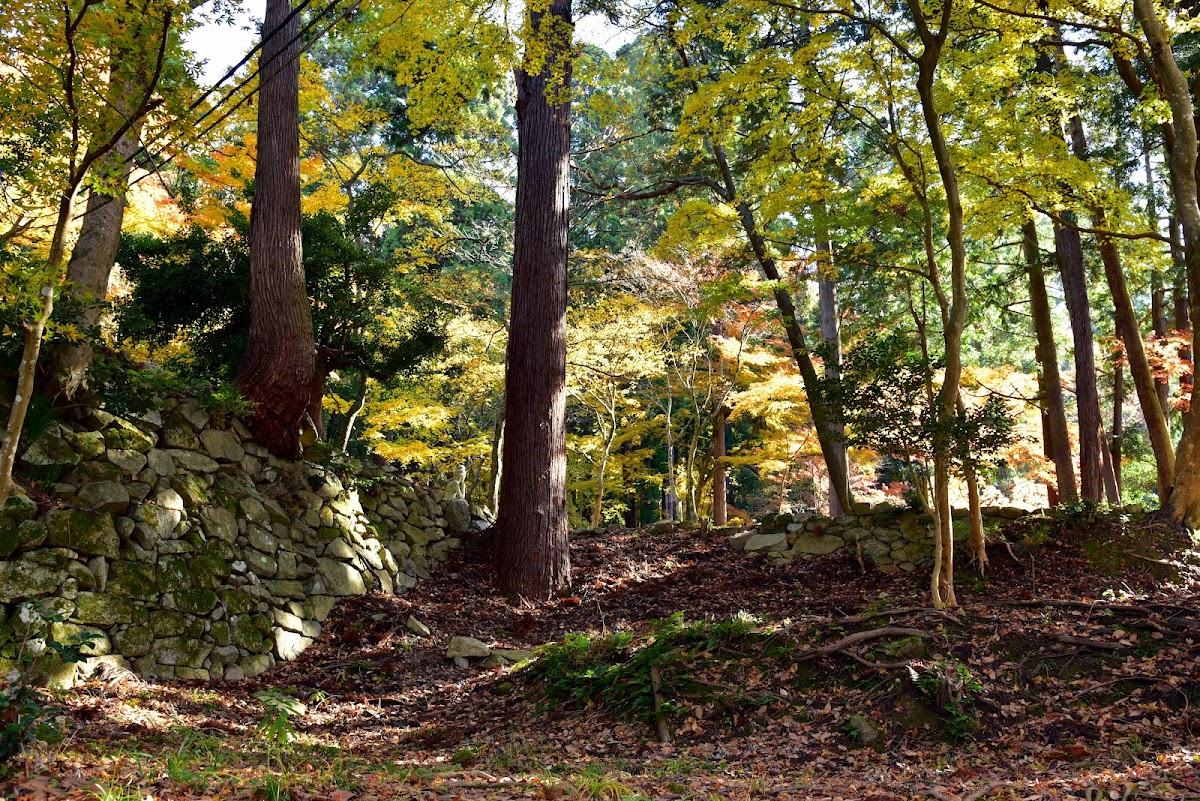
- Existing Gate: Valuable structures remaining as part of the castle facilities
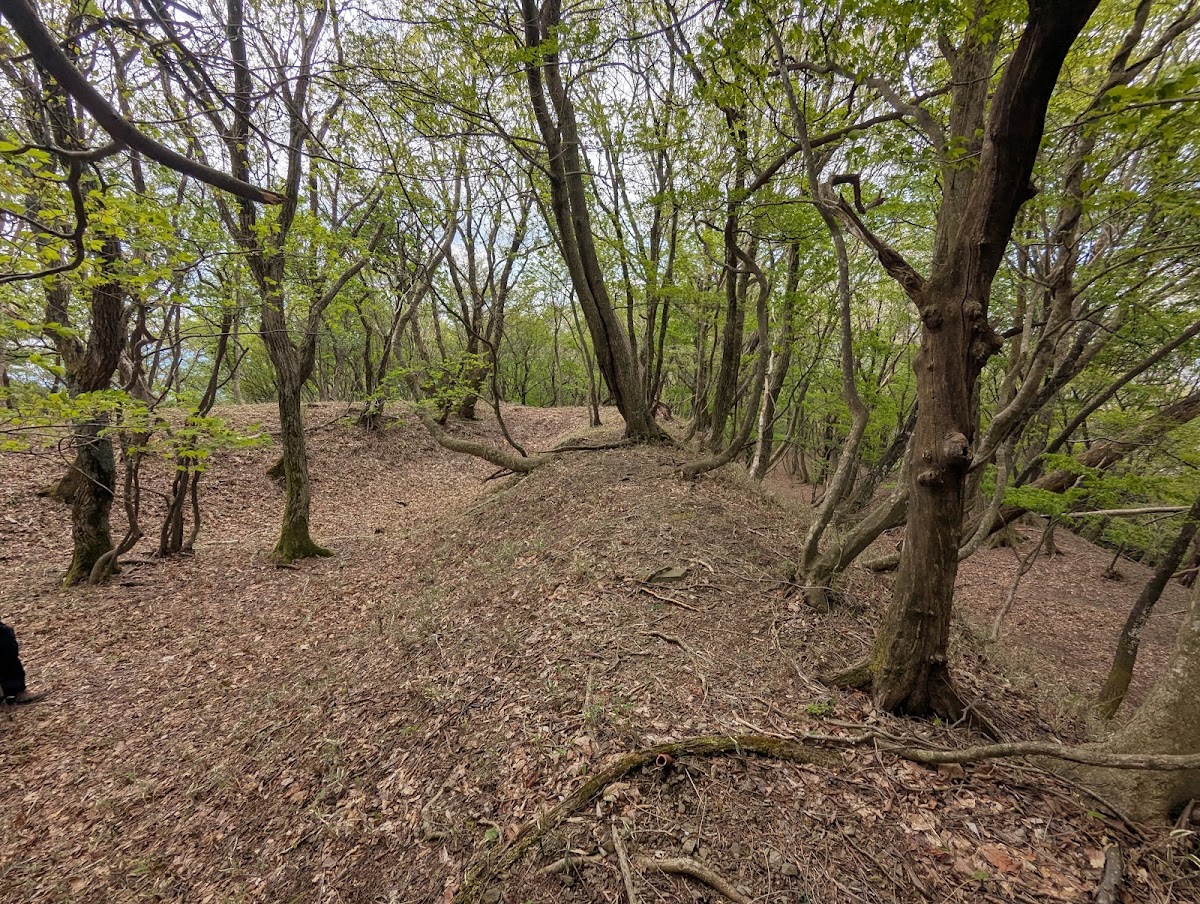
- Earthwork Traces: Remnants of earthworks remaining in some areas
These remains are protected as designated historical sites of Yamamoto Town and are important cultural assets of the region.
Highlights of Sakamoto Castle
Sakamoto Shrine and Main Enclosure Remains
The biggest highlight when visiting Sakamoto Castle is Sakamoto Shrine, built on the site of the main enclosure. From the shrine grounds, you can imagine the view that the former castle lords must have seen. Its location on the plateau provides an excellent vantage point for overlooking the surrounding area, and you can feel its military importance.
Walking the path to the shrine allows you to experience the route to the castle and feel the atmosphere of the time.
Landscape of the Former Moat
The rural area spreading across the lowlands surrounding the main keep is a remnant of the former moat. Observing this topography reveals the ingenuity of the castle’s defensive system. The significant difference in elevation between the main keep’s plateau and the surrounding area speaks to the difficulty of attacking the castle.
“Minokubi Castle Ruins” Marker
The marker standing before Sakamoto Elementary School is an important landmark for visitors. This marker marks the beginning of the guided tour to the castle ruins, serving as the starting point for historical exploration.
Surrounding Historical Landscape
Around Sakamoto Castle, traces of the Edo period remain, including the layout of the land and roads. Strolling through the area while imagining Sakamoto as a castle town allows for a deeper understanding of its history.
Access and Visiting Guide
Location
Address: Sakamoto, Yamamoto-cho, Watari-gun, Miyagi Prefecture
Transportation Access
Access by Train:
- Get off at Sakamoto Station on the JR Joban Line, approximately 10 minutes on foot
- Head towards Sakamoto Elementary School from Sakamoto Station, following the signposts
Access by Car:
- Approximately 10 minutes from Yamamoto IC on the Joban Expressway
- Accessible from National Route 6
- Parking available near Sakamoto Elementary School (consideration for school events, etc., is necessary)
Precautions During Visits
- The main castle site is within the grounds of Sakamoto Shrine, so please observe proper etiquette for worshippers.
- Sakamoto Elementary School is adjacent, so please visit quietly during school hours.
- To protect the remains, do not enter areas other than the designated viewing paths.
- The rural area is private property, so do not enter without permission.
Estimated Visiting Time
For a leisurely tour of the entire castle ruins, approximately 30 minutes to 1 hour is a good guideline. Including a visit to Sakamoto Shrine, observation of the remains, and a stroll around the surrounding area, allow 1 to 1.5 hours.
Best Time to Visit
Sakamoto Castle Ruins are open year-round, but the following times are especially recommended:
- Spring (April-May): The season of fresh greenery and beautiful views from the plateau.
- Autumn (October-November): The season of autumn foliage, enhancing the historical atmosphere.
- Winter: Snow cover can sometimes make the outlines of the remains more clearly visible.
Related Historical Sites in the Surrounding Area
Watari Castle Ruins
The ruins of the Watari clan’s castle, the main branch of the Sakamoto clan. Located in Watari Town, it is an important historical site for understanding its relationship with Sakamoto Castle. It is approximately a 20-minute drive away, and visiting both together will provide a deeper understanding of the Sengoku period history of this region.
Nakajima Castle
Another medieval castle site remaining in Yamamoto Town. A defensive structure existing at the same time as Sakamoto Castle, it is a valuable historical site for understanding the castle network of this region.
Soma Clan Related Historical Sites
Many historical sites of the Soma clan, who opposed Sakamoto Castle, remain around Soma City, Fukushima Prefecture. Visiting sites such as the Soma Nakamura Castle ruins provides a more comprehensive understanding of the role Sakamoto Castle played.
Date Masamune Related Historical Sites
Visiting historical sites of the Date clan, including Sendai Castle (Aoba Castle), helps understand the position of Sakamoto Fortress within the Sendai Domain’s defense system.
Historical Significance of Sakamoto Castle
Frontline of Border Defense
Sakamoto Castle was located near the border between the Date and Soma territories, playing a crucial role in a constantly tense relationship. From the Sengoku period to the early Edo period, this region was a disputed territory between the two powers, and Sakamoto Castle was situated on the front lines.
Examples of the Local Land Administration System
The Sakamoto Fortress during the Edo period is a prime example of the local land administration system of the Date Domain. The system, in which local landowners like the Ojo clan were granted a certain territory by the domain and entrusted with governing that region, was a characteristic of the Sendai Domain’s governing system.
The lord of Sakamoto Fortress bore not only military responsibilities but also a wide range of duties including local administration, justice, and tax management. This multifaceted role is a valuable example for understanding the realities of local governance during the Edo period.
Relationship with the Local Community
The Ojo clan’s 250-year rule of Sakamoto demonstrates a strong connection with the local community. The relationship between the lord and the people went beyond a simple relationship of dominance and submission, forming an interdependent community.
The existence of Sakamoto Shrine also symbolizes the relationship between the castle and the local community. As the guardian deity of the castle and the center of local faith, the shrine served as a spiritual link between the castle and the people.
Preservation and Utilization of Sakamoto Castle
Protection as a Town-Designated Historic Site
Sakamoto Castle ruins are legally protected as a designated historic site of Yamamoto Town. This designation restricts the destruction or alteration of the remains, making it possible to pass on this historical heritage to future generations.
Utilization for Local Education
Located adjacent to Sakamoto Elementary School, it serves as an excellent learning resource for local children to learn about their hometown’s history. Experiencing local history firsthand contributes to fostering a love for their community.
Potential as a Tourism Resource
As Yamamoto Town progresses with its recovery from the Great East Japan Earthquake, it is also focusing on utilizing its historical and cultural resources. Sakamoto Castle ruins are expected to be further utilized in the future as an important tourism resource that demonstrates the town’s historical identity.
References
The following materials are useful for studying the history of Sakamoto Castle:
- *Miyagi Prefecture History* (published by Miyagi Prefecture)
- *Yamamoto Town History* (published by Yamamoto Town)
- *Watari County History* (compiled by Watari County Education Association)
- *Complete Collection of Sendai Domain Historical Materials* (Sendai Domain Historical Materials Publication Association)
- Descriptions of Sakamoto Castle in various castle research books
These documents contain detailed records of Sakamoto Castle from its construction to its abandonment, the achievements of successive castle lords, and information on the castle’s structure.
Related Terms
- Watari Clan: The main branch of the Sakamoto clan and a powerful samurai group that ruled this region.
- Date Clan: A Sengoku period and Edo period daimyo family that controlled Sakamoto Castle.
- Soma Clan: A neighboring daimyo family that opposed Sakamoto Castle.
- Sendai Domain: The domain that governed Sakamoto Fortress during the Edo period.
- Local Fief System: An important system for understanding the form of governance of Sakamoto Fortress.
- Hirayama Castle: The castle style of Sakamoto Castle.
- Fortress: The nature of Sakamoto Castle during the Edo period.
Summary
Sakamoto Castle (Minokubi Castle) is a historical castle that existed for approximately 300 years, from its construction in 1572 until the Meiji Restoration. During the Sengoku period, it served as a defensive base against the Soma clan, and during the Edo period, it functioned as Sakamoto Fortress, an important base in the southern part of the Sendai Domain.
The rule of the Ojo clan, which lasted from 1616 until the Meiji Restoration, is a prime example of stable regional governance under the local fief system and demonstrates a deep connection between the castle and the local community.
The remains that still exist on the plateau behind Sakamoto Elementary School are protected as a valuable cultural asset of Yamamoto Town, and together with Sakamoto Shrine, they convey the history of the region to the present day. Sakamoto Castle is an important historical site for understanding the history of castles in southern Miyagi Prefecture and for learning about the realities of local governance during the Edo period.
By visiting Sakamoto Castle, you can experience the history of this region from the Sengoku period to the Edo period, the lives of the castle lords, and their relationship with the local community. Its convenient access, within walking distance of JR Sakamoto Station, is also a major draw, making it a historical site I highly recommend visiting as part of a tour of castles in Tohoku.