
Saiin Koizumi Castle: A Thorough Explanation of the History and Remains of Kyoto’s Only Sengoku Period Castle
What is Saiin Koizumi Castle?
Saiin Koizumi Castle was a flatland castle from the Sengoku period located in the vicinity of Saiin Kasuga-cho, Ukyo-ku, Kyoto City, Kyoto Prefecture. Also known as Koizumi Castle or Saiin Castle, it holds a historically significant position as the only medieval castle in Kyoto.
The area west of the current Hankyu Kyoto Line’s Saiin Station and Keifuku Electric Railway Arashiyama Line’s Saiin Station, where Shijo-dori and Sai-dori intersect, is considered to be the former castle grounds. It is believed that the castle was built by the Koizumi clan, a powerful local samurai family, in this area, which was called Saiin Koizumi-sho from the Heian period to the Kamakura period. During the Sengoku period, it functioned as a strategically important military point in Kyoto.
History of Saiin Koizumi Castle
Construction and the Koizumi Clan
The exact construction date of Saiin Koizumi Castle is unclear, but it is believed to have been built by the Koizumi clan, who were based in this area. The Koizumi clan were local lords based in Saiin Koizumi Manor, and strategically positioned the castle in the heart of the Kyoto Basin, controlling the Tanba-guchi (Tanba entrance) to the San’in Road.
The oldest historical record confirming the castle’s existence is the “Uesugi-bon Rakuchu Rakugai-zu Byobu” (Screen Painting of Kyoto’s Scenes in and Around Kyoto), believed to depict the Kyoto landscape from 1546 to 1549. This screen painting depicts the castle as “Sainoshiro,” and the name “Koizumi Hidekiyo” is identified as its lord. Koizumi Hidekiyo was a samurai who was active during the mid-Sengoku period and resided in this castle.
The Conflict Between Miyoshi Nagayoshi and Hosokawa Harumoto
Saiin Koizumi Castle’s appearance on the historical stage is deeply intertwined with the power struggle in the Kinai region during the Sengoku period. During the Tenbun era (1532-1555), a fierce conflict raged between Hosokawa Harumoto, the Kanrei (deputy shogun), and Miyoshi Nagayoshi, who rose to power from among Harumoto’s retainers.
It is presumed that Miyoshi Nagayoshi renovated Saiin Koizumi Castle as a base to oppose Hosokawa Harumoto. This castle is thought to have played a crucial role as a military base for the Miyoshi clan in Kyoto. The “Kototsugu-kyo Ki” (Diary of Tokitsugu) records that Hosokawa Harumoto attacked Koizumi Castle in 1550, confirming that the castle was indeed the site of battle at that time.
This battle was part of the power struggle in Kyoto, demonstrating that Saiin Koizumi Castle was not merely the residence of a local powerful family, but a vital fortress directly connected to the political and military situation in the Kinai region.
Uniqueness as the Only Castle in Rakuchu
The most distinctive feature of Saiin Koizumi Castle is that it is the only castle from the Sengoku period (Warring States period) located within Rakuchu. Generally, the central part of Kyoto was lined with the Emperor’s Palace, the residences of court nobles, and temples and shrines, making the construction of samurai castles extremely unusual.
However, the Saiin area was located at the western edge of Rakuchu and was a strategically important location controlling the entrance to the San’in-do, an important highway. Therefore, a castle as a military base was necessary during the turbulent Sengoku period. The depiction of the castle in the “Uesugi-bon Rakuchu Rakugaizu Byobu” (Screen Painting of Rakuchu and its Surroundings by the Uesugi Family) shows a flatland castle surrounded by a moat, suggesting its existence as a symbol of military power in Kyoto at the time.
Structure and Scale of Saiin Koizumi Castle
Castle Form
Saiin Koizumi Castle is classified as a flatland castle (with a moat). Because it was built on the flat land of the Kyoto Basin, it could not be expected to have the topographical defenses of a mountain castle. Instead, it is thought that defensive structures such as moats and earthworks were constructed.
The Edo period geographical record, “Yamashiro Meisho Shi,” states, “The locals say that in Saiin Village, north of Shijo, there is a thicket about three cho west of the entire embankment, which is the site of Koizumi Castle, with some remnants of the moat.” According to this, the castle was located northwest of Nishioji Shijo and north of Shijo Street, and traces of the moat still remained during the Edo period.
Scope of the Castle
Based on the depiction in the “Uesugi-bon Rakuchu Rakugaizu Byobu” (Screen Painting of Kyoto and its Surroundings by the Uesugi Family) and historical documents, it is estimated that the castle grounds extended to the western corner of Sai Street, which runs west of the current Hankyu Saiin Station, and north of Shijo Street. Specifically, it is considered certain that the area around the intersection of the current Shijo Street and Sai Street was included within the castle grounds.
While there are no clear records regarding the castle’s size, the description “approximately 330 meters to the west” suggests it was a fairly large fortress. It is presumed that the castle grounds, surrounded by a moat, contained the lord’s residence, the residences of retainers, and an armory.
Defensive Structures
The defenses of Saiin Koizumi Castle, a flatland castle, consisted mainly of moats and earthen ramparts. The depiction in the “Uesugi-bon Rakuchu Rakugaizu Byobu” (Screen Painting of Kyoto and its Surroundings by Uesugi) indicates that it was a moat-type castle surrounded by a water moat.
The term “total earthen rampart” is used to describe the earthen ramparts, suggesting that the entire castle grounds were surrounded by earthen ramparts. The description of remaining “thicket” suggests the possibility that bamboo groves were used as defensive structures for the castle. In flatland castles of the Sengoku period, bamboo groves were considered important natural obstacles to prevent enemy intrusion. ## Saiin Koizumi Castle Depicted in the Uesugi Version of the Rakuchu Rakugai-zu Folding Screen
Historical Value of the Folding Screen
The “Uesugi Version of the Rakuchu Rakugai-zu Folding Screen” is a national treasure-class pictorial document attributed to Kano Eitoku, and is a valuable historical document that precisely depicts the appearance of Kyoto during the Tenbun era. Saiin Koizumi Castle is clearly depicted as “Sainoshiro” in this screen, making it the only visual document that reveals the appearance of the castle at that time.
The depiction of the castle in the screen shows a fortress surrounded by a moat, with multiple buildings, gates, and bridges depicted. The name of the castle lord, Koizumi Hidekiyo, is also inscribed, providing extremely important evidence for the existence of the castle during the Tenbun era and identifying its lord.
Appearance of the Castle as Depicted from the Depiction
The following characteristics can be deduced from Saiin Koizumi Castle as depicted in the screen: First, the castle was a flatland castle with a moat, and a bridge spanned the moat. Multiple buildings were arranged within the castle grounds, and a castle gate is also visible.
The relative positions of the castle to surrounding roads and houses are also depicted, clearly showing its relationship with Shijo Street (the San’in Road at the time). The castle’s strategic location on a major road visually demonstrates its function as a military base controlling a key transportation hub.
Furthermore, Saiin Koizumi Castle is depicted relatively large within the overall screen painting, suggesting its significant importance in Kyoto at the time. As the only castle within the city limits, it indicates its politically and militarily important status.
Current Status and Remains of Saiin Koizumi Castle
Loss of Remains Due to Urbanization
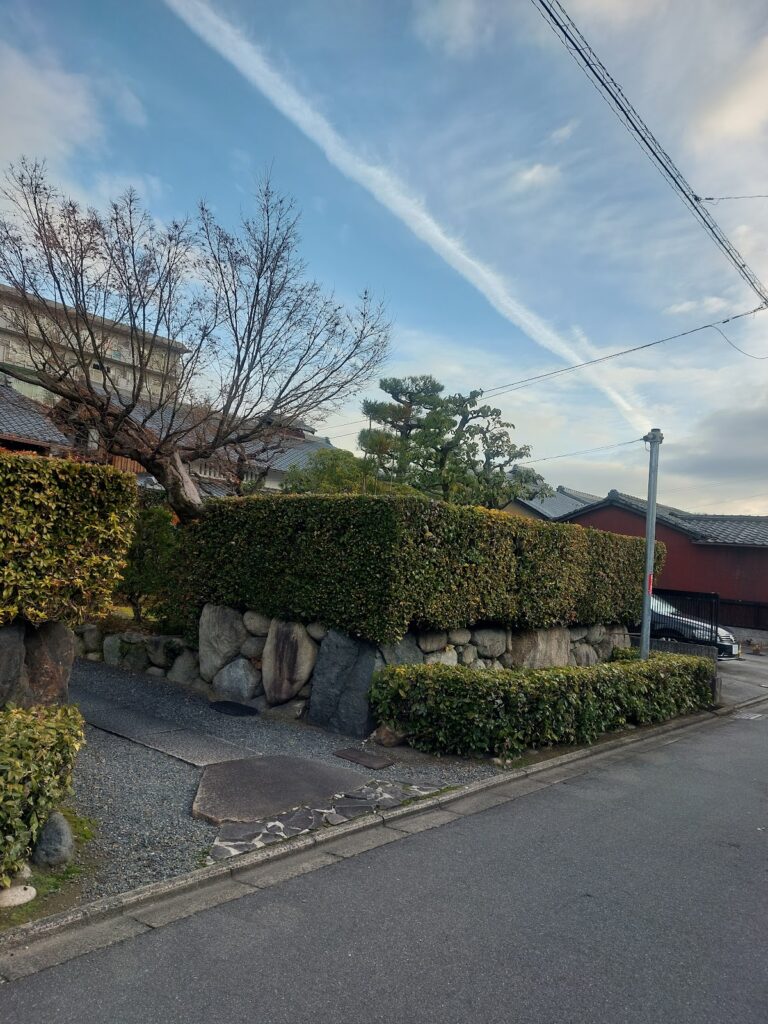
Unfortunately, very few remains of Saiin Koizumi Castle exist today. The castle site has been completely urbanized, and traces of the moat, believed to have existed during the Edo period, have disappeared due to urban development since the Meiji era.
The current Saiin district has developed as a transportation hub where the Hankyu Kyoto Line and Keifuku Electric Railway intersect, and is densely populated with shopping streets and residential areas. The area around the intersection of Shijo Street and Sai Street is considered to be the castle site, but no traces of the castle’s existence can be found on the surface.
Archaeological Excavations and Excavated Artifacts
To date, full-scale archaeological excavations concerning Saiin Koizumi Castle have been limited. Due to ongoing urbanization, large-scale investigations are difficult. However, small-scale investigations conducted in conjunction with construction work in the surrounding area have sometimes yielded medieval artifacts, providing archaeological evidence supporting the castle’s existence.
Excavated artifacts include fragments of medieval pottery and roof tiles, indicating that this area was the site of an important facility during the Sengoku period (Warring States period). If full-scale excavations are conducted in the future as part of redevelopment projects, more detailed information about the castle’s structure and scale may be obtained.
Confirmation of Stone Monuments and Castle Site
Currently, there appear to be no stone monuments or information boards indicating the site of Saiin Koizumi Castle. Therefore, even if you visit the site, there are no markers indicating the presence of a castle, making it difficult for someone unfamiliar with history to recognize it as a castle site.
Regarding the exact location of the castle site, based on depictions in the “Uesugi-bon Rakuchu Rakugai-zu Byobu” (Screen Painting of Kyoto and its Surroundings) and historical documents, it is considered certain that it was around the intersection of Shijo-dori and Sai-dori. In particular, the area west of Sai-dori and north of Shijo-dori is estimated to have been the central castle area.
Access and Visiting Guide
Transportation Access
Access to the Saiin Koizumi Castle site is very convenient.
Access by Train:
- Get off at Saiin Station on the Hankyu Kyoto Line, approximately 5 minutes on foot.
- Get off at Saiin Station on the Keifuku Electric Railway Arashiyama Line, approximately 5 minutes on foot.
Both stations are located very close to the estimated castle site and are easily accessible from central Kyoto. Hankyu Saiin Station is approximately 5 minutes from Kyoto Kawaramachi Station, and Keifuku Electric Railway Saiin Station is the starting point for lines heading towards Arashiyama.
Access by Car:
Shijo Street is a major thoroughfare in Kyoto City, making it accessible by car. However, the surrounding area is a commercial district, and parking will be at paid coin-operated parking lots.
Attractions Around the Castle Site
While no remains of Saiin Koizumi Castle itself exist, there are several attractions in the surrounding area, including:
Saiin Kasuga Shrine:
An ancient shrine located near the castle site, with a history dating back to the Heian period. It’s a shrine where you can feel the history of the Saiin area.
Shijo Street:
This was formerly part of the San’in Road and an important highway controlled by Saiin Koizumi Castle. It remains a bustling main road in Kyoto City today.
Saiin Shopping Street:
This shopping street exudes a local atmosphere, allowing you to experience the everyday life of Kyoto.
Points to Note When Visiting
The site of Saiin Koizumi Castle is completely urbanized, and there are no remains or markers such as monuments. Please keep the following points in mind when visiting.
- As this is a residential and commercial area, consideration for the surroundings is necessary when taking photographs.
- There are no signs indicating the castle site, so it is recommended to check the location beforehand.
- The area around the intersection of Shijo Street and Sai Street is considered to be the center of the castle grounds.
- Checking images of the “Uesugi-bon Rakuchu Rakugaizu Byobu” (Uesugi Version of the Rakuchu Rakugai Folding Screen) beforehand will make it easier to imagine what it looked like at the time.
Saiin Koizumi Castle and Kyoto in the Sengoku Period
The Uniqueness of Castles in Kyoto
Understanding Saiin Koizumi Castle is crucial to understanding the unique nature of castles in the city of Kyoto. Because Kyoto was the center of the imperial palace and the aristocratic society, the construction of castles by samurai families involved politically sensitive issues.
However, during the turbulent Sengoku period, rule by force became a reality, and military bases were needed in Kyoto. Saiin Koizumi Castle functioned as the only castle in the city of Rakuchu within this historical context.
The Miyoshi Regime and Control of Kyoto
Miyoshi Nagayoshi built a powerful force in the Kinai region during the Sengoku period, and for a time effectively controlled Kyoto. Saiin Koizumi Castle was one of the castles that the Miyoshi clan considered important as a military base in Kyoto, and it played a crucial role in their conflict with Hosokawa Harumoto.
The fact that Miyoshi Nagayoshi is said to have renovated the castle indicates that it was not merely the residence of a local lord, but a strategic base directly linked to the political situation in the Kinai region. The attack by Hosokawa Harumoto in 1550 (Tenbun 19) is a prime example of the castle’s importance.
The Aftermath of the Koizumi Clan
There are no detailed records of the fate of Koizumi Hidekiyo, the castle lord, and his family. Like many local lords, it is believed that the Koizumi clan disappeared from the historical stage amidst the turmoil of the Sengoku period.
The exact date of the abandonment of Saiin Koizumi Castle is unclear, but it is presumed that it lost its function as a castle amidst the significant political and military changes in Kyoto following Oda Nobunaga’s arrival in the capital (1568).
Historical Significance of Saiin Koizumi Castle
Value as the Only Castle in Kyoto
The greatest historical significance of Saiin Koizumi Castle lies in the fact that it is the only castle from the Sengoku period (Warring States period) in Kyoto. The existence of a samurai castle in the unique city of Kyoto is a symbolic representation of the chaos in Kyoto during the Sengoku period.
Normally, while Kyoto had imperial palaces and shogunate residences (such as the Muromachi Palace), castles belonging to local samurai were not built there. The existence of Saiin Koizumi Castle is a valuable historical site that illustrates the unique circumstances of Kyoto during the Sengoku period.
Historical Value of the “Uesugi Version of the Rakuchu Rakugai Folding Screen”
By being depicted in the “Uesugi Version of the Rakuchu Rakugai Folding Screen,” Saiin Koizumi Castle was preserved as a visual record for future generations. While many castles of the Sengoku period are documented only through written records, this castle is a valuable example of a castle whose appearance at the time can be confirmed through pictorial evidence.
The depiction of “Sainoshiro” in the folding screen is also important for understanding the reality of castle architecture in Kyoto during the Sengoku period. Much information can be gleaned from it, including the structure of the moated flatland castle, the arrangement of gates and bridges, and its relationship to the surrounding environment.
Importance in Local History
Saiin Koizumi Castle is also important when considering the history of the Saiin region. It constitutes an important page in local history, encompassing the history of Saiin Koizumi Manor from the Heian period, the activities of the local Koizumi clan, and the region’s role during the Sengoku period.
The Saiin district is currently a bustling commercial area within Kyoto City, but beneath it lies the history of the Sengoku period (Warring States period). When considering the historical identity of the region, the existence of Saiin Koizumi Castle is an essential element that should not be forgotten.
Related Castles and Historical Sites
Sengoku Period Castles Around Kyoto
Several important castles existed around Kyoto during the same period as Saiin Koizumi Castle.
Katsugun Jizoyama Castle:
A castle believed to have been located north of Shokokuji Temple, associated with the Hosokawa and Miyoshi clans. Like Saiin Koizumi Castle, it functioned as a military base in Kyoto during the Sengoku period.
Yodo Castle (Old Yodo Castle):
A castle located south of Kyoto, along the Yodo River, it was an important base controlling water transport to Kyoto. It is also known as the residence of Yodo-dono during the time of Toyotomi Hideyoshi.
Makishima Castle:
This castle, located along the Uji River, is known as the place where Ashikaga Yoshiaki took refuge against Oda Nobunaga.
These castles were all built in strategically important locations around Kyoto and are deeply connected to the political situation in the Kinai region during the Sengoku period.
Places Associated with the Koizumi Clan
The Koizumi clan was based in the Saiin area, but the extent of their activities and the spread of their family are not well understood. While a relationship with local ancient shrines such as Saiin Kasuga Shrine is possible, no clear historical records remain.
Future research is expected to shed more light on the relationship between the Koizumi clan and the local community.
Summary
Saiin Koizumi Castle is historically extremely important as the only castle that existed within the city limits of Kyoto during the Sengoku period. This castle, ruled by Koizumi Hidekiyo and serving as a base during the conflict between Miyoshi Nagayoshi and Hosokawa Harumoto, is depicted as “Sainoshiro” in the “Uesugi-bon Rakuchu Rakugaizu Byobu” (Uesugi Version of the Rakuchu Rakugai Folding Screen), preserving its appearance to this day.
Although the castle’s remains have been completely lost due to urbanization, it is certain that the castle once stood in the area where Shijo-dori and Sai-dori intersect near Hankyu Saiin Station. As a Sengoku period castle in the unique city of Kyoto, and as an important page in local history, the existence of Saiin Koizumi Castle should be remembered.
While no remains exist during a visit, one can imagine the depiction in the “Uesugi-bon Rakuchu Rakugaizu Byobu” and reflect on the historical fact that the only castle in Rakuchu once stood on this site. Saiin Koizumi Castle is an indispensable historical site for understanding Kyoto during the Sengoku period.
