Complete Guide to Saga Castle: A Thorough Explanation of its History, Highlights, and the Charm of the Honmaru History Museum
Saga Castle is a flatland castle located in the heart of Saga City, Saga Prefecture, and is a historically valuable fortress counted among Japan’s 100 Famous Castles. It originated as Muranaka Castle, the residence of the Ryuzoji clan, and underwent extensive expansion and renovation by the Nabeshima clan during the Keicho period, resulting in its current form. The Saga Castle Honmaru History Museum, a restored version of the Honmaru Palace, conveys the glory of the Saga Domain during the late Edo and Meiji Restoration periods, and its role as an educational center that produced many great figures such as Okuma Shigenobu and Eto Shinpei.
History of Saga Castle: From Muranaka Castle to the Nabeshima Clan’s Residence
Sengoku Period: Muranaka Castle of the Ryuzoji Clan
The origin of Saga Castle lies in Muranaka Castle, built by the Ryuzoji clan, a daimyo of Hizen Province, from the Kamakura period to the Sengoku period. The Ryuzoji clan expanded their power as a powerful daimyo ruling Hizen Province, and used Muranaka Castle as their base. The castle of this era was smaller in scale compared to the current Saga Castle, and was a fortress with a defensive structure characteristic of the powerful Sengoku period.
Major Renovation during the Keicho Period: Transformation into a Modern Castle by the Nabeshima Clan
From 1602 (Keicho 7) to 1611 (Keicho 16), Nabeshima Naoshige and his son Katsushige, vassals of the Ryuzoji clan, renovated and expanded Muranaka Castle. This construction transformed Saga Castle into a modern castle with a four-story, five-tiered (some sources say five-story, five-tiered) keep comprehensively. Ryuzoji clan, and during the Edo period, they were officially recognized as the lords of the 360,000-koku Saga Domain. Saga Castle functioned as the Nabeshima clan’s residence until the Meiji Restoration.
Changes in the Edo Period: Fires and Reconstruction
The history of Saga Castle is also a battle against fire. During the Kyoho era (1716-1736), the main keep was destroyed by fire, and during the Tempo era (1830-1844), the second keep was also destroyed by fire. In particular, the fire of 1835 (Tenpo 6) destroyed the main palace and the keep, and the keep was never rebuilt.
In 1838 (Tenpo 9), the main palace was rebuilt, and the Shachi Gate, which remains today as an Important Cultural Property, was completed at this time. This rebuilt main palace boasts an area of 2,500 tatami mats and is highly regarded as an architectural masterpiece that combines the simple lifestyle of the samurai with practical, functional beauty.
The Meiji Restoration and the Seven Sages of Saga
From the end of the Edo period to the Meiji Restoration, the Saga Domain played a crucial role in Japan’s modernization. At the Kodokan, the domain school, advanced education was provided not only in Confucianism but also in foreign languages such as English and Dutch, and artillery studies. Takato, Sano Tsunetami, and Shima Yoshitake. These individuals formed the core of the Meiji government and greatly contributed to Japan’s modernization.
Structure and Characteristics of Saga Castle: A Flatland Castle Known as the “Sunken Castle”
Basic Structure of the Castle
Saga Castle is classified as a complex flatland castle with a concentric, stepped enclosure. The main enclosure measured approximately 126m east-west and 122m north-south, with a four-story, five-tiered keep located in the northwest. The entire grounds castle were protected by a vast inner moat, approximately 50m to 80m wide, and multiple layers of outer moats.
Because it was a flatland castle built on flat ground, the stone walls were low, and the defensive structure mainly comprised of earthen ramparts. Pine and camphor trees were planted on the earthen ramparts, also serving as a screen. Due to this structure unique, Saga Castle is also known as the “sinking castle” or “turtle shell castle.”
Moat and Water Use
The most distinctive feature of Saga Castle is its vast moat. The Saga Plain is a low-lying wetland, and taking advantage of the abundant water resources, a wide moat surrounded the castle. This moat served not only a defensive function but also provided water for transportation and daily life in the castle town, playing a role in protecting both the castle and the surrounding town as a whole.
The moat was relatively shallow; rather, its width was designed to prevent enemy approaches. This structure was a highly effective defensive system for a castle built on flat land.
Features of the Keep
Saga Castle’s keep had a four-story, five-tiered structure located in the northwest corner. Although its exterior appeared to be four stories high, the interior had a complex five-story structure, making it a massive tower castle and a symbol of the castle. However, after being destroyed by fire in 1835, it was never rebuilt, and only the stone foundation of the tower remains today.
Reasons why the tower was not rebuilt include considerations for the shoginate, financial problems, and the priority given to the reconstruction of the main palace building for practical reasons.
Existing Remains: Shachi-no-mon Gate and Tsugi-yagura (Connecting Turret)
Nationally Designated Important Cultural Property: Shachi-no-mon Gate
The most important existing structure at Saga Castle is the Shachi-no-mon Gate, the main gate of the main enclosure. Completed in 1838, this gate boasts a magnificent structure in the yagura-mon (turret gate) style and is designated as a National Important Cultural Property.
The gate’s name comes from the shachi (mythical fish-like creatures) adorning its roof. The Shachi Gate bears the scars of cannonballs fired during the Saga Rebellion (1874), making it a valuable historical relic that tells the story of the turbulent times from the late Edo period to the early Meiji era. The bullet holes from that time are still vividly visible on the gate’s pillars and doors, leaving a strong impression on visitors as a witness to history.
Connecting Turret and Stone Wall
The connecting turret adjacent to the Shachi Gate is also designated as an Important Cultural Property. The turret served to complement the gate’s defensive functions and has a two-story structure. Inside, it functioned as an armory and a watchtower, making it an important facility for protecting the castle gate.
The stone walls are also an important historical relic of Saga Castle. Although relatively low in height due to its flatland castle design, they are sturdily built and are well-preserved, particularly around the main keep. The construction method of the stone walls is a valuable resource demonstrating early Edo period techniques.
Saga Castle Honmaru History Museum: Restored Honmaru Palace
Restoration History and Scale
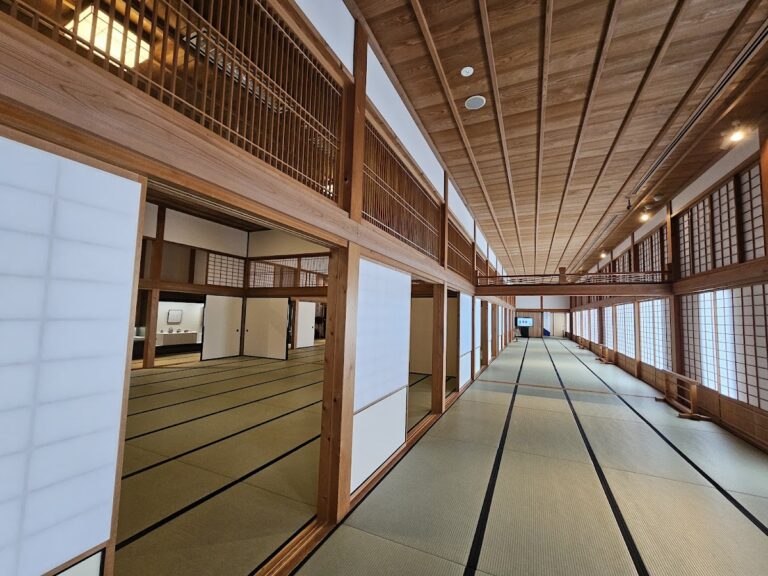
In 2004, a portion of the Saga Castle Honmaru Palace was restored in wood and opened to the public as the Saga Castle Honmaru History Museum. This restoration was based on meticulous research, including archaeological excavations, historical documents, and drawings, and attracted attention as one of the largest wooden restored buildings in Japan, covering approximately 2,500 tatami mats.
While the restored portion represents about one-fifth of the entire Honmaru Palace, it includes key areas such as the Outer Study, the Imperial Chamber, and the Small Study, providing a facility where visitors can experience the heart of the domain’s administration at the time.
Permanent Exhibition: The Saga Domain during the Late Edo and Meiji Restoration Periods
The permanent exhibition at the Saga Castle Honmaru History Museum provides a detailed introduction to the history and culture of the Saga Domain during the late Edo and Meiji Restoration periods. The exhibition is structured around the following themes:
The Administration of the Saga Domain
This section explains the rule of the Nabeshima clan, the domain’s finances, and industrial development, using actual documents and models. In particular, it details the Saga Domain’s industrial development policies and advanced initiatives, such as the manufacture of cannons using reverberatory furnaces.
Education and Human Resource Development
This section displays the educational content of the domain school, Kodokan, and the background behind the production of many talented individuals, including the Seven Sages of Saga. It helps to understand how the advanced educational policy, which actively incorporated not only Confucianism but also Dutch and Western learning, contributed to the domain’s success in the Meiji Restoration.
Development of Science and Technology
During the late Edo period, the Saga Domain built reverberatory furnaces and successfully manufactured cannons and steamships, leading Japan’s modernization. These technological innovations are explained in an easy-to-understand manner using models and videos.
Special Exhibitions and Events
In addition to its permanent exhibitions, the Saga Castle Honmaru History Museum regularly holds special exhibitions and themed exhibitions. The history and culture of Saga are explored through diverse themes, including Nabeshima ware used in the Saga Domain, Saga’s historical roads, and notable figures from Saga.
In addition, lectures called “History Museum Seminars” are held regularly, offering detailed explanations from experts. These events provide valuable opportunities for a deeper understanding of Saga’s history.
Publication of Archaeological Excavation Results
Excavation work is continuously being conducted at the site of the Saga Castle main keep, and the latest findings are made public as they occur. The excavations have revealed the detailed structure of the keep and the lifestyle of the time, and the exhibits are updated based on these findings.
Saga Castle Park: A Place of Relaxation for Citizens
The Saga Castle site has been developed into Saga Castle Park, a place of relaxation for citizens. Within the vast grounds, the remains of the main keep, moats, earthworks, and stone walls are well-preserved, allowing visitors to enjoy historical walks.
The park is planted with trees such as cherry trees and camphor trees, and in spring it becomes a popular spot for cherry blossom viewing, attracting many visitors. It also has a large lawn area, making it ideal for family picnics and strolls.
Saga Castle Park is located in the heart of Saga City, making it easily accessible. The surrounding area is a central hub, with administrative facilities such as the Saga Prefectural Government and Saga City Hall nearby.
Visitor Information: Information for Visiting Saga Castle Honmaru History Museum
Opening Hours and Closing Days
Opening Hours
9:30 AM – 6:00 PM (Open year-round, except for New Year’s holidays)
Closing Days
December 29th – December 31st
Admission Fee
Free (However, donations to the donation box are appreciated)
Access
Train/Bus
- Approximately 30 minutes on foot from JR Saga Station
- Immediately after alighting at “Saga Castle Ruins” bus stop (Saga City Bus from Saga Station Bus Center)
- 5 minutes on foot after alighting at “Museum Front” bus stop (Saga City Bus from Saga Station Bus Center)
Car
- Approximately 15 minutes from Nagasaki Expressway Saga Yamato IC
- Approximately 30 minutes from Saga Airport
Parking
Free parking available (approximately 100 regular cars)
Points to Note When Visiting the Saga Castle Honmaru History Museum
We recommend allocating at least one hour for your visit. For a thorough viewing of the exhibits, two hours would be ideal.
Volunteer guides are available within the museum (may not be available on Wednesdays and Saturdays). Receiving a guided tour will allow you to understand the exhibits more deeply.
Photography is permitted inside the museum, but the use of flash and tripods is prohibited. Also, you will need to remove your shoes when walking on the restored tatami mats.
Attractions Around Saga Castle
Saga Prefectural Museum and Art Museum
Adjacent to Saga Castle Park are the Saga Prefectural Museum and the Saga Prefectural Art Museum. The museum features comprehensive exhibits on Saga’s nature, history, and culture, while the art museum displays artworks related to Saga. Visiting both the Saga Castle Honmaru History Museum and the art museum will allow you to gain a deeper understanding of Saga’s history and culture.
Saga Shrine
Located southwest of Saga Castle, Saga Shrine is dedicated to Lord Nabeshima Naomasa and Lord Nabeshima Naohiro. Within the shrine grounds are subsidiary shrines such as Matsune Shrine, Saga Aragami Shrine, and Matsubara Ebisu Shrine, offering a glimpse into the history of the Saga Domain.
Chokokan Museum
Located within the grounds of Saga Shrine, the Chokokan Museum displays art, crafts, and historical materials passed down through the Nabeshima family. It offers a chance to see valuable items, including Nabeshima ware, making it an ideal facility for understanding the cultural aspects of the Saga Domain.
Saga Castle as one of Japan’s Top 100 Castles
Saga Castle is number 88 on the “Japan’s Top 100 Castles” list selected by the Japan Castle Association. The 100 Castles stamp can be obtained at the reception desk of the Saga Castle Honmaru History Museum.
The following points were considered as reasons for its inclusion in the Top 100 Castles list:
- Possesses a typical structure as a flatland castle
- Historical importance during the late Edo and Meiji Restoration periods
- Large-scale wooden reconstruction of the main keep
- Excellent preservation of important cultural properties such as the Shachi Gate
- Was a base for the Saga Domain’s pioneering initiatives
This castle site is well worth visiting not only for castle enthusiasts but also for history buffs.
The Four Seasons of Saga Castle
Spring: A Famous Cherry Blossom Spot
Saga Castle Park is known as one of Saga City’s leading cherry blossom spots. From late March to early April, approximately 400 Somei Yoshino cherry trees planted along the moat and within the park bloom simultaneously, creating a magnificent landscape. The trees are also illuminated at night, allowing visitors to enjoy the magical sight of cherry blossoms after dark.
Summer: Lush Green Walking Paths
In summer, Saga Castle Park offers cool walking paths with lush green shade from evergreen trees such as camphor and pine. Lotus flowers bloom in the wide moat, creating a quintessential summer scene.
Autumn: Autumn Leaves and Historical Walks
In autumn, the deciduous trees in the park change color, creating a beautiful landscape in harmony with the stone walls and moats. The weather is mild, making it the perfect season for historical walks.
Winter: The Silent Castle Ruins
In winter, Saga Castle Park is less crowded, allowing visitors to quietly reflect on history. On sunny days, the contrast between the blue sky and the white stone walls is beautiful, making it an ideal season for photography.
Preservation and Utilization of Saga Castle
Saga Castle ruins are designated as a national historic site, and preservation and utilization are being promoted by Saga Prefecture and Saga City. Following the restoration of the main palace, archaeological excavations and preservation and maintenance of the remains are planned to continue.
The Saga Castle Main Palace Historical Museum operates with a rare nationwide free admission system. This is based on the philosophy of “a museum created by everyone, for everyone,” and its operation is supported by donations from visitors. This initiative is attracting attention as a new model for the preservation and utilization of cultural properties. Furthermore, the castle is also dedicated to educational outreach activities, regularly hosting school groups and holding workshops for children. Through these activities, the castle aims to pass on its history to future generations.
Summary: Experiencing the Charms of Saga Castle
Saga Castle is a valuable historical site where you can experience Japanese history from the Sengoku period to the end of the Edo period and the Meiji Restoration. It possesses multifaceted appeal, including the history of the castle passed down from the Ryuzoji clan to the Nabeshima clan, its pioneering initiatives during the late Edo period, and its role as an educational center that produced many of the talents who supported the Meiji Restoration.
The restored Honmaru Palace is highly regarded as a facility that allows visitors to concretely understand the life of samurai and the administration of the domain at that time. The fact that it is open to the public free of charge is a wonderful initiative that allows many people to easily experience history.
When visiting Saga, be sure to visit Saga Castle and the Saga Castle Honmaru History Museum to learn about the glory of the Saga domain and Saga’s role in Japan’s modernization. The bullet holes remaining on the Shachi Gate, the vast moat, and the restored main palace are sure to provide an unforgettable historical experience.