Rikan Castle (Hyogo Prefecture) Complete Guide | History and Highlights of the Mountain Castle Known as Kumotsuki Castle
What is Rikan Castle? | An Overview of Kumotsuki Castle Floating in the Sky
Rikan Castle is a historical mountain castle located in Hirafuku, Sayo-cho, Sayo-gun, Hyogo Prefecture. It was designated a National Historic Site on October 13, 2017. Built on the summit of Mt. Rikan (373 meters above sea level), the castle functioned as an important military base protecting the border between Harima Province and Mimasaka Province (present-day northern Okayama Prefecture).
Its most distinctive feature is the three-story keep that existed in the early Edo period. Hirafuku has long been known as a famous spot for morning mist, and in the early morning when mist rolled in, the keep on the mountaintop could be seen floating above the sea of clouds, creating a fantastical scene. Because of this magnificent appearance, it was also known as “Kumotsuki Castle” (Cloud-Piercing Castle), and it is said to have boasted an imposing presence that seemed to pierce the clouds.
Currently, due to the ongoing collapse of the stone walls, public access is restricted. However, by participating in the “Rikami Castle Guided Tour” conducted by the Sayoyama Castle Guide Association, you can experience this historical mountain castle. The remains of the lord’s residence stone walls also exist at the foot of the mountain, attesting to the large scale of the entire castle complex.
History of Rikami Castle | From the Nanboku-cho Period to the Edo Period
Construction Period: Founded by the Akamatsu Clan
The history of Rikami Castle dates back to 1349 (Jōwa 5). It is believed to have begun when Bessho Atsunori, a member of the Akamatsu clan, built a castle on the summit of Mount Rikami. During the turbulent Nanboku-cho period, it was built as a strategic base to protect the western part of Harima Province.
The Akamatsu clan was a powerful daimyo family that expanded its influence mainly in Harima Province, and Rikami Castle was one of the important mountain castles controlled by the family. Castles from this period are thought to have been simple mountain castles primarily for defensive purposes.
Sengoku Period: A Castle Tormented by War
With the arrival of the Sengoku period (Warring States period), Rikami Castle became embroiled in power struggles within Harima Province. A particularly important event is its connection to the Battle of Kōzuki Castle, which took place from 1577 to 1580.
Kōzuki Castle, a mountain castle located near Rikami Castle, was the stage for fierce battles between the Amago clan, allied with Oda Nobunaga, and the Mōri clan. It is believed that Rikami Castle also came under the influence of forces such as the Ukita clan during this conflict. Harima Province became the front line between the Oda and Mōri forces, and Rikami Castle’s strategic importance increased.
Early Edo Period: Major Renovation by the Ikeda Clan
The most glorious period for Rikami Castle was the early Edo period. In 1600, Ikeda Terumasa, due to his achievements in the Battle of Sekigahara, became the lord of Himeji Castle with a 520,000 koku domain, thus ruling over the entire province of Harima.
Ikeda Terumasa appointed his nephew, Ikeda Yoshiyuki, as the lord of the 30,000-koku domain in Sayo District and stationed him at Rikami Castle. Ikeda Yoshiyuki began a large-scale renovation of Rikami Castle in 1601, developing it into a modern castle. The magnificent stone walls visible today were built during this period.
Ikeda Terumasa was a renowned castle lord known for building Himeji Castle, and his skills and aesthetic sense were passed down to his nephew, Yoshiyuki. Rikami Castle featured a three-story keep, and various enclosures such as the main keep, Osaka-maru, Karasu-maru, and a horse training ground were constructed. A residence called the Gozen-yashiki was also built at the foot of the mountain, resulting in a castle structure that combined a mountain castle with a residence for peacetime.
Abandonment and the Present
In 1615, due to the “One Castle Per Province” decree, Rikami Castle was abandoned. For a short period of just over a decade, Rikami Castle, as a modern castle, displayed its imposing presence in western Harima.
After its abandonment, the buildings gradually disappeared, but the stone walls remained in the mountains. From the Showa to the Heisei era, local researchers and government officials conducted investigations, leading to a re-evaluation of its historical value. Then, in 2017, it was designated a National Historic Site—the first in Sayo Town—and is attracting attention as one of Hyogo Prefecture’s representative mountain castle ruins.
Structure of Rikami Castle | Layout and Remains of a Mountain Castle in the Sky
Overall Layout
Rikami Castle is a magnificent mountain castle utilizing the entire Rikami Mountain, which stands at an altitude of 373 meters. The main enclosures, centered around the Honmaru (main keep), are located at the summit, while multiple baileys are arranged in a stepped pattern on the mountainside. In the Hirafuku post town at the foot of the mountain, there are the remains of a residence called Gozenyashiki, indicating a complex castle structure combining a mountain castle and a residence.
The castle’s layout skillfully utilizes the natural terrain, showcasing numerous ingenious features designed to hinder enemy intrusion. The steep mountain slopes themselves acted as natural defensive walls, and strategically placed stone walls made sieges extremely difficult.
Honmaru and Tenshu (Keep)
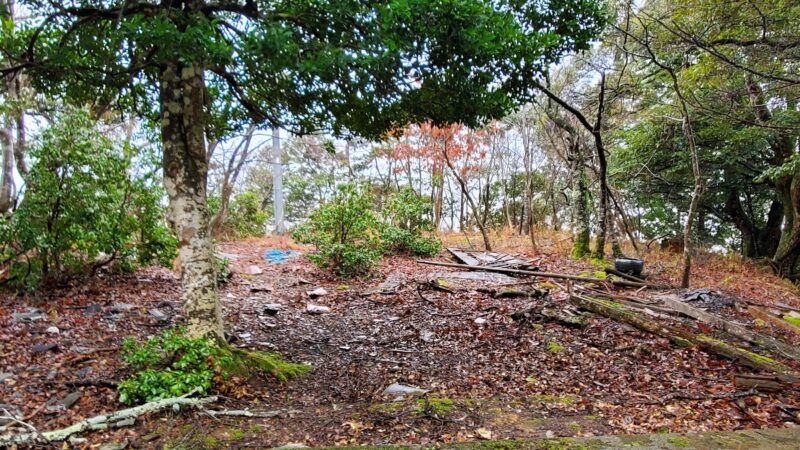
The Honmaru, located at the mountaintop, is the central part of Rikami Castle. A three-story keep stood here. While historical records regarding the keep’s detailed structure are limited, early Edo period documents and drawings suggest it was a magnificent and considerably large keep.
High stone walls were built around the Honmaru, and parts of them can still be seen today. The stone walls employ techniques ranging from rough-hewn stonework to fitted stonework, demonstrating the high level of stonework technology during the Ikeda clan’s era. From the Honmaru, one could enjoy a panoramic view of the Sayo Valley and surrounding mountains, serving both a military surveillance function and a symbolic space demonstrating the lord’s authority.
Osakamaru, Karasumaru, and Other Enclosures
Around the main enclosure (Honmaru), several major enclosures, including Osakamaru and Karasumaru, were arranged. Osakamaru was the second most important enclosure after the Honmaru, and is thought to have served as a key defensive point. Karasumaru was located on the north side of the castle and was designed to defend against invasions from the north.
These enclosures were demarcated by stone walls, and it is presumed that buildings were constructed within each. A flat area called a “baba” (horse training ground) has also been identified, which may have been used for horse training or as a gathering place for soldiers.
The enclosures were connected by narrow passages and stepped paths, a mechanism designed to restrict enemy movement during defense. Even today, the ingenuity of the castle’s layout can be discerned from the elevation differences of the enclosures and the arrangement of the stone walls.
Remains of the Lord’s Residence Stone Walls
At Hirafuku at the foot of the mountain was the lord’s residence, the Gozenyashiki. The remains of these Gozenyashiki stone walls are also included within the designated National Historic Site area and are important historical remains.
The Gozen Yashiki (lord’s residence) functioned as the government office and living quarters during peacetime, while the mountaintop castle served as a fortress during wartime. The remains of the stone walls confirm the existence of a considerably large residence, and remnants of gardens and ponds also remain.
The existence of the Gozen Yashiki, integrated with the Hirafuku post town, indicates that Rikami Castle was not merely a military facility but also functioned as a center of regional governance.
Characteristics and Techniques of the Stone Walls
The stone walls of Rikami Castle are valuable remains for understanding early Edo period castle construction techniques. The stones used are primarily locally sourced granite, stacked in a combination of stones of various sizes.
The construction method shows a transitional technique from “nozurazumi” (stacking natural stones as they are) to “uchikomi-tsugi” (stacking stones with processed edges). This indicates that the techniques cultivated by the Ikeda clan at Himeji Castle were applied to Rikami Castle.
The high stone walls around the main keep are particularly impressive, with some sections exceeding 10 meters in height. The stone walls built on the steep slope still speak to the high level of engineering skill that went into their construction over 400 years ago. However, due to deterioration over time, earthquakes, and heavy rains, collapse is progressing, making preservation measures an urgent necessity.
Current Status of Rikami Castle | Visitor Guide and Access Information
Access Restrictions and Safety Measures
Currently, due to the ongoing collapse of the stone walls at Rikami Castle, public access is restricted for safety reasons. Unauthorized entry is not only dangerous but also prohibited from the perspective of cultural property protection.
The only way to visit Rikami Castle is to participate in the “Rikami Castle Guided Tour” organized by the Sayoyama Castle Guide Association. This tour allows visitors to climb the castle under the guidance of a professional guide, limited to areas where safety has been confirmed.
Details of the Rikami Castle Guided Tour
The Rikami Castle Guided Tour, conducted by the Sayoyama Castle Guide Association, has been held regularly since April 2021. As of 2024, the tour is held every Sunday and on the first to third Tuesdays of each month (the schedule may change, so please check for the latest information), and it is possible to climb to the site of the castle keep.
Tour Overview:
- Meeting Place: Michi-no-Eki Shukuba-machi Hirafuku
- Meeting Time: 10:30 AM
- Duration: Approximately 3 hours
- Reservation Method: Reservations must be made online at least two weeks in advance
- Participation Fee: Paid (Please check the official website for the amount)
The tour includes an explanation of the stone walls and layout of each enclosure as you climb the mountain trail of Mt. Rikami. From the site of the main keep, you can enjoy a panoramic view of the town of Sayo and the surrounding mountains, and standing where the castle keep once stood, you can imagine the castle’s former appearance as it was known as Kumototsu Castle.
The mountain trail has some steep sections, so comfortable clothing and hiking boots are recommended. Depending on the season, insect repellent, sunscreen, and plenty of drinking water may also be necessary.
Access Information
By Public Transportation:
- Get off at Harima-Tokuhisa Station or Hirafuku Station on the JR Kishin Line, then walk approximately 15-20 minutes to Michi-no-Eki Shukuba-machi Hirafuku.
- Approximately 1 hour to 1 hour 30 minutes from Himeji Station on the JR Kishin Line.
By Car:
- Approximately 10 minutes from Sayo IC on the Chugoku Expressway.
- Free parking available at Michi-no-Eki Shukuba-machi Hirafuku (approximately 50 spaces).
Address:
Hirafuku, Sayo-cho, Sayo-gun, Hyogo Prefecture
Nearby Tourist Attractions
When visiting Rikami Castle, you can also enjoy nearby tourist attractions.
Hirafuku Post Town:
Hirafuku, spread out at the foot of Rikami Castle, is a historic townscape that flourished as a post town on the Inaba Highway. The storehouses and old townhouses along the riverbank remain, allowing you to experience the atmosphere of the Edo period. The scenery along the Sayo River is known as “Kawabata Scenic View” and is a popular spot for photography.
Michi-no-Eki Shukuba-machi Hirafuku:
This roadside station, which also serves as a meeting point for guided tours, offers local specialties and fresh vegetables for purchase. The restaurant serves Sayo’s local cuisine, and tourist information is also available.
Other Castle Ruins in Sayo Town:
Besides Rikami Castle, Sayo Town has several other mountain castle ruins, including Kozuki Castle and Fukuhara Castle. For mountain castle enthusiasts, exploring these ruins offers a fascinating historical experience.
Precautions When Visiting
When visiting Rikami Castle, please note the following:
- Always participate in a guided tour: Unauthorized entry is dangerous and may violate the Cultural Properties Protection Act.
- Wear comfortable clothing and shoes: Climbing mountain castles requires more physical exertion than you might imagine. Prepare appropriate hiking gear.
- Weather Check: The ground can become slippery during and after rain. Tours may be cancelled depending on the weather.
- Health Management: The approximately 3-hour hike requires a moderate level of physical fitness. Drink plenty of water and climb at a comfortable pace.
- Cultural Heritage Protection: Please cooperate in protecting cultural heritage by not touching stone walls or ruins, and by taking your trash with you.
Contact Information
Sayo Town Commerce and Tourism Division:
Phone: 0790-82-0670
Sayoyama Castle Guide Association (Guided Tour Reservations):
Details can be found on the Sayo Town Tourism Association website or at the Michi-no-Eki Shukuba-machi Hirafuku.
Cultural Value and Preservation Activities of Rikami Castle
Significance of National Historic Site Designation
On October 13, 2017, the Rikami Castle ruins (stone walls and the remains of the Gozenyashiki stone fort at the foot of the mountain) were designated a National Historic Site. This is the first National Historic Site designation in Sayo Town, and it is a great source of pride for the community.
The designation as a National Historic Site means that the government has recognized Rikami Castle’s significant value in understanding Japanese history. Its value was recognized as a valuable historical site that conveys the appearance of an early Edo period castle, and as an important historical site that tells the history of western Harima Province.
Stone Wall Collapse and Preservation Challenges
While designated a National Historic Site, Rikami Castle faces serious preservation challenges. The biggest problem is the collapse of the stone walls. More than 400 years have passed since its construction, and the collapse of the stone walls is progressing due to weathering, earthquakes, heavy rains, and other factors.
In particular, the heavy rains in western Japan in 2018 caused landslides around the castle ruins, damaging part of the stone walls. Such natural disasters are likely to occur again in the future, making preservation measures to pass on this valuable cultural property to future generations an urgent necessity.
Preservation and Development Plan and Future Prospects
Sayo Town and Hyogo Prefecture have formulated a preservation and development plan for Rikami Castle and are proceeding with phased preservation and repair work. The plan involves first conducting surveys and emergency measures on the stone walls at high risk of collapse, followed by full-scale restoration work.
At the same time, the use of the castle as a tourist resource is also being considered. The aim is to create a safe environment for visitors and to let more people know about the value of Rikami Castle, thereby gaining understanding and cooperation for its preservation.
The implementation of guided tours is part of an effort to promote the appeal of Rikami Castle while balancing safety and cultural property protection. It is also expected that as development progresses, it will become possible to visit a wider area.
Local Initiatives and Revitalization
Following the designation of Rikami Castle as a National Historic Site, Sayo Town has been actively engaged in regional revitalization efforts. Various activities are underway, including the development of a tourist route integrated with the Hirafuku post town, the holding of events themed around Rikami Castle, and the development of local specialty products.
Members of the Sayo Mountain Castle Guide Association are diligently working to convey the history and charm of Rikami Castle. The local people’s pride in protecting the castle ruins and their welcoming attitude towards visitors is an ideal model for cultural property preservation.
The Significance of Visiting Rikami Castle | What the Mountain Castle in the Sky Tells Us
Rikami Castle is a particularly impressive example among Japanese mountain castles. The magnificent stone walls built on a mountaintop 373 meters above sea level represent the pinnacle of early Edo period castle construction techniques, conveying the ambition and aesthetic sense of the rulers of that time.
As its alternative name, “Kumotsuki Castle” (Cloud-Piercing Castle), suggests, the sight of the castle tower floating above the mist is truly worthy of being called a castle in the sky. Although the castle tower is now gone, standing on the mountaintop and gazing out at the valley of Sayo below, you can relive the perspective of the castle lords who once ruled this land.
Visiting Rikami Castle is more than just seeing historical remains. The process of climbing the steep mountain path and sweating as you make your way to the summit itself allows you to truly appreciate the hardships and technical skills of the people of that time. Furthermore, standing before the stone walls quietly nestled in nature, you cannot help but feel the passage of time and the weight of history.
While Hyogo Prefecture boasts Himeji Castle, a World Heritage Site, Rikami Castle possesses a different kind of charm. Instead of a magnificent white castle tower, it’s the remains of stone walls enveloped in a deep forest. Yet, its appearance exudes a quiet strength and a nostalgia for a lost era.
If you have the opportunity to visit Sayo Town, be sure to take a guided tour of Rikami Castle. The experience of touring the mountain castle while listening to the explanations of a professional guide will not only deepen your understanding of history but also allow you to truly appreciate the profound depth of Japanese castle culture. The mountain castle known as Kumotsuji Castle, perched high in the sky, continues to tell its history quietly, yet surely.