Complete Guide to Oshima Castle (Ina District, Shinano Province) | A Masterpiece of Koshu-ryu Castle Construction Built by Takeda Shingen
What is Oshima Castle?
Oshima Castle is a Japanese castle site located in Moto-Oshima, Matsukawa-cho, Shimoina-gun, Nagano Prefecture. Also known as Daijo or Ina-Oshima Castle, it is designated as a Matsukawa-cho Historic Site. Built on a river terrace approximately 30 meters high overlooking the Tenryu River, this castle is known for the extensive renovations carried out by Takeda Shingen during the Sengoku period to serve as a base for his control of the Ina region.
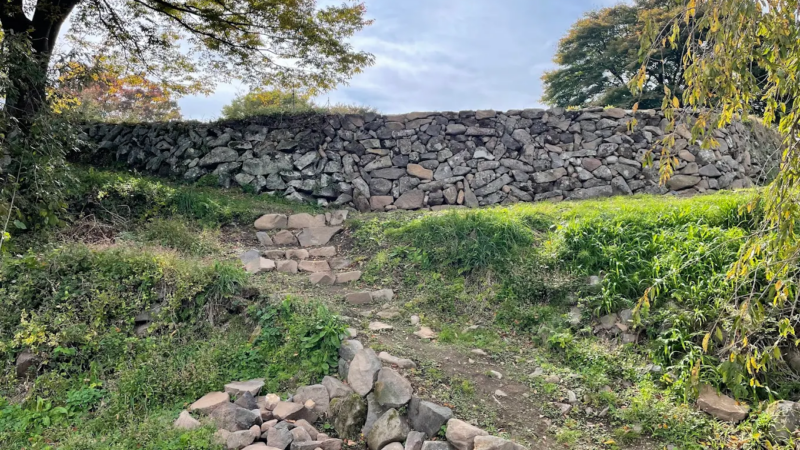
Currently, the castle site is maintained as Daijo Park, a valuable historical site where remnants strongly exhibiting the characteristics of Koshu-ryu castle construction, such as earthworks, dry moats, double crescent-shaped moats, and circular outworks, can be observed. As the largest and most technically sophisticated castle in the Shimoina region, it is highly regarded by castle enthusiasts and history buffs.
History of Oshima Castle
Late Heian Period to Kamakura Period: Construction by the Oshima Clan
The exact date of construction of Oshima Castle is uncertain, but it is believed to have been built by the Oshima clan, who ruled this area from the late Heian period to the Kamakura period. The Oshima clan is said to have originated when Hachiro Munetsuna, the eighth son of Katagiri Tameyuki, the lord of Funayama Castle and a descendant of the Ina Genji clan, was granted a portion of the Oshima region and adopted the name Oshima.
The Oshima clan, a powerful local family that ruled the area of Oshima Town at the time (present-day Furumachi and Arai districts), built a mountain castle utilizing the difficult-to-attack terrain jutting out into the Tenryu River, in preparation for war and other emergencies. The Oshima clan ruled Oshima Town and continued to own the castle throughout the Kamakura and Muromachi periods.
Sengoku Period: Takeda Shingen’s Rule and Major Renovations
In Tenbun 23 (1554) during the Sengoku period, Takeda Shingen, the Sengoku general of Kai Province, invaded Ina County and seized Oshima Castle from the Oshima clan. As the Takeda clan’s territory expanded, Oshima Castle became an extremely important strategic location, serving as a base for invasions into Suruga and Tōtōmi Provinces, and as a logistical base for controlling the Ina region.
In Genki 2 (1571), Takeda Shingen ordered Akiyama Torashige (Nobutomo), the castellan of Iida Castle, to carry out large-scale renovations of Oshima Castle. This major renovation made the castle, along with Takatō Castle, one of the Takeda clan’s two major bases in the Ina region. A letter from Takeda Harunobu (Shingen) dated August 18th (year unknown), estimated to be from the early Eiroku period, confirms the presence of a person believed to be “Akiyama Zen’emon-no-jō” and Murozumi Toramitsu at the castle.
This renovation transformed Oshima Castle into a technically sophisticated fortress, embodying the pinnacle of Koshu-style castle construction techniques. With features such as double crescent-shaped moats and large circular outworks, the Takeda-style defensive system was implemented throughout, making it one of the strongest castles in the Shimo-Ina region.
Tensho 10 (1582): Oda Army Invasion and Fall of the Castle
In Tensho 10 (1582), the Oda army, led by Oda Nobutada, the eldest son of Oda Nobunaga, invaded the Ina region. After Iida Castle fell, the Takeda forces concentrated their troops at Oshima Castle to attempt resistance. However, the defending commander, Takeda Nobuaki (Shingen’s younger brother), abandoned the castle without a fight and retreated to Kai.
The castle’s defenders also set fire to the castle and fled, resulting in the swift fall of Oshima Castle. This fall became one of the symbolic events in the process of the Takeda clan’s downfall. Oshima Castle boasted formidable defensive structures, but ultimately, it was lost due to the defection of the people.
Structure and Layout of Oshima Castle
Overall Layout and Topographical Features
Oshima Castle is built on a plateau approximately 30 meters high at the tip of a river terrace facing the Tenryu River. This terrain, surrounded on three sides by steep cliffs, makes it a natural stronghold. The castle employs a linear layout with the Third Bailey, Second Bailey, and Main Bailey arranged in a straight line, and large, deep dry moats are provided between each bailey.
Currently, it is maintained as Daijo Park, with ample parking, restrooms, and brochures available, making it an easy environment for visitors to stroll around.
Double Crescent Moat and Round Barbican: A Masterpiece of Koshu-ryu Castle Construction Techniques
The greatest highlight of Oshima Castle is the Double Crescent Moat and Round Barbican located at the castle’s main entrance. Upon arriving at the parking lot, you will be immediately overwhelmed by the large-scale Round Barbican. Such a large circular barbican is rare nationwide, and it is considered the most representative example of the Koshu-ryu style of castle construction.
The crescent-shaped moat is arranged in a double layer surrounding the barbican, effectively preventing enemy intrusion. This structure is well-preserved and can be clearly seen. There are still residences in the barbican area, and some areas show signs of daily life, which is also evidence that the castle ruins are deeply rooted in the community.
Main Bailey, Second Bailey, and Third Bailey
The central part of the castle is structured with the main bailey at the far end, followed by the second and third baileys. Each bailey is clearly separated by a difference in elevation, and deep dry moats are dug between them. These dry moats served not only a defensive function but also as a source of soil for constructing earthworks.
The traces of earthworks remain clearly visible around the main bailey, giving a glimpse into the castle’s grandeur at the time. Furthermore, the Central and Southern Alps can be seen from each bailey, making the excellent views another attractive feature of Oshima Castle. ### Arrangement of Dry Moats and Earthworks
Oshima Castle features multiple dry moats, their scale remarkable even among castles in the Shimo-Ina region. The dry moat separating the main keep and the second bailey is particularly deep and wide, suggesting it would have been a significant obstacle for attackers.
Earthworks are strategically placed throughout the castle, forming defensive lines. These earthworks are positioned with the “yokoyagakari” (flanking fire) technique, a characteristic of Koshu-ryu castle construction, demonstrating ingenuity in attacking the enemy from the flanks.
Highlights of Oshima Castle
Round Outwork and Crescent Moat Next to the Parking Lot
The first highlight visitors will see is the round outwork and double crescent moat located next to the parking lot. Paper maps of the castle grounds are available near the restrooms in front of the parking lot and can be freely taken as reference material for exploring the castle.
This round outwork is large even by national standards, demonstrating the high level of castle construction technology of the Takeda clan. The crescent-shaped moat surrounding the outwork is double-layered, forming a complex defensive system. In spring, wildflowers bloom around the moat, creating a beautiful landscape where historical remains and nature harmonize.
The Large Dry Moat Between the Main and Second Baileys
As you stroll through the castle grounds, you will be overwhelmed by the large dry moat located between the main and second baileys. This dry moat is several meters deep and wide, demonstrating the high level of castle construction technology of the time. Looking up from the bottom of the moat, the height of the earthworks and the depth of the dry moat become even more striking, allowing you to appreciate its functionality as a defensive structure.
Remains of Earthworks
The earthworks remaining throughout the castle grounds clearly demonstrate the characteristics of the Koshu-ryu style of castle construction. The earthworks around the main bailey, in particular, are well-preserved and largely retain their original shape. Walking along the top of the earthworks allows you to view the entire castle from the perspective of the defenders, helping you understand the ingenuity of the layout.
Development as Daijo Park
Currently, the Oshima Castle ruins have been developed as Daijo Park, with walking paths established. The park is regularly maintained with moderate grass cutting, creating an environment conducive to observing the ruins. Benches are also provided, allowing visitors to relax and enjoy the castle’s features.
Access Information
Access by Public Transportation
The castle ruins are approximately a 20-minute walk from JR Iida Line, Yamabuki Station. The path from the station to the ruins offers a scenic rural landscape with views of the Central and Southern Alps on both sides, making for a pleasant stroll. On a clear day, the walk while admiring the majestic mountain ranges is particularly enjoyable.
Access by Car
The park is approximately 10 minutes from the Matsukawa Interchange on the Chuo Expressway. Daijo Park has a large, free-to-use parking lot. Restrooms are also available in the parking lot, ensuring a comfortable visit.
Address and Location Information
Address: Moto-Oshima, Matsukawa-cho, Shimoina-gun, Nagano Prefecture
Located on a river terrace along the Tenryu River, the surrounding area is a quiet rural landscape. Entering “Daijo Park” or “Oshima Castle Ruins” into your car navigation system should lead you smoothly.
Visiting Guide and Sightseeing Points
Best Time to Visit
Oshima Castle Ruins are open year-round, but the best times to visit are Spring (April-May) and Autumn (October-November). Spring brings beautiful fresh greenery, and wildflowers bloom around the dry moat. Autumn offers stunning autumn foliage and mild weather, perfect for a stroll.
In summer, the vegetation can make the ruins somewhat difficult to see, but the shade of the trees provides a cool and comfortable environment for walking. Winter may bring snow, but the castle ruins amidst a snowy landscape also offer a unique charm.
Estimated Time Required
If you plan to thoroughly explore the entire castle site, allow approximately 1 to 1.5 hours. If you only want to see the main remains, focusing on the circular outwork and crescent-shaped moat, 30 minutes should suffice. If you plan to enjoy taking photographs and comparing the site with a map, we recommend allowing around 2 hours.
Useful Items to Bring
- Castle Layout Map: Paper maps are available in the parking lot, but obtaining one online beforehand will enhance your understanding.
- Comfortable Walking Shoes: The castle grounds are hilly, and you may need to descend into the dry moats, so trekking shoes or sneakers are recommended.
- Camera: There are many photo opportunities, including the circular barbicans and dry moats.
- Drinks: Essential, especially in summer, to prevent heatstroke.
- Insect Repellent Spray: Mosquitoes and other insects can be numerous in summer.
Precautions
- There are still residences in the barbican area, so please be considerate of the residents’ privacy.
- The slopes of the dry moats and earthworks can be slippery, so watch your step.
- To protect the remains, please refrain from unnecessarily trampling on the earthworks and moats.
- Please take all your trash with you.
Nearby Tourist Attractions
Historical Sites in Matsukawa Town
When visiting the Oshima Castle Ruins, we recommend also visiting other historical sites in Matsukawa Town. The Matsukawa Town Board of Education provides materials on local history and culture, allowing you to learn more about the history of Oshima Castle.
Views of the Tenryu River
Oshima Castle is located on a plateau overlooking the Tenryu River, and from the castle ruins you can enjoy a magnificent view of the river’s majestic flow. A walking path is also maintained along the Tenryu River, making it a popular spot for enjoying the natural scenery along the river.
Views of the Central and Southern Alps
Matsukawa Town is located in the Ina Valley, nestled between the Central and Southern Alps, offering magnificent mountain views on both sides. On clear days, you can enjoy beautiful mountain scenery from the Oshima Castle Ruins.
Surrounding Castles
In addition to Oshima Castle, numerous other castle ruins remain in the Shimo-Ina region. A “castle ruins tour” visiting castles associated with the Oshima and Katagiri clans, such as Funayama Castle, Nago Castle, Momoi Castle, and Jogahira Castle, would also be appealing to history buffs.
Historical Value and Evaluation of Oshima Castle
A Textbook Example of Koshu-ryu Castle Construction
Oshima Castle is a valuable historical site that strongly retains the characteristics of Koshu-ryu castle construction, having been extensively renovated by Akiyama Nobutomo at the command of Takeda Shingen. Takeda-style castle construction techniques can be seen throughout, including double crescent-shaped moats, circular barbicans, deep dry moats, and earthworks designed with flanking fire in mind.
Among castle researchers, Oshima Castle is highly regarded as a “textbook example” for learning Koshu-ryu castle construction. In particular, the scale and state of preservation of the circular barbican are outstanding nationwide, making it an indispensable example for understanding Takeda clan castles.
Strategic Importance in the Ina Region
Oshima Castle, along with Takato Castle, was one of the two major strongholds for Takeda Shingen in his control of the Ina region. Located on the invasion route to Suruga and Tōtōmi, it was also a crucial point controlling the Tenryū River’s water transport.
The Ina region was an important area connecting Kai and Shinano, and also a base for expansion into Suruga and Tōtōmi. Oshima Castle, as a military base controlling these strategic locations, played a vital role in the expansion of the Takeda clan’s territory.
Evaluation from Castle Enthusiasts
Oshima Castle receives high praise on castle information websites such as Kojōdan. Visitors frequently comment on its “clearly exhibiting the characteristics of Takeda clan castles,” “overwhelmed by the scale of the circular outwork,” and “excellent preservation of the remains.”
In particular, its current management as Daijō Park, providing a pleasant environment for strolling, is highly valued. With amenities such as parking, restrooms, and distribution of castle layout maps, the facility is well-equipped to accommodate visitors, making it enjoyable even for first-time visitors to castle ruins.
Preservation and Utilization of Oshima Castle
Protection as a Matsukawa Town Designated Historic Site
Oshima Castle is legally protected as a Matsukawa Town designated historic site, and efforts are being made to preserve its important remains. The local government and the board of education play a central role in regular grass cutting and maintenance of the remains.
Utilization as Daijo Park
The castle site has been developed as Daijo Park and is used as a place of relaxation for local residents. It is popular not only as a place for historical learning but also as a park rich in nature, enjoyed by people who come for walks and picnics.
Potential as a Tourism Resource
In recent years, with the growing interest in castle tourism, Oshima Castle has attracted attention as an important tourism resource in the Shimo-Ina region. It is also featured on the San’en-Nanshin regional tourism information website, “Meguru! San’en-Nanshin,” and is positioned as part of a wider regional tourism route.
In the future, by strengthening information provision to tourists through the installation of more explanatory signs, improved guidance, and the introduction of a digital guide system, we will be able to convey the value of Oshima Castle to even more people.
Summary: The Charm of Oshima Castle
Oshima Castle is a historical castle built by the Oshima clan during the Kamakura period and extensively renovated by Takeda Shingen during the Sengoku period. Currently maintained as Daijo Park, visitors can see the remains, such as the double crescent-shaped moat and circular outwork, which are highly regarded as masterpieces of Koshu-style castle construction.
Boasting the largest scale and most sophisticated design in the Shimo-Ina region, Oshima Castle is a must-see spot for castle enthusiasts and is recommended not only for history buffs but also for those who want to enjoy nature and scenery.
With good access and facilities such as parking and restrooms, it’s easy to visit. Why not enjoy a leisurely stroll through the castle ruins, feeling the spirit of the Sengoku period amidst the beautiful scenery of the Ina Valley surrounded by the Central and Southern Alps?
Oshima Castle, the base of operations for Takeda Shingen’s control of the Ina region, continues to deeply impress visitors with its magnificent layout and sophisticated defensive system, even after nearly 500 years.