Oshio Castle (Hyogo Prefecture) Complete Guide | History, Highlights, and Access Information for Harima’s Largest Mountain Castle
What is Oshio Castle?
Oshio Castle (also known as Ojio-jo or Ojio-jo) is a representative mountain castle of the Sengoku period located in Yumemae-cho, Himeji City, Hyogo Prefecture. Built on the summit of Mt. Oshio (Shiroyama), at an altitude of 370 meters, this castle boasts a vast scale, spanning approximately 600 meters east-west and 400 meters north-south, and is known as one of the largest mountain castles in Harima.
Currently designated as a national historic site, the original stone walls and baileys remain in excellent condition. It served as the base of the Akamatsu clan, the shugo (military governor) of Harima Province, for approximately 100 years, playing an important role as the political and military center of the Harima region.
History of Okishio Castle
Construction History and Akamatsu Masanori
Okishio Castle is said to have been built in 1469 (Bunmei 1) by Akamatsu Masanori. This construction is rooted in the important historical context of the Akamatsu clan’s restoration after the Kakitsu Rebellion (1441).
The Akamatsu main family, once destroyed in the Kakitsu Rebellion, sought to regain power amidst the chaos of the Onin War (1467-1477). Upon becoming the governor of Harima Province, Akamatsu Masanori began construction of Okishio Castle as a base for his control of Harima. He chose a location several kilometers inland from Himeji (Fuchu) along the Yumemae River because it offered both a suitable defensive terrain and a strategic position overlooking the central region of Harima.
The Akamatsu Clan’s Five Generations’ Main Castle
Okishio Castle served as the main castle for five generations of the later Akamatsu clan, from Akamatsu Masanori to Yoshimura, Harumasa, Yoshiyuki, and Norifusa. During this period, the castle underwent significant development, with large stone walls and numerous baileys being constructed.
The Akamatsu clan, as a powerful daimyo family serving as the governor of Harima, Bizen, and Mimasaka provinces, wielded considerable influence in the Harima region. The Kodera family, whom Kuroda Kanbei served, was also related to the Akamatsu clan as vassals. However, with the progress of the Sengoku period, internal conflicts within the family and struggles with surrounding forces gradually led to the decline of the Akamatsu clan’s power.
Hashiba Hideyoshi’s Conquest of Harima and the Castle’s Abandonment
During the Tensho era (1573-1592), Hashiba Hideyoshi (later Toyotomi Hideyoshi), acting on orders from Oda Nobunaga, began his conquest of Harima. In this process, the Akamatsu clan became subordinate to Hideyoshi.
Akamatsu Norifusa was recognized for his achievements during Hideyoshi’s Shikoku campaign (1585) and was transferred to Sumiyoshi Castle in Awa Province. As a result, Okishio Castle ceased to serve its purpose and was abandoned. Although its existence was relatively short, about 120 years after its construction, Okishio Castle is remembered as a castle that played an important role in the history of Harima Province.
Okishio Castle’s Layout and Structure
One of the Largest Castles in Harima
The most striking feature of Okishio Castle is its magnificent scale. More than 70 baileys of varying sizes have been identified at the castle site, indicating a wide-ranging defensive system extending beyond the main citadel.
The central part of the castle consists of the first bailey (presumably the main keep) located on the mountaintop at an altitude of 370 meters, and the main baileys (presumably the second and third baileys) located on the ridge to the west. These baileys are arranged in stages, designed to effectively prevent enemy incursions.
Honmaru (Main Enclosure)
The Honmaru is the central enclosure located at the highest point of Okishio Castle, and is believed to have housed the lord’s residence and important facilities. From the Honmaru, one can enjoy a panoramic view of the Harima Plain, including Himeji and the Yumemae River basin. This excellent view played an important role in military surveillance.
The Honmaru is surrounded by earthen ramparts and stone walls, indicating its high level of defense. Archaeological excavations have unearthed foundation stones and roof tiles, confirming the existence of a substantial building.
Ninomaru, Sannomaru, and Baba (Horse Training Ground)
To the west of the Honmaru are the Ninomaru and Sannomaru, arranged in succession. These enclosures played an important role in defending the Honmaru. The Ninomaru, in particular, has a large flat area and is presumed to have been used as residences for retainers and a troop encampment.
To the north of the Ninomaru is a long, narrow enclosure called Baba. The horse training ground (baba) was likely used for horse training and military exercises, a rare feature for a mountain castle. Stone walls remain in front of the training ground, providing valuable evidence of the stonework techniques of the time.
Southwestern Enclosures and Large Stone Wall
One of the most noteworthy remains of Okishio Castle is the large stone wall remaining in the southwestern enclosures. This wall reaches several meters in height and was constructed using the nozurazumi technique, skillfully stacking natural stones.
Stone walls in mountain castles during the Sengoku period were still in a stage before the development of sophisticated stonework techniques. The stone walls of Okishio Castle are important historical documents illustrating the development of stonework technology in the Harima region. The scale and high level of craftsmanship of the stone walls speak to the economic and technical prowess of the Akamatsu clan.
Although the southwestern enclosures are located away from the main keep, they functioned as part of the castle’s overall defensive system. These enclosures are thought to have served as lookout posts and sprinting bases.
Remains Along the Hiking Trail
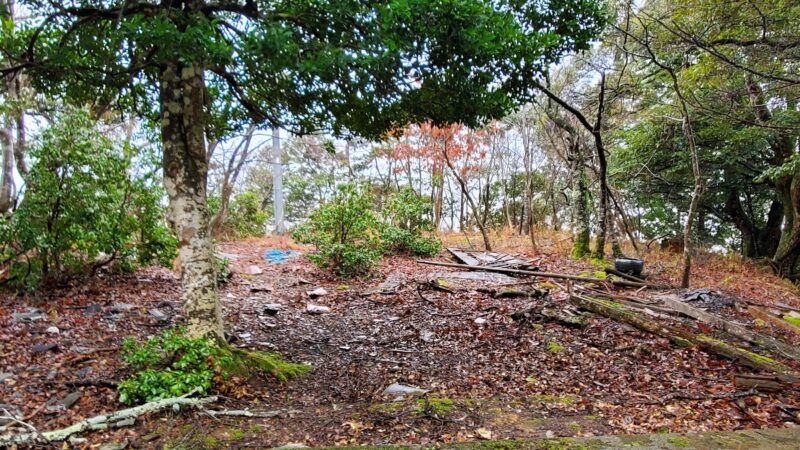
Many remains are preserved along the path from the current trailhead to the main keep. Moats, earthworks, and small enclosures are arranged in a continuous pattern, designed to progressively prevent enemy incursions.
Moats cutting across the ridgeline are particularly important defensive features unique to mountain castles. Multiple moats have been identified at Okishio Castle, indicating their strategic placement at key defensive points.
Highlights of Okishio Castle
Well-Preserved Stone Walls
The greatest highlight of Okishio Castle is its well-preserved stone walls. The stone walls in front of the horse training ground and the large stone walls of the southwest enclosures are particularly noteworthy. Constructed using the nozurazumi technique with natural stones, these walls are valuable relics that convey the castle-building techniques of the Sengoku period.
Observing the stone walls reveals the ingenuity put into the way the stones were stacked and selected. The technique of placing large stones at the base and filling the gaps with smaller stones was a method to enhance durability against earthquakes and weathering.
The Arrangement of the Vast Enclosures
The vast array of over 70 enclosures spread across a wide area truly conveys the scale of Okishio Castle. By touring the enclosures, arranged in stages from the main enclosure to the outer enclosures, you can experience the defensive system of a Sengoku period mountain castle.
Each enclosure’s shape and arrangement has its own meaning, reflecting its military function. Flat enclosures were used for building construction and troop stationings, while long, narrow enclosures were used as passageways and defensive lines.
View from the Main Enclosure
From the main enclosure, at an altitude of 370 meters, you can enjoy a magnificent view of the Harima Plain. On clear days, you can even see Himeji city and Himeji Castle. This view evokes the landscape of the time when the Akamatsu clan ruled Harima Province.
The location, overlooking the Yumemae River and the surrounding mountains, was ideal for monitoring strategic transportation points. For Sengoku-era daimyo, such views were not merely scenery, but a vital source of information for governing their territories.
Nature Through the Seasons
Okishio Castle Ruins are situated in a lush, mountainous area, offering beautiful scenery throughout the seasons. Each season offers a different charm: fresh greenery in spring, deep green in summer, vibrant autumn foliage, and the ruins become more visible after the leaves have fallen in winter.
The autumn foliage season, in particular, is stunning, with the contrast between the stone walls and the changing leaves attracting many castle enthusiasts and hiking aficionados.
Access and Visiting Guide
Access to the Trailhead
Access by Car
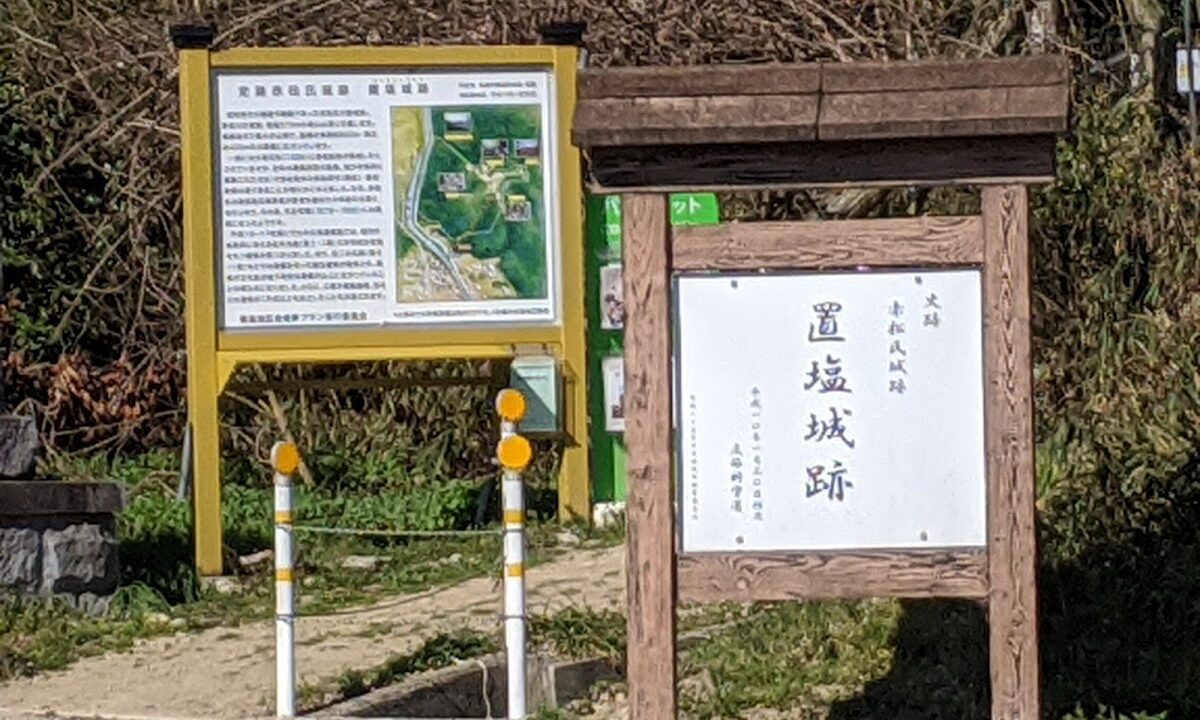
Visiting Okishio Castle Ruins is convenient by private car. From Himeji city center, head north on National Route 312, then turn east at the intersection of Prefectural Routes 67 and 80 (north of Miyaoki Elementary School). Immediately after crossing the bridge, turn north and follow the road to reach the trailhead.
There is a parking lot before the trailhead, which is free to use. However, parking space is limited, so early arrival is recommended, especially on weekends.
Access by Public Transportation
If using public transportation, take the Shinki Bus bound for Yumemae from JR Himeji Station, get off at the nearest bus stop, and then walk. However, due to the distance from the bus stop to the trailhead, access by car is recommended.
Hiking Time and Difficulty
The time required from the trailhead to the main keep is approximately 30 to 40 minutes one way. The hiking trail is well-maintained, but there are steep inclines typical of mountain castles, so a moderate level of physical fitness is necessary.
What to Bring and Wear
- Comfortable walking shoes (trekking shoes recommended)
- Drinking water
- Towel
- Seasonal clothing (insect repellent in summer, warm clothing in winter)
- Camera (for photographing the ruins)
- Walking stick (if needed)
Precautions for Visiting
Okishio Castle Ruins are designated as a National Historic Site. Please observe the following points when visiting:
- Protection of Ruins: Please be careful not to climb on or touch the stone walls or earthworks.
- Take Your Trash Home: Please take all your trash home to protect the natural environment.
- Safety Assurance: Some parts of the mountain path can be slippery. Particular caution is needed during and after rain.
- Check the Season: In summer, be careful of snakes and insects. In winter, check the sunset time and try to descend early.
- Avoid Solo Visits: Visiting in groups is recommended whenever possible.
Estimated Visit Time
If you plan to walk from the trailhead to the main keep and visit the main remains, allow approximately 2 to 3 hours in total. If you want to thoroughly explore all the baileys, you will need more time.
Nearby Tourist Attractions
Himeji Castle
Located about 30 minutes by car from Okishio Castle, Himeji Castle is a representative Japanese castle and a UNESCO World Heritage Site. While Okishio Castle is a mountain castle, Himeji Castle developed as a flatland castle. Visiting both castles allows you to compare the development of castle architecture.
Tatsuno Castle
Located in Tatsuno City, west of Himeji City, Tatsuno Castle is also an important castle in the Harima region. As a castle that existed during the same period as Okishio Castle, it provides an interesting point of comparison for understanding the Sengoku period history of Harima.
History and Culture of Yumemae Town
Yumemae Town in Himeji City, where Okishio Castle is located, retains old townscapes and temples and shrines. You can experience the local history and culture along with visiting the castle ruins. ## Investigation and Development of Okishio Castle
Results of Archaeological Excavations
Multiple archaeological excavations have been conducted at the Okishio Castle site. These excavations have unearthed artifacts such as building foundations, roof tiles, and ceramics, revealing the castle’s structure and the lifestyle of its inhabitants.
In particular, structural investigations of the stone walls have confirmed changes in castle construction techniques and traces of repairs, providing valuable information for unraveling the castle’s history.
Designation as a Historic Site and Preservation Activities
The Okishio Castle site is designated as a national historic site, and its preservation and development are being spearheaded by the Hyogo Prefectural Board of Education and the Himeji City Board of Education. The Hyogo Prefectural Museum of History exhibits and conducts research on materials related to Okishio Castle.
Local preservation societies and volunteer groups are also actively engaged in preservation activities, such as maintaining hiking trails, installing information boards, and providing guidance to visitors.
Future Development Plans
Currently, development plans are being considered at the Okishio Castle site to balance improved visitor convenience with the protection of the remains. Plans are underway to improve signage, enhance the safety of hiking trails, and create explanatory materials, aiming to create an environment where more people can understand the historical value of Okishio Castle.
Harima’s Mountain Castle Culture and Okishio Castle
Mountain Castles of the Harima Region
Many mountain castles were built in Harima Province (present-day southwestern Hyogo Prefecture) besides Okishio Castle. This is because Harima is a mountainous region and also a strategically important transportation hub facing the Seto Inland Sea.
Powerful local lords, including the Akamatsu, Kodera, and Bessho clans, built mountain castles in their respective territories and competed for power. Okishio Castle was one of the largest among them, symbolizing the Akamatsu clan’s authority in Harima.
Harima and the Role of Okishio Castle in the Sengoku Period
During the Sengoku period, Harima was situated between the Oda and Toyotomi forces in the east and the Mori forces in the west, becoming a battleground for the conflicts between these two forces. The Akamatsu clan, based at Okishio Castle, sought to survive amidst this complex political situation.
During the era in which Kuroda Kanbei was active, Okishio Castle held significant influence over the political landscape of Harima Province. The importance of Okishio Castle is evident from the fact that Kanbei’s lord, the Kodera clan, were vassals of the Akamatsu clan.
Summary
Okishio Castle, located in Himeji City, Hyogo Prefecture, is one of the largest mountain castles in Harima Province, and a valuable historical site that conveys the history of Harima and the architecture of the Sengoku period. Built by Akamatsu Masanori, and serving as the Akamatsu clan’s base for five generations, the castle boasts many attractions, including magnificent stone walls, a vast network of baileys, and excellent fortifications.
Designated a national historical site, the Okishio Castle ruins, currently undergoing preservation and maintenance, are an attractive destination not only for castle enthusiasts but also for history buffs and hiking lovers. From the main keep, the impressive stone walls, and the rich natural environment, one can reflect on the Sengoku period in Harima.
Okishio Castle, while relatively easily accessible from Himeji city center, retains the tranquil atmosphere characteristic of mountain castles. Why not visit it to gain a deeper understanding of Harima’s history? With appropriate preparation and attire, you’ll be able to fully experience the charm of a Sengoku period mountain castle.
Learning about its history beforehand at the Hyogo Prefectural Museum of History or local museums will lead to a deeper understanding and greater appreciation. Okishio Castle ruins are an irreplaceable historical heritage site where you can experience the history and culture of Harima.