
Complete Guide to Oguni Castle Ruins | History, Highlights, and Access Information for a National Historic Site Mountain Castle
What is Oguni Castle Ruins?
Oguni Castle Ruins (Oguni-jo Ato) is a nationally designated historic site mountain castle located in Shiri, Oguni-machi, Tsuruoka City, Yamagata Prefecture (formerly Atsumi-machi, Tagawa District). It stands on the summit of Mt. Tateyama, at an elevation of 348.5 meters, near the Oguni settlement, approximately 10 km southwest of JR Atsumi Onsen Station and about 6.5 km east of the Sea of Japan coast.
The elevation difference from the base of the mountain is approximately 235.5 meters, boasting the largest elevation difference among medieval mountain castle ruins in Yamagata Prefecture. This large-scale mountain castle played a crucial role in the history of conflicts in the Shonai region during the Sengoku period, serving as a border castle protecting the Uetsu border and major highways.
Designated a national historic site on December 19, 2002 (Heisei 14), it is now a valuable cultural heritage site highly regarded by history enthusiasts and castle fans.
History of Oguni Castle
Background of Construction and the Nanboku-cho Period
While the exact construction date of Oguni Castle is not precisely estimated, it was known as the residence of Oguni Masamitsu during the Nanboku-cho period. The Oguni clan acted as generals on the Southern Court’s side and established control over this region.
This mountain castle, utilizing the natural fortifications of Tateyama, is thought to have possessed the characteristics of a military stronghold from the beginning. Located overlooking the Oguni settlement, it had ideal strategic positions for monitoring and defending the surrounding area.
Changes During the Sengoku Period
During the Sengoku period, Oguni Castle became a central figure in the struggle for supremacy in the Shonai region. During this period, the castle’s rulers changed rapidly.
First, the castle came under the control of the Shonai Daiboji clan (Muto clan), then the Uesugi clan, and finally the Mogami clan. Each of these powers considered this castle a crucial strategic point protecting the border between Uetsu and Echigo provinces, and they strived to strengthen its defenses.
In particular, during renovations by the Uesugi clan, a large outer masugata (square enclosure) was built within the main enclosure, significantly enhancing its functionality as a fortress. This outer masugata remains in excellent condition today and is one of the highlights of the Oguni Castle ruins.
Abandonment and Aftermath
With the end of the Sengoku period in the Edo period, Oguni Castle ceased to serve its military purpose and was abandoned. However, the castle ruins retain well-preserved remains such as dry moats and earthworks, preserving it as a valuable historical site that conveys the castle’s construction techniques and structure at the time.
Structure and Highlights of Oguni Castle Ruins
Main Enclosure (Honmaru)
The summit of Tateyama Mountain is commonly known as the “Honmaru” (main enclosure) and was the central part of Oguni Castle. This location, reachable by a 40-minute hike from the village entrance, offers panoramic views of the surrounding area.
At the site of the main keep, a large outer masugata (square enclosure) remains, believed to have been constructed during renovations by the Uesugi clan. This masugata exhibits numerous features designed to enhance defensive capabilities, demonstrating the high level of castle-building technology during the Sengoku period. The scale of the main enclosure is among the largest of the mountain castle ruins in the prefecture, indicating the former importance of the castle.
Sites of the West Main Residence, Second Enclosure, and Third Enclosure
Nearby the main keep are the sites commonly known as the “West Main Residence,” “Second Enclosure,” and “Third Enclosure.” These functioned as secondary defensive structures protecting the main keep.
Each enclosure features defensive structures such as dry moats and earthworks, forming a multi-layered defensive structure. In particular, the passages connecting the enclosures show ingenious designs to prevent enemy intrusion, offering a typical example of Sengoku period mountain castle construction.
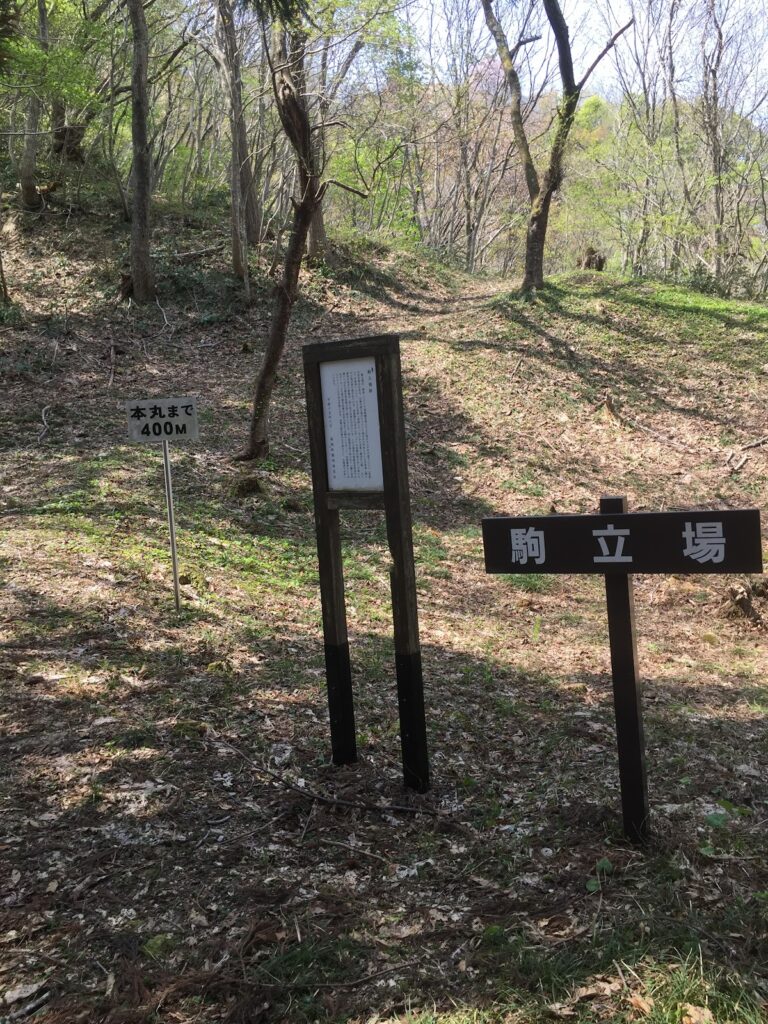
Horse Tether Site
The site commonly known as the “Horse Tether Site” is believed to have been used as a place to tether horses. It is thought to have played an important role as a logistics and movement base for the mountain castle.
From this site, traces of defensive structures utilizing the surrounding terrain can be observed, indicating that it functioned as part of the castle’s overall defensive system.
Dry Moat and Earthworks
One of the greatest highlights of the Oguni Castle ruins is the well-preserved dry moat and earthworks. These remains can still be clearly seen even after several hundred years.
The dry moat was an important defensive structure that separated the baileys and prevented enemy intrusion. Its depth and width suggest that large-scale civil engineering work was carried out. The earthworks were built by piling up soil excavated from the dry moat and functioned as a defensive wall.
Residence Site at the Foot of the Mountain
It is believed that a residence was located at the foot of the mountain for Oguni Castle, a mountain castle. In peacetime, the lord and his retainers lived in this residence, while in wartime, they would take refuge in the castle on the mountaintop.
Around the present-day Oguni settlement, place names and topographical features remain that indicate the former residence, allowing us to imagine the overall structure of the castle system, where the mountain castle and residence were integrated.
Historical Value of Oguni Castle Ruins
The Largest Elevation Difference in the Prefecture
The most distinctive feature of Oguni Castle Ruins is its elevation difference of approximately 235.5 meters from the foot of the mountain, the largest among medieval mountain castle ruins in Yamagata Prefecture. This large elevation difference demonstrates the castle’s high defensive capabilities and speaks to the immense effort invested in its construction.
A Strategic Point on the Uetsu Border
Oguni Castle was located on the Uetsu border, connecting Dewa Province (Yamagata Prefecture) and Echigo Province (Niigata Prefecture), and functioned as a border castle monitoring and defending major roads. This geographical location determined the strategic importance of the castle during the Sengoku period.
By controlling this key transportation hub connecting the Shonai region with the inland areas, it was possible to control the distribution of goods and military movements.
Remains that Tell the Story of the Shonai Region’s Conflict History
The remains at the Oguni Castle site are valuable historical documents that concretely tell the story of the Sengoku period conflicts in the Shonai region. The castle’s structure bears traces of repeated renovations and control by powerful daimyo such as the Mutō, Uesugi, and Mogami clans.
In particular, the outer masugata (square enclosure) built during the Uesugi clan’s renovation is of significant importance in castle history research as evidence that castle-building techniques from Echigo (present-day Niigata Prefecture) were brought to the Shonai region.
Preservation as a National Historic Site
Designated as a National Historic Site in 2002, the Oguni Castle site was recognized as a nationally important cultural heritage. This designation has facilitated the preservation and research of the remains, ensuring the transmission of this historical heritage to future generations.
Access and Visiting Information
Location
Address: Shiri, Oguni-machi, Tsuruoka City, Yamagata Prefecture (formerly Atsumi-machi, Tagawa District)
Transportation Access
Public Transportation:
- Approximately 10km southwest from JR Uetsu Main Line “Atsumi Onsen Station”
- It is convenient to use a taxi or rental car from the station.
Car:
- Approximately 15 minutes from Nihonkai Tohoku Expressway “Atsumi Onsen IC”
- Parking is available in the Oguni settlement.
About Visiting the Castle
The climb from the trailhead in the Oguni settlement to the main keep ruins takes approximately 40 minutes on foot. As it is a mountain castle, the following points should be noted:
- Clothing: Comfortable clothing and hiking boots or trekking shoes are recommended.
- Equipment: Bring drinking water, a towel, insect repellent, etc.
- Season: Spring to autumn is suitable for visiting the castle. It is dangerous in winter due to snow.
- Time: Allow approximately 2 hours for the round trip.
Points to Note During Your Visit
- Prior Study: Learning about the history of Oguni Castle before your visit will deepen your understanding of the ruins.
- Guidance: Local guided tours are sometimes held. Inquire with the Tsuruoka City Tourism Association.
- Photography: The view from the main keep ruins is spectacular. Don’t forget your camera!
- Observation of Ruins: Carefully observe the ruins such as the dry moats, earthworks, and masugata (square enclosures).
Nearby Tourist Attractions
Atsumi Onsen
This is the closest hot spring resort to Oguni Castle ruins, a historic hot spring town spreading around JR Atsumi Onsen Station. It’s perfect for relaxing after visiting the castle. With a history of over 1000 years since its opening, you can enjoy high-quality hot springs and seafood.
Shonai Oguni River
The Shonai Oguni River, flowing at the foot of Oguni Castle, is known for its clear waters and offers beautiful scenery throughout the seasons. It is particularly stunning during the fresh green season and the autumn foliage season.
Historical Sites in the Atsumi Area
Besides the ruins of Oguni Castle, the former Atsumi town is dotted with historical temples, shrines, and other historical sites. You can enjoy historical walks throughout the entire area.
Points to Note When Visiting Oguni Castle Ruins
Safety Management
- As it is a mountain castle, please be very careful of your footing.
- The ground becomes slippery during and after rain, so please be especially careful.
- Avoid climbing alone; it is recommended to visit with multiple people whenever possible.
- Check your cell phone signal strength beforehand.
Manners
- Please be aware that this is a nationally designated historical site and take care not to damage the remains.
- Please take all your trash with you.
- Collecting plants and capturing animals is prohibited.
- The use of fire is strictly prohibited.
Season and Weather
- Spring (April-June): The fresh greenery is beautiful, and the weather is mild, making it ideal for climbing the castle.
- Summer (July-August): Heat and insect repellent are necessary. Early morning visits are recommended.
- Autumn (September-November): The autumn foliage is magnificent, and the temperature is moderate. Most Popular Season
- Winter (December-March): Difficult to access due to snow. Season to avoid.
Differences from Other Oguni Castles
There are several castles named “Oguni Castle” in Yamagata Prefecture. Care must be taken to avoid confusion.
Oguni Castle (Mogami District, Dewa Province)
A mountain castle located in Honjo, Mogami-cho, Mogami-gun, Yamagata Prefecture. Also known as Iwabe-tate or Honjo-kan. It is believed to have been built on the site of the Mogami Hosokawa clan’s residence by the Oguni clan (Kuramasu clan), vassals of the Mogami clan.
Oguni Castle (Okitama District, Dewa Province)
A flatland castle located in Oguni-Kosaka-cho, Oguni-machi, Nishioitama-gun, Yamagata Prefecture. It existed from the Sengoku period to the Edo period. From 1692 (Genroku 5) onward, it was called “Oyakuya,” and is believed to have been built during the Tenbun era (1532-1555) by Kamigoriyama Moritame, a retainer of the Date clan.
Oguni Castle (Mutsu Province)
This mountain castle was located in Oguni, Hirakawa City, Aomori Prefecture, and served as the residence of Oguni Yasaburo Yasutsune during the late Kamakura period. It was a base for Oguni Yasutsune, known as a warrior of the Southern Court.
The Oguni Castle Ruins in Tsuruoka City is the only one of these designated as a National Historic Site, and stands out for its scale and excellent state of preservation.
Investigation and Research of the Oguni Castle Ruins
Archaeological Excavations
Multiple archaeological excavations were conducted at the Oguni Castle Ruins before and after its designation as a National Historic Site. These investigations have revealed the structure, changes, and period of use of the castle.
Excavated artifacts reveal traces of lifestyles and battles from the Sengoku period, illuminating a concrete historical picture that cannot be gleaned from written historical sources alone.
Creation of a Castle Layout Map
A detailed layout map has been created by castle researchers, revealing the overall structure of Oguni Castle. This layout map is an important resource for understanding the castle’s defensive system and movement patterns.
Academic Evaluation
Oguni Castle ruins are highly regarded in castle history research for the following reasons:
- Its structure as a large-scale mountain castle with the greatest elevation difference in the prefecture
- Clear traces of renovations by the Uesugi clan
- Its strategic location and historical role on the border of Uetsu Province
- The excellent state of preservation of the remains
Due to these characteristics, Oguni Castle ruins are positioned as one of the important case studies in the study of medieval Japanese mountain castles.
Preservation and Utilization of Oguni Castle Ruins
Preservation Activities
After its designation as a national historic site, Tsuruoka City formulated a preservation and management plan for the Oguni Castle Ruins and is striving for the appropriate preservation of the remains. Regular mowing and tree management are being carried out to maintain the visibility of the remains while also ensuring harmony with the natural environment.
Educational Activities
Local elementary and junior high schools provide opportunities for students to visit the Oguni Castle Ruins as part of their local history studies. The castle ruins are being utilized as a living teaching material for learning about the region’s history.
Utilization as a Tourism Resource
The Oguni Castle Ruins occupy an important position as part of the historical tourism route in the Shonai region. Diverse uses are being promoted, such as tourism plans combining the site with Atsumi Onsen (hot springs) and tours for history enthusiasts.
Summary
The Oguni Castle Ruins are a national historic site that Tsuruoka City, Yamagata Prefecture, is proud of. It is a large mountain castle built on Mt. Tateyama, which is 348.5 meters above sea level. With the largest elevation difference in the prefecture, approximately 235.5 meters, this castle played a crucial role in the Shonai region during the Sengoku period as a border castle protecting the Uetsu border and major highways.
From the Nanboku-cho period to the Sengoku period, the castle’s structure underwent repeated renovations as rulers changed hands from the Oguni clan to the Mutō, Uesugi, and Mogami clans. The outer masugata (square enclosure) of the main keep, built during the Uesugi clan’s renovations, is one of the castle’s greatest highlights.
Multiple baileys, including the main keep, the West Ōyashiki (large residence), the second bailey, the third bailey, and the Komaba-tachi (horse resting place), are arranged within the castle grounds, and remnants such as dry moats and earthworks are well-preserved. These remains are valuable historical heritage that convey the castle-building techniques and defensive systems of the Sengoku period.
Located approximately 10km from JR Atsumi Onsen Station, the climb from the trailhead to the main keep takes about 40 minutes. Spring to autumn is the best season to visit, making it a must-see spot for history buffs and castle enthusiasts.
By visiting the ruins of Oguni Castle, you can experience firsthand the history of conflict in the Shonai region during the Sengoku period and appreciate the magnificent mountain castle built by our ancestors. Please do visit this precious cultural heritage site where history and nature are intertwined.