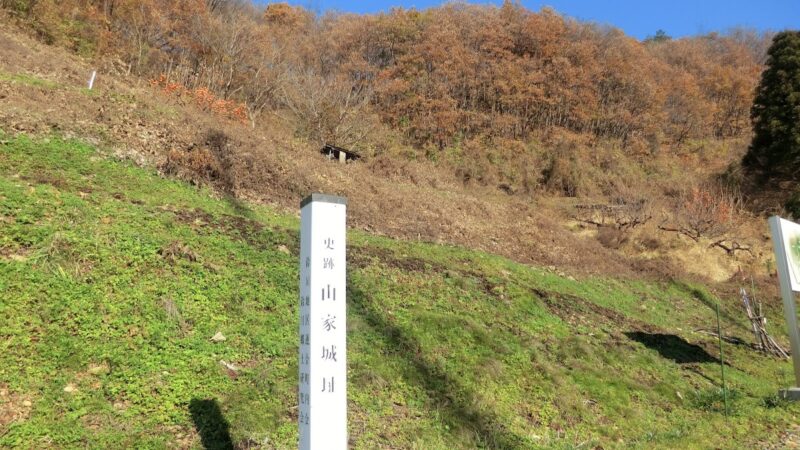
Oguni Castle, Tsuruoka City (Yamagata Prefecture) | The Complete History and Overview of a Medieval Mountain Castle Designated as a National Historic Site
Overview
Oguni Castle is a medieval mountain castle located in Shiri, Oguni-machi, Tsuruoka City, Yamagata Prefecture (formerly Atsumi-machi, Tagawa District). Situated on the summit of Mt. Tateyama, at an elevation of 348.5 meters, on the left bank of the Oguni River (Shonai Oguni River), it was designated a National Historic Site on December 19, 2002.
This castle played an important role as a border castle protecting the border between Uetsu and Echigo provinces from the Nanboku-cho period to the Sengoku period. The castle grounds boast a vast scale, approximately 1,030 meters east-west and 950 meters north-south, and are known as one of the largest mountain castles on the Sea of Japan side north of Toyama Prefecture.
Located approximately 10km southwest of JR Atsumi Onsen Station and about 6.5km east in a straight line from the Sea of Japan coast, Oguni Castle is situated southwest of the Oguni settlement. Even today, remnants such as earthworks, moats, and baileys remain in excellent condition.
History of Oguni Castle
Construction and the Era of the Oguni Clan
The exact construction date of Oguni Castle is uncertain, but it is believed to have been built by Oguni Masamitsu during the Nanboku-cho period. The Oguni clan was a powerful family that ruled this area during the Nanboku-cho period, using Oguni Castle as their base and controlling the Oguni region.
The Oguni area is strategically located on the Oguni Road, connecting Echigo and Dewa (Shonai), and has long been considered a vital transportation hub. It is believed that the Oguni clan leveraged this geographical advantage to build their power as regional rulers.
Changes in Rulers during the Sengoku Period
With the arrival of the Sengoku period, Oguni Castle came under the control of the Daiboji clan (Muto clan), who ruled Shonai. The Mutō clan was a powerful daimyo (feudal lord) of the Shōnai region during the Sengoku period. They positioned Oguni Castle as a crucial strategic point on the border between Echigo and Echigo provinces, and fortified it as a border castle to defend against invasions from Echigo.
Later, during the Tenshō era (1573-1592), it came under the influence of the Uesugi clan, and then later under the control of the Mogami clan, resulting in a rapid change of rulers. Each of these forces considered Oguni Castle important as a key point protecting the main road connecting Echigo and Shōnai, as well as the border between Echigo and Echigo, and strived to maintain and strengthen the castle’s fortifications.
Checkpoint Function and Formation of a Castle Town
Oguni Castle served not only as a military base but also as a checkpoint. It controlled people and goods traveling along the Oguni Road, functioning as a base for tax collection and maintaining public order.
Residences of samurai families, shrines, and temples were located around the castle, and a post town called Oguni-juku was formed. As a result, Oguni Castle supported the development of the Oguni region as a military, administrative, and economic center. ## Layout and Structure of Oguni Castle
Scale and Arrangement of the Castle Grounds
Oguni Castle boasts a vast area, approximately 1,030 meters east-west and 950 meters north-south. This makes it one of the largest mountain castles on the Sea of Japan side north of Toyama Prefecture, highlighting its high importance.
The castle is built on a ridge extending east-west and is composed of four main baileys. Centered around the highest point, the first bailey (Honmaru), the remains of the West Great Residence, the second bailey, the third bailey, and the horse stable site are arranged, forming a complex defensive system.
The elevation difference from the Oguni settlement is approximately 200 meters, and the Honmaru site can be reached in about 40 minutes using the hiking trail.
Structure of the First Bailey (Honmaru)
The first bailey (Honmaru), located at the highest point, covers an area of approximately 844 square meters. Earthen ramparts surround all four edges, enhancing its defensive capabilities. Below the earthen rampart is a steep cliff 7 meters high, and below that, a belt-shaped enclosure approximately 5.5 meters wide encircles the entire area. This belt-shaped enclosure was an important defensive structure for the main keep, serving to prevent enemy intrusion.
From the main keep, one can see the Oguni settlement, the flow of the Oguni River, and the surrounding valleys, demonstrating its strategically superior location.
Second and Third Enclosures and Defensive Facilities
Around the main keep are secondary enclosures such as the second and third enclosures. These enclosures also functioned as residential areas, and it is believed that they were used as living spaces for castle soldiers and retainers during peacetime.
Moats were constructed between the enclosures, preventing enemy intrusion and increasing the independence of each enclosure. Multiple entrances (koguchi) were provided on the north and south sides, each equipped with defensive facilities.
West Ooyashiki and Komatsunagatari
The West Ooyashiki site is a bailey located west of the main keep, possessing a relatively large, flat area. It has been suggested that this location may have been the site of the lord’s residence or the residences of senior retainers.
The Komatsunagatari site is thought to have been a place for tethering horses, and is presumed to have functioned as a waiting area for mounted warriors during wartime. Such a clearly preserved facility is a rare example of a medieval mountain castle.
Remains and Highlights of Oguni Castle
Earthworks and Cut Slopes
The greatest highlight of Oguni Castle is its well-preserved earthworks and cut slopes. In particular, the earthworks surrounding the main keep remain to a height of 1-2 meters, allowing visitors to experience the defensive system of a medieval mountain castle.
Cut slopes are artificially carved steep slopes, important defensive structures that made enemy intrusion difficult. At Oguni Castle, cut slopes reaching 7 meters in height remain, demonstrating the high level of technical skill involved.
Moats and Vertical Moats
Moats separating the baileys were a key element of Oguni Castle’s defense system. Multiple moats, approximately 3-5 meters deep, remain, enhancing the independence of the baileys and hindering enemy advances.
Vertical moats descending the slopes have also been identified; these are thought to have prevented enemies from climbing the slopes and also served a drainage function.
Entrances (Koguchi)
The entrances to the castle, the koguchi, were the areas requiring the strongest defenses. Oguni Castle had major koguchi on both the north and south sides, each equipped with defensive structures such as earthworks and stone walls.
Observing the structure of the koguchi allows us to understand the development of castle-building techniques from the medieval period to the Sengoku period.
Relationship between Oguni Castle and the Oguni Road
A Strategic Point Connecting Echigo and Shonai
The Oguni Road was an important route connecting Echigo Province (Niigata Prefecture) and the Shonai region of Dewa Province. Unlike the Hokkoku Kaido, which ran along the Sea of Japan coast, this inland route was considered important because it was relatively easy to travel even during the snowy winter months.
Oguni Castle was built overlooking this road and served to monitor and manage people and goods traveling along it. It functioned as a fortress to prevent enemy invasions during wartime and as a checkpoint during peacetime.
Frontline Border Guard
Located on the border between Uetsu and Echigo provinces, Oguni Castle was always on the front lines of border guarding. Especially during the Sengoku period, it was the front line where the Uesugi clan of Echigo and various forces in Shonai confronted each other, and it is believed to have been caught in the crossfire numerous times.
This characteristic as a border castle was the driving force behind the development of Oguni Castle into a large-scale mountain castle.
Significance of National Historic Site Designation
History of Historic Site Designation
Oguni Castle Ruins were designated a National Historic Site on December 19, 2002 (Heisei 14). This designation is proof that Oguni Castle has been recognized as having extremely high historical value as a medieval mountain castle.
The designation as a historical site was the result of many years of research and investigation by local preservation societies and researchers. Excavations and surveys revealed the castle’s structure and history, leading to widespread recognition of its importance.
Excellent State of Preservation
One of the main reasons Oguni Castle was designated a national historical site is the extremely good state of preservation of its remains. Located in the mountains, untouched by development, it retains almost its original appearance from the time of its construction.
Defensive structures such as earthworks, moats, cliffs, and gates are well-preserved, making them valuable resources for learning about the structure of medieval mountain castles. Furthermore, its large scale, one of the largest on the Sea of Japan side north of Toyama Prefecture, was also a factor in its high evaluation.
Value as a Regional Cultural Asset
Oguni Castle, as a representative medieval castle of Tsuruoka City and Yamagata Prefecture, is an important cultural asset that conveys the region’s history and culture. A local preservation society has been organized, and preservation and utilization activities, such as maintaining the hiking trails and installing information signs, continue.
With the designation as a historical site, appropriate preservation and management are being carried out with national support, and its use as a resource for historical education and tourism is also being promoted.
Access and Visiting Information for Oguni Castle
Access Method
Oguni Castle ruins can be accessed by car in about 15 minutes from JR Atsumi Onsen Station, or by taking a local bus. Heading south on the road leading into the Oguni settlement, you will find a signpost for the hiking trail entrance, and a parking lot is available near the entrance.
The most common route is from Prefectural Road 348 into the Oguni settlement. For car navigation, it is recommended to search for “Oguni Castle Ruins” or “Tsuruoka City, Oguni-machi, Shiri.”
Hiking Trail and Estimated Time
The hike from the trailhead to the main keep ruins takes about 40 minutes on foot. Although it is a mountain trail, it is relatively well maintained, and can be climbed with average physical fitness. However, caution is advised as the ground can become slippery during rainy weather and winter.
When hiking, it is recommended to wear comfortable clothing and non-slip shoes, and bring drinking water. Insect repellent is also necessary during the summer months.
Precautions for Visiting
Oguni Castle Ruins are designated as a national historic site, so visitors are required to be considerate of the preservation of the remains. Damaging the earthworks or cliffs, or collecting plants, is prohibited.
Also, as it is a mountain castle, cell phone reception may be poor in some areas. It is recommended to avoid hiking alone and, if possible, visit with others.
Best Season for Visiting
The best season to visit Oguni Castle Ruins is from spring to autumn. May, with its fresh greenery, and October, with its vibrant autumn foliage, offer particularly beautiful scenery and a pleasant visit.
Hiking becomes difficult in winter due to snow. In summer, overgrown vegetation can obscure the remains. The best time to observe the remains is immediately after the local preservation society has mowed the grass.
Nearby Tourist Attractions
Atsumi Onsen
Located approximately 10km from the Oguni Castle ruins, Atsumi Onsen is a hot spring resort with a history of over 1,000 years. After visiting Oguni Castle, relaxing in the hot springs is highly recommended.
The hot spring town boasts numerous inns and hotels, as well as plenty of day-trip bathing facilities. You can also enjoy a stroll along the Atsumi River that flows through the town.
Historical Landscape of Oguni Village
The Oguni village, spread out at the foot of Oguni Castle, is a historical settlement that retains the atmosphere of a former post town. Old houses, shrines, and temples are scattered throughout, allowing you to experience the atmosphere of yesteryear.
Information boards about Oguni Castle are also installed within the village, allowing you to learn about the castle’s history while strolling around.
Other Historical Sites in Tsuruoka City
Besides Oguni Castle, Tsuruoka City has many other historical sights. The area boasts numerous facilities that convey the history from the Edo period to the modern era, including the Tsurugaoka Castle Ruins (Tsuruoka Park), the Chido Museum, and the former Kazama Residence.
Visiting these sites in conjunction with Oguni Castle will allow you to experience the overall history of the Tsuruoka region.
Current Status and Future Challenges of Oguni Castle Research
Excavation and Research Results
Previous excavations have revealed much about the structure and changes of Oguni Castle. In particular, detailed surveys have been conducted regarding the layout of the baileys and the structure of the defensive facilities, resulting in the creation of precise layout maps.
Excavated artifacts have provided clues about the period in which the castle was used and the lifestyle of the time. Excavated items such as ceramics and iron products are important materials for considering the age and character of the castle.
Future Preservation and Utilization
Oguni Castle, designated as a National Historic Site, requires continued appropriate preservation and management. Continuous maintenance, including tree management and repair of collapsed areas, is necessary.
Furthermore, utilizing the site as a historical site is also an important issue. Efforts to convey the value of Oguni Castle to more people are expected, such as improving information boards, creating explanatory pamphlets, and conducting guided tours.
Research Utilizing Digital Technology
In recent years, research on castles has been advancing using digital technologies such as aerial photography using drones and 3D scanning technology. If such cutting-edge technologies are used in investigations of Oguni Castle, it may reveal new facts that have not been seen before.
Furthermore, it will be possible to recreate the castle’s appearance in its heyday using VR (virtual reality) technology, enabling new forms of historical experiences.
Summary
Oguni Castle, located in Tsuruoka City, Yamagata Prefecture, is a historical site of extremely high historical value as a medieval mountain castle. Built on Mt. Tateyama, at an altitude of 348.5 meters, this castle boasts one of the largest scales on the Sea of Japan side north of Toyama Prefecture, measuring approximately 1,030 meters east-west and 950 meters north-south.
Beginning with the Oguni clan during the Nanboku-cho period, and continuing through the Sengoku period under the rule of the Mutō, Uesugi, and Mogami clans, Oguni Castle consistently played a crucial role as a border castle protecting the Uetsu region. Located at a key transportation hub on the Oguni Road, and functioning as both a military base and a checkpoint, Oguni Castle is an indispensable part of the region’s history.
Designated a national historic site in 2002, its value has been widely recognized, and efforts are underway for its appropriate preservation and utilization. The well-preserved remains, including earthworks, moats, and cliffs, are invaluable resources for studying the structure of medieval mountain castles and continue to fascinate many castle enthusiasts and history buffs.
Located near Atsumi Onsen and relatively easy to access, Oguni Castle is a historic site you should definitely visit when in Yamagata Prefecture. Why not enjoy the view from the mountaintop while reflecting on medieval history?