Complete Guide to Ogaki Castle: The History and Highlights of the Famous Castle that Was the Stage of the Battle of Sekigahara
Located in Ogaki City, Gifu Prefecture, Ogaki Castle is a historically significant castle known as the base of Ishida Mitsunari’s army during the decisive Battle of Sekigahara. Also known as “Bijo” or “Kyorokujo,” it once boasted a beautiful keep designated as a National Treasure. This article comprehensively introduces all the information you need to know before visiting, from the detailed history of Ogaki Castle from its construction to the present day, to its highlights, exhibits, and access methods.
History of Ogaki Castle: From Construction to the Present
Construction Period: From the Muromachi Period to the Sengoku Period
There are several theories regarding the construction of Ogaki Castle, but the most widely accepted is that it was founded in 1535 (Tenbun 4) by Miyagawa Kichizaemonjo Yasusada (also known as Miyagawa Yasusada or Miyagawa Yasusada), a member of the Toki clan and governor of Mino Province. Initially, Ogaki Castle was a relatively small water castle, utilizing the Ushiya River and Suimon River as its outer moat, and consisting only of the main keep and the second bailey.
Ogaki was strategically important, located at a crucial transportation hub connecting the Nobi Plain with Omi and Kyoto, where the Tokaido, Nakasendo, and Hokkokukaido roads intersected. This geographical advantage formed the foundation for Ogaki Castle’s later development as a vital stronghold.
During the Sengoku period, Ujiie Naomoto (Bokuzen) became the castle lord and carried out large-scale renovations. These renovations gave Ogaki Castle the functionality of a full-fledged castle, and it was developed as a central castle in western Mino Province.
The Oda-Toyotomi Era: The Unifiers and Ogaki Castle
In 1567, when Oda Nobunaga pacified Mino Province, Ogaki Castle also came under the control of the Oda clan. Nobunaga recognized the strategic value of Ogaki Castle and appointed his senior retainer, Ujiie Naomoto, as its lord.
After the Honnō-ji Incident, during the era of Toyotomi Hideyoshi, Ōgaki Castle became even more important. Hideyoshi called Ōgaki Castle a “crucial castle” and appointed trusted generals such as Ikeda Tsuneoki and Ichiyanagi Naosue as its lords. In 1585, Hideyoshi’s nephew, Toyotomi Hidetsugu, became the lord of Ōgaki Castle and later rose to the position of regent. During this period, Ōgaki Castle flourished as the residence of a daimyo with a domain of 100,000 koku.
The Battle of Sekigahara and Ōgaki Castle
The most important event in the history of Ōgaki Castle is the Battle of Sekigahara in 1600. In this decisive battle for control of Japan, Ōgaki Castle made its mark in history as a central base for the Western Army.
As the Headquarters of the Western Army
Ishida Mitsunari designated Ōgaki Castle as the headquarters of the Western Army to oppose the Eastern Army led by Tokugawa Ieyasu. At Ogaki Castle, key Western Army generals such as Mitsunari, Ukita Hideie, Konishi Yukinaga, and Shimazu Yoshihiro gathered. Approximately 80,000 Western Army troops were assembled in the castle town, preparing to block the Eastern Army’s westward advance.
Ogaki Castle was chosen for its geographical advantage. Located near the confluence of the Tokaido and Nakasendo roads, and with easy access to supply lines to Kyoto and Osaka, it was an ideal base for preparing for a prolonged battle.
The Battle of Ogaki Castle
On the night of September 14th, 1600 (Keicho 5), the Western Army left Ogaki Castle and advanced towards Sekigahara. When the Western Army was defeated in the main battle of Sekigahara the following day, the remaining garrison at Ogaki Castle became isolated.
At Ogaki Castle, which was besieged by the Eastern Army’s Mizuno Katsunari, Matsudaira Yasunaga, and Tsugaru Tamenobu, Sagara Yorifusa, Akizuki Tanenaga, and Takahashi Mototane defended the castle. However, upon learning of the defeat in the main battle, they successively defected to the Eastern Army, and Ogaki Castle surrendered. This series of battles is known as the “Battle of Ogaki Castle.”
Edo Period: The Rule of the Toda Clan
After the Battle of Sekigahara, Tokugawa Ieyasu developed Ogaki Castle as the residence of a hereditary daimyo. Initially, Ishikawa Yasumichi was the lord of the castle, but from 1635 (Kanei 12) when Toda Ujitsune entered the castle, 11 generations of the Toda family ruled Ogaki as lords of a 100,000 koku domain until the Meiji Restoration.
During the Edo period, Ogaki Castle experienced a peaceful era, a stark contrast to the turmoil of the Sengoku period. Successive generations of the Toda clan focused on developing the castle town and promoting commerce and culture. Ogaki developed as a “city of water,” and industries utilizing its abundant groundwater flourished.
The castle grounds were also developed, and it was completed as a modern castle with a beautiful four-story, four-tiered keep at its center, surrounded by the main keep, second bailey, and third bailey. Water moats and earthen ramparts were also constructed, providing defensive functions as a flatland castle.
From the Meiji to the Early Showa Period: Until National Treasure Designation
After the Meiji Restoration, Ogaki Castle was abandoned due to the abolition of the feudal system. While many castle buildings were demolished, fortunately, Ogaki Castle’s keep was spared from destruction and preserved.
From the Meiji era to the early Showa period, Ogaki Castle’s keep was cherished by the citizens as a symbol of the region. Its historical and architectural value was recognized, and in 1936 (Showa 11), it was designated a former National Treasure (equivalent to the current Important Cultural Property). The four-story, four-tiered keep is rare nationwide, and its beautiful appearance was loved as a symbol of “Ogaki, the castle town.”
War Damage and Reconstruction: From Destruction to Reconstruction
On July 29, 1945, the Ogaki Castle keep, a national treasure, was destroyed in the Ogaki air raid. The castle town also suffered significant damage in this air raid, and many historical buildings were lost.
After the war, calls for the castle’s reconstruction grew among the citizens of Ogaki. Thanks to the enthusiasm and efforts of the citizens, the four-story, four-tiered keep was rebuilt in April 1959. The reconstructed keep features a reinforced concrete exterior, while the interior is housed as a museum focusing on the Battle of Sekigahara.
In 2017, it was selected as one of the “Continued Top 100 Japanese Castles,” reaffirming its historical value.
Architecture and Structure of Ogaki Castle
Features of the Keep
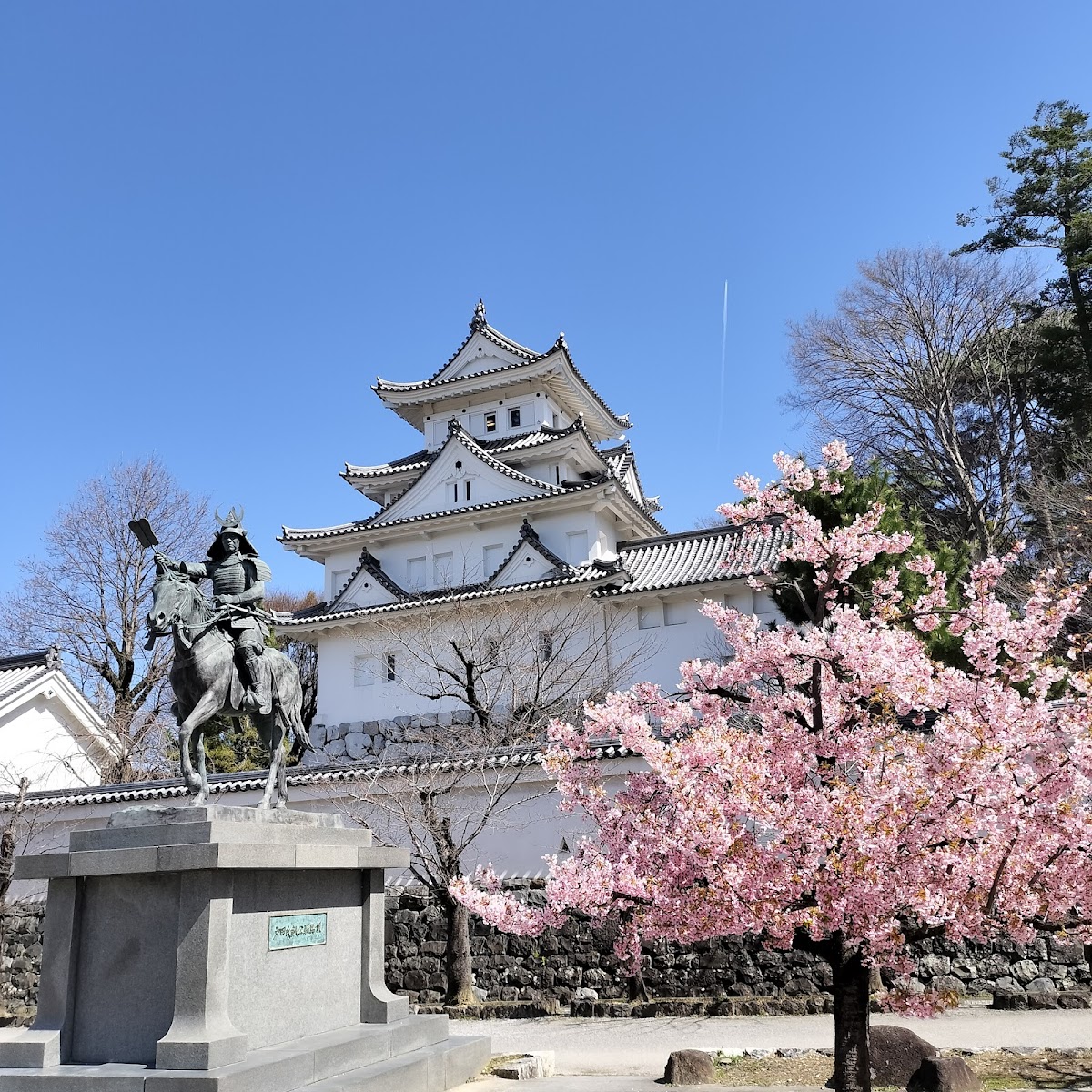
The Ogaki Castle keep has a four-story, four-tiered structure, a rare type of keep nationwide. The tower is approximately 20 meters tall, and the white walls and black clapboard siding create a beautiful contrast.
The top floor features an observation room offering panoramic views of Ogaki city. On clear days, you can even see Sekigahara, Mount Ibuki, and the Yoro Mountains, allowing you to imagine the scenery seen by the warlords of the Sengoku period.
Castle Layout
Ogaki Castle was a flatland castle, with the main keep at its center, surrounded by the second and third baileys. It was defended by moats and earthen ramparts, and featured the characteristics of a water castle, utilizing natural rivers such as the Suimon River as outer moats.
Currently, the main keep area has been developed into Ogaki Park, with the keep, surrounding stone walls, and part of the moat remaining. You can still imagine the vast castle grounds of yesteryear.
Ogaki Castle Exhibits
1st Floor: History of Ogaki Castle
On the first floor, you can learn about the history of Ogaki Castle from its construction to the present day through panel displays and models. The castle’s history is explained in detail, chronologically, from its construction by Miyagawa Yasusada, renovations by Ujiie Naomoto, the Battle of Sekigahara, the Toda clan’s rule, and the war damage and subsequent reconstruction.
2nd Floor: The Battle of Sekigahara and Ishida Mitsunari
The second floor focuses on exhibits related to the Battle of Sekigahara. It details the role of Ogaki Castle as the Western Army’s base, the activities of Western Army generals including Ishida Mitsunari, and the course of the battle.
Displays include battle formation diagrams, replicas of weapons and armor from the time, and historical documents, allowing visitors to experience the atmosphere of this pivotal battle.
3rd Floor: Life of Samurai and Commoners
The third floor showcases the lives of samurai and commoners in the Edo period castle town of Ogaki. Through everyday objects and documents, visitors can learn about the Toda clan’s rule, the development of the castle town, the state of commerce and industry, and the daily lives of commoners.
The museum also features detailed exhibits on Ogaki’s history as a “City of Water” and the industries that have utilized its abundant groundwater.
4th Floor: Observation Room
The top floor, the 4th floor, is an observation room offering a 360-degree panoramic view of Ogaki city. Visitors can see historical sites such as the Sekigahara area, Mount Ibuki, and the Yoro Mountains, experiencing the perspective of the warlords of the Sengoku period.
VR Video “Ogaki Castle”
In recent years, Ogaki Castle has also introduced exhibits utilizing VR (Virtual Reality) video. Visitors can experience videos that recreate the appearance of Ogaki Castle in its heyday and the scene during the Battle of Sekigahara using the latest technology.
Highlights of Ogaki Castle
Main Tower
The greatest highlight is undoubtedly the four-story, four-level main tower. The contrast between the white walls and black clapboard siding is beautiful, and it is a beloved symbol of the castle town of Ogaki. Especially during cherry blossom season, you can enjoy a beautiful landscape where the surrounding cherry blossoms and the castle tower harmonize.
Stone Walls and Moat
Around the main keep, parts of the original stone walls and moat remain, allowing you to feel the atmosphere of the Edo period castle. You can observe the techniques of castle construction up close, such as the way the stone walls are stacked and the arrangement of the moat.
Ogaki Park
The site of Ogaki Castle’s main keep has been developed into Ogaki Park, a place of relaxation for citizens. In spring, cherry blossoms bloom profusely, and it is known as a famous spot for cherry blossom viewing. Stone monuments and explanatory signs are also installed in the park, allowing you to learn about history while strolling around.
Surrounding Historical Spots
There are several related historical spots scattered around Ogaki Castle. Visiting Entsuji Temple, the family temple of the Toda clan, the remains of the Ogaki Domain School, and the historical townscape along the Suimon River in conjunction with the castle will allow you to understand the history of Ogaki more deeply.
Admission Fees and Opening Hours
Admission Fees
- General Admission: 100 yen
- Under 18: Free
*Group discounts and combined tickets with surrounding facilities are available. Please check the Ogaki City official website for details.
Opening Hours
- 9:00 AM – 5:00 PM (Last entry at 4:30 PM)
Closed Days
- Tuesdays (or the following day if Tuesday is a public holiday)
- The day after a public holiday
- Year-end and New Year holidays (December 29th – January 3rd)
*Temporary closures may occur due to exhibit changes, etc. Please check the latest information before visiting.
Access Information
Access by Train
From JR Tokaido Main Line/Yoro Railway “Ogaki Station”
- Walking: Approximately 10 minutes (approximately 700 meters)
- Exit the South Exit, head south along the station front street, and turn right at the Kuruwa-machi intersection. Ogaki Castle is located within Ogaki Park.
Ogaki Station is conveniently located, approximately 30 minutes from Nagoya Station and 10 minutes from Gifu Station on the Tokaido Main Line.
Access by Car
From Meishin Expressway “Ogaki IC”
- Approximately 15 minutes (approximately 5 kilometers)
- After exiting the Ogaki IC, take National Route 21 towards the city center. Follow the signs to reach Ogaki Castle.
From Tokai-Kanjo Expressway “Ogaki-Nishi IC”
- Approximately 20 minutes (approximately 7 kilometers)
Parking
There is no dedicated parking lot for Ogaki Castle, but there are several paid parking lots in the surrounding area. You can use the Ogaki City-operated parking lot or private parking lots. It can get crowded on weekends and holidays, so we recommend using public transportation.
Photography at Ogaki Castle
Personal commemorative photography is permitted at Ogaki Castle. However, permission is required in advance for commercial photography or photography using drones. For details regarding photography, please contact the Cultural Properties Department of Ogaki City Hall. Posting to social media is permitted, but please be considerate of other visitors’ privacy and take photos respectfully.
Points to Note When Visiting Ogaki Castle
Recommended Season
Spring (Late March to Early April)
Ogaki Castle is at its most beautiful during cherry blossom season. The contrast between the cherry blossoms in Ogaki Park and the castle tower is magnificent, attracting many visitors.
Autumn (November)
The autumn foliage season is also beautiful, allowing for a peaceful and tranquil castle visit. The weather is mild, making it ideal for sightseeing.
Estimated Time Required
For a visit to Ogaki Castle, approximately 1 hour is recommended if you want to thoroughly view the exhibits, while 30 minutes is sufficient for a quick look. If you plan to explore the surrounding historical sites as well, allow 2-3 hours.
Combining with Nearby Attractions
When visiting Ogaki Castle, we recommend combining it with the following nearby spots.
- Oku no Hosomichi Musubi no Chi Memorial Museum: Introduces the history of Ogaki, known as the place where Matsuo Basho ended his journey on “Oku no Hosomichi” (The Narrow Road to the Deep North).
- Around Suimon River: An area with beautiful historical townscapes and waterside scenery.
- Sekigahara Battlefield: Approximately 30 minutes by car. Visiting this area along with Ogaki Castle will deepen your understanding of the Battle of Sekigahara.
Summary: The Charm of Ogaki Castle
Ogaki Castle is a historically significant castle that was the stage for the Battle of Sekigahara, one of the most important battles in Japanese history. It has a long history as the base of operations for Ishida Mitsunari of the Western Army, and as the residence of the Toda clan, who held a 100,000 koku domain during the Edo period.
The beautiful castle tower, designated a national treasure before the war, was destroyed by fire during the war, but was rebuilt thanks to the enthusiasm of the citizens, and is still loved today as a symbol of “Ogaki, the castle town.” The unique four-story, four-tiered structure of the castle tower, the extensive exhibits, and the historical drama of the Battle of Sekigahara are major attractions of Ogaki Castle.
With easy access from Nagoya and Gifu, and reasonable admission fees, it’s a place you can easily visit. It’s a recommended spot not only for history buffs, but also for those interested in castle architecture and families.
When you visit Ogaki, be sure to visit Ogaki Castle and feel the weight of history that has continued from the Sengoku period to the present day. The view of Ogaki city from the observation room on the top floor of the castle tower will remind you of the view Ishida Mitsunari once saw, evoking a sense of historical romance.