Complete Guide to the History and Highlights of Ochi Castle | A Thorough Explanation of the Castle of the Ochi Clan, One of the Four Great Families of Yamato
What is Ochi Castle?
Ochi Castle is a medieval hilltop castle located in Ochi, Takatori-cho, Takaichi-gun, Nara Prefecture. As the base of the Ochi clan, a powerful local lord of Yamato Province (present-day Nara Prefecture), it played a central role in politics and military affairs within Yamato from the Nanboku-cho period to the Sengoku period.
Ochi Castle is a unique fortress built in a horseshoe-shaped valley opening to the south, skillfully utilizing the hilly terrain with a relative height of approximately 20 meters. Located in a long, narrow valley running east-west on the right bank of the Soga River, it is a natural stronghold surrounded on three sides by U-shaped hills.
Even today, remnants such as earthworks and moats remain, making it a valuable historical site for understanding the castle structure of medieval Yamato local lords.
Ochi Castle is a castle with a unique layout built in a horseshoe-shaped valley opening to the south, skillfully utilizing the hilly terrain with a relative height of approximately 20 meters. ## The History of the Ochi Clan and the Four Great Families of Yamato
The Origins and Expansion of Power of the Ochi Clan
The Ochi clan was a prominent family said to be descended from the Yamato Minamoto clan, which traced its ancestry to Emperor Seiwa, and was counted as one of the “Four Great Families of Yamato.” The Four Great Families of Yamato refers to four powerful local families: the Ochi, Toichi, Hashio, and Tsutsui clans, who wielded considerable power in medieval Yamato Province.
Ochi Chikaie, considered the first head of the Ochi clan, is said to have brought the Ochi Valley area under his control and founded the Amatsu Iwatowake Shrine. Many historical sites related to the Ochi clan remain around Ochi Castle, including the Yunan Shrine, which enshrines Chikaie, and Kounji Temple, which houses the tombs of successive generations of the Ochi clan.
The Ochi Clan During the Nanboku-cho Period
During the Nanboku-cho period, the Ochi clan played a central role in the Southern Court’s power. On the other hand, they fiercely opposed the Tsutsui clan, who sided with the Northern Court, and engaged in a power struggle within Yamato Province. During this period, the Ochi clan reigned as the most powerful force in the Nanwa region (southern Yamato Province).
The Battle of Tōmine and a Temporary Decline
During the time of Ochi Koretsugu, the Ochi clan suffered a defeat at the Battle of Tōmine, leading to a temporary decline. However, Koretsugu’s son, Ochi Ieie, succeeded in restoring their power with the support of the Hatakeyama clan, the governors of Kawachi Province.
During Ieie’s time, the Ochi clan regained enough power to overwhelm their former rival, the Tsutsui clan, and reached their peak in the latter half of the Muromachi period. During this time, the Ochi clan reigned as one of the most powerful local lords within Yamato Province.
Oda Nobunaga’s Invasion of Yamato and the Fall of Ochi Castle
Towards the end of the Sengoku period, as Oda Nobunaga’s influence extended to Yamato Province, the Ochi clan surrendered. In 1577 (Tensho 5), after suppressing Matsunaga Hisahide’s rebellion and pacifying Yamato Province, Oda Nobunaga ordered the destruction of all castles except for Koriyama Castle, the stronghold of the Tsutsui clan.
This order also resulted in the destruction of Ochi Castle, bringing an end to its history as the Ochi clan’s base, a position it held since the Middle Ages. This destruction order can be seen as a precursor to Nobunaga’s “One Castle Per Province” decree, fundamentally changing the governing system of Yamato Province.
Structure and Layout of Ochi Castle
Castle Structure Utilizing the Topography
Ochi Castle was a flatland castle built in a valley opening to the south. Its location offered excellent advantages in both defense and residential areas. The ridges surrounding it on three sides (excluding the south) served as strongholds, and a moat was constructed on the south side to further enhance its defenses.
The castle’s layout, skillfully utilizing the horseshoe-shaped hilly terrain, is a typical example of medieval castle design, demonstrating a design philosophy that maximized the use of the natural landscape.
Residential Area Structure
The flat area situated in the valley was leveled into three tiers: upper, middle, and lower, with the residence located on each level. While this area is now farmland, traces of two to three tiers of flat area can still be observed.
This tiered flat area structure is thought to have been a design choice for hierarchically arranging the lord’s residence, retainers’ quarters, and military facilities.
Defensive Structures
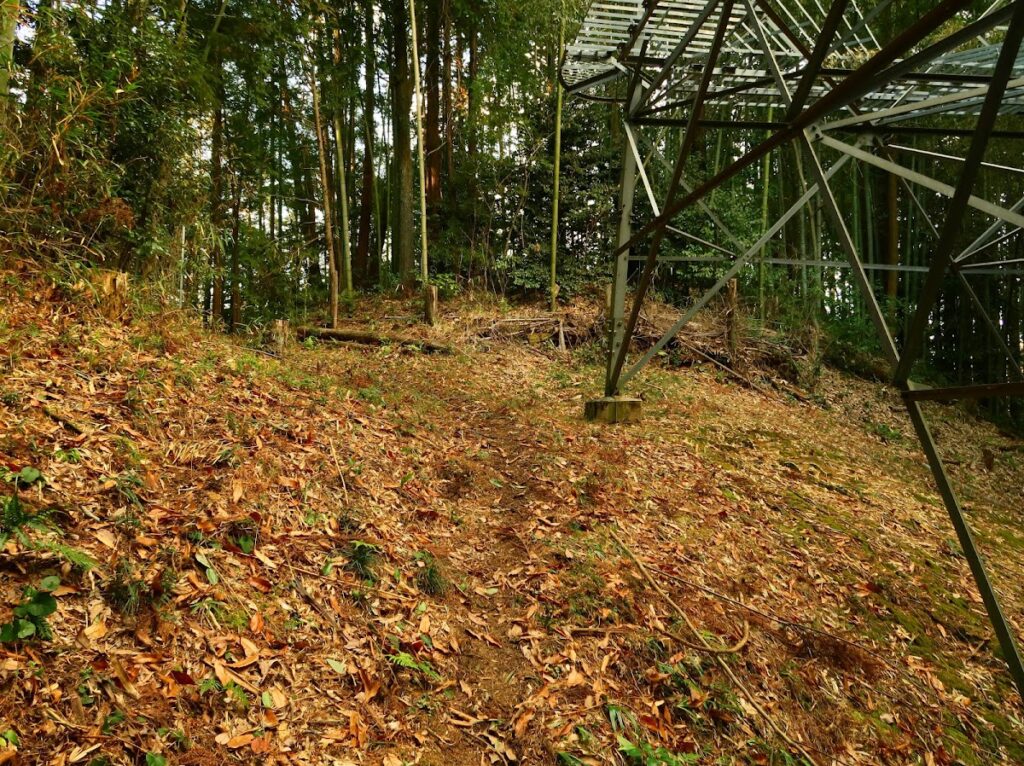
Dry moats and trenches remain on the southwestern mountaintop, providing insight into the defensive structures of the time. Traces of earthworks can also be found in various places, allowing for inferences about Ochi Castle’s defensive system from these remains.
A moat is an important defensive structure designed to cut off a ridge and prevent enemy intrusion. The remains suggest that Ochi Castle placed particular emphasis on its western defenses.
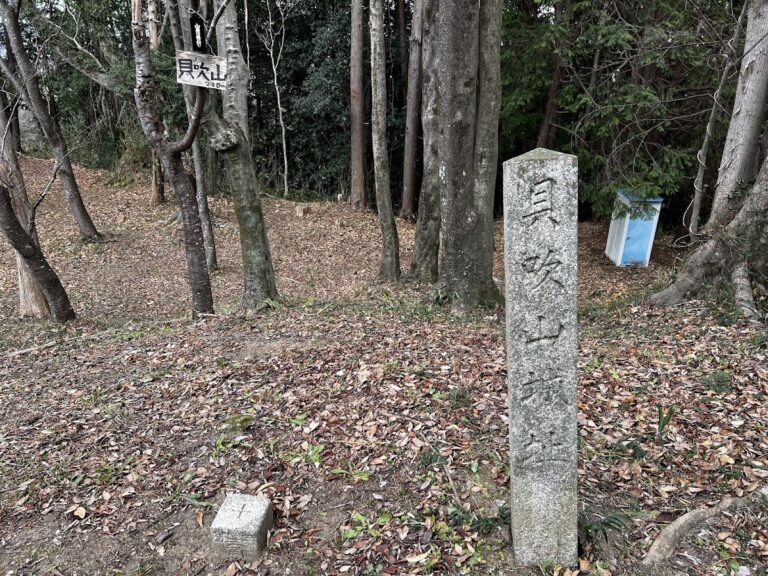
Relationship with Kaibukiyama Castle
Kaibukiyama Castle as a Fortified Outpost
Located approximately 1 kilometer east of Ochi Castle is Kaibukiyama Castle, which functioned as a fortified outpost for Ochi Castle. A fortified outpost refers to a mountain castle used as a refuge when the main castle was under attack.
Kaibukiyama Castle is thought to have been situated at higher elevations than Ochi Castle and possessed more robust defensive structures. This integrated castle system of the two castles was typical of the castle management practices of medieval Yamato people.
The Concept of a Castle-City Across the Entire Ochi Valley
Some views consider the entire Ochi Valley, including Ochi Castle and Kaibukiyama Castle, and even the Ochioka Hills, extending more than 2 kilometers from east to west, as a single large-scale castle complex. From this perspective, the Ochi clan’s base can be considered the largest “fortified city” among the medieval Yamato Province strongholds.
The Ochi Valley is dotted with temples, shrines, and residences associated with the Ochi clan, suggesting that it was not merely a military facility, but a comprehensive center with political, economic, and religious functions.
Highlights and Remains of Ochi Castle
Earthworks and Moats
The most clearly identifiable remains at the current Ochi Castle site are the earthworks and moats remaining on the southwestern mountaintop. The earthworks are earthen walls designed to prevent enemy intrusion, while the moats are a type of dry moat created by cutting through the ridge.
These remains have maintained their clear shape for over 500 years, demonstrating the high level of castle-building technology of the time. The moats, in particular, reach depths of several meters in some places, clearly demonstrating their function as defensive structures.
Terraced Flat Areas
In the valley where the residence is believed to have stood, terraced flat areas still remain today. These are composed of three levels: upper, middle, and lower, and it is presumed that each level had a different function.
The upper level is thought to have been the lord’s residence, the middle level the residences of senior retainers and facilities for administrative affairs, and the lower level likely the location of soldiers’ quarters and warehouses.
Related Historical Sites in the Surrounding Area
Numerous historical sites related to the Ochi clan exist around the Ochi Castle ruins. The Amatsu Iwatowake Shrine is said to have been founded by Ochi Chikaie, the first head of the Ochi clan, and Chikaie is enshrined at the Yunan Shrine. Furthermore, the Kounji Temple houses the tombs of successive generations of the Ochi clan, allowing visitors to reflect on the history of the Ochi clan.
By visiting these historical sites, you can gain a comprehensive understanding of the lifestyle, culture, and beliefs of the people of Yamato Province during the medieval period, going beyond simply visiting the castle ruins.
The Ochi Clan and the Noh Theater “Ochi Kanze”
A notable cultural contribution of the Ochi clan is their patronage of the Noh theater “Ochi Kanze.” Noh, a representative performing art of the medieval period, flourished in Yamato Province under the protection and support of the Ochi clan.
The Ochi Kanze is considered one of the origins of the Kanze school of Noh, serving as evidence of the Ochi clan’s high level of cultural sophistication. This reveals the multifaceted nature of the Ochi clan, who exerted a significant influence on Yamato Province not only militarily but also culturally.
Access to Ochi Castle
Location
Ochi, Takatori-cho, Takaichi-gun, Nara Prefecture
Access by Public Transportation
Approximately 30 minutes on foot from Kintetsu Yoshino Line “Ichio Station,” or approximately 10 minutes by taxi from Kintetsu Yoshino Line “Tsubosakayama Station.” Bus services are limited, so it is recommended to check the timetable in advance.
Access by Car
From the Minami-Hanna Expressway “Katsuragi IC,” it’s approximately 30 minutes via National Route 165 and Prefectural Route 35. There is a parking lot at the Takaichi Community Center, from which you can access the castle ruins on foot.
From Prefectural Route 35, head east, turn left, cross the river, and turn right to arrive at the Takaichi Community Center. Parking at the community center is free, but please note that parking may not be available depending on the community center’s usage.
Points to Note During Visits
The Ochi Castle Ruins are not a developed tourist area; much of the site consists of forest and farmland. Please note the following points when visiting:
- Wear comfortable clothing and walking shoes.
- Do not trespass on private property.
- Do not damage the ruins or dig up the soil.
- Always take your trash with you.
- Be especially careful during rainy weather or after rain, as the ground can be slippery.
- Take insect repellent in the summer.
Relationship between Ochi Castle and Takatori Castle
The Ochi clan is also known for later laying the foundation for Takatori Castle. Takatori Castle is a famous castle counted among Japan’s three greatest mountain castles, and its origins are said to date back to a fort built by the Ochi clan.
The development process from Ochi Castle to Takatori Castle is a good example of the changes in castles from the medieval to the early modern period, and visiting both castles together will allow you to gain a deeper understanding of the history of castles in Yamato Province.
Historical Significance of Ochi Castle
Importance as a Base for Local Lords of Yamato Province
Ochi Castle is not merely a castle; it is an extremely important historical site for understanding the local lord system in medieval Yamato Province. As the base of the Ochi clan, one of the four prominent families of Yamato Province, Ochi Castle symbolized the political and military situation of Yamato Province from the Nanboku-cho period to the Sengoku period.
Conflict with the Tsutsui Clan and the Process of Unifying Yamato Province
The long-standing conflict between the Ochi and Tsutsui clans was a crucial element in the process of unifying Yamato Province. Ultimately, Oda Nobunaga’s intervention gave the Tsutsui clan the upper hand, and Ochi Castle was destroyed. This process provides valuable insights into the nature of local governance during the Sengoku period.
Research Value of the Castle Structure
The structure of Ochi Castle, with its horseshoe-shaped valley layout, integrated two-castle system with a fortified outpost, and terraced residence arrangement, provides important data for the study of medieval castles. In particular, Ochi Castle is indispensable for understanding castle construction techniques that utilized the unique topography of Yamato Province.
Nearby Tourist Attractions
Takatori Castle Ruins
Takatori Castle, whose foundation is said to have been laid by the Ochi clan, is one of Japan’s three great mountain castles and a magnificent castle with impressive stone walls. Located about 15 minutes by car from Ochi Castle, it’s recommended to visit both.
Tsubosaka-dera Temple (Nan-Hokke-ji Temple)
This ancient temple, known for its healing of eye diseases, is about 20 minutes by car from Ochi Castle. It boasts many attractions, including a large stone statue of Kannon and stone artifacts imported from India, and is also famous for its cherry blossoms and autumn foliage.
Asuka Village
The Asuka region, the center of ancient Japan, is about 20 minutes by car from Ochi Castle. It’s dotted with must-see spots for ancient history enthusiasts, such as the Ishibutai Kofun, Takamatsuzuka Kofun, and Kitora Kofun.
Summary
Ochi Castle, as the residence of the Ochi clan, one of the four prominent families of Yamato, played a crucial role in the history of Yamato Province from the Nanboku-cho period to the Sengoku period. The unique layout utilizing the horseshoe-shaped valley, the integrated system with Kaibukiyama Castle, and the remaining earthworks and moats provide invaluable historical materials for understanding the castles of the Yamato people during the medieval period.
Until its destruction by order of Oda Nobunaga, Ochi Castle continued to function as the base of the Ochi clan. It was not merely a military facility, but also played a role as a center of politics, economy, and culture. Its cultural contributions, such as the patronage of the Noh theater troupe “Ochi Kanze,” should not be overlooked.
Although the castle ruins now stand in a quiet mountain village, the remains allow us to imagine its former glory. This historical site is a must-visit for anyone interested in the medieval history of Yamato Province or castle enthusiasts. Visiting it along with other related historical sites and Takatori Castle will provide a deeper understanding of history.