Nishinomiya Castle (Ikoma District, Nara Prefecture) Complete Guide | Sites Associated with Shima Sakon and Highlights of the Castle Ruins
What is Nishinomiya Castle? | Historic Castle Ruins in Heguri Town, Ikoma District, Nara Prefecture
Nishinomiya Castle is a medieval hill castle located in Nishinomiya 1-chome, Heguri Town, Ikoma District, Nara Prefecture. Built on a small hill approximately 92 meters above sea level with a relative height difference of about 30 meters, this castle attracts attention from history buffs as the birthplace of Shima Sakon (Shima Kiyooki), a renowned military strategist of the Sengoku period.
Currently, the castle ruins are being developed into a residential area, but the undulations of the terrain and traces of the baileys allow us to imagine its former appearance. Located in the northwestern part of the Nara Basin, near the Tatsuta River, a tributary of the Yamato River system, it occupied an important position as a transportation hub.
Basic Information on Nishinomiya Castle
- Location: 1-chome, Nishinomiya, Heguri-cho, Ikoma-gun, Nara Prefecture
- Castle Structure: Hilltop Castle (Hilltop Castle)
- Elevation: Approximately 92 meters
- Relative Height: Approximately 30 meters
- Construction Period: Around the mid-Muromachi period (estimated)
- Builder: Shima clan
- Main Lord: Shima clan
- Year of Abandonment: Unknown (estimated to be around the end of the Sengoku period)
- Remains: Remains of baileys, remains of earthworks (partial)
- Cultural Property Designation: None
History as the Shima Clan’s Base
The Shima Clan’s Origins and Relationship with Heguri-cho
The Shima clan was a local powerful family based in Heguri-gun, Yamato Province. The area around Heguri Town was within the sphere of influence of the Heguri clan from ancient times, and even in the Middle Ages, powerful local samurai groups held sway. The Shima clan was one such group, and it is believed they established their residence in Nishinomiya and controlled the surrounding area.
While detailed historical records regarding the Shima clan’s lineage are limited, it is believed that during the Sengoku period, they maintained their own power while serving powerful daimyo of Yamato Province, such as the Tsutsui clan and Matsunaga Hisahide. Nishinomiya Castle served as their base, playing a central role in both politics and military affairs.
Nishinomiya Castle in the Sengoku Period
During the Sengoku period, Yamato Province became the stage for conflict between the Tsutsui clan and Matsunaga Hisahide. The area around Nishinomiya Castle was no exception, and it is believed that the Shima clan skillfully employed diplomatic tactics to navigate the conflict between these two forces.
Although the castle was not particularly large, its layout, which cleverly utilized the hilly terrain, is thought to have possessed a strong defensive capability despite its small size. Located overlooking the Heguri Valley, it was a strategically important location for monitoring the road along the Tatsuta River.
The Birthplace of Shima Sakon (Shima Kiyooki)
Who Was Shima Sakon?
Shima Sakon (real name Shima Kiyooki) was a samurai who was active from the late Sengoku period to the Azuchi-Momoyama period. He served Ishida Mitsunari and is known for his role as his strategist in the Battle of Sekigahara.
As the satirical poem “There are two things that are too good for Mitsunari: Shima Sakon and Sawayama Castle” suggests, Shima Sakon’s bravery and strategic brilliance were highly regarded even in his time. The anecdote that Ishida Mitsunari offered him half of his own stipend to employ him speaks volumes about Sakon’s high value.
The Relationship Between Nishinomiya Castle and Shima Sakon
There are various theories about Shima Sakon’s birthplace, but Nishinomiya in Heguri Town is considered the most likely. It is believed that he was born and raised at Nishinomiya Castle, the base of the Shima clan, and spent his childhood there.
Shima Sakon’s birth is estimated to have been around the Tenbun era (1532-1555), coinciding with the period when Nishinomiya Castle functioned as the Shima clan’s base. It is likely that in his youth, Sakon studied martial arts and military strategy at this castle, laying the foundation for his later success.
The Life and Achievements of Shima Sakon
Shima Sakon is believed to have initially served Tsutsui Junkei, but many aspects of his subsequent career remain unclear. Ultimately, he served Ishida Mitsunari, becoming his trusted military advisor.
At the Battle of Sekigahara (1600), he fought valiantly as a core member of the Western Army, engaging fiercely against the Eastern Army’s Kuroda Nagamasa and Tanaka Yoshimasa units. While he is believed to have died in battle, theories of his survival persist.
Sakon’s tactical acumen and command abilities were highly regarded by both friend and foe, leading to the saying, “If Shima Sakon hadn’t supported Mitsunari, the Western Army would have collapsed much sooner.”
Structure and Layout of Nishinomiya Castle
Basic Structure of the Castle
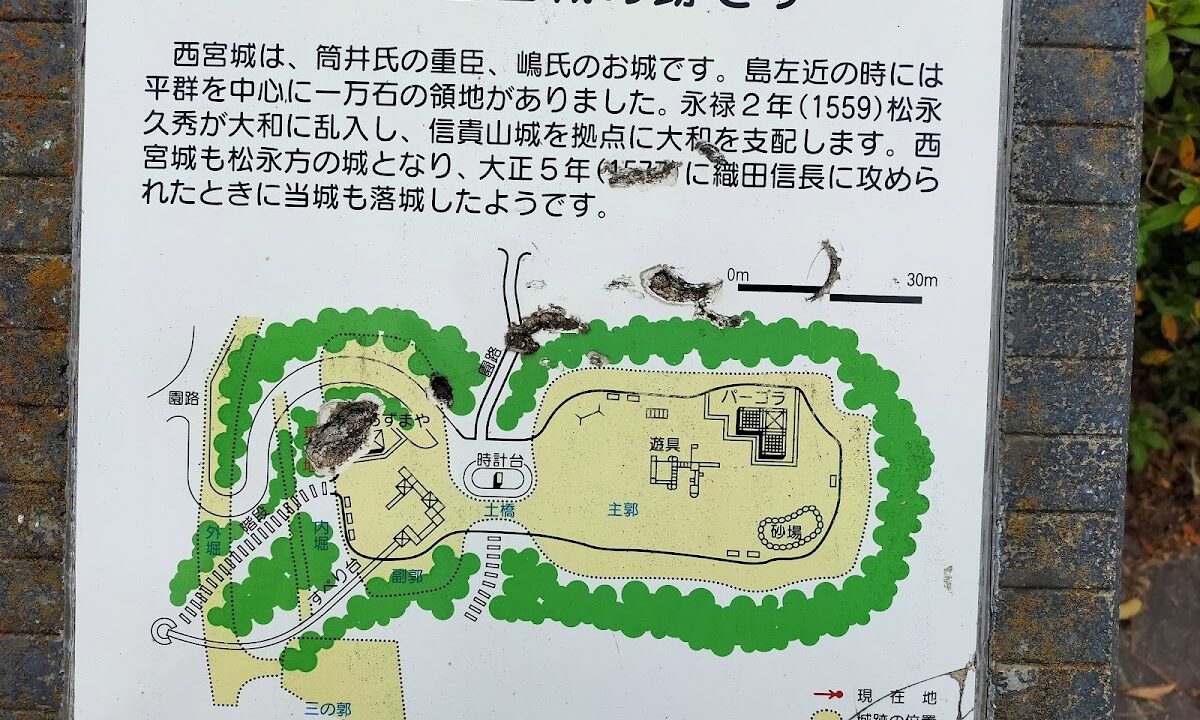
Nishinomiya Castle is a typical medieval hill castle, with a layout that makes maximum use of the natural terrain. It is presumed that multiple baileys were arranged around the main bailey.
Currently, the area is being developed into a residential area, making it difficult to confirm clear remains. However, the locations of former baileys and moats can be inferred from the topography and road layout. The castle area is thought to be approximately 200 meters east-west and 150 meters north-south.
Characteristics of Defensive Structures
The defenses of Nishinomiya Castle consisted mainly of the following elements:
- Utilization of Natural Terrain: The steep slopes of the hills were used as natural defensive walls.
- Arrangement of Enclosures: Multiple enclosures were arranged in stages around the main enclosure.
- Earthworks: Earthworks surrounding the enclosures (some traces remain).
- Moat: A moat cutting across the ridge (estimated from the terrain).
- Gate Marker: Skillfully placed gate marks serving as entrances and exits.
A notable feature is that no stone walls were used; it was an earthen fortress. This is a common characteristic of castles in medieval Yamato, indicating a style of construction before the full-scale introduction of stone wall technology.
Existing Remains
Currently, only a limited number of remains can be confirmed at the Nishinomiya Castle site, but with careful observation, the following traces can be found:
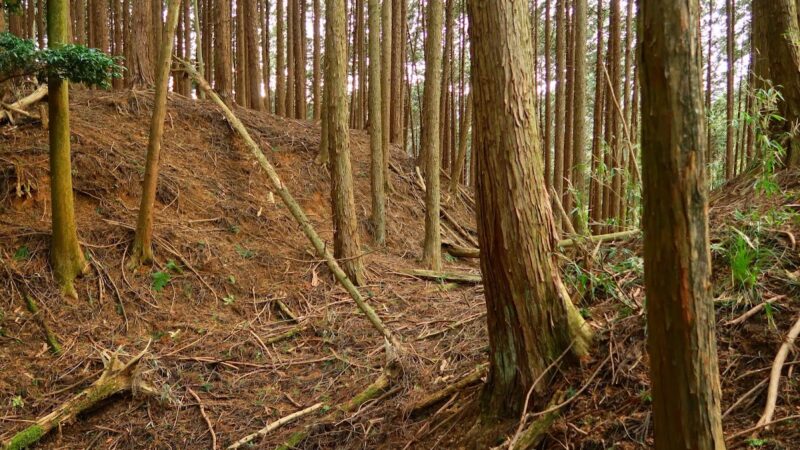
- Flat Area of Enclosure: An unnatural flat area remaining within a residential area
- Traces of Earthworks: Earthen mounds remaining on some property boundaries
- Topographical Differences: Topography indicating differences in elevation between enclosures
- Traces of Ancient Roads: A path believed to be the former route to the castle
Access and Visiting Information for Nishinomiya Castle
Access by Public Transportation
By Train:
- Get off at Kintetsu Ikoma Line “Heguri Station,” approximately 15 minutes on foot
- Get off at Kintetsu Ikoma Line “Tatsutagawa Station,” approximately 20 minutes on foot
Heguri Station is the nearest station. From the station, head towards Nishinomiya; the castle site is on a small hill within a residential area. The paths are well-maintained, so you are unlikely to get lost.
By Bus:
- Get off at the “Nishinomiya” bus stop on the Nara Kotsu bus line, then walk for about 5 minutes.
Since bus service is limited, we recommend checking the timetable in advance.
Access by Car
Route from Major Roads:
- Approximately 10 minutes from the “Ikoma IC” on the Hanwa Expressway
- Approximately 20 minutes from the “Horyuji IC” on the Nishimeihan Expressway
- Approximately 15 minutes from the “Ichibu IC” on the Daini Hanwa Expressway
Car Navigation Settings:
- Address: 1-chome, Nishinomiya, Heguri-cho, Ikoma-gun, Nara Prefecture
- Target Facility: Nishinomiya area, Heguri-cho
Parking Information
There is no dedicated parking lot at Nishinomiya Castle Ruins. When visiting, please consider the following options:
- Use a paid parking lot near Heguri Station (15-minute walk)
- Use nearby coin-operated parking lots (limited number available)
- Use of public transportation is recommended
Street parking is strictly prohibited as it is located in a residential area. Please be considerate of nearby residents and avoid causing any inconvenience.
Notes for Visitors
The Nishinomiya Castle Ruins are currently mostly private property. Please observe the following points when visiting:
- No trespassing on private property: Viewing within residential areas is limited to public roads.
- Consideration for residents: Avoid loud conversations and visits early in the morning or late at night.
- Take your trash with you: Cooperate with environmental conservation.
- Photography: Take care to avoid including houses or residents in your photos.
- Ensure safety: Do not approach steep slopes or areas prone to landslides.
Estimated Visiting Time
Please allow the following times for visiting the Nishinomiya Castle Ruins:
- Short Visit: Approximately 30 minutes (main areas only)
- Standard Visit: Approximately 1 hour (including a stroll around the surrounding area)
- Detailed Visit: 1.5 to 2 hours (including topographical observation and photography)
Including round-trip time from Heguri Station, we recommend allocating about half a day.
Nearby Attractions and Tourist Spots
Historical Sites in Heguri Town
Shigisan Chogosonshi-ji Temple: Located in the southern part of Heguri Town, this ancient temple is known as a center of Bishamonten worship. It’s about a 15-minute drive from Nishinomiya Castle, making it a convenient visit in conjunction with a tour of the castle ruins. The view from the temple grounds is magnificent, offering a panoramic view of the Yamato Basin.
Heguri Shrine: This shrine is associated with the ancient Heguri clan and is located about a 10-minute walk from Nishinomiya Castle. The quiet grounds are perfect for a stroll, allowing visitors to experience the region’s history.
Tatsuta River: Known as a famous spot for autumn foliage, even mentioned in the Hyakunin Isshu (One Hundred Poets, One Poem Each), the Tatsuta River flows north of Nishinomiya Castle. Beautiful autumn leaves can be enjoyed here, and walking paths are well-maintained.
Nearby Castle Ruins
Tsubaki Castle: A medieval mountain castle located in the southern part of Heguri Town, which functioned at the same time as Nishinomiya Castle. More clearly defined remains are preserved, making it a worthwhile visit for castle enthusiasts.
Tatsuta Castle: An ancient strategic point located along the Tatsuta River, approximately 3 kilometers from Nishinomiya Castle. While few remains exist today, it is a historically significant castle site.
Shigisan Castle: A mountain castle extensively renovated by Matsunaga Hisahide, approximately 20 minutes by car from Nishinomiya Castle. The stone walls and bailey remains are well-preserved, conveying the appearance of a Sengoku period mountain castle.
Nature and Scenery of Heguri Town
Heguri Town is located at the western foot of the Ikoma Mountains and is blessed with abundant nature. Even though the area around Nishinomiya Castle is a residential area, a lush green environment is maintained.
- Ikoma Mountain Range Hiking Courses: Multiple courses are available, allowing you to enjoy nature in every season.
- Heguri Valley Rural Landscape: Beautiful scenery that evokes the original landscape of Japan.
- Famous Cherry Blossom and Autumn Foliage Spot: Particularly beautiful scenery unfolds in spring and autumn.
Historical Value and Future Challenges of Nishinomiya Castle
Historical and Cultural Value
Nishinomiya Castle possesses significant historical value in the following respects:
- Birthplace of Shima Sakon: A place associated with the famous military strategist of the Sengoku period.
- Research on Medieval Yamato Castles: A typical example of an earthen hill castle.
- Important Center for Local History: A key to unraveling the medieval history of the Heguri region.
- The Reality of Local Lords: The place where the Shima clan, a local lord, lived and worked.
Current Status of Preservation and Utilization
Currently, the Nishinomiya Castle ruins are not designated as a cultural property, and public efforts for preservation are limited. There are concerns about the disappearance of the remains as residential development progresses. On the other hand, local history enthusiasts and researchers continue their research and documentation activities, making efforts to pass on the historical value of the castle ruins to future generations.
Future Prospects and Challenges
The following challenges exist regarding the preservation and utilization of the Nishinomiya Castle ruins:
Preservation Challenges:
- Large-scale excavation is difficult due to its location within a residential area.
- Consideration of protection through cultural property designation is necessary.
- Detailed surveying and documentation of remaining structures is required.
Utilization Possibilities:
- Developing it as a tourist resource associated with Shima Sakon.
- Disseminating information through the installation of historical explanatory signs.
- Utilizing it for local history education.
- Incorporating it into walking courses.
In Heguri Town, town development utilizing local historical resources is underway, and the Nishinomiya Castle ruins are attracting attention as part of this effort.
Things to Know Before Visiting Nishinomiya Castle
Best Time to Visit
Nishinomiya Castle Ruins are open year-round, but the following times are especially recommended:
Spring (March-May):
- Mild weather, perfect for strolling
- Beautiful scenery during cherry blossom season
- Beautiful fresh greenery, ideal for photography
Autumn (October-November):
- Cool and pleasant weather for walking
- Beautiful autumn foliage
- Can be enjoyed in conjunction with the autumn leaves along the Tatsuta River
Times to Avoid:
- Mid-Summer (July-August): Hot and insect-heavy
- Rainy Season (June): Muddy ground due to rain
- Mid-Winter (January-February): Extremely cold
Clothing and Items to Bring
Recommended Clothing:
- Comfortable clothing (casual everyday wear is acceptable)
- Comfortable walking shoes (sneakers, etc.)
- Hat (for sun protection)
- Appropriate jacket for the season
Useful items to bring:
- Drinking water
- Camera (for recording)
- Binoculars (for topographical observation)
- Map or guidebook
- Notebook and writing utensils
- Insect repellent (summer)
- Rain gear (for unstable weather)
Points for visiting castle ruins
Points for effectively visiting Nishinomiya Castle ruins:
- Prior study: Review the history of the Shima clan and Shima Sakon
- Topographical observation: Read the topography to determine the layout of the baileys and the remains of defensive structures
- Surrounding environment: Check the view from the castle and its relationship to the road
- Photo documentation: Record your observations with photographs
- Interacting with locals: If possible, talk to locals
Nishinomiya Castle and the Sengoku period history of Yamato Province
The Sengoku Period in Yamato Province
During the Sengoku period, Yamato Province was characterized by a unique political situation where religious forces centered around Kofuku-ji Temple and samurai forces such as the Tsutsui clan and Matsunaga Hisahide were intricately intertwined.
The Shima clan, based at Nishinomiya Castle, also sought to survive within this complex political environment. Understanding the Sengoku history of Yamato Province clarifies the historical position of Nishinomiya Castle.
The Conflict Between the Tsutsui Clan and Matsunaga Hisahide
A defining characteristic of the Sengoku period in Yamato Province is the long-running conflict between the Tsutsui clan and Matsunaga Hisahide. The two fiercely opposed control of Yamato Province, and many castles became battlefields.
It is believed that the Shima clan maintained their power during this conflict, sometimes siding with the Tsutsui clan and sometimes with the Matsunaga clan. The record that Shima Sakon served Tsutsui Junkei in his youth can be understood within this context.
Oda Nobunaga’s Invasion of Yamato
During the Tensho era (1573-1592), Oda Nobunaga intervened in Yamato Province and defeated Matsunaga Hisahide. Afterward, Yamato Province came under the control of Tsutsui Junkei, but after Junkei’s death, it became a direct territory of Toyotomi Hideyoshi.
The fate of the Shima clan and Nishinomiya Castle during this period is unclear, but like many small and medium-sized castles, it is presumed to have been abandoned as the unified government progressed.
Summary: The Charm and Significance of Visiting Nishinomiya Castle
Although not large in scale, Nishinomiya Castle holds significant historical value as the birthplace of Shima Sakon, a renowned military strategist of the Sengoku period, and as a valuable historical site that reveals the realities of local powerful families in medieval Yamato.
Currently a residential area, with few clear remains, it is possible to imagine its former appearance by observing the topography. For history buffs, especially those interested in Shima Sakon and the Sengoku period, it is a place worth visiting.
Nishinomiya Castle Ruins, nestled amidst the rich natural beauty and historical atmosphere of Heguri Town, offers a tranquil opportunity to reflect on history. Visiting the ruins in conjunction with the nearby Shigisan Chogosonshi Temple and the autumn foliage along the Tatsuta River will undoubtedly enrich your historical exploration.
When visiting the castle ruins, please be mindful that it is a residential area and observe proper etiquette. Enjoy a journey that evokes the romance of the Sengoku period while respecting the local history and culture.