Complete Guide to Nishikata Castle (Tochigi Prefecture) | History and Highlights of a National Historic Site Mountain Castle
What is Nishikata Castle Ruins? A Mountain Castle in Tochigi Designated as a National Historic Site
Nishikata Castle is a Japanese castle ruin located in Honjo, Nishikata-machi, Tochigi City, Tochigi Prefecture (formerly Tsuga District, Shimotsuke Province). Built on the eastern slopes of Shiroyama (221.3 meters above sea level), located at the eastern end of the Ashio Mountains, it was officially designated a National Historic Site on October 11, 2024.
This castle, which served as the ancestral home of the Nishikata clan, a branch of the Utsunomiya clan, was used for over 200 years, from the early Muromachi period to the end of the Sengoku period. It is valued as a precious historical site that conveys the highest level of castle construction technology of the time.
On June 24, 2024, the National Council for Cultural Affairs, in its Cultural Properties Subcommittee meeting, recognized the historical value and excellent state of preservation of the Nishikata Castle ruins and recommended to the Minister of Education, Culture, Sports, Science and Technology that it be designated a historical site. This means that it has become a nationally protected site as an important medieval castle ruin within Tochigi Prefecture.
History of Nishikata Castle | The Residence of the Nishikata Clan, a Branch of the Utsunomiya Clan
Establishment of the Nishikata Clan and Castle Construction
While there are no clear records of the exact construction date of Nishikata Castle, it is believed to have been built in the early Muromachi period. The Nishikata clan, the lords of the castle, were a branch of the Utsunomiya clan, a powerful samurai family in Shimotsuke Province, descended from Nishikata Kagetai.
The Utsunomiya clan was a prestigious family that ruled Shimotsuke Province from the Kamakura period to the Muromachi period. Their branches spread throughout Shimotsuke Province, governing their respective territories. The Nishikata clan was one such branch, based in the present-day Nishikata area of Tochigi City.
Nishikata Castle in the Sengoku Period
During the Sengoku period, Nishikata Castle functioned as an important border castle within the Utsunomiya clan’s sphere of influence. Located particularly on the border with the Minagawa clan to the south, it played a strategic role as a buffer zone between the two forces.
Records indicate that in 1515, when Utsunomiya Tadatsuna was defeated in battle against Minagawa Munenari, Nishikata Castle also fell. This event demonstrates that Nishikata Castle was not merely a residence, but a practical military base.
At that time, the Utsunomiya clan was allied with the Yuki and Satake clans, resisting the Hojo clan’s attempt to conquer the Kanto region. Nishikata Castle played a vital role in the Utsunomiya clan’s defense line amidst the complex political situation of the Sengoku period.
Circumstances Leading to the Castle’s Abandonment
In 1590, after Toyotomi Hideyoshi’s siege of Odawara, Tokugawa Ieyasu entered the Kanto region, drastically changing the power dynamics of Shimotsuke Province. The western territory was granted to the Yuki clan, and the Nishikata clan relocated to Akabane in Haga District (present-day Ichikai Town), a replacement territory granted to them by the Utsunomiya clan.
With this change of territory, Nishikata Castle ceased to serve its purpose and was abandoned. Since then, Nishikata Castle has remained untouched, resulting in the preservation of its Sengoku period castle structure almost entirely intact.
Structure and Layout of Nishikata Castle | Top-Level Castle Construction Technology of the Sengoku Period
Basic Castle Structure
Nishikata Castle is a typical mountain castle built on Shiroyama Mountain, which is 221.3 meters above sea level. Eight enclosures (kuruwa) are arranged from the summit to the eastern foot of the mountain, running north-south, each separated by earthworks, moats, and earthen bridges.
The castle grounds feature a cross-shaped arrangement of defensive strongholds on the east-west and north-south ridges, creating a robust design to withstand attacks from all sides. This arrangement demonstrates the advanced castle construction technology of the late Sengoku period, conveying to the present day the cutting edge of castle building at that time. ### Features of Defensive Structures
The most distinctive feature of Nishikata Castle is the advanced defensive techniques evident throughout. The castle’s entrances (koguchi) are equipped with a defensive technique called “yokoya,” effectively preventing enemy intrusion.
Yokoya is a defensive technique that involves bending the castle walls or earthworks to attack invading enemies from the flanks. Nishikata Castle features multiple yokoya, allowing for multi-faceted defense against attacking forces.
Horikiri are deep trenches dug to cut across ridges, serving as crucial defensive structures to hinder enemy advances. Nishikata Castle has multiple horikiri, each functioning as an independent defensive unit.
Arrangement of Earthworks and Enclosures
Each enclosure is surrounded by earthworks, which obstructed visibility during movement within the castle and protected against enemy arrows and firearms. The height and thickness of the earthworks vary depending on the location, with stronger earthworks being built for more important enclosures.
The structure, with the main enclosure located at the mountaintop and the enclosures arranged in stages downwards, is typical of mountain castles. However, in the case of Nishikata Castle, the arrangement is not a simple stepped pattern, but rather a complex curved pattern, which enhances its defensive capabilities.
Preservation of the Remains
The remains of Nishikata Castle, with the exception of the western enclosure area, are largely intact and highly regarded by castle researchers. While golf courses have been developed on the north and south sides of the castle, the central remains have remained untouched, allowing visitors to see the castle almost exactly as it was during the Sengoku period.
This excellent state of preservation was a major reason for its designation as a National Historic Site. The earthworks, moats, and gate structures are clearly visible, making it extremely valuable material for studying the castle construction techniques of the time.
Highlights of Nishikata Castle | Must-See Points for Castle Enthusiasts
View from the Main Enclosure (Honmaru)
Located on a mountaintop at an altitude of 221.3 meters, the main enclosure offers a panoramic view of the Nishikata area of Tochigi City. During the Sengoku period, castle lords surveyed their territory from this location and monitored enemy movements. On a clear day, you can appreciate the vastness of the Kanto Plain and truly understand the strategic importance of this castle.
Skillful Enclosures
Nishikata Castle features multiple entrances, none of which are simple entry points. They incorporate defensive techniques such as flanking fire and staggered entrances. The eastern entrance, in particular, has a complex structure designed to confuse attacking forces.
Observing these entrances reveals the ingenuity of castle designers during the Sengoku period in preventing enemy intrusion.
Clear Moats
The moats, dug to cut across the ridge, are a key element of Nishikata Castle’s defensive system. The moat, several meters deep, remains remarkably clear even after more than 500 years, its sheer scale being astonishing.
Standing at the bottom of the moat and looking up, you can truly appreciate how difficult it must have been to overcome this obstacle.
Continuity of Earthworks and Enclosures
The eight enclosures, running north-south, were each separated by earthworks, functioning as independent defensive units. This structure reveals a multi-layered defense strategy, where even if one enclosure was breached, the next could provide cover.
Moving from enclosure to enclosure, you can imagine how the soldiers of that time defended the castle.
Access Information to Nishikata Castle
Access by Train
The nearest station is Tobu Kanazaki Station on the Tobu Nikko Line. Nishikata Castle ruins are approximately a 30-minute walk from the station. Exit the station and head west, following the signs to reach Chotoku-ji Temple.
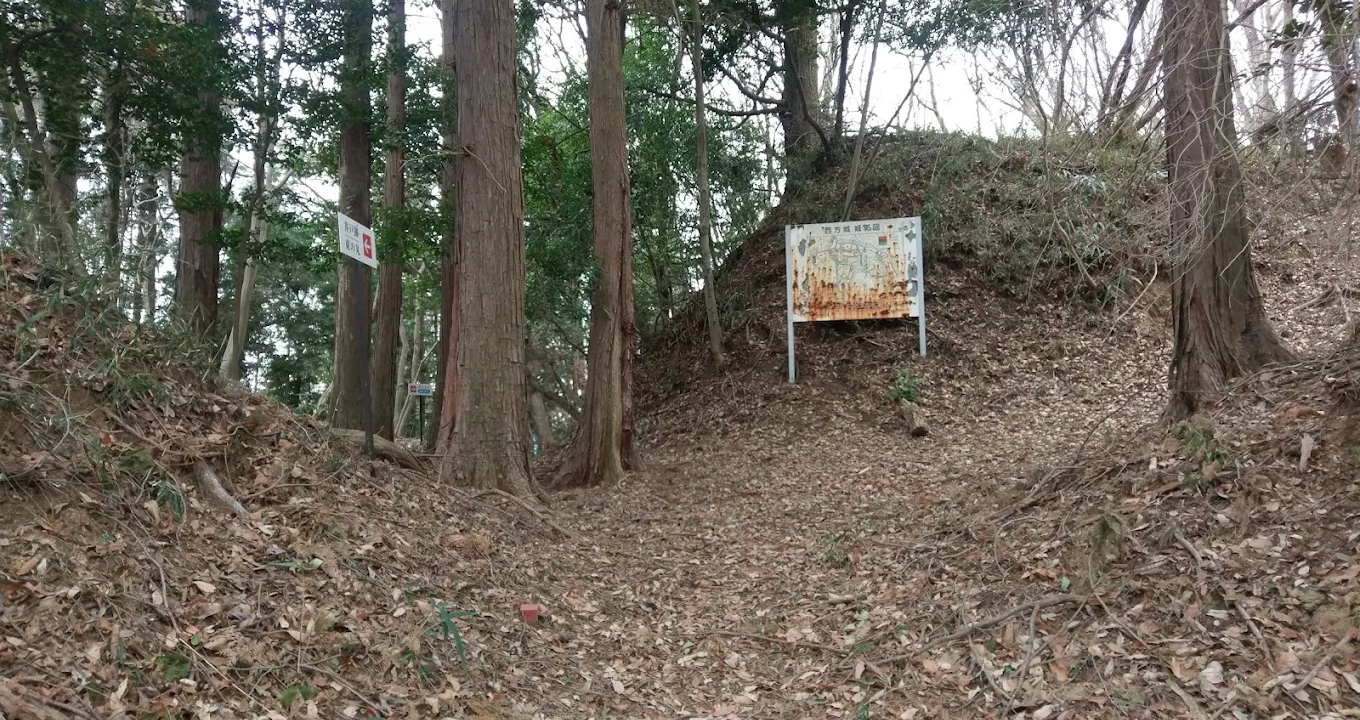
Chotoku-ji Temple is a landmark temple marking the entrance to Nishikata Castle, and the hiking trail begins beside this temple. The path from the station to Chotoku-ji Temple is flat, but from there to the castle ruins it becomes a mountain trail, so comfortable walking shoes are recommended.
Access by Car
If traveling by car, the nearest interchanges are the Tochigi Interchange or the Sano-Fujioka Interchange on the Tohoku Expressway. From the interchanges, it takes approximately 20 minutes via National Route 293 to reach the Nishikata area.
There is some parking space around Chotoku-ji Temple, but the number of spaces is limited, so please consider using public transportation. The parking lot may be crowded, especially on holidays and during peak seasons.
Climbing Route
The trail starting beside Chotoku-ji Temple is relatively well-maintained, but it continues with the steep incline typical of mountain castles. The initial part of the climb is particularly steep, so it is recommended to take breaks and climb slowly.
Along the path to the castle, you can see bamboo groves and various plants, and some areas even have plant identification tags. The climb to the main keep at the summit takes about 20-30 minutes for those in good physical condition, and about 40-50 minutes even at a leisurely pace.
Please prepare the following equipment when climbing to the castle:
- Comfortable walking shoes (trekking shoes are ideal)
- Drinking water
- Towel
- Hat (summer)
- Insect repellent (spring to autumn)
- Rain gear (for unpredictable weather)
Role of Nishikata Castle in the Region and Community Activities
Historical Symbol of the Region
Nishikata Castle ruins are an important historical symbol in the Nishikata area of Tochigi City. For local residents, these castle ruins are a place to remember the era in which their ancestors lived and are an important element in forming the region’s identity.
With its designation as a National Historic Site, Nishikata Castle ruins have become a cultural asset attracting national attention and are being re-recognized as a source of regional pride.
Activities at the “Nishikata Festival in the Middle of Nowhere”
The “Nishikata Festival in the Middle of Nowhere” is held annually in the region, and the Nishikata Castle Group of the Tochigi City Cultural Affairs Division’s Cultural Properties Section participates in this event. At the festival, various artists perform and stories related to the Nishikata region are presented. The Nishikata Castle Group provides detailed explanations of the Nishikata Castle ruins on stage.
Through these local events, the history and value of the Nishikata Castle ruins are widely conveyed to local residents and visitors, contributing to increased awareness of cultural property protection.
Efforts for Preservation and Utilization
Tochigi City is actively working on the preservation and utilization of the Nishikata Castle ruins. Following its designation as a National Historic Site, plans are underway to formulate a preservation and management plan for the remains and to develop facilities for visitors.
Local residents, history enthusiasts, and castle researchers are cooperating to continue activities that pass on the value of the Nishikata Castle ruins to future generations.
Related Historical Sites Around Nishikata Castle
Nijō Castle Ruins
Near Nishikata Castle lies another castle site called Nijō Castle. This castle is also believed to be related to the Nishikata clan and may have functioned as a branch castle or outpost of Nishikata Castle.
Visiting Nijō Castle Ruins along with Nishikata Castle will provide a deeper understanding of the castle network of the time.
Manago Castle and Akakabe Castle
Other medieval castle ruins, such as Manago Castle and Akakabe Castle, are scattered around the Nishikata region. Visiting these castle ruins will provide a more comprehensive understanding of the power dynamics in Shimotsuke Province during the Sengoku period and the ruling system of the Utsunomiya clan.
Chōtoku-ji Temple
Chōtoku-ji Temple, which serves as the entrance to Nishikata Castle, is itself a historical temple. As a temple that conveys the history of the region and its connection to Nishikata Castle, it is worth visiting during your trip.
Precautions When Visiting Nishikata Castle
Safety Precautions
Nishikata Castle ruins are a mountain castle with steep slopes and areas with uneven footing. Please pay attention to the following points when visiting:
- Avoid visiting during or after rain, as the ground can be slippery.
- Avoid visiting alone; travel in groups whenever possible.
- Check your cell phone signal strength beforehand.
- Allow ample time to descend the mountain before sunset.
Request for Protection of the Ruins
Nishikata Castle ruins are a valuable cultural asset. Please observe the following manners when visiting:
- Do not damage the remains such as earthworks or moats.
- Always take your trash with you.
- Do not collect plants.
- Do not enter areas other than designated routes.
- The use of fire is strictly prohibited.
Best Time to Visit
Nishikata Castle Ruins are open to visitors throughout the year, but the following times are especially recommended:
- Spring (April-May): Beautiful fresh greenery and mild weather.
- Autumn (October-November): Enjoy the autumn foliage and comfortable temperatures.
- Winter (December-February): The remains are easier to observe due to fallen leaves.
Summer (July-August) is hot and there are many insects, so sufficient preparation is necessary.
The Value of Nishikata Castle that Castle Fans Should Know
Academic Value
Nishikata Castle Ruins are an extremely important site for studying the structure of mountain castles from the late Sengoku period. In addition to the excellent state of preservation of the remains, the minimal alterations make it a valuable example of the original castle construction techniques.
In particular, the structure of the flanking defenses and gates is attracting attention from castle researchers as a prime example of the development of defensive techniques during the Sengoku period.
Positioning as a Mountain Castle in the Kanto Region
While numerous mountain castles exist in the Kanto region, Nishikata Castle is known for its sophisticated layout. As a castle of the Utsunomiya clan, which developed uniquely while being influenced by the castle construction techniques of the Hojo clan, it is also important as a subject of comparative research.
Significance of National Historic Site Designation
The designation of Nishikata Castle as a National Historic Site in 2024 signifies nationwide recognition of its value. This will enable financial support for preservation and establish a long-term preservation and management system.
Furthermore, the designation as a National Historic Site is expected to enhance its value as a tourist resource and contribute to regional development.
Summary | Nishikata Castle: A Valuable Historical Site Where You Can Experience the Sengoku Period
Nishikata Castle (Tochigi City, Tochigi Prefecture) is a mountain castle built by the Nishikata clan, a branch of the Utsunomiya clan. It is a historical fortress used from the early Muromachi period to the end of the Sengoku period. Its designation as a National Historic Site in 2024 recognized its historical and academic value nationwide.
Built on a mountain 221.3 meters above sea level, Nishikata Castle is a technically sophisticated mountain castle with eight baileys arranged north-south and equipped with advanced defensive structures such as earthworks, moats, and flanking defenses. The remains are remarkably well-preserved, showcasing the highest level of castle-building technology from the late Sengoku period.
Access is approximately a 30-minute walk from Tobu Kanazaki Station, followed by a 30-50 minute hike to the summit from the trailhead next to Chotoku-ji Temple. Comfortable shoes and adequate preparation are necessary for a visit, but the view from the summit and the clearly preserved remains are well worth the effort.
In the local area, activities are underway to widely promote the value of the Nishikata Castle ruins through events such as the “Nishikata Festival in the Middle of Nowhere,” and the site is carefully preserved as a symbol of the region.
For castle enthusiasts, history buffs, and hiking enthusiasts alike, the Nishikata Castle ruins are an attractive spot to visit when you come to Tochigi Prefecture. Be sure to visit and experience this precious historical site where you can feel the spirit of the Sengoku period.
--765x450.png)