Nakijin Castle Ruins Complete Guide | A Thorough Explanation of the World Heritage Site’s History, Highlights, Access, and Fees
Nakijin Castle Ruins, located in Nakijin Village in northern Okinawa Island, is a World Heritage Site and a historical gusuku (castle) that flourished as the residence of the King of Hokuzan during the Three Kingdoms period before the unification of the Ryukyu Kingdom. Since its registration as a UNESCO World Heritage Site in 2000 as part of the “Gusuku Sites and Related Properties of the Ryukyu Kingdom,” it has become one of Okinawa’s leading tourist destinations, attracting many visitors from both Japan and abroad.
This article comprehensively explains everything you need to know before visiting Nakijin Castle Ruins, from its historical background to its highlights, admission fees, opening hours, and access methods.
What is Nakijin Castle Ruins?
Nakijin Castle Ruins, also known as “Hokuzan Castle,” is a historical gusuku located on the Motobu Peninsula in northern Okinawa Island. Built on a hill 90-100 meters above sea level, this castle served as the residence of the King of Hokuzan from the late 13th to the early 15th century.
Protected by a deep 70-80 meter deep gorge to the east and a cliff over 70 meters high behind it, it was a natural fortress renowned as “impregnable.” The castle walls reached approximately 8 meters in height, and fortifications were strategically placed on the surrounding mountains, showcasing the advanced fortification techniques of the time.
History of World Heritage Registration
In November 2000 (Heisei 12), Nakijin Castle Ruins, along with Shuri Castle Ruins, Zakimi Castle Ruins, Katsuren Castle Ruins, Nakagusuku Castle Ruins, Seifa Utaki, Sonohiyan Utaki Stone Gate, Tamaudun Mausoleum, and Shikinaen Garden, were registered as a World Cultural Heritage site as part of the “Gusuku Sites and Related Properties of the Kingdom of Ryukyu.” This marked the international recognition of the importance of the history and culture of the Ryukyu Kingdom.
It is designated as a national historical site and is also selected as the 98th of Japan’s 100 Famous Castles.
The History of Nakijin Castle and the King of Hokuzan
The Hokuzan Kingdom during the Three Kingdoms Period
The 14th century in Ryukyu was a period known as the “Three Kingdoms Period,” in which the kingdom was divided into three powers: Hokuzan, Chuzan, and Nanzan, vying for supremacy. Nakijin Castle served as the residence of the King of Hokuzan during this Three Kingdoms Period, functioning as the political, economic, and cultural center of northern Okinawa Island.
The Hokuzan Kingdom controlled the Yanbaru region in northern Okinawa Island and established its own sphere of influence, including engaging in tributary trade with China (Ming Dynasty). Nakijin Castle played a crucial role as a symbol of its power and as a key castle protecting the northern region.
The Castle’s Construction and Development
Archaeological excavations have revealed that the construction of Nakijin Castle dates back to the late 13th century. In the mid-14th century, the main enclosure (honmaru) was constructed with stone walls, and in the first half of the 15th century, the castle grounds were further expanded.
The Hokuzan Kings ruled for three generations, but in 1416 (Oei 23), the Hokuzan Kingdom was destroyed by Sho Hashi, the King of Chuzan, and Nakijin Castle was captured. This paved the way for the unification of Ryukyu.
Nakijin Castle After the Unification of the Ryukyu Kingdom
After the fall of Hokuzan, a governor (kanshu) dispatched from the Ryukyu royal government was stationed at Nakijin Castle, and it continued to function as a governing center for the northern region. The governor system continued until 1665, after which it was used as a place of religious ceremonies.
Structure and Characteristics of Nakijin Castle Ruins
Castle Layout
Nakijin Castle consists of seven enclosures (kuruwa), including the outer enclosure. The main enclosure (Honmaru) is situated on the summit of a hill 100 meters above sea level, with other enclosures cleverly positioned to protect it, utilizing the natural terrain.
The main enclosures are as follows:
- Main Enclosure (Honmaru): The central part of the castle, believed to have been the living quarters of the King of Hokuzan
- Uchibaru: A sacred space adjacent to the main enclosure
- Ushimi: An enclosure located on the east side of the castle
- Heiromon: An important gate serving as the main entrance to the castle
- Outer Enclosure: A vast defensive line surrounding the entire castle
Beautifully Curved Castle Walls
The most distinctive feature of Nakijin Castle is its beautifully curved castle walls that follow the terrain. The walls, stretching approximately 1.5 kilometers in total, are constructed using a technique called “Nozurazumi,” employing cut limestone blocks.
The castle walls are arranged in a wave-like pattern to conform to the undulating terrain, and their elegant curves are the reason why it is called “one of Okinawa’s finest castles.” The details of the castle walls are extremely beautiful, and they convey to this day the high level of stonemasonry skills of the time.
Heiromon Gate
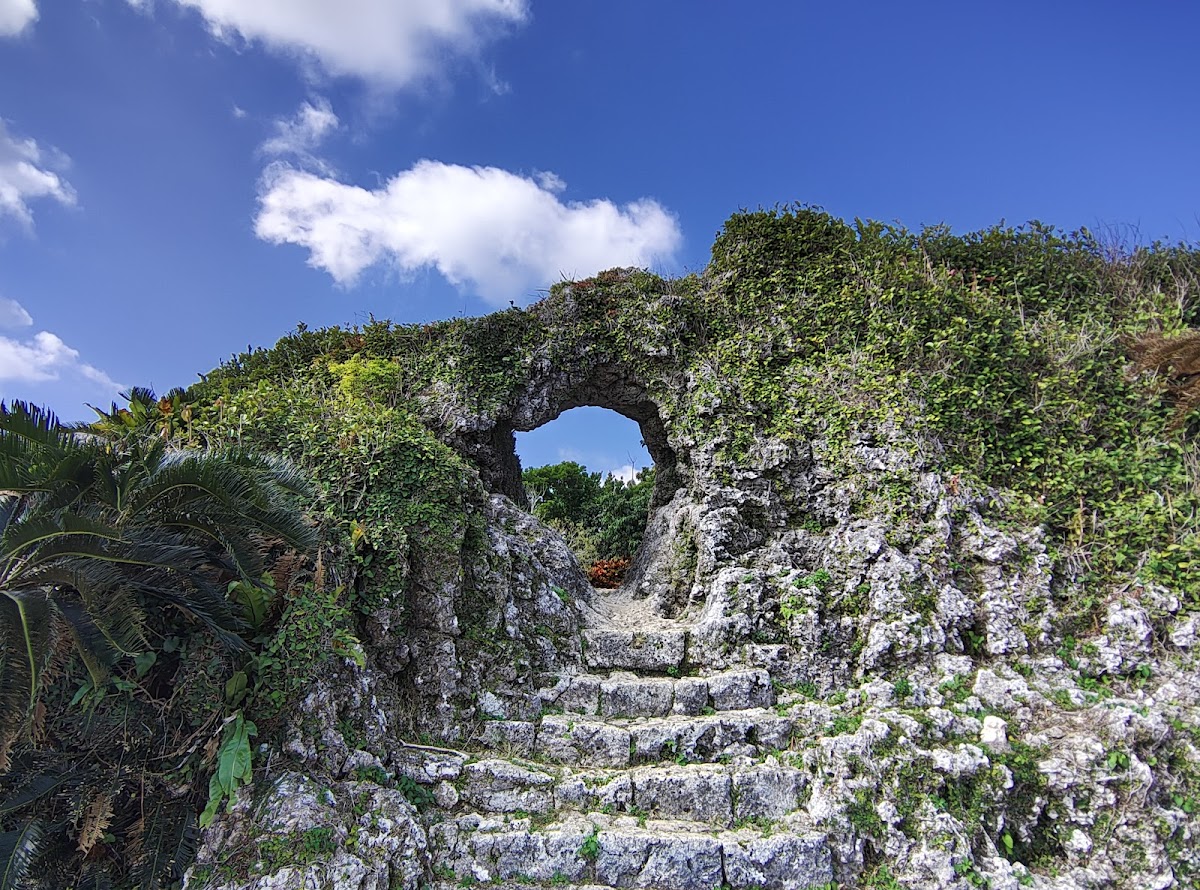
Heiromon Gate is the main gate of Nakijin Castle and is an important gate that all visitors must pass through to enter the castle. Restored in 1962 (Showa 37), this gate is an arched stone structure that showcases the unique architectural style of the Ryukyu Islands.
High castle walls rise on both sides of the gate, creating a sturdy structure that prevents enemy intrusion. After passing through the gate, a path leads to the castle grounds, allowing visitors to enjoy a stroll while feeling the weight of history.
Highlights of Nakijin Castle Ruins
Spectacular View from the Main Enclosure
The view from the main enclosure (honmaru) is one of the biggest highlights of visiting Nakijin Castle Ruins. From a hilltop approximately 100 meters above sea level, you can enjoy a panoramic view of the cobalt-blue East China Sea stretching endlessly into the distance.
On clear days, you can see Iheya Island, Izena Island, and even Yoron Island, and the breathtaking scenery overwhelms visitors. The view at sunset is particularly spectacular, with the setting sun over the East China Sea and the silhouette of the castle walls creating a fantastical scene.
Shigema-jokaku
Shigema-jokaku is an enclosure located on the north side of the castle, believed to have once been the living quarters of the King of Hokuzan. Although only the remains of the stone walls remain today, it is an important area that allows you to appreciate the scale of the castle at that time.
Uuchibaru
Uuchibaru is a sacred space adjacent to the main enclosure, a place where only women were allowed to enter. During the Ryukyu Kingdom era, important rituals were performed here.
Even today, this area is a sacred site (utaki) and an object of worship, carefully preserved by the local people. This area, imbued with a sacred atmosphere, is a precious place where one can experience the spiritual culture of Ryukyu.
The Ushimi Castle Walls
The castle walls in the Ushimi area of Nakijin Castle feature particularly beautiful curves and are a popular photo spot. The gently undulating walls give the impression of a dragon lying down.
There are also places where you can walk along the top of the walls, allowing you to observe the stonework techniques up close.
A Famous Spot for Kanhi-zakura Cherry Blossoms
Nakijin Castle Ruins are also known as a famous spot for Kanhi-zakura cherry blossoms, the earliest blooming cherry blossoms in Japan. Every year from late January to early February, approximately 660 Kanhi-zakura trees adorn the castle grounds.
In the warm climate with temperatures above 20 degrees Celsius, the sight of deep pink blossoms in full bloom is a unique Okinawan scene not seen on the mainland. During this time, the “Nakijin Gusuku Cherry Blossom Festival” is held, attracting many tourists.
History and Culture Center
Adjacent to the Nakijin Castle ruins, the Nakijin Village History and Culture Center displays artifacts unearthed during archaeological excavations and detailed exhibits on the castle’s history. Visiting before exploring the castle ruins will allow you to gain a deeper understanding of Nakijin Castle’s history.
Admission Fees and Opening Hours
Admission Fees
As of 2024, the admission fees for Nakijin Castle Ruins are as follows (fees may be revised, so please check the official website for the latest information before visiting):
Individual Rates
- Adults: 1,000yen
- Children (Elementary, Junior High, and High School Students): 500 yen
- Children under elementary school age: Free
Group Rates (20 or more people)
- Adults: 800 yen
- Children: 400 yen
The admission fee includes entry to the Nakijin Village Historical and Cultural Center.
Opening Hours
Normal Opening Hours
- 8:00 AM to 7:00 PM (Last entry: 6:30 PM)
Opening hours may change depending on the season and events, so it is recommended to check the official website before visiting.
Closed Days
The castle is open year-round, but may be temporarily closed during severe weather such as typhoons.
Access Methods
Access by Car
The most convenient way to access Nakijin Castle Ruins is by car.
From Naha City
- Using the Okinawa Expressway: Approximately 90 minutes
-Naha Airport → Okinawa Expressway “Kyoda IC” → National Route 58 → National Route 505 → Nakijin Castle Ruins
- Distance: Approximately 85 kilometers
From Nago City
- Via National Routes 58 and 505: Approximately 30 minutes
- Distance: Approximately 20 kilometers
From Churaumi Aquarium
- Via National Route 505: Approximately 15 minutes
- Distance: Approximately 10 kilometers
Parking
Nakijin Castle Ruins has a free parking lot.
- Capacity: Approximately 320 cars
- Fee: Free
-Large buses can be parked.
It’s about a 5-minute walk from the parking lot to the ruin castles entrance. During events such as the cherry blossom festival, crowds are expected, so we recommend arriving early.
Access by Public Transportation
Local Bus
From Naha Airport/Naha Bus Terminal, you can use the Yanbaru Express Bus or the Expressway Bus.
- Yanbaru Express Bus: Get off at the “Nakijin Castle Ruins Entrance” bus stop, approximately 15 minutes on foot.
- Expressway Bus (Route 111): Get off at the “Nakijin Castle Ruins Entrance” bus stop, approximately 15 minutes on foot.
Travel time: Approximately 2 hours
Since the number of buses is limited, we recommend checking the timetable in advance.
Taxi
If you take a taxi from Nago city, the travel time is approximately 30 minutes, and the fare is approximately 4,000-5,000 yen.
Recommendation for Rental Car
Since public transportation is limited in northern Okinawa Island, using a rental car is the most efficient option. The area around Nakijin Castle Ruins is dotted with popular tourist spots such as Churaumi Aquarium, Kouri Island, and the Bise Fukugi Tree-lined Street, so renting a car to tour the area is recommended.
Estimated Time and Sightseeing Plan
Standard Estimated Time
Please use the following as a guideline for the time required to visit Nakijin Castle Ruins:
- Exploring the castle grounds only: Approximately 60-90 minutes
- Including a visit to the Historical and Cultural Center: Approximately 90-120 minutes
- If you want to take your time taking photos: Approximately 120-150 minutes
The castle grounds are hilly and have many stone steps, so we recommend wearing comfortable shoes.
Recommended Sightseeing Plan
Half-Day Plan
- Preparation at Nakijin Village Historical and Cultural Center (30 minutes)
- Stroll around Nakijin Castle Ruins (90 minutes)
- Lunch at a nearby restaurant (60 minutes)
Full-Day Plan
Morning:
- Visit Nakijin Castle Ruins (120 minutes)
Afternoon:
- Churaumi Aquarium (120 minutes)
- Kouri Island and Kouri Bridge (60 minutes)
- Bise Fukugi Tree-lined Street (30 minutes)
Precautions and Manners for Exploring the Castle Grounds
Clothing and Items to Bring
- Comfortable Shoes: The castle grounds have many stone steps and uneven terrain, so comfortable walking shoes such as sneakers are essential.
- Hat and Sunscreen: There is little shade, so heatstroke prevention is especially important in the summer.
- Drinks: There are no vending machines inside the castle grounds, so prepare drinks in advance.
- Rain Gear: Since the weather can change quickly, a folding umbrella is recommended.
Visitor Etiquette
- Please refrain from climbing on top of the castle walls, as this is dangerous.
- In sacred areas such as Utaki, please observe quietly and be considerate of those offering prayers.
- Damaging the ruins or taking stones is strictly prohibited.
- Please take all your trash with you.
Accessibility Information
Nakijin Castle Ruins is a historical site, and as such, there are many stone steps within the castle grounds, limiting accessibility. Many areas are difficult to access by wheelchair, so it is recommended to consult with the management office in advance.
Wheelchair access is possible from the parking lot to the Historical and Cultural Center.
Nearby Tourist Attractions
Churaumi Aquarium
Located about 15 minutes by car from Nakijin Castle Ruins, this is one of Okinawa’s most popular tourist attractions. In the world’s largest tank, “Kuroshio Sea,” you can see whale sharks and manta rays swimming gracefully.
Kouri Island and Kouri Bridge
Approximately 20 minutes by car from Nakijin Castle Ruins. This island, accessible via the 1,960-meter-long Kouri Bridge, is a beautiful beach resort with emerald green waters and white sandy beaches. It’s also known as the “Island of Love.”
Bise Fukugi Tree-lined Street
Near Churaumi Aquarium, this village boasts approximately 20,000 Fukugi trees. A healing spot where you can stroll through the dappled sunlight, preserving the original landscape of Okinawa.
Nakijin Village’s Food Culture
Nakijin Village and its surroundings are dotted with restaurants using local ingredients, offering Okinawan soba noodles, seafood dishes, and Agu pork dishes. Enjoying local cuisine before or after visiting the castle ruins is highly recommended.
Event Information
Nakijin Gusuku Cherry Blossom Festival
Held annually from late January to early February, this is the largest event at Nakijin Castle Ruins. With approximately 660 Kanhizakura cherry trees in full bloom, the area is illuminated at night, creating a magical atmosphere.
During the event period, local specialty product sales and live music performances are held, attracting many tourists.
World Heritage Site Registration Commemorative Events
Events commemorating the World Heritage site registration are held irregularly. Details can be found on the official website and social media.
Legends of Nakijin Castle Ruins
The Legend of Shigema Utudaru
Nakijin Castle is associated with a sad legend about a beautiful woman named Shigema Utudaru. She was a beautiful woman who served the King of Hokuzan, but it is said that she threw herself from the castle when it fell to an attack by the Chuzan army.
This legend is passed down locally as a story symbolizing the historical tragedy of Nakijin Castle.
Legends of Heroes
Various legends of heroes remain concerning the battle between the King of Hokuzan and King Sho Hashi of Chuzan. These stories evoke a sense of the historical romance of Ryukyu.
About the Shiina Castle Ruins
The historical site designation of Nakijin Castle includes the “Shiina Castle Ruins.” Shiina Castle is believed to have functioned as a subsidiary castle of Nakijin Castle and formed part of its defensive system.
Photo Spots and Best Season
Recommended Photo Spots
- Osumi Castle Walls: A classic spot showcasing the beautiful, undulating curves.
- View from the Main Enclosure: A spectacular viewpoint with the East China Sea as a backdrop.
- Heiro Gate: A place to capture the beauty of Ryukyu architecture.
- Cherry Blossoms and Castle Walls: A popular photo spot available only in January and February.
Best Season
Late January to Early February: The Kanhizakura cherry blossoms are in full bloom, offering the most spectacular scenery. However, crowds are expected.
March to May: The weather is mild and ideal for sightseeing. It’s a beautiful season with fresh greenery.
September to November: The typhoon season is over, and the weather is relatively stable.
Summer (June to August): The sun is strong and it’s hot, but the contrast between the blue sea and sky is beautiful. Take full precautions against heatstroke.
Preservation and Future of Nakijin Castle Ruins
Ongoing Archaeological Excavations
Ongoing archaeological excavations are currently underway at Nakijin Castle Ruins, leading to continuous new discoveries. These findings play a crucial role in understanding the history of the Ryukyu Kingdom.
Preservation Activities
To pass on its value as a World Heritage Site to future generations, restoration of the stone walls and preservation activities of the remains are continuously being carried out. Local residents, government officials, and experts are cooperating to protect this precious cultural heritage.
Summary
Nakijin Castle Ruins is a valuable World Heritage Site that conveys the history of the Three Kingdoms period before the unification of the Ryukyu Kingdom. It boasts diverse attractions, including its beautifully curved castle walls, the spectacular view from the main enclosure, and its reputation as a spot for Kanhizakura cherry blossoms.
While it takes about 90 minutes to access from Naha city, it’s an ideal spot to visit as a base for sightseeing in northern Okinawa Island, especially when combined with Churaumi Aquarium and Kouri Island. Admission is 1,000 yen for adults. Opening hours are from 8:00 AM to 7:00 PM (last entry at 6:30 PM). Free parking is available.
Nakijin Castle Ruins offers a chance to experience historical romance, breathtaking scenery, and Okinawan culture. When visiting Okinawa, be sure to stop by. Before your visit, check the official website for the latest admission fees, opening hours, and event information to ensure a fulfilling experience.