Nakao Castle (Kyoto Prefecture, Kyoto City) Complete Guide: The Last Stronghold of the Muromachi Shogunate Built on the Hill Behind Ginkaku-ji Temple
What is Nakao Castle?
Nakao Castle is a mountain castle built on a mountaintop approximately 280 meters above sea level, near the border of Jōdoji and Ichijōji Ōtani in Sakyō-ku, Kyoto City, east of Ginkaku-ji Temple (Jishō-ji Temple). Construction began in 1549 (Tenbun 18) by Ashikaga Yoshiharu, the 12th Shogun of the Muromachi Shogunate, with the aim of returning to Kyoto. It was a short-lived castle, falling the following year to the forces of Miyoshi Nagayoshi.
However, this castle occupies an extremely important position in the history of Japanese castles. This is because Nakao Castle is considered the oldest example of a castle with measures against firearms recorded in historical documents, and is a valuable historical site that shows a turning point in castle construction technology during the Sengoku period.
Basic Information on Nakao Castle
Location and Access
Location: Ichijoji Otani, Sakyo-ku, Kyoto City, Kyoto Prefecture, and other locations
Former Province: Yamashiro Province
Elevation: Approximately 280 meters
Relative Height: Approximately 180 meters (difference in elevation from the base)
Classification and Structure: Mountain castle, multi-bailey style with earthworks and moats
Access:
- Take the city bus to “Ginkakuji-mae” or “Ginkakuji-michi” bus stop, then walk for approximately 40-60 minutes (mountain climb)
- Use the route branching off from the Daimonji-yama mountain trail
- Approach from the Nyoigatake area is also possible
Common Names and Alternate Names
Nakao Castle is described in historical documents as “the mountain castle above Jisho-ji Temple” or “the castle above Higashiyama Jisho-ji Temple.” The expression “Jisho-ji no Otake Nakao,” indicating the construction site, is also seen.
History of Nakao Castle
Background of Construction: Ashikaga Yoshiharu’s Plan to Return to Kyoto
In 1549 (Tenbun 18), Ashikaga Yoshiharu, the 12th Shogun of the Muromachi Shogunate, found himself in a difficult situation. Following the defeat of the Kanrei (deputy shogun) Hosokawa Harumoto by his vassal Miyoshi Nagayoshi in the Battle of Eguchi in 1548 (Tenbun 17), Yoshiharu was forced to flee Kyoto to Sakamoto in Omi Province.
Aiming to restore his authority as Shogun and return to Kyoto, Yoshiharu began construction of Nakao Castle on October 18, 1549, on the hillside behind Jisho-ji Temple (Ginkaku-ji Temple) in Higashiyama, a suburb of Kyoto. This location was a strategic point overlooking the city of Kyoto, and its proximity to Ginkaku-ji Temple, a symbol of Higashiyama culture, is thought to have also served to demonstrate the legitimacy of the Shogunate.
The Death of Ashikaga Yoshiharu and the Entry of Ashikaga Yoshiteru
Just one year after construction began, in May of Tenbun 19 (1550), Ashikaga Yoshiharu died of illness (some say he committed suicide due to his illness). After Yoshiharu’s death, his eldest son, Ashikaga Yoshiteru (then known as Yoshifuji), who became the 13th Shogun, entered Nakao Castle with Hosokawa Harumoto.
The young Shogun, Yoshiteru, attempted to use Nakao Castle as a base to resist the forces led by Miyoshi Nagayoshi. However, faced with the overwhelming military power of the Miyoshi forces, Nakao Castle became isolated.
The Battle and Fall of Nakao Castle
On November 21, Tenbun 19 (December 28, 1550 AD), Miyoshi Nagayoshi’s army attacked Nakao Castle. This was the “Battle of Nakao Castle.”
Under fierce attack from the Miyoshi army, Ashikaga Yoshiteru, judging it impossible to hold the castle, set fire to it himself and fled towards Sakamoto and Katata. This retreat by self-destruction can be seen as a painful decision made to preserve the prestige of the shogun.
Nakao Castle fell just over a year after its construction began and was never rebuilt. However, despite its short period of use, Nakao Castle left an important mark on the history of Japanese castles.
Ashikaga Yoshiteru’s Aftermath
After losing Nakao Castle, Ashikaga Yoshiteru continued to aim for a return to Kyoto. In 1552, he temporarily returned to Kyoto, but his conflict with Miyoshi Nagayoshi continued. Finally, in 1565, Yoshiteru was attacked by the Miyoshi Three and others in the “Eiroku Incident” and met a tragic end at Nijo Palace.
Layout and Remains of Nakao Castle
Structure of the Main Enclosure
The main enclosure (honmaru) of Nakao Castle is built on the summit of a ridge extending northwest from Mt. Daimonji, at an elevation of approximately 270.5 meters. The main enclosure is long and narrow from north to south, measuring approximately 50 meters by 25 meters.
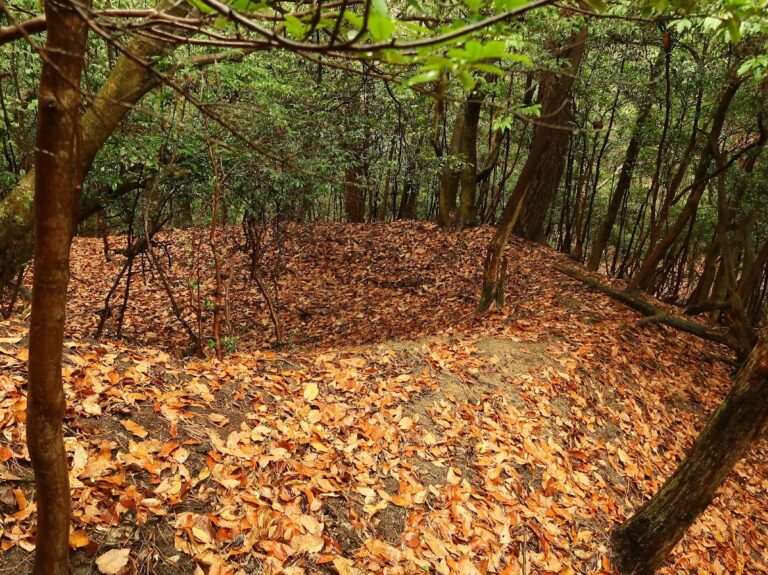
As a mountain castle, it secured a relatively large flat area, sufficient space to accommodate the shogun’s residence and important military facilities. Even today, the flat surface of the main enclosure is clearly visible, and traces of earthworks remain around it.
Double Earthworks: The Oldest Example of Firearm Defense
The most distinctive feature of Nakao Castle is the presence of double earthworks. These double earthworks are thought to be a defensive structure to protect against musket bullets, and are considered the oldest documented example of a castle with firearm defenses.
The Tenbun era (1532-1555) was only a few years after firearms were introduced to Japan (Tenbun 12, 1543). The fact that castle construction was already being carried out with firearms in mind during this period is important evidence of the rapid development of military technology during the Sengoku period.
The double earthen rampart structure uses the outer rampart to block direct fire from firearms and the inner rampart to form a double line of defense. This significantly improved defensive capabilities, allowing for counterattacks from the inner rampart even if the enemy breached the outer rampart.
Enclosures and Moats
Multiple enclosures (kuruma) are arranged around the main enclosure. These enclosures are arranged in stages, utilizing the ridge terrain, forming a series of interconnected enclosures.
Furthermore, moats are provided along the ridge, preventing enemy intrusion and clearly defining the castle area. Moats are a typical defensive feature of mountain castles and were effectively utilized at Nakao Castle.
Defenses on the Southeast Side
On the southeast side of the castle, defensive structures were positioned to prepare for enemy approaches from the direction of Mt. Nyoigatake. Because this area has relatively gentle terrain, particularly strong defenses were necessary.
Currently, some of the remains on this side are unclear, but it is presumed that a series of earthworks and small enclosures once stood there.
Access to Nakao Castle and the Climbing Route
Route from Ginkaku-ji Temple
The most common approach is the route starting from Ginkaku-ji Temple.
- After visiting the grounds of Ginkaku-ji Temple, head to the mountain path on the east side.
- Proceed along the mountain trail towards Mt. Daimonji.
- At the fork in the trail, head towards Nakao Castle (there are signs).
- You will arrive at the castle ruins in approximately 40-60 minutes.
The hiking trail is well-maintained, but as it is a mountain castle, appropriate equipment (hiking boots, drinking water, etc.) is necessary.
Route from the direction of Nyoigatake
Access is also possible from the direction of Nyoigatake (Nyoigatake). This route follows the ridge of Daimonjiyama, making it a more challenging mountain climb.
Nyoigatake also has the ruins of another mountain castle, “Nyoigatake Castle,” and visiting it along with Nakao Castle allows you to experience the medieval mountain castles of the Higashiyama area.
Points to Note When Visiting the Castle
- Season: Spring to autumn is the best time to visit, but summer requires precautions against the heat.
- Estimated Time: Expect 2-3 hours round trip.
- Equipment: Hiking boots, drinking water, map or GPS app.
- Weather: Avoid visiting in rainy weather as it can be slippery.
- Avoiding Solo Visits: It is preferable to visit with multiple people if possible.
Nearby Spots around Nakao Castle
Ginkaku-ji Temple (Jisho-ji Temple)
Ginkaku-ji Temple, located at the foot of Nakao Castle, is a Rinzai Zen temple that originated from a mountain villa built by Ashikaga Yoshimasa, the 8th Shogun of the Muromachi Shogunate. Registered as a World Heritage Site and a symbol of Higashiyama culture, visiting Ginkaku-ji Temple in conjunction with Nakao Castle allows you to understand both the culture and the turmoil of the Muromachi period.
Daimonji Mountain
Daimonji Mountain, with an elevation of 465 meters, is famous for the “Gozan Okuribi” (Five Mountains Bonfire Festival) held every year on August 16th. A ridge walk from Nakao Castle to Daimonji Mountain is also possible, offering a spectacular panoramic view of Kyoto city.
Nyoigatake and Nyoigatake Castle
Located east of Nakao Castle, Nyoigatake (elevation 472 meters) also contains the ruins of Nyoigatake Castle, a mountain castle. This is also a Sengoku period mountain castle, possibly used at the same time as Nakao Castle.
Honen-in Temple
Honen-in Temple, within walking distance of Ginkaku-ji Temple, is a tranquil Jodo sect temple. Located along the Philosopher’s Path, it’s an ideal resting spot before or after climbing Nakao Castle.
Historical Significance of Nakao Castle
Symbol of the Decline of the Muromachi Shogunate
Nakao Castle is a symbol of the era when the authority of the Muromachi Shogunate declined and powerful shugo daimyo and sengoku daimyo rose to power. The situation where the shogun himself had to hole up in a mountain castle to fight clearly demonstrates the weakening of the central government. ### A Turning Point in Castle Construction Technology
The adoption of double earthen ramparts as a countermeasure against firearms marks a significant turning point in the history of Japanese castles. It is a valuable example of the transitional technology from medieval mountain castles to early modern castles designed to accommodate the new weapon, firearms.
Its Place in Kyoto’s Sengoku Period History
The Battle of Nakao Castle was a decisive battle that solidified Miyoshi Nagayoshi’s hegemony in Kyoto. Following this, Miyoshi Nagayoshi reigned as the de facto ruler of the Kinai region, laying the foundation for the “Miyoshi regime” that continued until Oda Nobunaga’s arrival in Kyoto.
Current Status and Preservation of Nakao Castle
Currently, the Nakao Castle ruins are registered as a Kyoto Prefecture archaeological site and are managed by the Cultural Properties Protection Division of the Kyoto Prefecture Board of Education. The location of the ruins can be confirmed on the Kyoto Prefecture Archaeological Site Map.
The remains of the castle are relatively well-preserved, and the flat surface of the main enclosure, traces of the double earthen ramparts, and moats can be seen. However, due to the passage of approximately 470 years, some parts are obscured by weathering and vegetation.
In recent years, research and visits by castle researchers and history enthusiasts have increased, and the historical value of Nakao Castle is being re-evaluated.
Points to Note When Visiting Nakao Castle
Ascending the Castle While Imagining History
When visiting Nakao Castle, you can have a deeper experience by not just looking at the remains, but by imagining the historical drama that unfolded on this mountaintop approximately 470 years ago.
- Shogun Ashikaga Yoshiharu looking down on Kyoto city from this place, dreaming of his restoration of power.
- The young Ashikaga Yoshiteru enduring attacks from the Miyoshi army, and ultimately making the decision to set fire to the castle himself.
- The transience of the castle, which fell in just one year despite the introduction of the latest technology of double earthworks.
Imagining these historical scenes will make your visit to Nakao Castle more meaningful.
Photography Tips
- View from the Main Enclosure: On a clear day, you can enjoy a panoramic view of Kyoto city.
- Cross-section of the Double Earthen Embankment: This section reveals the structure designed to counter firearms.
- Depth of the Moat: This remains demonstrates the defensive techniques of a mountain castle.
- View Overlooking Ginkaku-ji Temple: This viewpoint reveals the relative positions of the castle and the temple.
Seasonal Highlights
- Spring: Climb the castle amidst the fresh greenery; the area around Ginkaku-ji Temple is also beautiful during cherry blossom season.
- Summer: The remains are covered in lush greenery; however, heat protection is essential.
- Autumn: The beauty of the Higashiyama area, a famous spot for autumn leaves; the weather is ideal for climbing the castle.
- Winter: The remains become easier to see due to fallen leaves; the air is clear and the views are excellent.
References and Historical Materials
The following are some of the main historical materials and research literature concerning Nakao Castle:
- “Kototsugu-kyo Ki” (Diary of Yamashina Tonotsugu, containing records of the construction and battles of Nakao Castle)
- * Hosokawa Ryoke Ki (Records of the Hosokawa family, details of the Battle of Nakao Castle)
- Ashikaga Sueyo Ki (Records from the late Muromachi period)
- Research reports on Nakao Castle in various castle research books
- Research report on the ruins by the Kyoto Prefectural Board of Education
These historical materials reveal the construction history, structure, and details of the battle at Nakao Castle.
Summary: The Appeal of Nakao Castle
Nakao Castle, though a short-lived castle that fell just over a year after its construction, is a mountain castle that holds an important place in the history of Japanese castles.
Main Attractions:
- A groundbreaking example in the history of castle construction: a double earthen rampart designed to counter firearms.
- The stage for the tragedy of Ashikaga Yoshiharu and Yoshiteru, father and son, during the decline of the Muromachi Shogunate.
- Excellent accessibility, located on the hillside right behind the cultural heritage site of Ginkaku-ji Temple.
- Spectacular views overlooking Kyoto city.
- Relatively well-preserved remains.
When visiting Kyoto, why not explore not only famous temples and shrines, but also the ruins of a Sengoku period mountain castle like this one? Nakao Castle is a valuable spot where you can experience the multi-layered history of Kyoto, where the vibrant Higashiyama culture and the turbulent Sengoku period intersect.
Prepare thoroughly for your climb and embark on a journey to experience the historical romance of Nakao Castle, the last stronghold of the Muromachi Shogunate.