Nakagusuku Castle (Okinawa Prefecture) Complete Guide | World Heritage Site History, Highlights, and Access Information
What is Nakagusuku Castle? A World Heritage Site Representing Okinawa
Nakagusuku Castle (Nakagusuku Castle Ruins) is a castle site from the Ryukyu Kingdom era, spanning Kitanakagusuku Village and Nakagusuku Village in Nakagami District, Okinawa Prefecture. Built on a hill approximately 160m above sea level, this castle was registered as a UNESCO World Heritage Site in December 2000 as a component of the “Gusuku Sites and Related Properties of the Ryukyu Kingdom.”
While there are approximately 300 gusuku castles of varying sizes in Okinawa Prefecture, Nakagusuku Castle stands out for its particularly good state of preservation. It is a valuable cultural asset, designated as a National Historic Site and one of Japan’s Top 100 Castles. Its location, overlooking both the East China Sea and the Pacific Ocean, speaks to its importance as a strategic military point.
Significance of World Heritage Registration
Nakagusuku Castle was registered as a World Heritage Site because of its outstanding architectural techniques that convey the history and culture of the Ryukyu Kingdom to the present day, and its unique stone-making culture. In particular, the beautiful curves of the castle walls, completed by Gosamaru, are highly regarded as the pinnacle of Ryukyu’s unique castle-building techniques.
History of Nakagusuku Castle | The Story of Gosamaru and the Ryukyu Kingdom
The Beginning of Construction and the Former Nakagusuku Lord
The construction of Nakagusuku Castle dates back to the late 14th century. Initially, the Former Nakagusuku Lord (Sachinakaku Aji) built the first, second, southern, and western baileys over several generations. This period was the Three Kingdoms era, when Ryukyu was divided into three kingdoms: Hokuzan, Chuzan, and Nanzan, and Nakagusuku Castle functioned as an important defensive base for Chuzan.
Expansion and Completion by Gosamaru
The most important turning point in the history of Nakagusuku Castle came in 1440 (the 5th year of the Jōtō era). By order of King Shō Taikyū of the Ryukyu Kingdom, Gosamaru, a renowned general, moved from Zakimi Castle to Nakagusuku Castle.
Gosamaru was known as a master castle builder, and he expanded Nakagusuku Castle by adding the northern and third baileys, completing it into its current form. His castle-building techniques were of the highest standard at the time, and in particular, his stonework employed a sophisticated construction method called “aikata-zumi” (mutual stacking).
The Gosamaru-Amawari Rebellion
In 1458 (the 9th year of the Jingtai era), Nakagusuku Castle became the stage for a significant event in Ryukyuan history. Due to false accusations that Amawari, the lord of Katsuren Castle, was plotting a rebellion, Gosamaru was attacked by the royal army and forced to commit suicide. The “Gosamaru-Amawari Rebellion” is recorded as an important event in the process of unifying the Ryukyu Kingdom.
Subsequent History
After Gosamaru’s death, Nakagusuku Castle was temporarily abandoned, but it has since been preserved as an important historical site in the region. In 1853, Commodore Perry and his entourage visited and recorded its beauty. While it was affected by the Battle of Okinawa during World War II, fortunately, much of the castle wall escaped destruction, and it retains its original appearance to this day.
Architectural Features of Nakagusuku Castle | Unique Ryukyuan Stone-Masonry Techniques
Layout Composed of Six Enclosures
Nakagusuku Castle is composed of six enclosures (kuruwa): the first enclosure, second enclosure, third enclosure, north enclosure, west enclosure, and south enclosure. Each enclosure is skillfully positioned utilizing the natural terrain, forming a robust defensive system as a whole.
The total area covers approximately 15,000 square meters, making it one of the largest castles in Okinawa. Each enclosure is arranged to take advantage of the differences in elevation, with the first enclosure being the highest point.
Beautifully Curved Castle Walls
The most distinctive feature of Nakagusuku Castle is its elegantly curved castle walls. Unlike mainland Japanese castles, Ryukyu castle walls make extensive use of curves rather than straight lines. This served not only aesthetic purposes but also a practical purpose to enhance defensive capabilities against attacks.
The height of the castle walls varies depending on the location, but the highest points reach approximately 15 meters. This combination of height and curved beauty creates the unique landscape of Nakagusuku Castle.
Three Types of Stone Masonry Techniques
At Nakagusuku Castle, you can observe three different stone masonry techniques, varying depending on the construction period.
Nozura-zumi (rough stone masonry): This is the oldest type of stone masonry, where natural stones are stacked with little to no processing. It can be seen in parts of the southern and western enclosures.
Nuno-zumi (cloth stone masonry): This technique involves stacking stones horizontally, resulting in a neat and beautiful appearance. **Aikata-zumi (Mutual Stacking): This is the most advanced technique that Gosamaru excelled at, where large and small stones are combined and stacked without gaps. This technique, seen in the North and Third Enclosures, demonstrates the highest level of castle-building technology of the time.
Arch Gate Structure
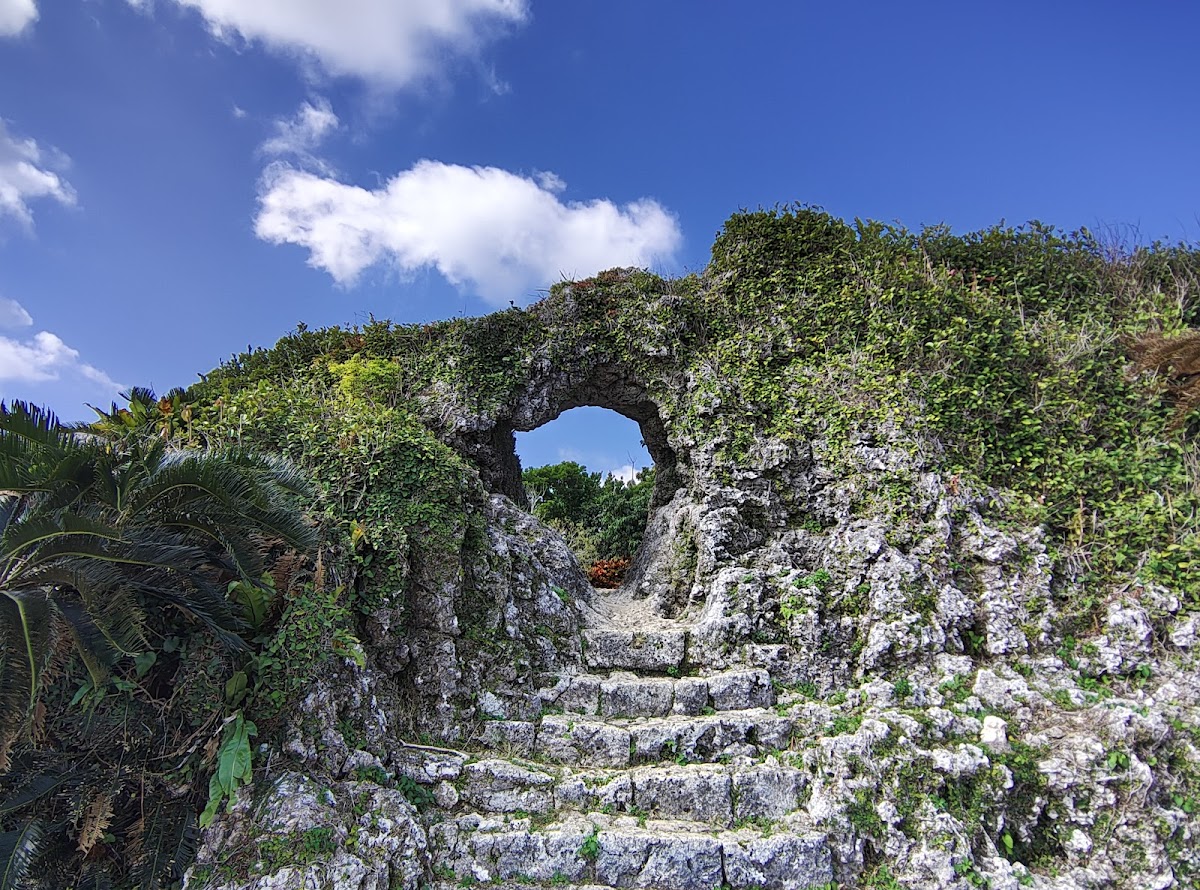
Nakagusuku Castle has several arch gates remaining, showcasing the unique arch structure of Ryukyu. The arch of the main gate, in particular, is exquisitely crafted, featuring a full-fledged arch structure using wedge stones. Such stone arch gates are also important evidence of cultural exchange between Ryukyu and China/Southeast Asia.
Nakagusuku Castle Highlights | Complete Guide to Must-See Spots
Entering from the Main Gate
A visit to Nakagusuku Castle begins at the main gate. After purchasing a ticket, you can use a free cart to ascend to the main gate, making it accessible even for those with limited physical strength or the elderly.
Passing through the beautiful arch of the main gate marks the beginning of a time travel to the Ryukyu Kingdom era. The exquisite stonework of the gate is truly astonishing when viewed up close, showcasing the high level of craftsmanship.
First Enclosure | Spectacular View from the Highest Point
The First Enclosure is located at the highest point of Nakagusuku Castle, offering breathtaking views from an altitude of approximately 160 meters. On a clear day, you can see the Pacific Ocean to the east, the East China Sea to the west, Onna Village to the north, and the Chinen Peninsula to the south.
It is believed that the main hall once stood here, serving as the residence of the Anji (lord). While only the foundation of the stone wall remains today, the spacious area allows us to imagine the scale of the building at that time.
Second Enclosure | Center of Life
The Second Enclosure is the second most important space after the First Enclosure, and is presumed to have been the center of daily life. The view from here is also magnificent, allowing you to enjoy the beautiful natural environment of Okinawa beyond the castle walls.
Remnants of the stone pavement also remain, providing a glimpse into the life of that time.
Third Enclosure | Gosamaru’s Addition
The Third Enclosure is an addition made by Gosamaru, where you can observe magnificent stonework using the interlocking stone technique. The stone walls, skillfully combining large and small stones, are laid without gaps like a puzzle, and have remained intact for over 500 years, preserving their original form.
The remains of a well are also found here, illustrating the importance of securing a water source within the castle.
North Enclosure | Key to Defense
The North Enclosure is also an addition made by Gosamaru, with a structure that emphasizes defensive functions. The height and thickness of the castle walls are particularly impressive, and ingenuity to prevent enemy intrusion can be seen throughout.
From here, the view to the north opens up, allowing you to see as far as Yomitan Village.
West and South Enclosures | Remains from an Older Era
The West and South Enclosures were built during the time of the former Nakajo Anji, and are characterized by stonework using the rough-hewn stone technique. By comparing it to the expanded section of Gosamaru, you can truly appreciate the advancements in castle construction technology.
These enclosures are located in relatively quiet areas, making them ideal spots for reflecting on history at a leisurely pace.
Walking Along the Castle Walls
One of the major attractions of Nakagusuku Castle is the opportunity to actually walk along some of its walls. The view from atop the stonework is exceptional, allowing you to experience what it was like to be a watchman in those days. However, please be sure to walk with caution and safety in mind.
Back Gate and Stone-Paved Path
In addition to the main gate, a back gate also remains, which boasts a beautiful arched structure. Around the back gate, a stone-paved path made of Ryukyu limestone remains, giving insight into the roads of that time.
Natural Environment of Nakagusuku Castle | Seasonal Charms
Farfugium japonicum Flowers
Nakagusuku Castle is blessed with a rich natural environment, and the yellow flowers of the Farfugium japonicum, which bloom from autumn to winter, are particularly magnificent. Every year, the “Nakagusuku Castle Ruins Tsuwabuki Festival” is held, where visitors can enjoy the contrast between the stone walls and the flowers.
Subtropical Vegetation
Subtropical plants unique to Okinawa grow naturally within the castle ruins, creating a landscape where historical heritage and nature harmonize. Trees such as banyan and akagi grow close to the stone walls, creating a unique atmosphere.
Birdwatching Spot
Nakagusuku Castle, with its high elevation and lush greenery, is also known as a birdwatching spot. There are opportunities to observe Okinawan endemic birds such as the Ryukyu White-eye and the Blue Rock Thrush.
Visiting Information | Fees, Opening Hours, and Access
Admission Fees
Individual Rates
- Adults: 400 yen
- Junior and Senior High School Students: 300 yen
- Elementary School Students: 200 yen
- Children under elementary school age: Free
Group Rates (20 or more people)
- Adults: 320 yen
- Junior and Senior High School Students: 240 yen
- Elementary School Students: 160 yen
Visitors with a disability certificate and one caregiver are admitted free of charge upon presentation of the certificate.
Visiting Hours
Regular Season (May-September)
- 8:30 AM – 6:00 PM (Last entry 5:30 PM)
Winter Season (October-April)
- 8:30 AM – 5:00 PM (Last entry 4:30 PM)
The park is open year-round, but may be temporarily closed in case of severe weather such as an approaching typhoon. We recommend checking the official website for the latest information before visiting. ### Access Information
Access by Car
From Naha Airport: Approximately 30 minutes via the Okinawa Expressway
- Approximately 5 minutes after exiting at Kitanakagusuku IC
- Free parking available (approximately 150 regular cars)
Access by Bus
From Naha Bus Terminal:
- Get off at the “Kuba” bus stop on the No. 30 Awase-Nishi Line, approximately 15 minutes on foot
- Get off at the “Kuba” bus stop on the No. 52 Yokatsu Line, approximately 15 minutes on foot
Since it is uphill from the bus stop, you may want to consider taking a taxi.
Taxi Access
From Naha City: Approximately 40 minutes, fare approximately 4,000-5,000 yen
Facility Information
- Management Office (Ticket Sales)
- Free Cart (Shuttle service to the main gate)
- Restrooms (Barrier-free access)
- Vending Machines
- Parking (Free)
Comparison of Nakagusuku Castle with Other Castles
Differences from Shuri Castle
While Shuri Castle was the political and cultural center of the Ryukyu Kingdom, Nakagusuku Castle was built as the residence of a local lord, emphasizing military functions. Many buildings of Shuri Castle were lost due to war and fire, but Nakagusuku Castle is characterized by its well-preserved stone walls.
Comparison with Nakijin Castle
Nakijin Castle was built earlier than Nakagusuku Castle as a base for Hokuzan. While Nakijin Castle is larger in scale, Nakagusuku Castle, built by Gosamaru, is considered superior in the sophistication of its stonework. ### Relationship with Zakimi Gusuku
Zakimi Gusuku is a castle built by Gosamaru before he moved to Nakagusuku Gusuku. Visiting both allows you to compare the development of Gosamaru’s castle-building techniques. Zakimi Gusuku is more compact, but the beauty of its arched gate is particularly noteworthy.
Historical Connection with Katsuren Gusuku
Katsuren Gusuku was the residence of Amawari, and is historically deeply connected to Nakagusuku Gusuku through the “Gosamaru-Amawari Rebellion.” Visiting both gusuku allows you to understand the complex political situation during the unification of the Ryukyu Kingdom.
Tourist Attractions Around Nakagusuku Gusuku
Nakamura Family Residence
This is a nationally designated important cultural property, a traditional house located about 10 minutes by car from Nakagusuku Gusuku. It is a valuable building that conveys the style of Ryukyu samurai housing from the mid-18th century, and is recommended to visit in conjunction with a gusuku tour.
Katsuren Castle Ruins
This World Heritage Site gusuku (castle) is about a 20-minute drive away. Known as the residence of Amawari, it has deep historical ties to Nakagusuku Castle.
Kaichu Road
This road, approximately 5km long, stretches from the Katsuren Peninsula to Henza Island, offering a spectacular drive with the sea stretching out on both sides. It’s about a 30-minute drive from Nakagusuku Castle.
Restaurants in Kitanakagusuku Village
Numerous excellent Okinawan restaurants are scattered around Nakagusuku Castle. Enjoying dishes made with local ingredients allows for a deeper experience of Okinawan culture.
Event Information | Year-Round Events
First Sunrise Viewing
Every year on New Year’s Day, a first sunrise viewing event is held. The first sunrise from an altitude of 160 meters is exceptional, making it the perfect place to welcome the new year. Since the park opens early in the morning, please check the details in advance.
Tsuwabuki Festival
Held from autumn to winter, the Nakagusuku Castle Ruins Tsuwabuki Festival features the vibrant yellow flowers of the Tsuwabuki plant adorning the castle ruins. Special events and sales of local products are also held during the festival.
Gosamaru Day Commemorative Event
On May 30th, “Gosamaru Day,” a commemorative event is held to honor Gosamaru. Performances of Ryukyuan dance and traditional arts, as well as historical lectures, provide a great opportunity to learn about Gosamaru’s achievements.
Sunrise Walk
This walking event takes place early in the morning, allowing visitors to stroll through Nakagusuku Castle while bathed in the morning sun. Visiting at a different time than usual allows you to discover new charms.
Cosplay Event
In recent years, the Kitanakagusuku Village Cosplay Event has also been held, offering opportunities for cosplay photography against the backdrop of historical buildings. It is attracting attention as a new way to utilize historical heritage.
Cultural Property Fire Prevention Drill
Fire drills are conducted annually on January 26th, Cultural Property Fire Prevention Day. This is an opportunity to see the efforts being made to protect valuable cultural assets.
Nakagusuku Castle Visit Tips and Manners
Estimated Time Required
Leisurely Visit: Approximately 90-120 minutes
Standard Visit: Approximately 60 minutes
Quick Visit: Approximately 40 minutes
We recommend allowing about 2 hours, including time for photography and enjoying the scenery.
Clothing and Items to Bring
- Comfortable walking shoes (sneakers, etc.)
- Hat (due to strong sunlight)
- Sunscreen
- Drinks (especially essential in summer)
- Camera
- Rain gear (weather can change quickly)
Avoid heels and sandals, as there are areas where you walk on top of the castle walls.
Visitor Etiquette
- Do not climb the stone walls
- Do not collect plants
- Always take your trash with you
- Do not enter restricted areas
- Do not make loud noises
- Drone use requires prior permission
As this is a World Heritage site and a place visited by many people, please observe proper etiquette during your visit.
Best Photo Spots
- The arch of the main gate (an iconic photo of the entrance)
- The view from the first enclosure (a panoramic photo)
- The curved castle wall (capturing the characteristics of Nakagusuku)
- The interlocking stonework of the third enclosure (details of stonework techniques)
- Around the back gate (a quiet atmosphere with fewer people)
The morning light and the slanted light of the evening are especially good for taking beautiful photos.
Preservation and Future of Nakagusuku
Preservation Activities
Even after being registered as a World Heritage site, Nakagusuku continues to undergo preservation and restoration work. Reinforcement work to maintain the stability of the stone walls, vegetation management, and regular surveys and research are being carried out.
Regular cleaning activities are carried out by local residents and volunteers, fostering a heightened awareness of protecting cultural properties throughout the community.
Educational Activities
Local schools use Nakagusuku Castle as teaching material for local history lessons, providing children with a place to learn about the region’s history and culture. Guide training courses are also held, demonstrating a commitment to cultivating guides with specialized knowledge.
Digital Archiving
Nakagusuku Castle is being digitally archived using the latest technologies, including 3D scanning and drone photography. This is expected to ensure its reliable transmission to future generations and to develop new ways of experiencing the site, such as through the use of VR.
Balancing Tourism and Preservation
While the number of tourists has increased since its World Heritage designation, balancing this with the protection of cultural properties remains a challenge. Efforts for sustainable tourism, such as managing visitor numbers appropriately and improving tour routes, are ongoing.
Summary | Experience the Charm of Nakagusuku Castle
Nakagusuku Castle is a valuable World Heritage site that conveys the history and culture of the Ryukyu Kingdom, as well as the castle-building techniques of the renowned general Gosamaru. The beautifully curved castle walls, the exquisite stonework, and the breathtaking views from an altitude of 160 meters continue to captivate visitors.
This castle, which holds three important designations—a World Heritage Site, a National Historic Site, and one of Japan’s Top 100 Castles—is a must-see tourist spot when visiting central Okinawa Island. Its easy accessibility, just about 30 minutes by car from Naha, is another attractive feature.
Whether you’re interested in history, seeking a scenic spot, a photography enthusiast, or simply want to enjoy Okinawa’s nature, this is a place that will satisfy all visitors.
Visit Nakagusuku Castle to feel the spirit of the Ryukyu Kingdom era and experience the brilliance of Gosamaru’s castle-building techniques. We hope you’ll see with your own eyes the craftsmanship embodied in each stone of the walls and the weight of over 500 years of history.
With its changing natural environment throughout the seasons and various events held throughout the year, Nakagusuku Castle offers new discoveries with every visit. It’s a representative historical site of Okinawa that you should definitely add to your list of places to visit during your Okinawa trip.