Nagaizaka Castle (Gunma Prefecture) Complete Guide: History and Highlights of the Cliffside Fortress Where Uesugi Kenshin Deployed His Forces
What is Nagaizaka Castle?
Nagaizaka Castle (Nagaizaka-jo) is a Sengoku period mountain castle that spanned Tanashita, Akagi-machi, Shibukawa City, Gunma Prefecture, and Kawagaku, Showa-mura, Tone-gun. Located at an altitude of approximately 480 meters and a relative height of approximately 210 meters, it is known as a “cliffside castle,” overlooking the steep cliffs of Nagai-no-sawa to the north and the cliffs of the Tone River to the west.
It is a fortified mountain castle with a scale of approximately 260 meters from north to south and 180 meters from east to west, and is currently protected as a Gunma Prefecture designated historical site. It played an important role as a strategic point in the Kanto region, repeatedly contested by leading warlords of the Sengoku period such as Uesugi Kenshin, the Hojo clan, and the Sanada clan.
Geographical Features and Location
Nagaisaka Castle is located on Nagaisaka, along the old Numata Highway, and its location is extremely strategic. Built on a cliff overlooking the Tone River, the western side drops almost vertically into the river. The castle’s layout, making maximum use of this natural fortification, created a defensive structure that was extremely difficult for attackers to penetrate.
Currently, the Kan-Etsu Expressway passes directly beneath the castle ruins, highlighting its important position as a key transportation hub. This geographical importance has remained unchanged since the Sengoku period, functioning as a vital transportation point connecting Numata and southern Kanto.
History of Nagaisaka Castle
Construction Date and Builder
The builder and exact construction date of Nagaisaka Castle are unknown. However, it first appears in historical records in Eiroku 3 (1560), with the “Kazawa-ki” recording that Nagao Kagetora (Uesugi Kenshin) established a camp at Nagaisaka. This suggests that some kind of military facility existed there no later than 1560.
One theory suggests that it originated as a fortified camp built by Uesugi Kenshin to attack Numata Castle. However, given the sophisticated layout that utilizes the terrain, it has also been suggested that a small fort built by local lords may have existed even earlier.
Uesugi Kenshin and Nagaisaka Castle
In 1560, Nagao Kagetora (later Uesugi Kenshin), lord of Kasugayama Castle in Echigo Province, marched to the Kanto region at the request of Kanto Kanrei Uesugi Norimasa. It is said that when attacking Numata Akimasa, lord of Numata Castle, Kenshin deployed his forces at Nagaisaka Castle.
Kenshin’s strategy was skillful. Instead of attacking Numata Castle head-on, he positioned his forces at Nagaisaka, cutting off communication routes between Numata Castle and the Hojo clan’s stronghold, isolating it. This strategy forced Numata Akimasa to surrender. This battle serves as an important example demonstrating the strategic value of Nagaisaka Castle.
The Struggle Between the Hojo and Sanada Clans
After the death of Uesugi Kenshin, the balance of power in the Kanto region shifted dramatically. Nagaisaka Castle became increasingly important as a frontline base in the Hojo clan’s campaign against Numata. In particular, during the Tensho era (1573-1592), a fierce struggle for control of the castle unfolded between the Hojo and Sanada clans.
Hojo Ujikuni, son of Hojo Ujiyasu, aimed to secure the Numata territory, while Sanada Masayuki, who belonged to the Takeda clan, also claimed control of the Numata region. Because Nagaisaka Castle was located on the front lines between these two forces, it frequently changed hands and became a site of intense battles.
After the fall of the Takeda clan in 1582, Sanada Masayuki attempted to strengthen his control over the Numata territory as an independent force, leading to continued tension with the Hojo clan. Nagaisaka Castle is believed to have functioned as an important subsidiary castle in the defense of Numata Castle by the Sanada clan during this period.
Abandoned Castle and Present Day
After the Hojo clan was destroyed in Toyotomi Hideyoshi’s Odawara campaign in 1590, the Numata territory became stable under the control of the Sanada clan. It is presumed that Nagaisaka Castle ceased its military role around this time.
By the Edo period, the castle had already been abandoned, and the castle site was used for farmland and forest. However, the remains such as earthworks and moats are relatively well preserved and are now protected as a Gunma Prefecture designated historical site.
Structure and Layout of Nagaisaka Castle
Overall Structure
Nagaisaka Castle is a fortified mountain castle measuring approximately 260 meters north-south and 180 meters east-west. Utilizing the natural fortifications of the cliffs, it achieved strong defensive capabilities while minimizing artificial defensive structures.
The castle is broadly composed of the main enclosure (Honmaru), the second enclosure (Ninokuruwa), and the third enclosure (Sanokuruwa), with each enclosure separated by earthworks and moats. In particular, the cliff facing the Tone River on the west side served as a natural defensive wall virtually impossible for attackers to climb.
Characteristics of the Main Enclosure (Honmaru)
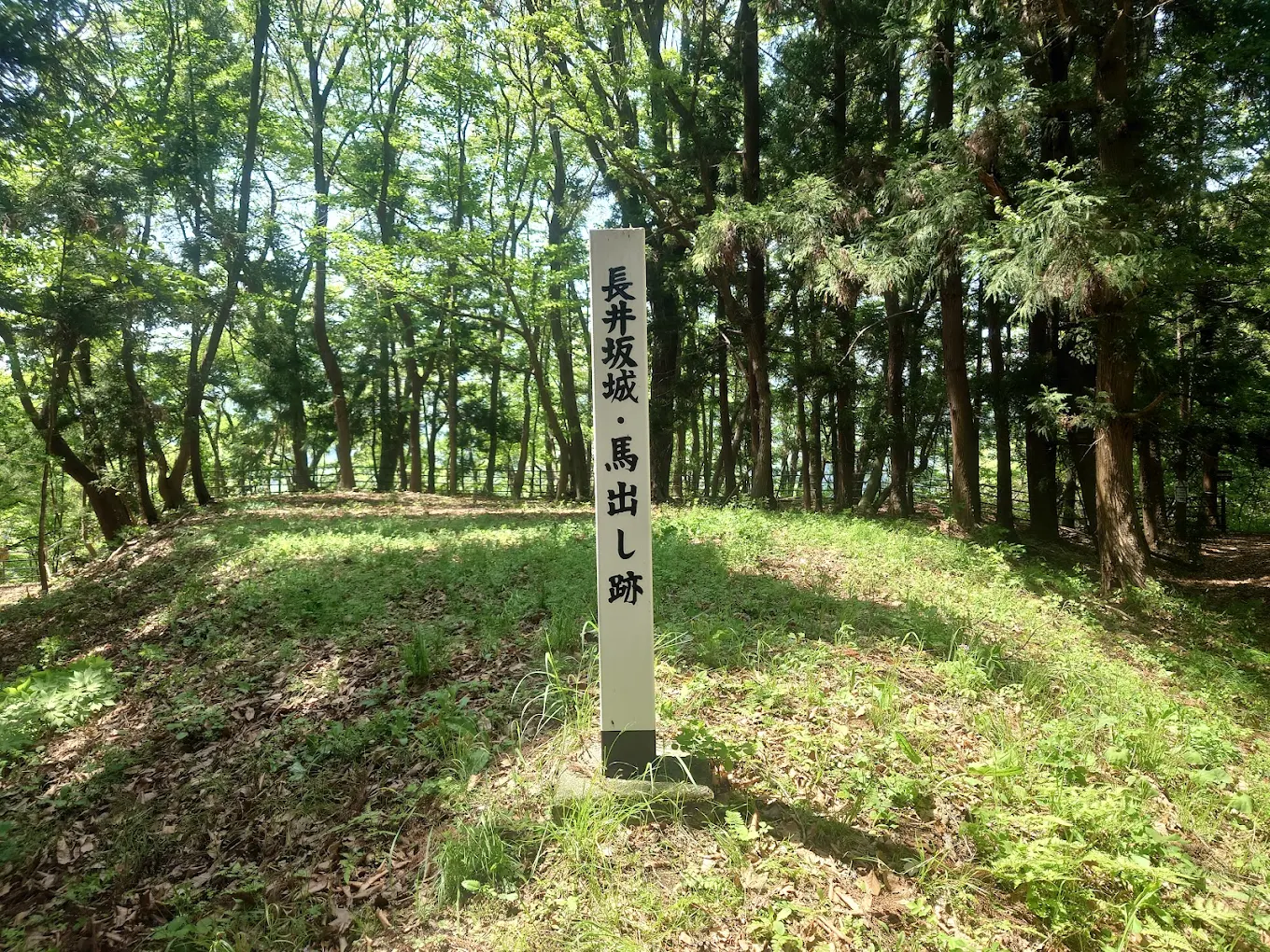
The main enclosure is located at the western end of the castle, on the cliff overlooking the Tone River. It is surrounded on three sides by earthworks approximately 2.5 meters high, with only the east side being an opening. This arrangement is a clever design to enhance defensive efficiency by limiting the access route to the main enclosure, protected by the cliff at the rear, to one direction.
The main enclosure is relatively compact in size, which is thought to reflect its character as a temporary encampment. It can be said that the design was intended to function as a mobile military base rather than housing a large permanent force.
Earthworks and Moats
The most prominent remains of Nagaisaka Castle are the earthworks and moats. The earthen ramparts that demarcate each enclosure remain clearly visible today, with some reaching heights of approximately 1.5 to 2.5 meters. The ramparts surrounding the main enclosure are particularly well-preserved, showcasing the castle-building techniques of the Sengoku period.
Moats were constructed between enclosures or to separate the castle grounds from the outside, and multiple such trenches have been identified. These trenches served to block the ridgeline, making enemy intrusion difficult.
Entrances (Koguchi)
Multiple entrances (koguchi) to the castle have also been identified. The entrance to the main enclosure, in particular, remains as an opening in the earthen rampart, demonstrating defensive ingenuity. The placement of the entrances was designed to lure the enemy in and allow for attacks from the flanks, demonstrating the high level of castle-building techniques of the Sengoku period.
Natural Fortress: Cliffs
The most distinctive feature of Nagaisaka Castle is undoubtedly the cliffs facing the Tone River. To the west, a nearly vertical cliff extends all the way to the Tone River, creating a sense of height that is still dizzying even today. This cliff allowed the castle to almost completely defend against attacks from the west.
Similarly, the Nagai-no-Sawa area to the north is also steep, and with natural fortifications protecting both the north and west, the directions that needed to be defended were limited to the east and south. This topographical advantage is why, despite being a relatively small castle, it was able to function as an important military base.
Highlights of Nagaisaka Castle
Well-Preserved Earthworks
The biggest highlight when visiting Nagaisaka Castle is its well-preserved earthworks. In particular, the earthworks surrounding the main enclosure remain at a height of about 2.5 meters, allowing visitors to imagine what it looked like during the Sengoku period. The curves and changes in height of the earthworks allow one to discern the intentions of the castle’s builders.
Walking along the top of the earthworks allows you to experience the perspective of the defenders of that time. The difference in view between the inside and outside of the earthworks will give you a real sense of its function as a defensive structure. ### View from the Cliff
The view from the cliff overlooking the Tone River is breathtaking. The landscape, a tapestry of cliffs dropping vertically below, the Tone River flowing below, and the mountains on the opposite bank, truly conveys the ruggedness of this castle’s location. However, the edge of the cliff is dangerous, so extreme caution is necessary.
This view is not merely aesthetically pleasing; it also speaks to how difficult this fortress was to attack during the Sengoku period. It helps to understand why famous generals like Uesugi Kenshin and Sanada Masayuki valued this location so highly.
Clear Moat
The moat that demarcates the castle grounds is another highlight. The deep moat carved into the ridge is still clearly visible today, demonstrating its function as an obstacle to enemy advances. The depth and width of the moat offer insights into the level of civil engineering technology at the time.
Structure of the Enclosure
The entrance to the main enclosure remains as an opening in the earthen rampart, allowing you to observe the defensive ingenuity. Imagining the movement through the entrance helps you understand how advantageous the defenders’ position was for attacking.
A Tranquil Atmosphere
Nagaisaka Castle has relatively few visitors, allowing you to leisurely explore the castle ruins in a tranquil atmosphere. The environment, where only the sounds of birds and wind can be heard, is ideal for contemplating the history of the Sengoku period. You can often have the castle ruins all to yourself, allowing you to observe the remains at your own pace.
Access Information
Access by Car
The most convenient way to access Nagaisaka Castle is by car.
- From Kan-Etsu Expressway Shibukawa-Ikaho IC: Approximately 15 minutes
- From Kan-Etsu Expressway Showa IC: Approximately 10 minutes
Access is via National Route 17 and then a prefectural road. While there are information boards near the castle ruins, they are somewhat difficult to find, so it is recommended to check a map beforehand. Parking space is limited, with only a few cars able to park on the roadside. Please be considerate of other visitors.
Access by Public Transportation
Access by public transportation is difficult. The distance from the nearest station is long, and bus routes are limited, so it’s best to assume you’ll be visiting by car.
- JR Joetsu Line Shibukawa Station: Approximately 20 minutes by taxi from the station
- JR Joetsu Line Numata Station: Approximately 25 minutes by taxi from the station
Entrance to the Castle and Required Time
The entrance to the castle ruins is on the east side. There is a signpost, but it’s not very noticeable, so you need to look carefully. The path to the castle is an unpaved mountain trail, and there are some steep sections.
The time required from the entrance to the main enclosure is approximately 15-25 minutes. Including time to explore the castle grounds, it’s best to allow 40 minutes to 1 hour in total. If you want to carefully observe the ruins, we recommend allowing about an hour and a half.
Notes for Visitors
- Clothing: As it is a mountain castle, comfortable clothing and non-slip shoes are essential. Particular caution is needed after rain, as the ground can become slippery.
- Season: In summer, vegetation can be overgrown, making the ruins difficult to see. Visiting from late autumn to early spring is recommended.
- Safety Precautions: The edge of the cliff is extremely dangerous. Please be very careful not to get too close to the cliff.
- Insect Repellent: In summer, there are many mosquitoes and gnats, so carrying insect repellent spray is recommended.
- Drinking Water: There are no vending machines around the castle ruins, so please prepare your own drinking water in advance.
Nearby Tourist Attractions
Numata Castle Ruins
Located approximately 15 kilometers north of Nagaisaka Castle, Numata Castle Ruins is a castle with a deep connection to Nagaisaka Castle. Numata Castle, which Uesugi Kenshin captured from Nagaisaka Castle, later became an important base for the Sanada clan. Currently, it is maintained as Numata Park, and the remains of stone walls and moats are still visible.
Nagurumi Castle Ruins
Nagurumi Castle, built by the Sanada clan as a branch castle of Numata Castle, is a castle from the same period as Nagaisaka Castle. It is known that the Hojo clan’s capture of Nagurumi Castle in 1589 (Tensho 17) served as a pretext for Toyotomi Hideyoshi’s siege of Odawara. It is currently selected as one of the Continued Top 100 Japanese Castles.
Ikaho Onsen
Ikaho Onsen, a representative tourist destination in Shibukawa City, is about a 20-minute drive from Nagaisaka Castle. After visiting the castle ruins, it would be nice to relax and soothe your fatigue in the hot springs. You can also enjoy the charming scenery of the stone steps leading up to the castle.
Mount Akagi
Mount Akagi, one of Japan’s 100 Famous Mountains, rises to the east of Nagaisaka Castle. At the foot of Mount Akagi, there are several shrines and lakes, making it a great place for nature walks.
Historical Value of Nagaisaka Castle
Importance in Uesugi Kenshin’s Kanto Strategy
Nagaisaka Castle is an important fortress for understanding Uesugi Kenshin’s Kanto strategy. Instead of simply attacking Numata Castle head-on, Kenshin employed a sophisticated strategy of setting up camp at Nagaisaka to cut off communication between Numata Castle and the Hojo clan’s stronghold.
This strategy demonstrates Kenshin’s military talent and proves the strategic importance of the Nagaisaka location. While controlling a key transportation hub to isolate the enemy was a fundamental strategy of the Sengoku period, its execution required a precise understanding of the terrain and securing logistics.
The Front Line Between the Hojo and Sanada Clans
During the Tensho era, Nagaisaka Castle was located on the front line between the two major powers, the Hojo and Sanada clans. During this period, Nagaisaka Castle held significance beyond mere military presence. In other words, it was a castle symbolizing control over the Numata territory.
For the Hojo clan, the Numata territory represented the northern limit of their control over the Kanto region, and for the Sanada clan, it was a foundation for their independent power. The struggle between the two was not merely a territorial dispute, but a battle for survival as Sengoku daimyo.
Position in the History of Castle Construction Technology
The layout of Nagaisaka Castle is a prime example of castle construction technology from the mid-to-late Sengoku period. The design philosophy of maximizing the use of natural terrain while placing only the minimum necessary artificial defensive structures demonstrates the rationality of castle construction techniques at the time.
In particular, the method of utilizing cliffs as defensive lines embodies the fundamental concept of mountain castle construction. The pragmatism of the Sengoku period—achieving maximum defensive effect with limited labor and materials—is reflected in the layout of Nagaisaka Castle.
Current Status and Preservation Activities of Nagaisaka Castle
The Nagaisaka Castle ruins are protected as a Gunma Prefecture designated historical site, but due to the low number of visitors, maintenance is kept to a minimum. Conversely, this also has the advantage of preserving the remains without alteration.
In recent years, investigations by local history enthusiasts and castle researchers have led to a re-evaluation of the historical value of Nagaisaka Castle. However, its name recognition is not necessarily high, and the number of visitors remains limited.
Basic maintenance such as grass cutting is carried out, but full-scale archaeological excavations and development plans have not yet been implemented. It is hoped that in the future, the value of Nagaisaka Castle will be recognized by more people, and appropriate preservation and utilization will progress.
Summary
Nagaisaka Castle is a Sengoku period mountain castle located in Shibukawa City, Gunma Prefecture. It is an important castle in the history of the Sengoku period in the Kanto region, used by Uesugi Kenshin as a base for his conquest of Numata, and subsequently fought over by the Hojo and Sanada clans.
The castle’s layout, which utilizes the natural fortifications of the Tone River cliffs, conveys the castle-building techniques of the Sengoku period to the present day. The well-preserved earthworks, clearly defined moats, and breathtaking views from the cliffs evoke the spirit of the Sengoku period (Warring States period) in visitors.
Access is somewhat difficult, and it’s a quiet castle site with few visitors, but precisely because of this, it’s a place where you can deeply contemplate the history of the Sengoku period. This castle site is a must-visit for anyone interested in mountain castles in Gunma Prefecture, or those who want to trace the footsteps of Uesugi Kenshin and the Sanada clan.
By visiting Nagaisaka Castle, you can glimpse a part of the regional history of the Sengoku period that isn’t found in textbooks, and the tactics and strategies employed by famous generals. Standing on the cliff and overlooking the Tone River, why not reflect on the historical drama that once unfolded in this very place?