Complete Guide to Nagahama Castle Ruins (Numazu City, Shizuoka Prefecture) | A Thorough Explanation of the Hojo Naval Base
Located in the Uchiura district of Numazu City, Shizuoka Prefecture, Nagahama Castle Ruins is a coastal castle that played an important role as a naval base for the Hojo clan during the Sengoku period. Built on a small hill jutting out into Suruga Bay, this castle was developed as a historical park in 2015, reviving its appearance from approximately 400 years ago. This article comprehensively introduces information you should know before visiting Nagahama Castle Ruins, from its historical background and highlights to access methods.
What is Nagahama Castle Ruins? | Overview of a National Historic Site
Nagahama Castle Ruins is a valuable cultural property designated as a national historic site in 1988. Located on a hill approximately 30 meters above sea level facing Suruga Bay in Uchiura Nagahama, Numazu City, it is known as a coastal castle characterized by its location jutting out into the sea.
Basic Information
- Location: Nagahama, Uchiura, Numazu City, Shizuoka Prefecture
- Designation: National Historic Site (Designated in 1988)
- Construction Period: Late Muromachi period (Major renovation around 1579)
- Builder: Okawa clan (Renovation by the Hojo clan)
- Castle Style: Coastal castle/Naval castle
- Main Remains: Enclosures, moats, earthworks, dry moats, vertical moats
- Opening Hours: Always open (Historical Site Park)
- Admission Fee: Free
History of Nagahama Castle | The Hojo Naval Force and the Battle for Suruga Bay
Background of Construction and Early History
Nagahama Castle began as the residence of the Okawa clan, who served the Hojo clan from the Muromachi period. The Uchiura area faces the deep inlet of Suruga Bay, known as Oku-Suruga Bay, and its topography, surrounded by Nagaizaki and Awashima Island, was ideal for anchoring ships. This geographical advantage was a key factor in the development of Nagahama Castle as a naval base.
Hojo Soun and the Pacification of Izu
The relationship between the Hojo clan and Izu began in 1493 (Meio 2), when Hojo Soun launched a surprise attack on the residence of Ashikaga Chachamaru, the Horikoshi Shogun, and pacified Izu, establishing his base at Nirayama. This pacification of Izu marked the first step for the Hojo clan as a Sengoku daimyo, and thereafter, the Hojo clan expanded their power throughout the Kanto region.
Development as a Naval Base (1579)
Nagahama Castle first appeared on the historical stage in 1579 (Tensho 7). In that year, the Hojo clan was in fierce conflict with the Takeda clan over control of Suruga Bay. The Hojo clan extensively renovated (improved) Nagahama Castle, positioning it as a naval base in Suruga Bay.
This renovation strengthened Nagahama Castle’s function as a fortress protecting the naval base of Shigesu Port. Kajiwara Kagemune, the commander of the Hojo navy, was dispatched, and a system was established to prepare for invasions by the Takeda clan.
Conflicts with the Takeda Clan
During the Sengoku period, water transport in Suruga Bay was extremely important both militarily and economically. The Takeda and Hojo clans waged fierce battles for control of this sea area. Nagahama Castle functioned for the Hojo clan as a defensive base in the western part of Suruga Bay and as a launching base for their navy.
End under the Toyotomi Regime
In 1590 (Tensho 18), when the Hojo clan was destroyed in Toyotomi Hideyoshi’s Odawara campaign, Nagahama Castle also ceased to serve its purpose. Afterward, the castle was abandoned and lost its function as a fortress, but the remains were preserved in good condition.
Structure and Characteristics of Nagahama Castle Ruins | Layout of a Coastal Castle
Location as a Coastal Castle
The most distinctive feature of Nagahama Castle is that it is a coastal castle built on a hill overlooking the sea. Taking advantage of its topography, surrounded by the sea on three sides, it was designed to provide strong defense against land attacks and enable the rapid deployment of naval forces from the sea.
Arrangement of Enclosures
The castle ruins consist of multiple enclosures (kuruma), arranged in a stepped pattern around the main enclosure. Each enclosure is demarcated by moats and earthworks, preventing enemy intrusion. In the current historical park, visitors can experience the layout of these enclosures by walking around.
Ingenious Defensive Features
Moats: These are moats dug to cut across ridges, serving as important defensive structures to hinder enemy advances. Multiple clear moats can be seen at the Nagahama Castle ruins.
Vertical Moats: These moats, dug along the slope, defended against attacks from the side. Restoration work has made it possible to visually understand the scale and arrangement of the vertical moats.
Earthworks: These are defensive walls made by piling up earth, surrounding the baileys. They served to prevent enemy intrusion and also concealed the interior.
Dry Moats: These are moats that do not hold water. Multiple dry moats have been identified at Nagahama Castle. They functioned as a defensive structure unique to mountain castles.
Connection to Naval Facilities
Below the castle lay the Shigesu Port, where it is believed that naval ships were anchored. The integrated structure of the castle and port clearly demonstrates the characteristics of Nagahama Castle as a naval castle.
The History of Archaeological Excavation and Historical Site Development
Results of Archaeological Excavation (1985)
The archaeological excavation conducted in 1985 (Showa 60) scientifically confirmed the remains of Nagahama Castle. This excavation revealed the layout of the baileys, the scale of the moats, and traces of buildings, clarifying the overall structure of the castle.
Designation as a National Historic Site (1988)
Based on the results of the archaeological excavation, the site was designated a national historic site in 1988. This meant that the Nagahama Castle ruins were protected as a national cultural property, paving the way for full-scale development.
Development as a Historical Site Park (Completed in 2015)
In 2015 (Heisei 27), the historical site development was completed, and the site opened as a historic site park. This development aimed to restore the castle’s appearance from approximately 400 years ago as closely as possible, based on the results of the archaeological excavation.
The features of the restoration are as follows:
- Restoration of the flat areas of the baileys
- Clarification of moats and vertical trenches
- Restoration of earthworks
- Marking of building pillar remains
- Installation of explanatory panels
- Improvement of viewing paths
Currently, it is a valuable historical park where visitors can see the restored remains up close and experience the atmosphere of a Sengoku period coastal castle.
Highlights of Nagahama Castle Ruins | Checkpoints for Visitors
Restored Castle Remains
At Nagahama Castle Ruins, which has been restored as a historical park, you can see the following remains:
Main Bailey: This is the central bailey of the castle, located at the highest point. From here, you can see a panoramic view of Suruga Bay and appreciate its function as a naval surveillance base.
Moats: Multiple moats have been restored, and their depth and scale are astonishing. This is a highlight where you can understand the importance of moats as defensive structures.
Vertical Moats: The vertical moats descending the slope demonstrate the ingenuity of Nagahama Castle’s defensive system.
Earthworks: The earthworks surrounding the baileys have been restored, allowing for a visual understanding of the castle’s appearance at the time.
Building Pillar Markings: Pillar holes confirmed during archaeological excavations are marked on the ground, revealing the building’s layout and scale.
Naval Exhibits
Within the historical park, there are explanatory panels about the Hojo navy. Panels detailing the warships of the time and full-scale models showing the size of the ships allow visitors to learn about the realities of the navy.
Scenic Viewpoint
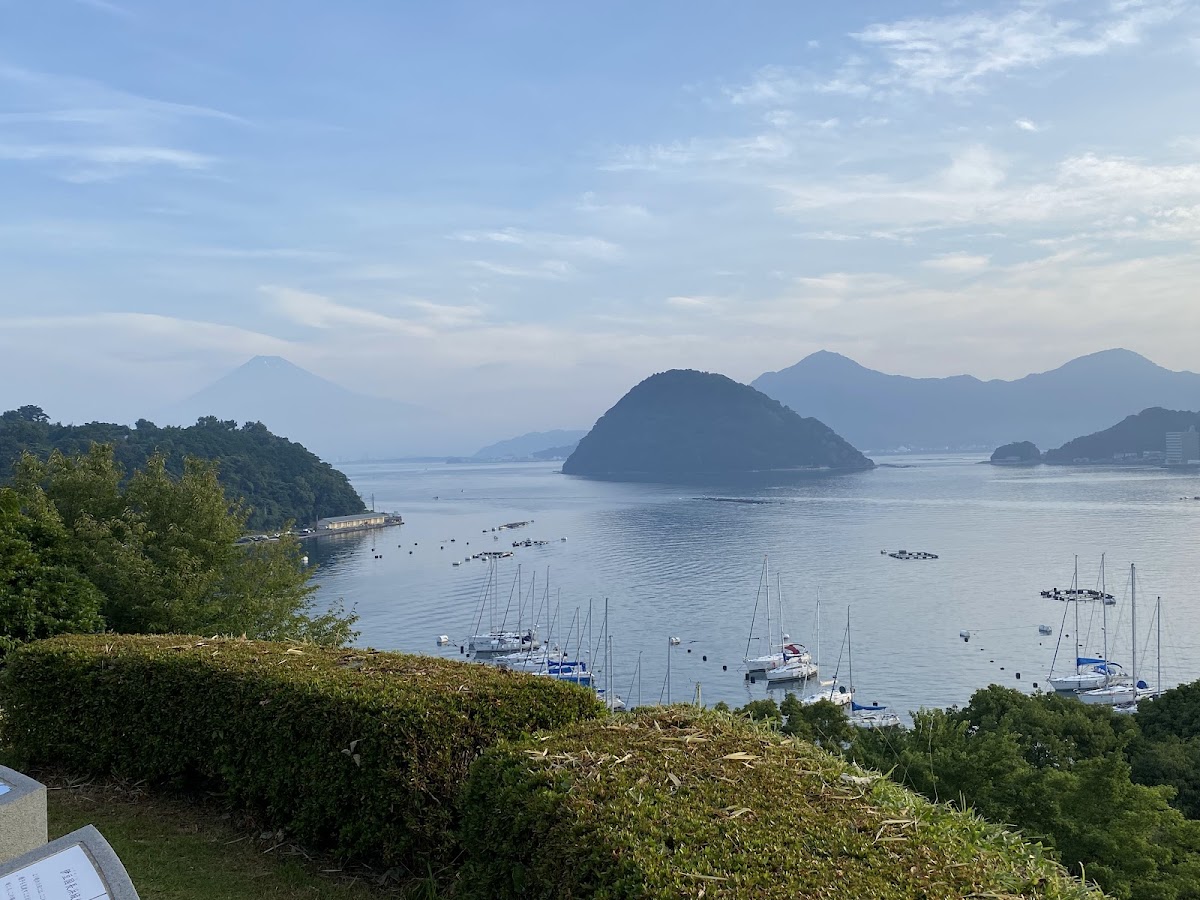
From the hilltop, a beautiful view of Suruga Bay unfolds. On clear days, Mount Fuji can be seen, making it an excellent photo spot. This view speaks to the excellent location of Nagahama Castle as a naval surveillance base.
Ascent Routes from the East and West
Nagahama Castle ruins can be reached from either the east or the west. By using both routes, you can gain a deeper understanding of the castle’s overall layout. The route from the east is relatively gentle, while the route from the west offers scenic views characteristic of a coastal castle.
Access Methods | How to Get to Nagahama Castle Ruins
Access by Public Transportation
From JR Numazu Station:
- Take the Tokai Bus from the South Exit of JR Numazu Station
- Get off at the “Nagahama Castle Ruins” bus stop (approximately 40 minutes)
- A short walk from the bus stop
The Tokai Bus route heads towards Uchiura, and since the number of buses is limited, it is recommended to check the timetable in advance.
Access by Car
From Tomei Expressway:
- Via National Route 1 and National Route 414 from Numazu IC or Nagaizumi-Numazu IC
- Approximately 40 minutes
From Shin-Tomei Expressway:
- Via National Route 414 from Nagaizumi-Numazu IC
- Approximately 40 minutes
Parking Information
Nagahama Castle Ruins has a dedicated parking lot. It is free to use and has space for approximately 10 regular cars. However, it may be crowded during tourist season and on weekends, so early arrival is recommended.
Estimated Time Required
For a thorough visit to the castle ruins, allow approximately 60-90 minutes. Including photography and viewing explanatory panels, about 2 hours should be sufficient for a leisurely visit.
Nearby Tourist Spots | Places to Visit Together
Kokokuji Castle Ruins
Kokokuji Castle Ruins, located in Negoya, Numazu City, is also known as a castle associated with Hojo Soun. This castle served as a base for the Hojo clan’s expansion into Izu and Suruga provinces. Visiting it along with the Nagahama Castle ruins provides a comprehensive understanding of the Hojo clan’s strategy. It is designated a national historic site, and its magnificent dry moat remains intact.
Nirayama Castle Ruins
Located in Izunokuni City, the Nirayama Castle ruins were the base for Hojo Soun’s conquest of Izu. It is an important historical site as the birthplace of the Hojo clan and an essential location for understanding its connection to Nagahama Castle.
Uchiura Coastline
The Uchiura area surrounding the Nagahama Castle ruins is a scenic spot with a beautiful coastline. There are numerous viewpoints offering stunning views of Mount Fuji across Suruga Bay, making it ideal for a stroll.
Numazu Port
Numazu Port, located in the city of Numazu, is a tourist spot where you can enjoy fresh seafood. It’s recommended to stop by before or after visiting the Nagahama Castle ruins and savor the local cuisine.
Points to Note and Advice for Visitors
Clothing and Items to Bring
- Comfortable Walking Shoes: The castle ruins have uneven terrain and you will be walking on dirt and grass paths, so comfortable walking shoes such as sneakers are essential.
- Hat and Sunscreen: There is little shade, so sun protection is important on sunny days.
- Drinks: Hydration is especially necessary in the summer. There are few vending machines in the area, so prepare in advance.
- Rain Gear: As it is a coastal area with unpredictable weather, a folding umbrella is recommended.
Best Season
Nagahama Castle Ruins can be visited throughout the year, but the best times are:
- Spring (March-May): The weather is mild, and the fresh greenery is beautiful.
- Autumn (October-November): The temperature is moderate, the air is clear, and Mount Fuji is clearly visible. – Winter (December-February): The snow-capped peak of Mt. Fuji is beautiful, and the clear air provides the best views.
Summer requires precautions against the heat, but it’s also a beautiful season with a stunning contrast between the blue waters of Suruga Bay and the greenery.
Photography Tips
- View of Suruga Bay from the main enclosure
- Impressive structure of the moat
- Series of vertical moats and earthworks
- Combination of Mt. Fuji and the castle ruins on a clear day
- Full-scale model of a naval vessel
Historical Value and Modern Significance of Nagahama Castle Ruins
Importance in Naval History Research
Nagahama Castle Ruins is an extremely important historical site for studying the history of Japanese naval forces. Among the many land castles in Japan, examples of well-preserved remains of castles that clearly functioned as naval bases are limited. Nagahama Castle Ruins provides valuable physical evidence for understanding the reality of the Hojo navy.
Contribution to Local History Education
The Nagahama Castle Ruins, developed as a historical park, are also utilized as a site for local history education. They play an important role as a field trip site for elementary and junior high schools in Numazu City, and as a base for history learning among the general public.
Utilization as a Tourism Resource
As a tourism resource for Numazu City, the Nagahama Castle Ruins have been selected as one of the “100 Treasures of Numazu.” As a historical site popular with both history enthusiasts and general tourists, it contributes to enhancing the region’s appeal.
Summary | The Value of Visiting Nagahama Castle Ruins
Nagahama Castle Ruins is a valuable historical site where you can experience the reality of a naval castle from the Sengoku period. Built to protect Shigesu Port, which functioned as a naval base for the Hojo clan, this castle became the stage for battles with the Takeda clan over control of Suruga Bay.
With the completion of the historical site restoration in 2015, the castle’s appearance from approximately 400 years ago has been restored, allowing visitors to see the remains such as baileys, moats, vertical trenches, and earthworks up close. The view of Suruga Bay from its location jutting out into the sea is spectacular, and on clear days, Mount Fuji can even be seen.
Accessible by bus from Numazu Station, this historical park is free to visit and recommended not only for history buffs but also for families and couples. Nearby are other related historical sites such as the Kokokuji Castle ruins, making it a worthwhile place to visit as part of a historical walk tracing the history of the Hojo clan.
Experience the atmosphere of a Sengoku period seaside castle and reflect on the history of the Hojo navy—Nagahama Castle ruins is a special place where you can experience such historical romance. When you visit Shizuoka Prefecture, be sure to stop by.