Myōjō Castle, Ōsaki City (Miyagi Prefecture): Complete Guide | The Castle and Historical Remains of the Ōsaki Clan, the Ōshū Tandai
What is Myōjō Castle? | An Overview of the Medieval Flatland Castle Remaining in Ōsaki City, Miyagi Prefecture
Myōjō Castle is a medieval flatland castle located in Jōnai, Furukawa Ōsaki, Ōsaki City, Miyagi Prefecture. Known as the base of the Ōsaki clan, who ruled the Tohoku region extensively as the Ōshū Tandai, its scale and grand design attest to the immense power of the Ōsaki clan at the time.
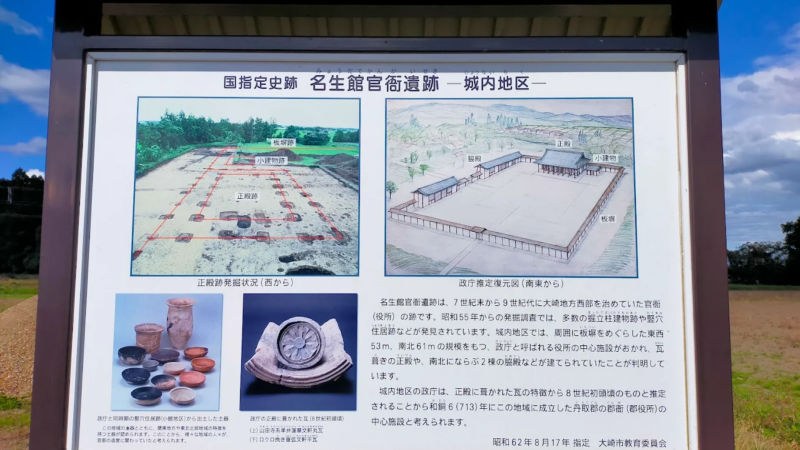
The current Myōjō Castle site is preserved as a complex site overlapping with the nationally designated historical site “Myōjōkan Kanga Ruins,” making it a valuable historical heritage site where ancient government office remains and medieval castle remains exist in the same location. The castle, skillfully utilizing the slightly elevated river terrace on the west bank of the Egai River, consisted of multiple baileys such as the North Bailey, Ōkan, Kokan, and Uchikan, boasting a vast castle area.
A description of Myōjō Castle is found in the *Ōishiji Documents* from the second year of the Kannō era (1351), suggesting that it was already built by that time. It was also known as “Goshokan” and “Yoshitakakan,” and is famous as the residence of Ōsaki Yoshitaka, the last head of the Ōsaki clan.
History of Myōjō Castle | The Rise and Fall of the Ōsaki Clan over 200 Years
The Establishment of the Ōsaki Clan and its Rule as the Ōshū Tandai
The history of Myōjō Castle is closely intertwined with the history of the Ōsaki clan. The Ōsaki clan was a branch of the Ashikaga family, descended from the Kawachi Minamoto clan, and its founder was Shiba Iekane, who descended to Ōshū as the Ōshū Tandai of the Muromachi Shogunate. Iekane established the Ōsaki region as his base and adopted the name Ōsaki.
The position of Oshu Tandai was an important post established by the Muromachi Shogunate to govern the Tohoku region. The Osaki clan, leveraging this authority, controlled a vast area stretching from northern Miyagi Prefecture to southern Iwate Prefecture. Myōshō Castle served as the center of this administration, playing a crucial role in both political and military affairs.
Relationship between Myōshō Castle and Surrounding Forces during the Sengoku Period
During the Sengoku period, the Osaki clan maintained their power through relationships with powerful surrounding daimyo such as the Date and Mogami clans. They forged complex alliances, particularly with the Date clan to the south, including marriage alliances.
During the Tenshō era (1573-1593), Osaki Yoshitaka, the 12th head of the Osaki clan, resided at Myōshō Castle. However, by this time, the Osaki clan was already losing its former power, and control over its retainers was said to have weakened.
The Turning Point of 1590: The Siege of Odawara and the Dispossession of Domain
The greatest turning point in the history of Myōjō Castle came in 1590. During Toyotomi Hideyoshi’s Siege of Odawara, the final stage of his unification of Japan, Ōsaki Yoshitaka was ordered to participate, but he refused.
There are various theories as to the reason for this non-participation, but it is thought that it may have been due to his inability to control his retainers, or perhaps his determination to resist Hideyoshi’s unification of Japan to the very end. As a result, Ōsaki Yoshitaka’s territory was confiscated by Hideyoshi’s pacification of Ōshū, and the Ōsaki clan met its fate of dispossession and extinction.
The Kasai-Ōsaki Rebellion and the Battle for Myōjō Castle
The Outbreak of the Rebellion and the Role of Myōjō Castle
Immediately after the Ōsaki clan’s dispossession, the Kasai-Ōsaki Rebellion broke out in 1590. This was a large-scale rebellion launched by the former retainers and subjects of the Osaki and Kasai clans, who had lost their territories as a result of Toyotomi Hideyoshi’s pacification of Oshu, against the newly appointed lord.
The rebels holed up in Myōshō Castle, using it as a base of resistance. The vast grounds and strong defensive structures of Myōshō Castle made it an ideal siege site for the rebels. It is believed that several thousand rebels gathered at Myōshō Castle at this time.
Suppression by Gamō Ujisato
Gamō Ujisato, who had been granted Aizu, was tasked with suppressing the rebellion. Ujisato led a large army to attack Myōshō Castle and, after a fierce battle, subdued the rebels. It is believed that Myōshō Castle suffered significant damage in this battle.
After suppressing the rebellion, Gamō Ujisato temporarily entered Myōshō Castle and made it his administrative center for the region. Furthermore, records show that Ujisato, suspecting Date Masamune’s rebellious intentions, holed up in Myōjō Castle to keep Masamune in check. This indicates the strategic importance of Myōjō Castle.
The Road to Abandonment
After the suppression of the Kasai-Ōsaki Rebellion, this region eventually came under the control of Date Masamune, but Myōjō Castle was not used as his main residence. The Date clan established Sendai Castle as their base and governed this region by stationing vassals there. Therefore, Myōjō Castle gradually lost its function and is believed to have been abandoned.
During the time of Tokugawa Ieyasu, the Sendai Domain’s rule was established, and Myōjō Castle completely disappeared from the historical stage. Since then, the castle ruins have been used as farmland and for private residences, and remain so to this day.
Layout and Remains of Myōjō Castle
Castle Structure Utilizing River Terraces
Myōjō Castle was built skillfully utilizing the natural topography of a river terrace on the west bank of the Egai River. This terrace surface, while relatively flat, is elevated above the surrounding area, making it a suitable terrain for defense.
The castle grounds were vast, extending approximately 800 meters east-west and 600 meters north-south, clearly demonstrating the power of the Ōsaki clan, the Ōshū Tandai (governor of Ōshū Province). Despite being a flatland castle, it secured a certain level of defensive strength by utilizing the elevation difference of the terrace.
Multiple Enclosures
Myōjō Castle had a complex layout consisting of multiple enclosures (kuruwa). The following main enclosures have been identified:
North Enclosure: Located in the northern part of the castle grounds, this enclosure retains relatively well-preserved remains. Part of the earthworks still exists, giving a glimpse into its original scale.
Odachi: This is the central enclosure of the castle, believed to be the site of the Osaki clan’s residence. It has the largest area and is presumed to have served as an administrative center.
Kodachi: This enclosure is adjacent to Odachi and may have housed retainers’ residences or warehouses.
Uchikan: This enclosure is located in the central part of the castle and is thought to have been an important defensive stronghold.
These enclosures were demarcated by earthworks and moats, forming a complex defensive system.
Existing Remains
The following remains can be observed at the current Myojo Castle site:
Earthworks: Remnants of earthworks are scattered throughout the castle grounds. They are particularly well-preserved around Kitakan, where earthworks approximately 2-3 meters high can be seen.
Remains of Dry Moats: Traces of moats that demarcated the enclosures remain as depressions in the terrain. Archaeological excavations have confirmed the existence of moats more than 10 meters wide.
Terraced Topography: In addition to the natural topography of river terraces, artificially created terraces can be seen in various places, providing clues to understanding the structure of the castle.
However, most of the castle area has now been converted into private houses and farmland, making it difficult to completely restore its original appearance. Nevertheless, the undulations of the terrain and the remaining earthworks allow us to appreciate the vast scale of the castle.
Complex Site with the Myōshōkan Government Office Ruins
Historical Heritage Site Where Ancient and Medieval Periods Overlap
One of the most distinctive features of the Myōshō Castle ruins is that it is a complex site where the ruins of an ancient government office and the ruins of a medieval castle exist in the same location. The Myōshōkan Government Office Ruins are the remains of an ancient government office that existed from the Nara period to the Heian period, and are a nationally designated historic site.
The fact that this area remained an important base from ancient times demonstrates its geographical and strategic advantages. The water transport on the Egai River, the surrounding fertile plains, and its position as a transportation hub consistently made this area an important location from ancient to medieval times. ### Archaeological Excavation Results
Continued archaeological excavations are underway at the Myōshōkan Government Office Site, uncovering numerous remains of ancient government buildings and medieval castle structures. These investigations have yielded the following important insights:
- Layout and scale of ancient government buildings
- Structure of buildings in medieval castles
- Detailed structure of earthworks and moats
- Dating based on excavated artifacts
- Transformation process of the castle
The results of these excavations enhance the historical value of Myōshō Castle and provide valuable data demonstrating continuity from ancient to medieval times.
Access and Visiting Information for Myōjō Castle
Transportation Access
Access by Train:
- Approximately 10 minutes on foot from Higashi-Ōsaki Station on the JR Rikuu East Line
- Approximately 15 minutes by car from Furukawa Station on the JR Tohoku Shinkansen and Tohoku Main Line
Access by Car:
- Approximately 8 minutes from Furukawa Interchange on the Tohoku Expressway
- Accessible from National Route 47
To reach the castle ruins, aim for the Myōjōkan Government Office Ruins or Jōsen-in Temple.
Visiting Points
Myōjō Castle Ruins are freely accessible, but since much of the area is private property (residential and farmland), please be careful not to trespass. A visit should take approximately 30 minutes.
Recommended Sightseeing Route:
- Understand the overall layout using the information board at the Myōshōkan Government Office Ruins.
- Examine the earthwork remains around the North Building.
- Walk around the castle grounds while observing the terrace topography.
- Examine the topography around Jōsen-in Temple.
Information boards are installed on-site, where you can read detailed explanations about the history and structure of Myōshō Castle.
Nearby Tourist Attractions
Nearby tourist attractions to visit in conjunction with Myōshō Castle:
- Myōshōkan Government Office Ruins: A nationally designated historical site as an ancient government office site.
- Jōsen-in Temple: A temple related to Myōshō Castle.
- Furukawa Castle Ruins: Another medieval castle site in Ōsaki City.
- Ōsaki City Matsuyama Sake Museum: A facility where you can learn about the history and culture of the region.
Cultural Property Designation and Preservation Activities of Myōshō Castle
The Myōshō Castle Ruins were designated as a cultural property of Ōsaki City (then Furukawa City) in January 1970. Furthermore, the site is designated as a National Historic Site as the Myōshōkan Government Office Ruins, and is protected by multiple layers of protection.
Local preservation efforts for the castle ruins continue, including the maintenance of the remains and the installation of information boards. Archaeological excavations are also continuously conducted, and new discoveries are gradually revealing the history of Myōshō Castle.
Myōshō Castle Tells the Story of Medieval Tohoku
Myōshō Castle is not merely a castle ruin, but an important historical heritage site for understanding the medieval history of the Tohoku region. It is deeply connected to important events in Japanese history, such as the more than 200-year rule of the Ōsaki clan, the relationship between the Muromachi Shogunate and the Tohoku region, the regional situation during the Sengoku period, Toyotomi Hideyoshi’s unification of Japan and the pacification of Ōshū, and the large-scale popular uprising known as the Kasai-Ōsaki Rebellion.
The scale of the castle, utilizing a vast terrace, conveys the immense power the Ōsaki clan wielded at the time. The remains of earthworks and moats, and the complex layout consisting of multiple baileys, serve as valuable teaching materials for learning about the structure of medieval castles.
While the site of Myōjō Castle is now a quiet rural area, a careful observation of its topography reveals its past as the political and military center of the Tohoku region. Myōjō Castle, with its connections to famous historical figures such as Date Masamune, Gamō Ujisato, and Toyotomi Hideyoshi, is a must-see spot for history buffs visiting Miyagi Prefecture.
For castle enthusiasts, those interested in Tohoku history, and those wanting to learn about medieval local governance, Myōjō Castle offers numerous discoveries and learning opportunities. When visiting Ōsaki City, be sure to stop by this historic castle site.