Mugishima Castle (Yatsushiro City, Kumamoto Prefecture) Complete Guide | The History and Hub of Nanban Trade Built by Konishi Yukinaga
Mugishima Castle is a castle located in Kuni-gun, Yatsushiro City, Kumamoto Prefecture, dating from the Azuchi-Momoyama period to the early Edo period. Built on the delta at the mouth of the Kuma River, this castle played an important role as a hub for Nanban trade and is now designated as part of the national historic site “Yatsushiro Castle Ruins.” This article provides a detailed explanation of Mugishima Castle’s history from its construction to its collapse, its characteristics, and its current remains.
History of Mugishima Castle
Construction by Konishi Yukinaga (Tensho 16, 1588)
In Tensho 16 (1588), after Toyotomi Hideyoshi’s conquest of Kyushu, Konishi Yukinaga, who came to rule the southern half of Higo Province with a domain of 240,000 koku, ordered his senior retainer, Konishi Yukishige (also known as Konishi Suegato, Konishi Yukishige), to construct Mugishima Castle. Konishi Yukinaga abandoned his previous base, Furufumoto Castle, and constructed a new castle on a delta adjacent to the port of Tokubuchi at the mouth of the Kuma River.
Konishi Yukinaga was known as a Christian daimyo and ruled over Uto, Mashiki, Yatsushiro, and Amakusa. The selection of the site for Mugishima Castle was heavily influenced by the convenience of maritime transportation and water transport. At the time, the western side of the castle faced the Yatsushiro Sea, and the northern side was a large inlet. These geographical conditions were crucial to Mugishima Castle’s function as a base for trade with the West.
An Advanced Fortress with All-Stone Walls
Mugishima Castle was an advanced fortress for its time, featuring all-stone walls. While stone wall technology rapidly developed from the end of the Sengoku period, the construction of such a large-scale stone wall castle in Kyushu demonstrates Konishi Yukinaga’s wealth and technical prowess.
The castle’s structure was a concentric layout, with the main keep at the center, surrounded by the second and third baileys, and enclosed by a moat. Archaeological excavations have confirmed that the stone walls reached heights of over 5 meters in some places.
Function as a Hub for Nanban Trade
One of the main reasons for the construction of Mugishima Castle was its function as a hub for Nanban trade. Tokubuchi-no-tsu, adjacent to the north of the castle, was designated a direct port of Toyotomi Hideyoshi, and trade with Portugal and Spain took place there.
Konishi Yukinaga, a Christian daimyo, had close ties with missionaries and actively adopted Western culture and technology. Goods imported from Nanban were traded around Mugishima Castle, playing a crucial role as a gateway for international trade in Higo Province.
The Battle of Sekigahara and Mugishima Castle
Mugishima Castle as a Western Army Base
In the Battle of Sekigahara in 1600, Konishi Yukinaga sided with the Western Army along with Ishida Mitsunari and others. This decision drastically altered the fate of Mugishima Castle.
Before and after the main battle of Sekigahara, battles between the Eastern and Western armies also took place within Higo Province. Kato Kiyomasa, who belonged to the Eastern Army, controlled the northern half of neighboring Higo Province and invaded Konishi Yukinaga’s territory.
Conquest by Kato Kiyomasa
After the Western Army’s defeat at the Battle of Sekigahara, Konishi Yukinaga was captured and executed in Kyoto. Subsequently, Higo Province was unified and ruled by Kato Kiyomasa, and Mugishima Castle came under his control.
Kato Kiyomasa designated Kumamoto Castle as his main castle, and Mugishima Castle was positioned as a subsidiary castle. Until the time of Kiyomasa’s eldest son, Kato Tadahiro, Mugishima Castle continued to function as the administrative center of the Yatsushiro region.
The One Castle Per Province Decree and the Survival of Mugishima Castle
In 1615 (Keicho 20), the Edo Shogunate issued the One Castle Per Province Decree, ordering each daimyo to demolish castles other than their own. However, Mugishima Castle of the Kumamoto Domain was exceptionally allowed to survive.
This was a special exception of “Two Castles Per Province,” officially recognizing both Kumamoto Castle and Mugishima Castle. The reason for this is believed to be the strategic importance of the Yatsushiro region and the fact that Mugishima Castle was indispensable for governing the Kuma River basin. This exception is a historical fact that illustrates the importance of Mugishima Castle.
Collapse Due to the Great Earthquake of Genna
The Great Earthquake of Genna 5 (1619)
The history of Mugishima Castle came to an end with the great earthquake that occurred on May 1, 1619 (Genna 5). This earthquake is recorded as the “Genna Great Earthquake” and is estimated to have been a massive one, around magnitude 7.
The earthquake caused significant damage to the stone walls and structures of Mugishima Castle, rendering it unusable as a castle. This disaster caused immense damage throughout the Yatsushiro region, and it is said that many lives were lost.
Relocation to Yatsushiro Castle
After the collapse of Mugishima Castle, Kato Tadahiro (son of Kiyomasa) decided to build a new castle. This is the current Yatsushiro Castle (Matsue Castle).
The new castle was to be built in Matsue, north of Mugishima Castle, and construction began in 1622 (Genna 8). Yatsushiro Castle was built on more stable ground, incorporating lessons learned from Mugishima Castle. It is believed that some of the stone materials from Mugishima Castle were reused in the construction of the new Yatsushiro Castle.
Structure and Characteristics of Mugishima Castle
Location and Topography
Mugishima Castle was built on the delta at the mouth of the Kuma River. With the Kuma River flowing to the south, the Maekawa River to the north, and the Yatsushiro Sea to the west, it was a strategically important location for water transport.
While this location offered excellent access to water transport, it suffered from the problem of soft ground. In fact, this soft ground is cited as one of the causes of the castle’s collapse during the Great Genna Earthquake.
Castle Structure
The structure of Mugishima Castle, as revealed by archaeological excavations, is as follows:
- Honmaru: The central part of the castle, presumed to have contained a keep or a building equivalent to a keep.
- Ninokuruwa: Arranged to surround the Honmaru, where important buildings stood.
- Sannomaru: The outer enclosure, where the residences of retainers were located.
- Stone Walls: Constructed entirely of stone walls, with sections exceeding 5 meters in height confirmed.
- Moat: A moat surrounded the castle.
Excavated Artifacts
A variety of artifacts have been unearthed during the excavations:
- Roof Tiles: Numerous high-quality roof tiles, including gold-leaf tiles and eaves tiles, have been discovered.
- Ceramics: Chinese celadon and white porcelain, as well as European pottery, have been unearthed, indicating traces of trade with the Nanban (Southern Barbarians).
- Stone Materials for the Stone Walls: The use of stone from the Aso mountain range indicates that materials were sourced from a wide area.
- Musket Balls: Musket balls, showing evidence of battle, have also been discovered.
These excavated artifacts demonstrate that Mugishima Castle was not merely a military base, but a culturally rich fortress.
Designation as a National Historic Site “Yatsushiro Castle Ruins Group”
History of Historic Site Designation
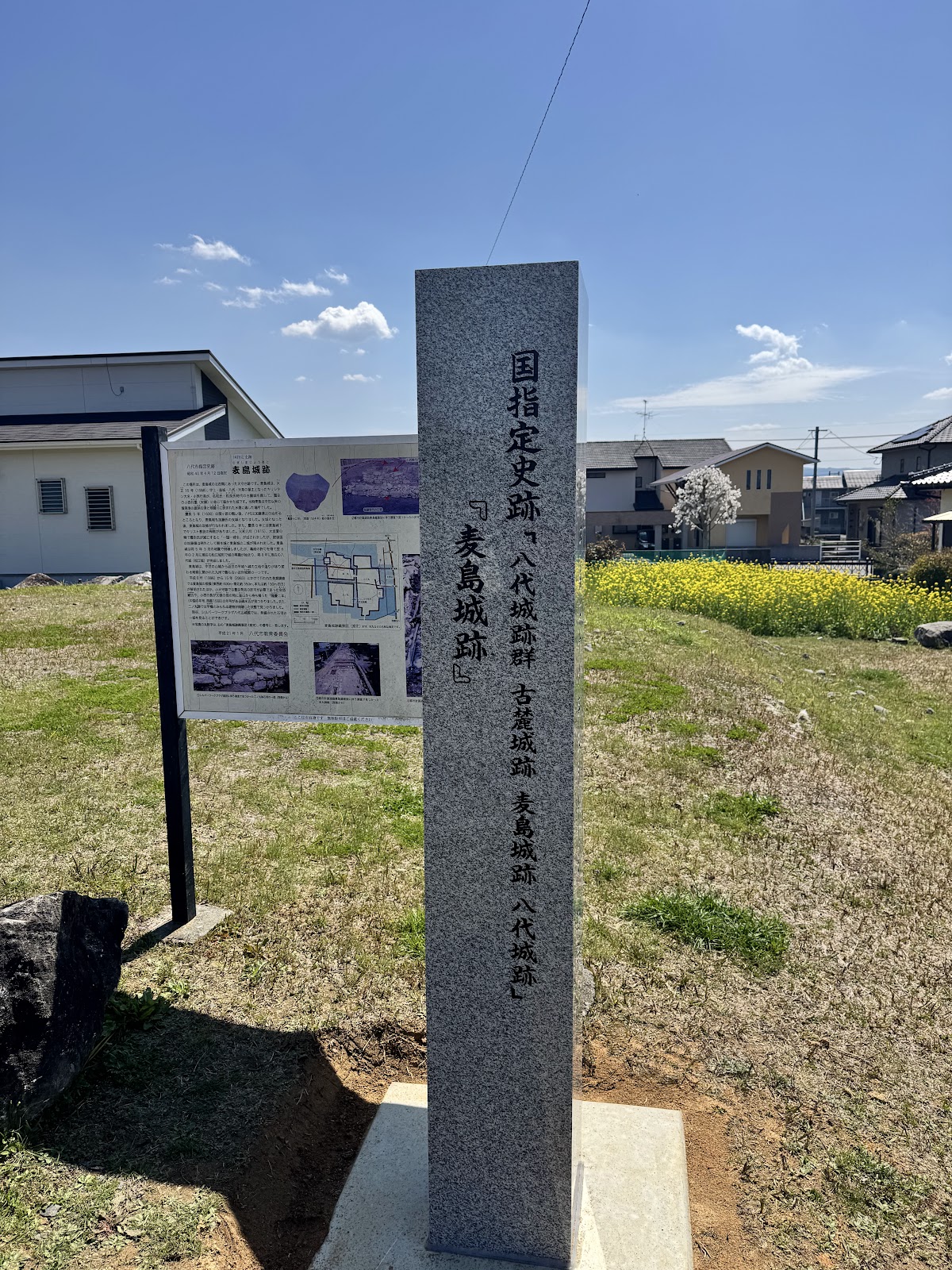
On March 18, 2014, Mugishima Castle Ruins, along with Furufumoto Castle Ruins and Yatsushiro Castle Ruins, were designated as a National Historic Site as part of the “Yatsushiro Castle Ruins Group.” This designation recognizes the holistic evaluation of the castle’s evolution in the Yatsushiro region.
The castle’s evolution—Furufumoto Castle (Medieval period) → Mugishima Castle (Azuchi-Momoyama period) → Yatsushiro Castle (Edo period)—is a valuable example for understanding the history of Japanese castles, and its historical value was recognized.
Historical Significance of the Yatsushiro Castle Ruins
The Yatsushiro Castle Ruins are historically significant for the following reasons:
- Development of Castle Construction Technology: Exhibits the transition from medieval mountain castles to early modern flatland castles.
- Center for Southern European Trade: A site that tells the story of international exchange.
- Record of Earthquake Disaster: A valuable example showing the relationship between natural disasters and castles.
- Example of Two Castles per Province: A concrete example of an exceptional measure in the policies of the Edo Shogunate.
Current Status of the Mugishima Castle Ruins
Current State of the Remains
The current Mugishima Castle ruins are a residential and agricultural area, making it difficult to confirm traces of the castle on the surface. However, archaeological excavations have confirmed that remains such as stone walls are well-preserved underground.
After the excavation, the remains were backfilled for preservation. This is a measure to protect the remains from weathering and destruction. They are being preserved underground in their current state in preparation for future development plans.
Mugishima Community Center Exhibition
The Mugishima Community Center displays materials related to Mugishima Castle, including excavated roof tiles. It’s a valuable facility for learning about the castle’s history.
Exhibits include:
- Historical panels explaining Mugishima Castle
- Photographs and drawings of the excavation survey
- Excavated roof tiles and ceramics
- Reconstruction renderings
Yatsushiro City Silver Human Resources Center Stone Wall Exhibition
The Yatsushiro City Silver Human Resources Center, located in the Mugishima area, displays a portion of the excavated stone wall. This is a valuable opportunity to see the actual stone wall up close.
This stone wall is important material demonstrating the techniques used in the construction of Mugishima Castle’s entire stone wall, allowing visitors to learn about the stone-laying techniques of the time.
Access and Visiting Information for Mugishima Castle
Access Methods
Public Transportation:
- Approximately 10 minutes by car from JR Kagoshima Main Line “Yatsushiro Station”
- Approximately 5 minutes on foot from Sanko Bus “Mugishima” bus stop
By Car:
- Approximately 15 minutes from Kyushu Expressway “Yatsushiro IC”
- Parking: Several spaces available at Mugishima Community Center
Points to Note When Visiting Mugishima Castle Ruins
- Mugishima Community Center: First, review the materials here to understand the castle’s history.
- Strolling Around the Castle Ruins: Although it’s a residential area, you can imagine what it was like in those days from the topography.
- Kuma River Estuary: Visiting the Kuma River estuary, which is close to the castle, will help you understand why it was a key point for water transport.
- Comparison with Yatsushiro Castle: If you have time, visit Yatsushiro Castle as well to experience the changes in the castle’s history.
Precautions When Visiting
- The castle ruins are located in a residential area, so please be considerate of the residents’ privacy.
- There are ruins underground, so please do not excavate or do anything else without permission.
- Please check the opening hours of the Mugishima Community Center in advance.
- We recommend taking precautions against the heat in summer and preparing rain gear during the rainy season.
Mugishima Castle and the History of Kumamoto
The Conflict Between Konishi Yukinaga and Kato Kiyomasa
The relationship between Konishi Yukinaga and Kato Kiyomasa is essential when discussing the history of Mugishima Castle. The two were also in conflict during Toyotomi Hideyoshi’s invasion of Korea, dividing Higo Province into north and south for their rule.
Konishi Yukinaga, as a Christian daimyo, adopted Western culture and pursued policies that emphasized trade. On the other hand, Kato Kiyomasa, a leading figure of the militaristic faction, excelled in military power and territorial management. The contrasting governing styles of these two men had a significant impact on the history of Higo.
Role as a Branch Castle of the Kumamoto Domain
After the Battle of Sekigahara, when Kato Kiyomasa acquired the Higo domain of 540,000 koku, Kumamoto Castle became the main castle, and Mugishima Castle became a branch castle. This “one province, two castles” system was a special measure permitted by the shogunate as an exception to the “one province, one castle” decree.
Mugishima Castle played an important role as a governing center for the Yatsushiro region and as a management center for the Kuma River water transport. Senior retainers of the Kato family were appointed as castle lords, responsible for local administration and military affairs.
The Great Genna Earthquake and Kumamoto’s Earthquake History
The Great Genna Earthquake of 1619 (Genna 5) not only destroyed Mugishima Castle but also caused significant damage to the Kumamoto region. This earthquake is one of the historical records demonstrating that Kumamoto is an earthquake-prone area.
Even today, the damage to Kumamoto Castle caused by the 2016 Kumamoto Earthquake is still fresh in our memories. The collapse of Mugishima Castle leaves an important lesson for considering the relationship between natural disasters and castle architecture.
Mugishima Castle and the Nanban Trade
The Role of Tokubuchi Port
Tokubuchi Port, adjacent to Mugishima Castle, flourished as a trading port since the Middle Ages. Its importance increased further when Toyotomi Hideyoshi designated it as a directly controlled port.
The following trade took place at Tokubuchi Port:
- Imports: Raw silk, silk fabrics, ceramics from China; firearms, gunpowder, and glass products from Europe, etc.
- Exports: Silver, sulfur, swords, lacquerware, handicrafts, etc.
Influence of Christian Culture
Konishi Yukinaga, as a Christian daimyo, permitted the propagation of Christianity within his territory. Churches were built around Mugishima Castle, and records indicate that many of his subjects converted to Christianity.
Missionaries not only engaged in religious activities but also introduced Western medicine, astronomy, and printing technology. Mugishima Castle functioned as a center for such cultural exchange.
The End of its Role as a Trading Hub
After the Battle of Sekigahara and the execution of Konishi Yukinaga, the function of Mugishima Castle as a trading hub for Southern Barbarians rapidly declined. While Kato Kiyomasa was tolerant of Christianity, he was not as enthusiastic as Konishi Yukinaga.
Furthermore, as the Edo Shogunate’s isolationist policy progressed, free trade became restricted. By the time Mugishima Castle collapsed in a major earthquake, the golden age of Southern Barbarian trade had already come to an end.
Results of Archaeological Excavations and Research
Major Archaeological Excavations
Multiple archaeological excavations have been conducted at the Mugishima Castle site:
- Early Heisei Era Excavations: Basic understanding of the castle’s extent and structure
- Heisei Era Excavations: Detailed clarification of the stone wall structure and techniques
- Pre- and Post-Historic Site Designation Excavations: Confirmation of preservation status and basic research for development planning
These investigations have gradually revealed the overall picture of Mugishima Castle.
Findings from Research
Through archaeological excavations and literature research, the following has been revealed:
- Fortress Construction Techniques: Advanced techniques for constructing the entire castle with stone walls were employed.
- Castle Scale: It was a large-scale castle with a main keep, second bailey, and third bailey.
- International Nature: Numerous foreign goods resulting from the Nanban trade have been unearthed.
- Earthquake Damage: The severity of the earthquake can be inferred from the collapse of the stone walls.
- Inheritance to Yatsushiro Castle: The techniques and materials of Mugishima Castle were passed on to Yatsushiro Castle.
Future Research Topics
Many aspects of Mugishima Castle remain unclear:
- Presence and structure of the keep
- Detailed structure of the castle town
- Specific scale and content of the Nanban trade
- Details of earthquake damage
- Actual use of materials for Yatsushiro Castle
Future research is expected to unravel these mysteries.
Summary: The Historical Value of Mugishima Castle
Mugishima Castle, despite its short history of just over 30 years, is a castle of significant importance in Japanese history.
Built by the Christian daimyo Konishi Yukinaga, it served as a base for trade with the West and became a stage for international exchange. It experienced the turning point of history, the Battle of Sekigahara, and was granted the special exception of two castles per province, serving as a branch castle of Kato Kiyomasa. It was later destroyed by the Great Genna Earthquake, a natural disaster, and the lessons learned from this were applied to the construction of the subsequent Yatsushiro Castle.
Although its remains are no longer visible above ground, the ruins buried underground are valuable cultural assets that convey the history of that time. When visiting Yatsushiro City, Kumamoto Prefecture, be sure to visit the Mugishima Castle ruins and reflect on its history.
As part of the national historic site “Yatsushiro Castle Ruins,” the Mugishima Castle ruins will continue to be preserved and utilized. In the future, it is hoped that some of the remains will be developed, allowing more people to experience history.