Moridera Castle (Himi City) Complete Guide | History and Highlights of the Stone Wall Remains of Toyama Prefecture’s Largest Mountain Castle
What is Moridera Castle? | Overview of Himi City’s Largest Mountain Castle
Moridera Castle is a Sengoku period mountain castle located on Moridera Castle Mountain in Himi City, Toyama Prefecture. It is also known as “Yuyama Castle,” “Iyama Castle,” and “Iguchi Castle,” and is recorded as “Yuyama” in medieval historical documents.
Built on a north-south ridge at an altitude of approximately 160 meters, facing the left bank of the middle reaches of the Aogawa River, which originates from the Hodatsu Hills on the border of Etchu and Noto provinces, it is known as the largest mountain castle in Himi City. Its scale is considered second only to the three major mountain castles of Etchu (Matsukura Castle, Masuyama Castle, and Moriyama Castle), and it occupies an important position among medieval castles in Toyama Prefecture.
Currently, it is protected as a Himi City designated historical site and is maintained as Moridera Castle Ruins Forest Park. Selected as Toyama Castle Card No. 34, it is a historical site that attracts attention from castle enthusiasts and history lovers.
Basic Information on Moridera Castle
Location and Access
Location: Moridera, Himi City, Toyama Prefecture
Former Province: Etchu Province
Access:
- Approximately 15 minutes by car from Himi Station on the JR Himi Line
- Approximately 10 minutes from Himi Kita Interchange on the Noto Expressway
- There is a path leading to the castle from the Moridera settlement; the main keep can be reached in approximately 30 minutes on foot.
Parking: Parking space available near the Moridera settlement (a few cars)
Castle Classification and Structure
Classification: Mountain Castle
Structure: Concentric Mountain Castle
Builder: Noto Hatakeyama Clan (Some theories attribute it to the Yuyama Clan)
Year of Construction: Around the Eisho era (1504-1521), estimated to be the early 16th century
Main Lords: Yuyama Tsuguyoshi, Kawada Nagachika (vassal of the Uesugi clan), Sasa Narimasa
Year of Abandonment: Around Tensho 13 (1585)
Keep Structure: No keep existed (due to being a medieval mountain castle)
Main Remains: Stone walls, earthworks, moats, vertical moats, baileys, stone-paved main road
History of Moridera Castle | Battles over the Border between Noto and Etchu
Built as a base for the Noto Hatakeyama clan’s invasion of Etchu Province
Mori-dera Castle is believed to have been built in the early 16th century, around the Eisho era, by the Noto Hatakeyama clan, who were the shugo daimyo (provincial governors) of Noto Province. It functioned as a base for invasions from Noto to Etchu Province, or as a subsidiary castle controlling a crucial transportation hub connecting Etchu and Noto.
Located overlooking the road crossing the Aramayama Pass from Ao to Noto, and with a path running through the castle grounds from the Mori-dera settlement to the Shiba Pass, it was a strategically important fortress built at a vital transportation point.
The local lord, the Yuyama clan, is believed to have served as the castle’s lord, and the name Yuyama Tsuguyoshi is recorded. The Yuyama clan is thought to have been subordinate to the Noto Hatakeyama clan and was responsible for governing this region.
Uesugi Kenshin’s Rule of Etchu Province and Moridera Castle
In the mid-16th century, Etchu Province became a battleground, with Uesugi Kenshin of Echigo Province, the Hatakeyama clan of Noto Province, and the Ikkō-ikki forces all vying for power. From the Eiroku era (1558-1570) onward, Uesugi Kenshin frequently invaded Etchu, and it is believed that Moridera Castle also came under his control.
The Uesugi clan stationed their retainer, Kawada Nagachika (Kawada Shuzen), at Moridera Castle, utilizing it as a front-line base for their campaigns toward Noto. Kawada Nagachika is known as a senior retainer of Uesugi Kenshin and a key figure in the Uesugi clan’s rule of Etchu.
During this period, Moridera Castle functioned as an important base in the Uesugi clan’s administration of Etchu, supporting the region’s control system in conjunction with castles such as Nanao Castle in Noto and Ao Castle in Himi.
Large-Scale Renovation and Construction of Full-Scale Stone Walls by Sasa Narimasa
In 1581, Sasa Narimasa, a vassal of Oda Nobunaga, was granted the entire province of Etchu and made Toyama Castle his residence. To strengthen his control over Etchu, Sasa Narimasa renovated and improved castles throughout the region, and Moridera Castle was among those affected.
During Sasa Narimasa’s time, full-scale stone walls were constructed at Moridera Castle. This is the only example of its kind among medieval castles in Toyama Prefecture, and it holds extremely high historical value as one of the earliest examples of rough-hewn stone walls built by a Sengoku-period daimyo in the Japanese archipelago.
In the central areas, such as the main keep and the second bailey, stone walls using river stones were constructed in important areas such as entrances and earthworks. Archaeological excavations have also confirmed a stone-paved main road extending up to 3 meters wide, revealing traces of large-scale renovations by Sasa Narimasa.
Abandonment of the Castle under the Toyotomi Regime
In 1585, during Toyotomi Hideyoshi’s conquest of Etchu Province, Sasa Narimasa surrendered, and Etchu came under the control of Maeda Toshiie. It is believed that Moridera Castle was abandoned during this process.
Maeda Toshiie established a system of unified rule over Noto and Etchu Provinces, consolidating his main bases at Kanazawa Castle and Toyama Castle. As a result, Moridera Castle, a mountain castle on the border, ceased to serve its purpose.
Highlights of Moridera Castle | Toyama Prefecture’s Only Medieval Stone Walls and Defensive Remains
Authentic Rough-Wooded Stone Walls
The greatest highlight of Moridera Castle is its authentic stone walls, the only remaining example of medieval stonework in Toyama Prefecture. Rough-wooded stone walls, constructed using river stones, remain in excellent condition in important areas around the main keep and second bailey.
These stone walls were built during the time of Sasa Narimasa and are valuable remains for understanding the stonework techniques of the late 16th century. The stone walls, built using the latest technology of the time, still stand today, more than 400 years later, demonstrating the high level of castle-building technology during the Sengoku period.
In particular, the stone walls around the main keep remain to a height of 2-3 meters, allowing for close observation. This is a valuable opportunity to actually see the characteristics of medieval stone walls, such as the way the stones were stacked and selected.
3-meter-wide stone-paved main approach
The stone-paved main approach, confirmed through archaeological excavations, is another noteworthy structure. Its width of 3 meters indicates the importance of this castle and the scale of the extensive renovations carried out by Sasa Narimasa.
The stone-paved path served as a practical facility to prevent muddy conditions during rainy weather and allow for the passage of large armies, while also having symbolic significance, demonstrating the castle’s grandeur. A portion of it is currently preserved, allowing visitors to experience the formal approach to the castle as it was at the time.
Defensive Remains such as Earthworks, Moats, and Vertical Ditches
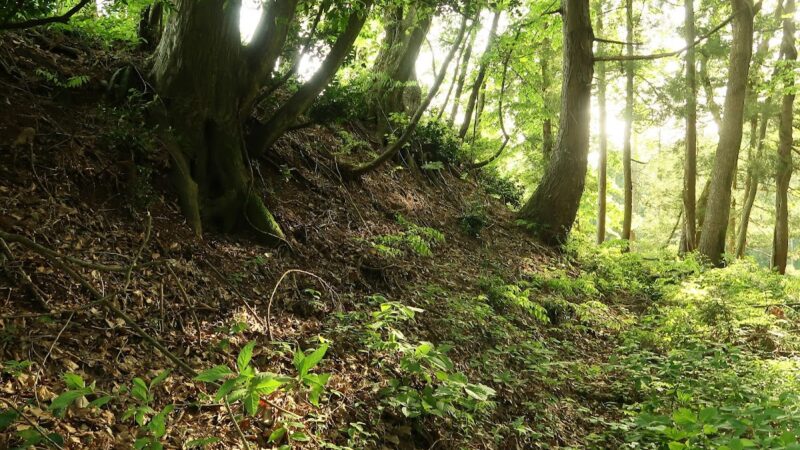
Besides the stone walls, Moridera Castle boasts well-preserved defensive remains characteristic of medieval mountain castles, including earthworks, moats, and vertical ditches.
Earthworks were built surrounding the baileys, preventing enemy intrusion and protecting the interior of the baileys. Earthworks approximately 2-3 meters high remain in various locations, providing clues to understanding the castle’s structure at the time.
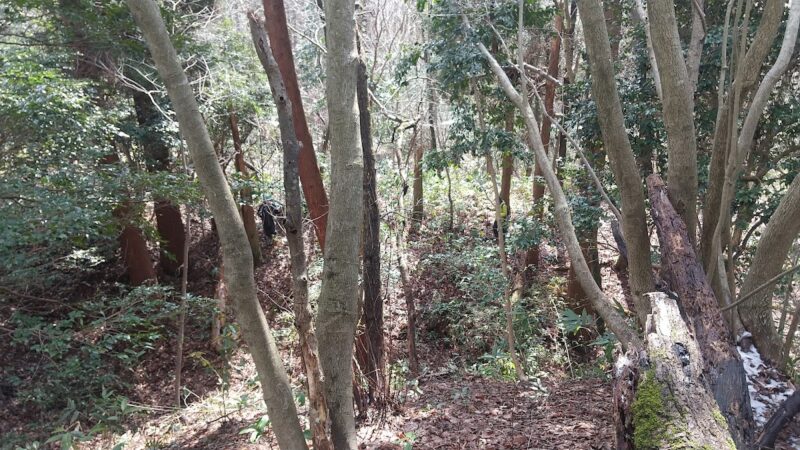
Moats are dry moats dug to cut across ridges, serving as important defensive structures to hinder enemy advances. Multiple moats have been identified at Moridera Castle, some reaching depths of 3-5 meters.
Vertical Ditches are moats dug vertically along slopes, preventing attacks from the enemy’s flanks. The vertical ditches at Moridera Castle run along the slopes in multiple lines, demonstrating a sophisticated multi-layered defensive system.
Arrangement and Layout of the Enclosures
Mori-dera Castle has a linear layout with multiple enclosures arranged on a ridge extending north and south. The central area consists of the main enclosure (Honmaru) and the second enclosure (Ninmaru), surrounded by several enclosures arranged in a stepped fashion.
To the south are several independent enclosures, such as “Saida Yashiki,” “Nozaki Yashiki,” and “Kanetoyama,” which are thought to have functioned as subsidiary castles or outposts. This complex layout indicates that Mori-dera Castle was not merely a fort, but a large-scale military base.
Each enclosure offers views of the Aogawa River basin and the Noto Peninsula, suggesting it also served a military surveillance function.
Development of Mori-dera Castle Ruins as a Forest Park
Currently, the Mori-dera Castle ruins have been developed as Mori-dera Castle Ruins Forest Park, with access paths and information boards. The park is designed to be easily accessible without damaging the remains, making it popular not only with castle enthusiasts but also with hikers and nature walkers.
The climb to the main keep from the Moridera settlement takes about 30 minutes, but the path is relatively well-maintained, making it an enjoyable and moderate workout. The fresh greenery in spring and the vibrant autumn foliage are beautiful, making it an attractive spot to explore history while enjoying the changing seasons.
Attractions around Moridera Castle | History and Culture of Himi
Historical Landscape of Moridera Settlement
Walking through the Moridera settlement after descending from the castle, you’ll encounter scenery that evokes the past. Old houses, stone walls, and waterways remain, giving a glimpse into the castle town at the foot of the mountain castle.
Place names and legends related to the castle also remain within the settlement, and listening to the stories of the locals will allow you to understand the history of Moridera Castle more deeply.
Aio Castle Ruins
Aio Castle, located about 5 kilometers northwest of Moridera Castle, is also an important castle from the Sengoku period. Facing the sea, this castle has a contrasting location to Moridera Castle, and the two castles formed a defensive network in the border region between Noto and Etchu provinces.
Aio Castle was also used by Uesugi Kenshin and Sasa Narimasa, and visiting it together with Moridera Castle provides a more comprehensive understanding of the Sengoku period history of this region.
Views of Himi City and Toyama Bay
Himi City is a port town facing Toyama Bay and is known for its fresh seafood. “Himi’s winter yellowtail” is particularly famous nationwide, attracting many tourists in winter.
Furthermore, from Himi city, you can see the Tateyama mountain range across Toyama Bay, and this spectacular view symbolizes the charm of Toyama Bay, which has been selected as one of the “World’s Most Beautiful Bays Club.”
Himi Banyagai
Located near Himi Fishing Port, “Himi Banyagai” is a tourist facility where you can enjoy Himi’s seafood and local specialties. This area features a variety of restaurants, including conveyor belt sushi restaurants, seafood restaurants, and souvenir shops, allowing you to fully enjoy Himi’s food culture.
Visiting before or after your visit to Moridera Castle allows you to combine historical exploration with culinary delights.
Access and Visiting Information for Moridera Castle
Detailed Access Information
Public Transportation:
Approximately 15 minutes by taxi from Himi Station on the JR Himi Line, or take the Himi city loop bus towards Moridera (advance confirmation is recommended as buses are infrequent).
By Car:
- Approximately 10 minutes from Himi Kita IC on the Nōetsu Expressway via National Route 160
- Approximately 1 hour from Kanazawa via National Routes 415 and 160
- Approximately 40 minutes from Toyama city via National Route 415
Parking: There are a few parking spaces near the Moridera settlement. Caution is advised as large vehicles may have difficulty accessing the area.
Points to Note When Visiting
Estimated Time Required: Approximately 1 to 1.5 hours from ascent to descent.
Clothing and Equipment:
- As it is a mountain castle, wear comfortable walking shoes (trekking shoes recommended).
- Wear appropriate clothing for the season (insect repellent in summer, warm clothing in winter).
- Bring drinking water.
- Be careful as the ground can be slippery in rainy weather.
Visiting Season: Visits are possible year-round, but spring (April-May) and autumn (October-November) are the best times due to the weather. Be aware that there may be snow in winter.
Precautions:
- To protect the historical site, be careful not to damage the remains.
- Take all your trash with you.
- No open flames.
- Beware of wild animals (wild boars, bears, etc.).
Obtaining the Toyama Castle Card
Toyama Castle Card No. 34 (Mori-dera Castle) is distributed at Himi City Museum, Himi City Tourist Information Center, and other locations. Castle card collectors are advised to check the distribution locations and opening hours in advance.
Historical Value and Future Preservation of Moridera Castle
Moridera Castle possesses extremely high historical value as the only castle in Toyama Prefecture with a full-fledged medieval stone wall remaining. It is a valuable relic for understanding stonework techniques of the late 16th century and an important historical site that tells the story of Sasa Narimasa’s rule over Etchu Province.
Himi City protects the Moridera Castle ruins as a city-designated historical site and is developing it as a forest park, aiming to balance the preservation and utilization of this historical heritage. In recent years, archaeological excavations have been continuously conducted, and new discoveries are expected.
Moridera Castle, which conveys the history of the Etchu-Noto border region during the Sengoku period, plays an important role as a resource for local history education and tourism. It is hoped that appropriate preservation and utilization will continue in the future to ensure that this valuable historical heritage is passed on to future generations.
Summary | Moridera Castle: A Representative Medieval Mountain Castle of Toyama Prefecture
Moridera Castle (Yuyama Castle) is a Sengoku period mountain castle remaining in Himi City, Toyama Prefecture, and boasts the largest scale in Himi City. Built in the early 16th century by the Noto Hatakeyama clan, it was a strategically important castle used by famous Sengoku warlords such as Uesugi Kenshin and Sasa Narimasa.
Its most distinctive feature is its authentic stone walls, the only remaining example of a medieval castle in Toyama Prefecture. The rough-hewn stone walls, built during the time of Sasa Narimasa, are highly valued as a precious relic that conveys the castle-building techniques of the late 16th century.
Furthermore, defensive structures such as earthworks, moats, and vertical trenches are also well-preserved, making it a valuable historical site where you can actually experience the structure of a medieval mountain castle. The remains revealed by archaeological excavations, such as the 3-meter-wide stone-paved main road, are also a highlight.
Currently, the site has been developed as Moridera Castle Ruins Forest Park, and is popular not only with history buffs but also with people who enjoy hiking and nature walks. When you visit Himi City, be sure to visit this valuable historical site and feel the spirit of the Sengoku period.