Momii Castle (Hyogo Prefecture) Complete Guide | Exploring the Legend of the Blue Demon and the History of Akechi Mitsuhide’s Struggle
What is Momii Castle?
Momii Castle is a Sengoku period mountain castle located in Fukuzumi, Tamba-Sasayama City, Hyogo Prefecture. Also known as Yasuda Castle and Fukuzumi Castle, it was a strong fortress built on the summit of Mt. Shirao, at an altitude of approximately 390-394 meters. The relative height from the foot of the mountain is approximately 140-150 meters, boasting a strategic location overlooking the important transportation hub where the Kyoto Road and the Settsu Road intersected.
It is known as the residence of the Momii clan, local lords who ruled the eastern part of Taki District in Tamba Province, and is particularly famous for the legend of Momii Norinari, who was feared as the “Blue Demon.” In 1577, during the conquest of Tanba Province by Akechi Mitsuhide, acting on orders from Oda Nobunaga, a fierce battle took place here, ultimately leading to the castle’s fall.
Currently, the site is maintained as a castle ruins park, with the remains of the multi-bailey mountain castle well-preserved, making it a valuable historical site where one can experience the Sengoku period history of the Tanba region.
History of Momii Castle
Construction and Development by the Momii Clan
The exact construction date of Momii Castle is unclear, but the prevailing theory is that it was built during the Eisho era (1504-1521) by Momii Terutsuna. The Momii clan were local lords based in Momii Manor in the eastern part of Taki District, Tanba Province, and held considerable influence in this region since ancient times.
The Momii clan was subordinate to the Hatano clan, a powerful local family in Tanba Province. They served under Hatano Hideharu, whose base was Yakami Castle, and were responsible for defending eastern Tanba. Momii Castle was strategically located at the intersection of the Kyoto-Tanba Road (San’in Road) and the road to Settsu Province, making it an extremely important military and economic base.
The Era of Momii Norinari, the Blue Demon
The most well-known member of the Momii clan is Momii Norinari. He is also known as Momii Tsunatoshi and is legendary as a fierce general feared under the nickname “Blue Demon.” His bravery was said to be renowned throughout Tanba, making him an object of fear for both friend and foe.
However, there is little historical evidence to support the existence of Momii Norinari, and it has been suggested that he may be a fictional character created from later military chronicles and legends. The actual lord of the castle is confirmed to be Momii Tsunatoshi, and researchers are divided on whether Kyogyo is an alias for Tsunatoshi or a completely different person.
Battles with Akechi Mitsuhide
First Battle in 1576
In 1575, Oda Nobunaga ordered Akechi Mitsuhide to conquer Tanba. Tanba was a strategically important point connecting the Kinai region and the San’in region, and its control was essential for the Oda regime.
In November 1576, Akechi Mitsuhide intensified his invasion of Tanba, and Momii Castle became a target. This battle was a fierce fight lasting 18 days, and the Momii clan resisted tenaciously, successfully repelling Mitsuhide’s army. The rugged terrain of the mountain castle and the bravery of the Momii clan repelled Mitsuhide’s large army.
This defeat was a major blow to Akechi Mitsuhide, and the conquest of Tanba became protracted.
Fall of the Castle in 1577
In October of the following year, 1577, Akechi Mitsuhide regrouped and attacked Momii Castle again with a larger army. Learning from the previous year’s failure, Mitsuhide is thought to have employed a strategy combining meticulous siege tactics and a siege by starvation.
This time, the Momii clan could not hold out, and the castle fell. The castle lord, Momii Tsunatoshi, committed suicide, marking the end of the Momii clan’s rule. After the fall of the castle, Momii Castle came under the control of the Oda clan, but the detailed events after that are unknown.
Abandonment and its Aftermath
It is unclear when Momii Castle was abandoned, but it is thought to have ceased its role as a mountain castle after the pacification of Tanba during the Tensho era, coinciding with the end of the Sengoku period. By the Edo period, the castle had already been abandoned and was buried in the surrounding forest.
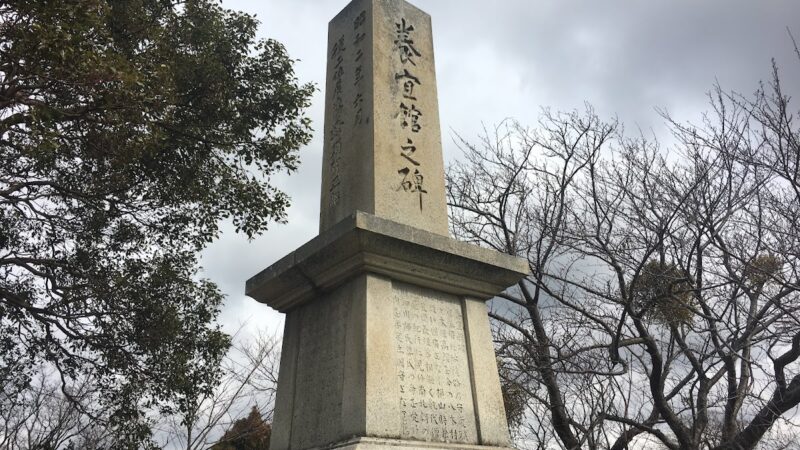
Currently, thanks to local preservation efforts, it has been developed into a castle ruins park, with a climbing path and information boards installed. As a valuable historical site in Tamba-Sasayama City, it attracts many castle enthusiasts and history buffs.
Structure and Highlights of Momii Castle
Layout and Castle Structure
Momii Castle has a typical renkaku-shiki yama-shiro (multi-bailey mountain castle) structure. The main bailey (honmaru) is located on the mountaintop at an altitude of approximately 390 meters, with multiple baileys arranged along the ridge. The elevation difference of approximately 150 meters posed a significant obstacle for attackers.
The castle’s layout skillfully utilizes the mountain’s topography, employing natural steep slopes as defensive lines. Artificial defensive structures are concentrated along the main ridgelines, demonstrating ingenuity in preventing enemy incursions.
Main Enclosure (Honmaru)
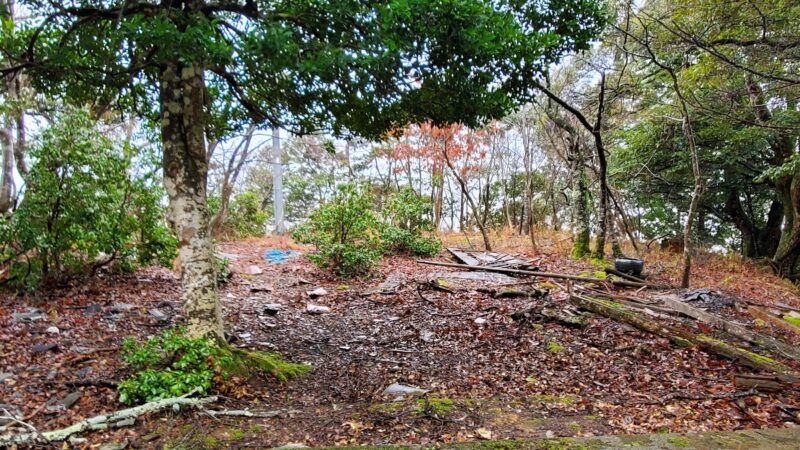
Located on the mountaintop, the main enclosure is the central part of the castle and is presumed to have housed the lord’s residence and command post. Even today, the flat, well-defined shape of the enclosure remains clearly visible, and traces of earthworks can be seen around it.
From the main enclosure, one can overlook the Fukuzumi settlement and the main road below, demonstrating its excellent position for monitoring people traveling along the Kyoto Road. On clear days, one can see the mountains of Tanba and even as far as Kyoto, highlighting its importance as a military surveillance base.
Enclosures
Several enclosures are arranged around the main enclosure. These functioned as garrisons for soldiers, storage areas for supplies, and reserve defensive positions. The terraced structure, utilizing the elevation differences between the enclosures, allowed for multiple layers of defense, preventing an enemy from breaching one enclosure and stopping them at the next defensive line.
The size and arrangement of each enclosure indicate that Momii Castle was a fortress capable of accommodating a considerable number of troops.
Moats
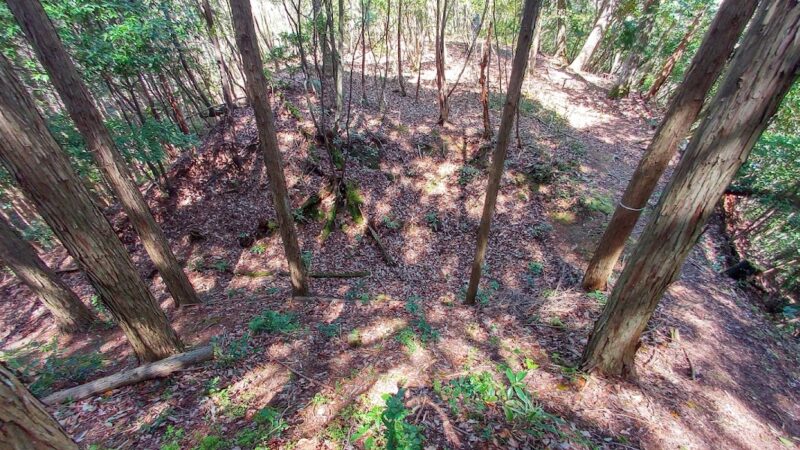
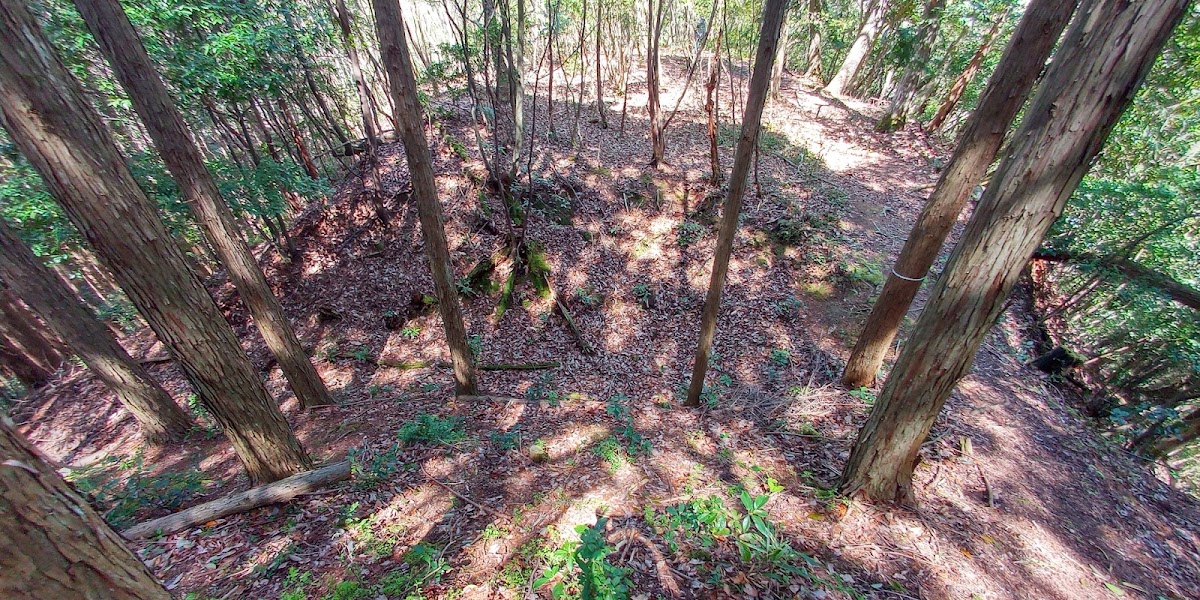
To prevent enemy incursions from the ridge, Momii Castle has several moats. Moats are dry moats dug vertically into the ridge, serving as important defensive structures to block enemy advances.
Some of Momii Castle’s moats are several meters deep, and their scale is still evident today. The moat behind the main enclosure is particularly large, illustrating its importance in the castle’s defense.
Earthworks
Traces of earthworks remain around the enclosures. These earthworks are walls made by piling up earth, protecting against enemy arrows and firearms, and clearly defining the boundaries of the enclosures.
While some parts have collapsed due to years of wind and rain, the earthworks around the main enclosure remain relatively well-preserved, showcasing the castle-building techniques of the Sengoku period.
Vertical Moats and Cut Slopes
Traces of vertical moats can also be seen on the slopes. Vertical trenches, dug along slopes, were effective in hindering enemy lateral movement and limiting attack routes.
Furthermore, artificially carved steep slopes, known as “kirigi,” are seen in various places, suggesting that the natural terrain was made even more rugged to enhance defensive capabilities.
Access and Visiting Guide
Location
Fukuzumi, Tamba-Sasayama City, Hyogo Prefecture
Transportation Access
Access by Car
- Approximately 20 minutes from the Tannan-Sasayama IC on the Maizuru-Wakasa Expressway
- Proceed along National Route 372 towards Kyoto, then to the Fukuzumi area
- Parking available near Zenshoji Temple
Public Transportation
- Approximately 30 minutes by bus from JR Fukuchiyama Line’s Sasayamaguchi Station, alight at the Fukuzumi bus stop
- Approximately 5 minutes on foot from the bus stop to the castle entrance
Castle Ascent Route
The entrance to Momii Castle Ruins Park is located near Zenshoji Temple in the Fukuzumi area. An information board is installed at the entrance. From here to the main enclosure at the summit is approximately 750 meters, taking about 30-40 minutes.
The path to the castle is well-maintained, but there are steep slopes and stairs typical of mountain castles, so comfortable shoes and clothing are essential. Particular caution is needed after rain, as the path can become slippery.
Estimated Visiting Time
- Ascent: 30-40 minutes
- Castle Interior Tour: 30-40 minutes
- Descend: 20-30 minutes
- Total: Approximately 1 hour 30 minutes to 2 hours
If you plan to thoroughly explore the castle and enjoy taking photos, allow around 2 hours.
Notes for Visitors
- Season: Spring to autumn is the best time to visit, but insect repellent is necessary in summer.
- Clothing: Long-sleeved shirt and long pants, trekking shoes or athletic shoes are recommended.
- Items to Bring: Drinking water, towel, insect repellent spray, map or smartphone.
- Safety: If visiting alone, inform family members or others of your destination beforehand.
- Manners: Destroying the ruins or collecting plants is strictly prohibited. Please take all your trash with you.
Nearby Tourist Attractions
Yagami Castle Ruins
Located approximately 10 kilometers west of Momii Castle, Yagami Castle was the base of the Hatano clan and the center of their rule over Tanba Province. It was the residence of the Hatano clan, to whom the Momii clan was subordinate, and is known as the site of fierce battles with Akechi Mitsuhide. Visiting both Momii Castle and Yagami Castle together will provide a deeper understanding of Tanba’s Sengoku period history.
Sasayama Castle Ruins
This is a modern castle built in the early Edo period by order of Tokugawa Ieyasu. The main hall has been restored and is open for viewing. By comparing it with Momii Castle, a mountain castle from the Sengoku period, you can learn about the history of castle development.
The Townscape of Fukuzumi
The Fukuzumi district, spreading at the foot of Momii Castle, is a historic settlement that once flourished as a post town. By strolling through the townscape, which retains the atmosphere of the old highway, you can experience the importance of the transportation hub that Momii Castle oversaw.
Tamba Sasayama City Historical Museum
This museum introduces the history and culture of Tamba Sasayama. It also exhibits materials related to Momii Castle and the Sengoku period in Tamba, making it ideal for learning before or after visiting the castle.
The Charm and Historical Significance of Momii Castle
Importance as a Transportation Hub
The greatest feature of Momii Castle lies in its location. Located at the intersection of the Kyoto Road (San’in Road), which connected Kyoto with the Tanba and San’in regions, and the road leading to Settsu, Momii Castle was a strategically important point where the flow of people and goods could be monitored and controlled.
Therefore, capturing Momii Castle was an unavoidable task for Oda Nobunaga as he advanced his conquest of Tanba. Akechi Mitsuhide’s two attacks on the castle were also due to this geographical importance.
Characteristics as a Local Lord’s Castle
Momii Castle is a typical mountain castle built by a local lord during the Sengoku period. Although smaller in scale than castles built by daimyo (feudal lords), it possessed robust defensive structures that skillfully utilized the terrain, and functioned effectively as a base for regional control.
It is a good example of how the Momii clan, local lords, built an efficient castle with limited resources, and is a valuable case study in the study of Sengoku period castles.
The Role of Akechi Mitsuhide in the Conquest of Tanba
Akechi Mitsuhide’s conquest of Tanba was a crucial military operation in establishing the Oda regime’s control over the Kinai region. The battle for Momii Castle is positioned as part of this Tanba campaign.
The repelling of the attack in 1576 and the subsequent fall of the castle the following year demonstrate Mitsuhide’s cautious and meticulous strategist. His method of learning from a single failure, regrouping, and launching a counterattack is an episode that illustrates Mitsuhide’s military talent.
The Cultural Value of the Blue Demon Legend
While the historical accuracy of the legend of Momii Norinari’s “Blue Demon” is questionable, it holds significant meaning as a part of local folk culture. The legend of this fearsome warrior reflects the intensity of the Sengoku period and the fear of the people, providing clues to the social psychology of the time.
Furthermore, the very fact that this legend has been passed down to the present day demonstrates the significant impact that Momii Castle and the Momii clan had on the region.
Preservation Status and Future Challenges
Momii Castle ruins are in relatively good condition, with the main remains clearly visible. Thanks to the efforts of the local preservation society and Tamba-Sasayama City, the approach to the castle has been improved and information boards have been installed, making it a more accessible historical site for visitors.
However, due to its nature as a mountain castle, deterioration of the remains due to erosion from wind and rain and changes in vegetation is unavoidable. Continued preservation and management activities are necessary.
Furthermore, due to the scarcity of historical records, many aspects of Momii Castle’s detailed history and structure remain unknown, and further clarification through archaeological investigations and documentary research is expected.
Significance of Visiting Momii Castle
Momii Castle is a valuable historical site where one can experience the life and battles of a local lord during the Sengoku period, and the process of the Oda regime’s unification of Japan. Its connection to the famous warlord Akechi Mitsuhide is also a major attraction for history enthusiasts.
The rugged terrain unique to mountain castles, along with the remaining structures such as baileys and moats, serve as living teaching materials that convey the castle-building techniques and tactics of the time. The experience of actually climbing to the summit and working up a sweat allows you to relive the hardships and realities of battle faced by Sengoku-era warlords.
When visiting Tanba Sasayama, be sure to also visit the Momii Castle ruins and feel the spirit of the Sengoku period. The view of the Tanba mountains and the surrounding roads from the summit remains unchanged from hundreds of years ago, showing us the same scenery that the Momii clan and Akechi Mitsuhide saw.
References
For those who wish to learn more about the history and structure of Momii Castle, the following resources are helpful.
- “Medieval Castles and Manor Sites in Hyogo Prefecture,” Hyogo Prefectural Board of Education
- “History of Tamba-Sasayama City,” Tamba-Sasayama City
- “Comprehensive Survey of Japanese Castles,” Volume 12 (Shin Jinbutsu Oraisha)
- Related papers and research books on “Akechi Mitsuhide and Tamba”
- Research reports from various castle research websites
Through these documents, you can gain more detailed knowledge about the historical background of Momii Castle and the situation in Tamba during the Sengoku period.
Summary
Momii Castle is a Sengoku period mountain castle remaining in Tamba-Sasayama City, Hyogo Prefecture, and played an important role as a strategic base controlling a key transportation hub. It flourished as the residence of the Momii clan and is particularly known for the legend of Momii Noriyuki, who was feared as the “Blue Demon.”
During the Tensho era, it was attacked twice by Akechi Mitsuhide and eventually fell, but the battle was an important part of the Oda regime’s conquest of Tamba. The remains of this multi-bailey mountain castle are still well-preserved, allowing visitors to learn about the castle-building techniques of the Sengoku period from the baileys, moats, and earthworks.
Climbing to the mountain castle, located at an altitude of approximately 390 meters and a relative height of approximately 150 meters, requires physical exertion, but the view from the summit and the sense of history make for a valuable experience. Momii Castle is one of the historical sites that should not be missed when exploring the history of Tanba Sasayama.