Complete Guide to Mikazuki Jinya (Sayo-cho, Hyogo Prefecture) | Detailed Explanation of History, Highlights, Access, and Restored Facilities
Located in Sayo-cho, Sayo-gun, Hyogo Prefecture, Mikazuki Jinya is a historical building that functioned as the administrative center of the Harima Mikazuki Domain from the mid-Edo period until the Meiji Restoration. Also known as “Noino Jinya,” it is currently undergoing restoration based on archaeological excavations and is attracting attention as a valuable example of Jinya architecture in the Harima region. This article provides a detailed explanation of Mikazuki Jinya, from its origins to its current highlights.
History and Background of Mikazuki Jinya
Dispossession of the Mori Family of Tsuyama Domain and Establishment of a New Domain
The history of Mikazuki Jinya begins with the dispossession of the Mori family of Tsuyama Domain in 1697 (Genroku 10). The Mori family of the Tsuyama Domain, which ruled Mimasaka Province (present-day Okayama Prefecture), became extinct when the fourth lord, Mori Nagashige, died without an heir. While the main branch of the Mori family was dissolved as a result of this confiscation, Mori Nagatoshi, the lord of the Tsuyama Shinden Domain in Mimasaka Province and a branch family member, was granted new territory.
Mori Nagatoshi was transferred to a territory encompassing 65 villages across the Sayo, Ibeshi, and Shiso districts of Harima Province, totaling 15,000 koku. This established the Harima Mikazuki Domain, and Nagatoshi became its first lord, establishing a jinya (fortified residence) in Mikazuki.
Construction and Completion of the Jinya
In Genroku 11 (1698), Mori Nagatoshi entered his new territory and began construction of the jinya, which would serve as the domain’s administrative center, and the residences of his retainers. Noinomura village was chosen as the site for the construction of the Jinya (fortified residence). The existing village headman’s residence was relocated there, and construction of the Jinya proceeded.
Construction of the Jinya took approximately two years, and it was largely completed by 1700 (Genroku 13). The Jinya measured approximately 51 meters east-west and 61 meters north-south, built on a hilltop castle-like location at an elevation of approximately 250 meters. Equipped with stone walls and moats, it possessed castle-like defensive functions despite its small size.
174 Years Until the Meiji Restoration
The Mikazuki Jinya was ruled by the Mori family for nine generations, starting with the first Mori Nagatoshi. Throughout the feudal period, the Noino district flourished as a castle town and a political and cultural center, becoming one of the important bases in the Harima region.
During the reign of the last lord, Mori Toshiakira, the Meiji Restoration occurred, and the Mikazuki Domain was abolished in 1871 with the abolition of the feudal domains and establishment of prefectures. While most of the jinya (fortified residence) was dismantled, a watchtower and part of the domain school remain, preserving them as valuable Edo-period architectural relics.
Architectural Structure and Characteristics of the Mikazuki Jinya
Basic Structure of the Jinya
The Mikazuki Jinya possesses the typical characteristics of Edo-period jinya architecture. Unlike castles, it lacked large-scale defensive structures such as a keep, but it had basic defensive features such as stone walls, moats, gates, and watchtowers.
The jinya grounds mainly consisted of the lord’s residence (“Goten”), the administrative office (“Seichou”), and the offices of retainers. A moat surrounded the area, and entry and exit were controlled by multiple gates.
Watchtower (Existing Structure)
The most important existing structure at Mikazuki Jinya is the watchtower. This watchtower is a valuable building that has survived from the Edo period and served the role of defense and surveillance for the Jinya. Its two-story structure, high enough to overlook the surrounding area, made it a crucial point for the overall security of the Jinya.
The watchtower exhibits a typical style of wooden architecture and is preserved as an important cultural asset that conveys Edo period architectural techniques. It can still be seen today, conveying the atmosphere of the Jinya at that time to visitors.
Structure of Stone Walls and Moat
Excavation surveys that began in 1996 revealed the detailed structure of the stone walls and moat of Mikazuki Jinya. The stone walls were constructed using the Nozurazumi technique, where natural stones were stacked, and were built using stone materials from the Harima region.
The moat was positioned to surround the Jinya, serving both defensive and drainage functions. Archaeological excavations confirmed the depth and width of the moat, as well as the foundation structure of the stone walls. The current restoration and maintenance are based on these findings.
Restored Facilities and Highlights
Restoration of the Nagaya Gate
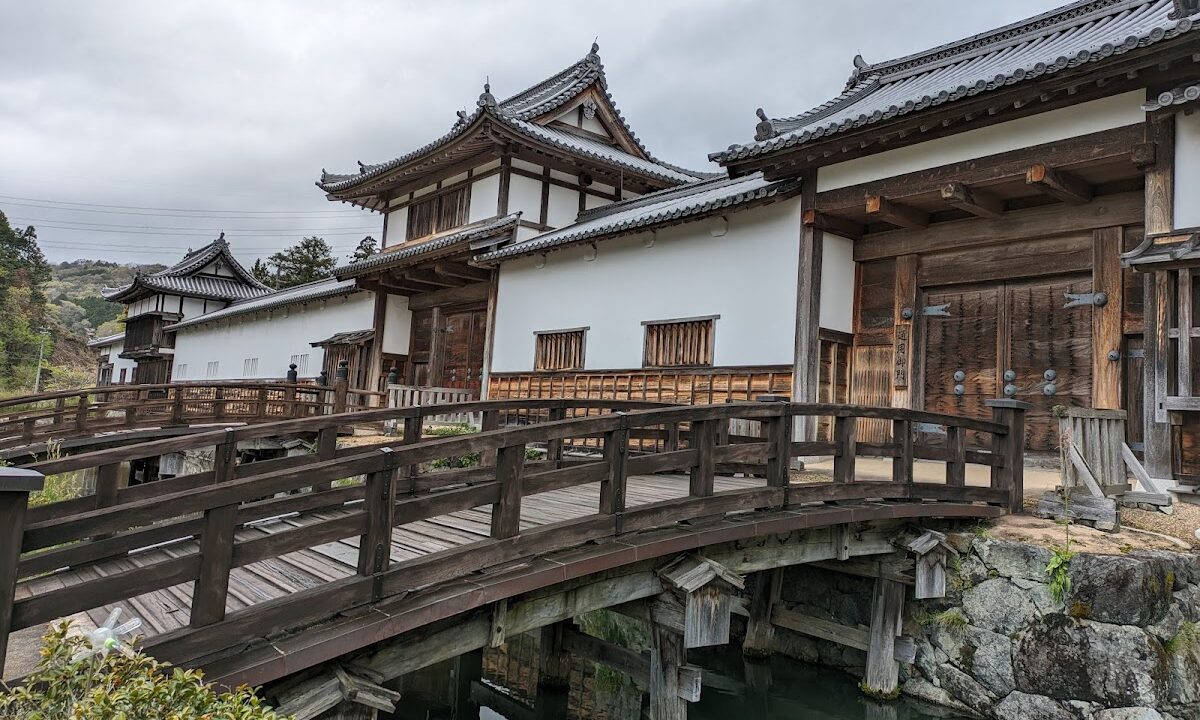
The Nagaya Gate, which adorns the entrance to the Mikazuki Jinya (fortified residence), is a structure restored based on archaeological excavations and records from ancient documents. A Nagaya Gate is a type of gate with long buildings (retainers’ quarters and warehouses) on both sides, a common architectural style seen in samurai residences and fortified residences during the Edo period.
The restored Nagaya Gate faithfully reproduces the architectural techniques of the time, with details such as wood processing methods, joinery, and roofing techniques adhering to the Edo period style. Visitors can experience the atmosphere of an Edo-period fortified residence by passing through this gate.
General Gate and Middle Gate
The fortified residence had multiple gates, each used for different purposes. The Tsuyō-gomon (general gate) was used for everyday entry and exit, primarily by retainers and merchants. The Naka-gomon (middle gate), on the other hand, was a more formal gate, used for important guests and ceremonies.
These gates have also been restored through archaeological excavations, confirming the locations of their foundations and pillars. The arrangement and structure of the gates provide insights into the social hierarchy and rituals of the Edo period.
Bridges and Moat Landscape
Several bridges spanned the moat of the Edo residence. These bridges have also been restored, with wooden reconstructions being created. The combination of the moat and bridges demonstrates the defensive function of the residence while also forming a beautiful landscape.
The landscape, with its restored moat, bridges, and stone walls, is a valuable space that conveys the appearance of the Edo period residence and is a popular spot for photography.
Mikazuki Clan Noino Jinya Museum
Facility Overview and Exhibits
The Mikazuki Clan Noino Jinya Museum is located on the site of the former Mikazuki Jinya (fortified residence), where visitors can learn about the history of the fort and the results of archaeological excavations. The museum displays artifacts unearthed during excavations, a reconstructed model of the fort, ancient documents, and drawings.
Of particular note is the reconstructed model showing the layout of the fort’s buildings. This model allows for a three-dimensional understanding of the entire fort’s former appearance. Furthermore, the excavated ceramics, roof tiles, and metal products provide insights into the lifestyle and technological level of the time.
Opening Hours and Visitor Information
The Mikazuki Clan Noino Jinya Museum is open on Saturdays, Sundays, and public holidays from 10:00 to 16:00. Admission is free, and anyone can easily visit. Volunteer guides are available to provide explanations, allowing visitors to learn more about the history of the fort.
While the museum is generally closed on weekdays, group visits may be possible by contacting the Sayo Town Board of Education in advance.
Archaeological Findings and Historical Significance
Archaeological Excavations in the Heisei Period
Full-scale archaeological excavations of the Mikazuki Jinya began in 1996 (Heisei 8). These excavations revealed detailed structural information about the Jinya, including the building foundations, the structure of the stone walls, the layout of the moats, and drainage facilities.
Particularly important discoveries include the confirmation of the layout and scale of the palace buildings, the detailed understanding of the stone wall construction techniques, and the stratigraphic confirmation of the Jinya’s transformation process. These findings have greatly contributed to the study of Jinya architecture in the Harima region.
Value as a Castle Site in Hyogo Prefecture
While many castle and Jinya sites remain in Hyogo Prefecture, the Mikazuki Jinya possesses unique historical value as a Jinya of a small domain in the Harima region. In particular, the combination of existing watchtowers and restoration work based on archaeological excavations makes this a prime example of cultural property preservation and utilization.
The Hyogo Prefectural Museum of History also features Mikazuki Jinya as one of the “castle sites in Hyogo Prefecture,” positioning it as an important historical heritage site within the prefecture.
Access and Surrounding Information
Access by Public Transportation
The nearest station to Mikazuki Jinya is Mikazuki Station on the JR Kishin Line. It’s approximately a 15-minute walk from Mikazuki Station to the Jinya site. The route from the station to the Jinya retains the atmosphere of a former castle town, making for an enjoyable stroll.
The JR Kishin Line connects Himeji Station and Niimi Station (Okayama Prefecture), and is a major mode of transportation in the Harima region. It takes approximately one hour to reach Mikazuki Station from Himeji Station.
Access by Car
If traveling by car, the nearest interchange is Sayo Interchange on the Chugoku Expressway. It takes about 10 minutes from the interchange to Mikazuki Jinya. There is a parking lot near the Jinya that can be used free of charge.
When searching with a car navigation system, searching for “Mikazuki-han Noino Jinya-kan” or “Sayo-cho Noino” will guide you to the correct location.
Nearby Tourist Attractions
Around Mikazuki Jinya, there are many tourist attractions where you can experience the history and culture of the Harima region. In Sayo-cho, there is the Hirafuku Historical Preservation District, where you can see a beautiful townscape that retains the atmosphere of an Edo-period post town.
Sayo-cho is also famous for its sunflower fields, and in the summer, you can see vast fields of sunflowers. You can create a travel plan that combines historical exploration and nature sightseeing.
Photo Spots at Mikazuki Jinya
Recommended Photo Spots
Mikazuki Jinya boasts a beautiful landscape where historical buildings and nature harmonize, making it an ideal spot for photography. Here are some particularly recommended photo spots.
Panoramic View Including the Watchtower: Viewing the Jinya (fortified residence) from a slightly elevated vantage point offers a panoramic view of the watchtower, the restored gate, and the stone walls, capturing the entire structure of the Jinya. The morning light is particularly beautiful, highlighting the shadows of the buildings.
Front View of the Nagaya Gate: Photographing the restored Nagaya Gate from the front captures the atmosphere of the Edo-period Jinya entrance. Including the structure of the Nagaya (long buildings) on either side of the gate provides a good understanding of the architectural style of the time.
Moat and Stone Walls: Walking along the moat and photographing the texture of the stone walls and their reflections in the water is also recommended. The surrounding vegetation changes with the seasons, offering different views.
Seasonal Scenery
Mikazuki Jinya displays different beauty in each of the four seasons. In spring, cherry blossoms bloom, coloring the Jinya ruins. In summer, the fresh greenery is beautiful, and in autumn, the autumn leaves stand out against the backdrop of the stone walls and buildings. In winter, the sight of the jinya (feudal lord’s residence) covered in snow is also charming.
Because you can enjoy different expressions depending on the season you visit, there are new discoveries to be made each time you visit.
Culture and Education of the Mikazuki Domain
Domain School and Educational System
The Mikazuki Domain had a domain school for the education of the children of samurai. Parts of this school building still exist, conveying the state of education at the time. It is evident that even though it was a small domain, it placed great emphasis on education.
At the domain school, academic subjects, mainly Confucianism, were taught, and martial arts training was also conducted. Furthermore, efforts were made to cultivate practical administrative skills, fostering personnel who would support the domain’s administration.
Cultural Activities
In the Mikazuki Domain, successive lords encouraged cultural activities. In particular, cultures such as waka poetry, tea ceremony, and calligraphy were nurtured, and the lords themselves participated in these activities. They also protected shrines and temples within the territory and supported festivals, contributing to the development of local culture.
This cultural accumulation forms the cultural foundation of present-day Sayo Town and contributes to its regional identity.
Preservation and Utilization Efforts
Designation and Protection as a Cultural Property
The Mikazuki Jinya Ruins have been designated as an important cultural property of Sayo Town, and preservation efforts continue. The existing watchtower, in particular, is considered a very important structure and undergoes regular repairs and preservation treatment.
Appropriate protective measures have also been taken for the remains confirmed through archaeological excavations, ensuring their preservation for the future.
Collaboration with the Community
The cooperation of local residents is essential for the preservation and utilization of the Mikazuki Jinya. Local volunteer groups conduct cleaning and guiding activities at the Jinya, conveying its charm to visitors.
Furthermore, the Mikazuki Jinya is used as an important teaching material in local schools, providing a place for children to learn about local history. Through these efforts, the value of the Jinya is being passed on to future generations.
Research and Academic Value
Contribution to Jinya Architecture Research
The Mikazuki Jinya is an important case study for the study of Edo period jinya architecture. In particular, it provides valuable information for understanding the structure and operation of jinya of small domains.
Researchers from diverse fields, including architectural history, archaeology, and history, have conducted research on the Mikazuki Jinya, and their findings have been published as academic papers and reports.
Position in Harima Regional History
Harima Province was a region with many domains and jinya during the Edo period. The Mikazuki Domain was a small domain among them, but it played an important role in the local community. Research on the Mikazuki Jinya is an essential element for understanding the regional history of Harima.
In particular, the case of the Mikazuki Domain offers many insights into the realities of small domains, which differed from large domains, and their relationship with local communities.
Notes and Manners for Visitors
Visitor Manners
The Mikazuki Jinya Ruins are a cultural property and a valuable historical heritage site for the local community. Please observe the following points when visiting:
- Do not climb on the restored buildings or stone walls.
- Take all your trash with you.
- Do not damage the plants.
- Do not make loud noises.
- Do not enter areas other than designated areas.
Especially existing structures such as watchtowers are valuable cultural properties, so please be very careful not to touch or damage them.
Notes Regarding Photography
Photography is generally permitted, but permission is required in advance for commercial photography. Please also be considerate of other visitors.
If you wish to take aerial photographs using a drone, you must consult with the Sayo Town Board of Education in advance and obtain permission.
Summary: The Charm and Future Prospects of Mikazuki Jinya
Mikazuki Jinya is a historical building that functioned as the center of the Harima Mikazuki Domain for 174 years, from the Genroku era to the Meiji Restoration. The existing watchtower, the restored nagaya-mon (long gatehouse), tsuyō-gomon (general gate), and chūgomon (middle gate), as well as the stone walls and moats revealed through archaeological excavations, make this a valuable heritage site that conveys the appearance of an Edo-period jinya (fortified residence).
Among the castle ruins in Hyogo Prefecture, Mikazuki Jinya holds great value as a unique type of jinya and as an important historical site that tells the story of the Harima region. Its convenient location, accessible on foot from JR Kishin Line Mikazuki Station, is also one of its attractions.
Through archaeological excavations and restoration projects that have continued since the Heisei era, the appearance of the jinya is gradually being revealed, and restoration is progressing. The Mikazuki-han Noino Jinya Museum clearly displays these findings, conveying the appearance of an Edo-period jinya to visitors.
Continued preservation and utilization efforts are expected for Mikazuki Jinya in the future. When visiting the Harima region, be sure to visit this historic jinya site and experience the history and culture of a small Edo-period domain. Along with the beautiful scenery of the four seasons, you can feel the lives of the people who lived there.