A Complete Guide to the History and Highlights of Mattō Castle (Hakusan City, Ishikawa Prefecture) | From a Base of the Ikkō-ikki Rebellion to the Residence of Maeda Toshinaga
Mattō Castle, located in Hakusan City (formerly Mattō City), Ishikawa Prefecture, is a castle that played an important role in the history of Kaga Province. It began as the residence of a powerful local clan in the late Heian period, flourished as the base of the Ikkō-ikki rebellion, fell to Shibata Katsuie of the Oda army, and then became the residence of powerful daimyo such as Maeda Toshinaga and Niwa Nagashige. Currently, it is maintained as Mattō Castle Ruins Park and serves as a place of relaxation for citizens.
Basic Information on Mattō Castle
Mattō Castle was a flatland castle located in Mattō, Ishikawa District, Kaga Province, present-day Kojōmachi, Hakusan City, Ishikawa Prefecture. It was built on a flat area at an elevation of approximately 21 meters in the central part of the Tetori alluvial fan, located on the north bank of the Tetori River, almost midway between Kanazawa Castle (Oyama Gobo) and Komatsu Castle—a strategically important location.
Location: Kojōmachi, Hakusan City, Ishikawa Prefecture (formerly Kojōmachi and Nishishinmachi, Mattō City)
Castle Structure: Flatland Castle
Construction Period: Late Heian Period
Builder: Mattō Clan (a branch of the Hayashi Clan)
Main Lords: Mattō Clan, Kaburagi Clan (during the Ikkō-ikki rebellion), Maeda Toshinaga, Niwa Nagashige
Year of Abandonment: 1614 (Keichō 19)
Remains: Part of the earthworks and dry moat
Current Status: Mattō Castle Ruins Park
History of Mattō Castle
Late Heian Period: Established as the residence of the Mattō Clan
The origins of Mattō Castle date back to the late Heian period. It is believed to have begun when the Mattō Clan (considered a branch of the Hayashi Clan), who ruled this area, built a residence there. The Mattō Clan held power as a local powerful family in Kaga Province and was responsible for the development and governance of this region. Initially, it is believed that the site was more of a samurai residence than a castle, with simple defensive structures. However, the name Mattō became established during this period, and the area played a central role in the region.
Muromachi Period: The Mattō Clan as a Retainer
With the arrival of the Muromachi period, the Mattō clan began serving as retainers of the Muromachi Shogunate. Retainers were a group of samurai directly under the Shogun, holding the honorable position of guarding the palace and serving as the Shogun’s close advisors. During this time, the Mattō clan maintained their power in Kaga Province while maintaining connections with the central government.
Sengoku Period: The “Mattō Group,” the Headquarters of the Ikkō-ikki
The most important period in the history of Mattō Castle is the era of the Ikkō-ikki. From the late 15th to the 16th century, Kaga Province became a “country owned by peasants,” ruled by the Ikkō-ikki (an autonomous organization of followers of the Jōdo Shinshū Honganji sect).
Mattō Castle functioned as the headquarters of the “Matō Group” within the Ikkō-ikki rebellion, and its full-scale fortification progressed during this period. The Mattō Group was led by the Kaburagi clan, and defensive facilities such as water moats, dry moats, and earthworks were constructed at the castle, strengthening its character as a military base.
Battles with Uesugi Kenshin
In 1577 (Tenshō 5), when Uesugi Kenshin of Echigo invaded Kaga, Mattō Castle was also attacked. However, Mattō Castle withstood the Uesugi army’s attack and ultimately avoided falling through a peace agreement. This battle demonstrated the high defensive capabilities of Mattō Castle.
1580 (Tenshō 8): Fall of the Castle by the Oda Army
Oda Nobunaga, who had been engaged in a long war with the Ikkō-ikki, ordered his senior retainer, Shibata Katsuie, to lead the suppression of the Kaga Ikkō-ikki in 1580 (Tenshō 8). The Oda army, led by Shibata Katsuie, invaded Kaga Province with overwhelming force, and Mattō Castle was subjected to fierce attacks.
After several days of fighting, Mattō Castle fell. This marked the end of approximately 100 years of Ikkō-ikki rule, and Kaga Province came under the control of the Oda clan. With this fall, Mattō Castle transformed from an Ikkō-ikki stronghold into an Oda castle.
Under the Oda Regime: Development of the Castle Town and Fortification
After its fall, Mattō Castle was redeveloped as an important Oda stronghold. Under the command of Shibata Katsuie, the castle’s fortifications were strengthened and the castle town was developed, giving it the appearance of a flatland castle. The layout of the baileys, including the main bailey, second bailey, and third bailey, became clearer, and it is believed that the moats and earthworks were also expanded.
The Era of Maeda Toshinaga (circa 1582-1585)
After the Honnō-ji Incident in 1582 (Tenshō 10), Kaga Province came under the control of Maeda Toshiie. Maeda Toshinaga, Toshiie’s eldest son, entered Mattō Castle and resided there for approximately three years.
Maeda Toshinaga would later become the second lord of the Kaga Domain, and this period at Mattō Castle was a crucial experience in his youth. As the lord of Mattō with a domain of 40,000 koku, Toshinaga governed the area and contributed to the development of the castle town.
The Era of Niwa Nagashige (circa 1585-1596)
After Maeda Toshinaga, Niwa Nagashige, the son of Niwa Nagahide (a senior retainer of Oda Nobunaga), became the lord of Mattō Castle. Niwa Nagashige resided there for approximately 11 years, and this period is considered one of the golden ages of Mattō Castle.
Niwa Nagashige, as the lord of Mattō with a 40,000 koku domain, strived to further improve the castle and develop the castle town. He also promoted commerce and improved the roads, and Mattō flourished as an important key city in southern Kaga Province.
1614 (Keichō 19): Abolition due to the One Castle Per Province Decree
After the Battle of Sekigahara in 1600 (Keichō 5), Maeda Toshinaga became the lord of Kaga Province, and the Kaga Domain was established with Kanazawa Castle as its base. Mattō Castle continued to exist as a branch castle of the Kaga Domain, but it was abolished in 1614 (Keichō 19) due to the Edo Shogunate’s One Castle Per Province Decree (One Castle Per Province Policy).
After its abolition, Mattō functioned as an important economic center where the Kaga Domain’s warehouses were located, and it continued to develop as a post town on the Hokkoku Kaidō road. The castle facilities were gradually dismantled, and the castle site was converted into fields and town land. ## Layout and Structure of Mattō Castle
Basic Structure of the Castle
Mattō Castle was a flatland castle built on the flat land of the Tedori alluvial fan. It is believed to have had a concentric layout with the main keep (Honmaru) at the center, surrounded by the second and third baileys (Ninmaru). The total area is estimated to be around 100,000 square meters, functioning as a medium-sized flatland castle.
Main Keep
The main keep was the core of the castle, located in the center of the current Mattō Castle Ruins Park. It is believed that the lord’s residence and other important buildings were located on the site of the main keep. It was surrounded by earthen ramparts and a moat, enhancing its defensive capabilities.
A sign indicating the “site of the main keep” is currently installed in the park, allowing visitors to understand where the center of the castle was in its heyday.
Moats and Dry Moats
Important defensive features of Mattō Castle were the moats and dry moats. A moat utilizing the abundant water of the Tedori River surrounded the castle, preventing enemy intrusion. Furthermore, dry moats were constructed in some areas, forming multiple lines of defense.
Even today, remnants of the water moats can be seen in parts of the park, allowing us to imagine the scale of the castle at that time.
Earthworks
Earthworks were built around the castle, enhancing its defensive capabilities. Fences and walls were likely placed on top of the earthworks, and it is believed that watchtowers and turrets were also positioned there. Even today, remnants of the earthworks remain in parts of the park, making them valuable castle ruins.
Castle Town
A castle town developed around Mattō Castle, with samurai residences, merchant districts, temples, and shrines systematically arranged. Especially after the Oda regime, during the time of Maeda Toshinaga and Niwa Nagashige, the castle town was further developed, and commerce and handicrafts flourished.
Because the Hokkoku Kaido road passed through the castle town, it also functioned as a post town, a bustling place where many travelers and merchants came and went.
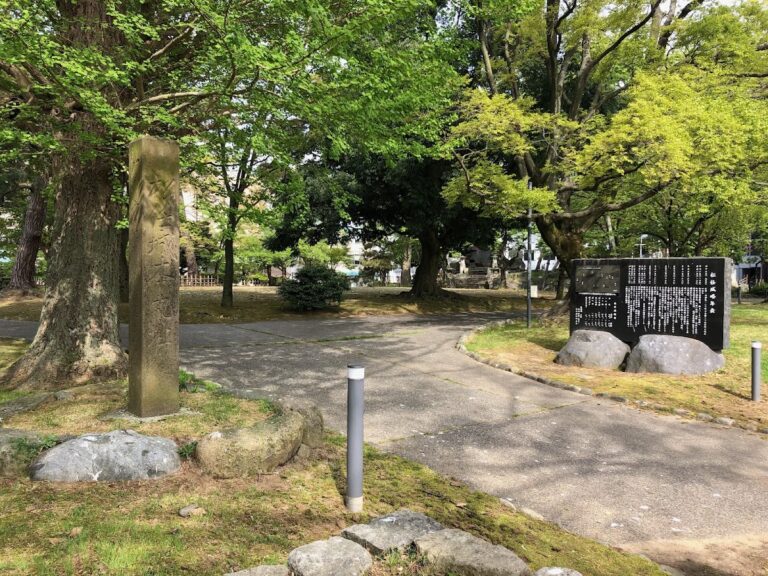
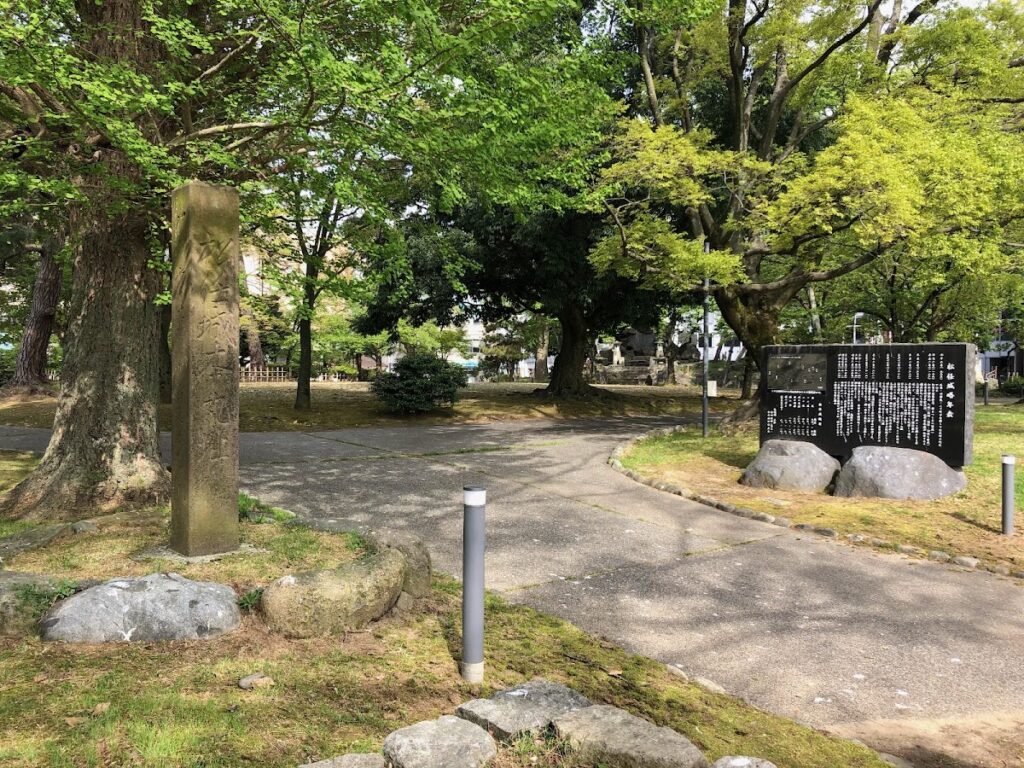
Current Mattō Castle Ruins Park
Park Development
Approximately 400 years after the castle’s abandonment, the Mattō Castle ruins have been developed into “Mattō Castle Ruins Park,” a place of relaxation for the citizens of Hakusan. The park features playgrounds, open spaces, and walking paths, making it a popular spot for families and local residents.
The park covers approximately 2 hectares and utilizes a portion of the castle ruins. In spring, cherry blossoms bloom, making it a popular spot for cherry blossom viewing.
Remains of the Castle Ruins
Several remains of the castle from its era remain within Mattō Castle Ruins Park.
Remains of Earthworks: Parts of the park preserve remnants of the original earthworks, which can be viewed along with explanatory signs.
Traces of Dry Moats: By carefully examining the park’s topography, traces of the former dry moats can be discerned in certain areas.
Sign at the Main Enclosure Site: An information board has been installed at the site of the main enclosure, allowing visitors to learn where the central part of the castle was located.
Information Boards and Explanations
Several information boards explaining the history of Mattō Castle are installed within the park. Detailed explanations are provided about the castle’s history, layout, and major lords, allowing visitors to enjoy a stroll while learning about the castle’s history.
Castle Site Monument
A stone monument marking the “Mattō Castle Site” stands within the park, commemorating the fact that this area was once an important castle. It is also a popular spot for commemorative photos.
Access to Mattō Castle
Public Transportation
From Mattō Station on the JR Hokuriku Main Line:
- Approximately 10 minutes on foot
- Mattō Station is a major station where express trains also stop, and is accessible from Kanazawa Station in approximately 15 minutes.
- The route from the station to the castle ruins park is flat and easy to walk.
By Car
From Hakusan Interchange on the Hokuriku Expressway:
- Approximately 15 minutes by car
- Accessible via National Route 8
From Kanazawa City Center:
- Approximately 30 minutes by car
- Via National Route 157 or National Route 8
Parking: Mattō Castle Ruins Park has a dedicated parking lot which is free to use. However, spaces are limited, and it may be full during events.
Address
Kojomachi, Hakusan City, Ishikawa Prefecture (Matsuto Castle Ruins Park)
Nearby Tourist Attractions
Matsuto Furusato Museum
Located within walking distance of Matsuto Castle Ruins Park, the Matsuto Furusato Museum is a facility that introduces the history and culture of the Matsuto area. Visitors can learn about materials related to Matsuto Castle, exhibits from the Ikko-ikki rebellion era, and the history of the town’s development as a castle town.
Location: 312 Tonomachi, Hakusan City, Ishikawa Prefecture
Phone: 076-276-5614
Hakusan City Museum
This museum comprehensively exhibits the history and culture of Hakusan City, and houses materials related to Matsuto Castle and the Ikko-ikki rebellion. Recommended for those interested in local history.
Tedori River
The Tedori River, which flows south of Matsuto Castle, is an important river in Kaga Province and greatly influenced the castle’s location. A walking path is maintained along the river, allowing visitors to enjoy nature. ### Kanazawa Castle and Kenrokuen Garden
Located approximately 15km north of Mattō Castle, Kanazawa Castle and Kenrokuen Garden flourished as the base of the Maeda family of the Kaga Domain. Visiting Kanazawa Castle, which became the center of the Kaga Domain after Mattō Castle was abandoned, allows for a deeper understanding of the region’s history.
Points to Note When Visiting Mattō Castle
Best Season for Visiting
Spring (Late March to Early April): The cherry blossoms in the park are in full bloom. This is the perfect season to enjoy cherry blossom viewing while strolling through the castle ruins.
Autumn (October to November): The autumn foliage is beautiful, and the pleasant weather makes it ideal for a stroll.
Summer and Winter: Summer offers lush greenery, and winter brings snowy scenery. However, Ishikawa Prefecture experiences heavy snowfall in winter, so caution is advised regarding the weather during winter visits.
Estimated Visiting Time
A visit to Mattō Castle Ruins Park takes approximately 30 minutes to 1 hour. If you plan to carefully observe the remains or visit the nearby Mattō Furusato Museum, allow 2 to 3 hours.
Photography Tips
- The castle ruins monument is a classic spot for commemorative photos.
- The earthwork remains are a valuable subject for castle enthusiasts.
- The combination of cherry blossoms in spring and the castle ruins monument makes for a beautiful composition.
- Taking photos with the information board is ideal as a record of your visit.
Historical Significance of Mattō Castle
Importance in the Study of the Ikkō-ikki Rebellion
Mattō Castle is an extremely important historical site in the study of the Kaga Ikkō-ikki rebellion. Research on Mattō Castle, the base of the Mattō group, is essential for understanding the reality of a “country owned by peasants” for approximately 100 years.
The Ikkō-ikki were not merely religious uprisings, but rather regional governments possessing a high degree of self-governance and military power, and Mattō Castle was one of their core strongholds. The process of its fortification and its defensive capabilities, including its ability to withstand attacks by Uesugi Kenshin, serve as evidence of the Ikkō-ikki’s strong organizational and military capabilities.
Oda Regime’s Control of Kaga
The fall of Mattō Castle to Shibata Katsuie marked a crucial turning point in Oda Nobunaga’s conquest of Kaga. By successively capturing the Ikkō-ikki’s strongholds, the Oda regime achieved complete control of Kaga Province.
The post-fall reconstruction of Mattō Castle and the construction of its castle town are studied as an example of the Oda regime’s castle town policy.
The Formation of the Maeda Family and the Kaga Domain
The three years Maeda Toshinaga spent at Mattō Castle provided invaluable experience for his later management of the Kaga Domain. It was at Mattō Castle that the young Toshinaga learned the practicalities of governance as a 40,000-koku lord. The Kaga Domain later grew into a major domain known as “Kaga Hyakumangoku” (Kaga of a Million Koku), but its foundation can be said to have been formed including the experience gained during the time of Mattō Castle.
Hokkokukaido Road and the Regional Economy
Even after the castle was abandoned, Mattō continued to develop as an important post town on the Hokkokukaido Road. The Kaga Domain’s warehouses were located there, maintaining its function as an economic hub. The town layout, developed as a castle town, became the foundation for Mattō’s subsequent development and formed the prototype of the current central area of Hakusan City.
Relationship between Mattō Castle and the Ikkō-ikki Uprising
The Establishment of the Kaga Ikkō-ikki Uprising
In the latter half of the 15th century, the influence of the Jōdo Shinshū Honganji sect (Ikkō-shū) rapidly expanded in Kaga Province. In 1488 (Chōkyō 2), the Ikkō-ikki forces attacked and destroyed the provincial governor, Togashi Masachika. For approximately 100 years thereafter, Kaga Province became a “country owned by the peasants,” governed by the Ikkō-ikki.
The Role of the Mattō Group
The Kaga Ikkō-ikki was composed of several regional organizations called “groups.” The Mattō Group was one of the most powerful, controlling the southern part of Ishikawa County.
The Mattō Group was led by the Kaburagi clan, who governed the region both militarily and administratively from their base at Mattō Castle. The Ikkō-ikki organization was not merely a religious group, but a complex entity possessing characteristics of a feudal lord.
Development of Fortification
Mattō Castle, during the Ikkō-ikki era, developed into a full-fledged castle amidst the military tensions of the Sengoku period. Defensive structures such as water moats, dry moats, and earthen ramparts were constructed, and it became a military base equipped with armories and granaries.
The fact that it repelled Uesugi Kenshin’s invasion demonstrated the high level of Matsuto Castle’s defenses.
Confrontation with Oda Nobunaga
In parallel with the Ishiyama War against Honganji Temple, Oda Nobunaga also proceeded with suppressing the Kaga Ikko-ikki rebellion. In 1580, a large army led by Shibata Katsuie invaded Kaga, and Matsuto Castle was besieged.
Faced with the overwhelming military strength and firearms of the Oda army, Matsuto Castle fell after several days of resistance. This marked the end of the Kaga Ikko-ikki’s rule, which had lasted for approximately 100 years.
Summary: The Charm of Matsuto Castle
Matsuto Castle is a historically important castle site located in Hakusan City, Ishikawa Prefecture. Beginning as the residence of the Mattō clan in the late Heian period, then flourishing as a base for the Ikkō-ikki rebellion, falling to the Oda army, and becoming the residence of Sengoku period warlords such as Maeda Toshinaga and Niwa Nagashige, Mattō Castle’s history is truly a microcosm of Kaga Province’s history.
Currently, it is maintained as Mattō Castle Ruins Park, and the few remaining earthworks and dry moats evoke its former glory. Its convenient location, just a 10-minute walk from JR Mattō Station, makes it an attractive stop for those sightseeing in Kanazawa.
For those interested in the history of the Ikkō-ikki rebellion, Sengoku period castles, and the formation of the Kaga Domain, Mattō Castle is a historical site well worth visiting. Visiting it in conjunction with the nearby Mattō Furusato Museum will allow for a deeper understanding of the region’s history.
When visiting Ishikawa Prefecture, be sure to visit Mattō Castle Ruins Park and reflect on the history of over 400 years ago.