Matsuo-yama Castle (Gifu Prefecture) Complete Guide | The History and Remains of a Mountain Castle That Held the Key to the Battle of Sekigahara
What is Matsuo-yama Castle?
Matsuo-yama Castle is a Sengoku period mountain castle located in Matsuo, Sekigahara-cho, Fuwa-gun, Gifu Prefecture. Built around the summit of Mt. Matsuo (293.1 meters above sea level, some sources say 292.9 meters), it is a full-fledged mountain castle spanning approximately 400 meters east-west and 250 meters north-south, and is a designated historical site of Sekigahara Town.
Also known as “Choteiken-jo,” it is historically significant as the location where Kobayakawa Hideaki deployed his troops during the Battle of Sekigahara. The castle’s greatest feature is its strategic location overlooking the Sekigahara Basin, giving it a geographical advantage over both the Eastern and Western army’s positions.
History of Matsuo-yama Castle
From Construction to the Sengoku Period
The exact construction date of Matsuo-yama Castle is unclear, but it is believed to have been built by the Tomishima clan during the Oei era (1394-1428). Located on the border between Mino and Omi provinces, Matsuo-yama was a crucial transportation hub connecting the two provinces from ancient times, functioning as a typical “border castle” where the Higashiyama-do, Ise-kaido, and Hokkoku-kaido roads intersected.
From the Nanboku-cho period to the Sengoku period, this area was the front line where the forces of Mino and Omi provinces clashed. The castle’s lords changed over time; after the Tomishima clan, Higuchi Naofusa and Fuwa Mitsuharu defended the castle.
Asai Nagamasa and Matsuo-yama Castle
Matsuo-yama Castle first appeared on the historical stage in 1570, during the late Sengoku period. When Asai Nagamasa broke his alliance with Oda Nobunaga and clearly adopted a stance of opposition to Nobunaga, he ordered his subordinate Higuchi Naofusa to occupy Mount Matsuo and renovate the castle in order to strengthen the defenses of the Mino border.
At this time, Mount Matsuo Castle functioned as an important base for invasions from Omi to Mino, and as a key point for monitoring Omi from Mino. Despite being a relatively low mountain at an elevation of 293 meters, its topography, overlooking the surrounding area, provided extremely advantageous military conditions.
The Eve of the Battle of Sekigahara
In 1600, on the eve of the Battle of Sekigahara, Ishida Mitsunari ordered Ito Morimasa, the lord of Ogaki Castle, to renovate Mount Matsuo Castle. It is clear that Mitsunari recognized the strategic importance of this castle, and Mount Matsuo occupied a crucial position in the Western Army’s deployment plan at Sekigahara.
Initially, Mitsunari planned to station a trustworthy general on Mount Matsuo, but ultimately, it was Kobayakawa Hideaki who took up camp there. Hideaki was Toyotomi Hideyoshi’s adopted son and fought on the Western Army’s side, but his loyalty was questionable.
The Battle of Sekigahara and Kobayakawa Hideaki’s Betrayal
On September 15, 1600, the Battle of Sekigahara began. Kobayakawa Hideaki, positioned on Mount Matsuo with approximately 15,000 soldiers, remained motionless even after the battle began.
Tokugawa Ieyasu of the Eastern Army, exasperated by Hideaki’s attitude, ordered his musketeers to fire warning shots towards Mount Matsuo. This “warning shot” prompted Hideaki to finally decide to switch sides to the Eastern Army. Hideaki’s forces swiftly descended Mount Matsuo and poured into the camp of Otani Yoshitsugu of the Western Army. This betrayal is considered to have determined the outcome of the Battle of Sekigahara, and Matsuo-yama Castle is remembered as a place that changed the course of Japanese history. Due to Hideaki’s betrayal, Otani Yoshitsugu fought valiantly but was killed, and the Western Army completely collapsed.
Matsuo-yama Castle After the War
After the Battle of Sekigahara, Matsuo-yama Castle is believed to have been abandoned. In the Edo period, this area developed into part of Sekigahara, a post town on the Nakasendo road, and the castle lost its function. However, due to its importance in the Battle of Sekigahara, its value as a historical site has continued to be recognized.
Layout and Remains of Matsuo-yama Castle
Main Enclosure (Castle Platform)
The main enclosure, located at the summit of Mount Matsuo, is called the “Castle Platform” and is the central part of Matsuo-yama Castle. The main enclosure is surrounded by steep slopes and earthen ramparts, making it a highly defensible structure. The earthen ramparts remain in good condition today, surrounding the main enclosure at a height of approximately 1-2 meters.
The main enclosure measures approximately 40 meters east-west and 30 meters north-south, a standard size for a mountain castle. It is believed that Kobayakawa Hideaki’s headquarters were located in this space, overlooking the Sekigahara Basin and observing the battle.
Masugata Koguchi and Umadashi
A masugata koguchi (square-shaped gate) is located on the south side of the main enclosure, with a umadashi-like enclosure positioned in front of it. A masugata koguchi is a defensive structure characterized by a “U”-shaped bend in the passageway to prevent enemy intrusion, and is typical of castles from the late Sengoku period.
The umadashi is a small enclosure located in front of the koguchi, functioning as a gathering place for sorties or as a forward base to defend the koguchi. The umadashi at Matsuo-yama Castle is highly likely to have been constructed during renovations just before the Battle of Sekigahara.
Belt Enclosures and Vertical Moats
A belt enclosure is located on the north side of the main enclosure. This long, narrow enclosure surrounds the main enclosure, serving as both a frontline defense and a troop movement route.
Multiple vertical moats can be seen on the northern and southern slopes. Vertical moats are dug vertically along the mountain slope, effectively hindering enemy lateral movement and limiting attack routes. The vertical moats of Matsuo-yama Castle are still clearly visible today, making them important remains for understanding the defensive system of the time.
Moats and Cut Slopes
The eastern approach to the castle follows a ridge, but a moat is provided on the western side for defense. A moat is dug to divide the ridge and is an important defensive structure for preventing enemy intrusion.
Throughout the castle, cut slopes (artificially carved steep slopes) can be seen in many places. This castle showcases the Sengoku period’s castle-building techniques, which utilized the natural terrain while enhancing defensive capabilities through human intervention.
Well Remains
Securing water was a matter of life and death for mountain castles. Matsuo-yama Castle retains well remains, indicating that it was equipped to withstand sieges. The ability to secure water near the mountaintop was a crucial factor in increasing the castle’s military value.
Terraced Enclosures
Several terraced enclosures are located around the main enclosure, particularly on the north and south sides. These enclosures are terraced structures built on the mountain slopes and were used as troop garrisons and storage areas for supplies. Considering that Kobayakawa Hideaki commanded a large army of 15,000 men, these terraced enclosures were essential for troop deployment.
Strategic Importance of Matsuo-yama Castle
Geographical Advantage
The greatest feature of Matsuo-yama Castle lies in its location. At an elevation of 293 meters, the castle offered a perfect vantage point overlooking the surrounding plains and other positions. It provided an excellent vantage point for assessing the battle situation, as it allowed for a clear view of the Eastern and Western army’s positions in the Sekigahara Basin.
The relative height from the base of the mountain was approximately 190 meters, a height that required considerable effort to ascend. However, the well-maintained access roads likely made troop deployment relatively easy.
A Strategic Transportation Hub
Matsuo-yama was strategically located, controlling the transportation routes connecting Mino and Omi provinces. At Sekigahara, where major highways such as the Tōsandō (Nakasendō), Ise Kaidō, and Hokkoku Kaidō intersected, Matsuo-yama was positioned to monitor and control these routes.
During the Sengoku period, border castles were called “border castles” and played a crucial role in the tense relations between the two provinces. Matsuo-yama Castle is a prime example; it served as both a fortress protecting Mino and a foothold for invasions into Omi, possessing a dual nature. ### Location at Sekigahara
The location of Mount Matsuo at the Battle of Sekigahara held dual significance for the Western Army. Firstly, it was an offensive position capable of attacking the Eastern Army’s rear; secondly, it was a defensive position protecting the Western Army’s flank.
However, this strategic importance became a fatal weakness for the Western Army due to Kobayakawa Hideaki’s betrayal. Otani Yoshitsugu’s troops, attacked from Mount Matsuo—a position supposedly allied—were caught in a pincer movement and suffered a devastating blow.
Access to Matsuo Castle
Access by Car
It’s approximately a 10-minute drive from the Sekigahara Interchange on the Meishin Expressway to the parking lot at the foot of Mount Matsuo. Follow the signs south from National Route 21, and after passing under the Meishin Expressway, you will arrive at the parking lot. Parking is free and has space for about 10 cars.
Address: 731-1 Yamanaka, Sekigahara-cho, Fuwa-gun, Gifu Prefecture (Matsuo Mountain Foot Parking Lot)
Access by Public Transportation
It’s approximately a 30-minute walk from JR Tokaido Main Line “Sekigahara Station” to the Matsuo Mountain Foot Parking Lot. Head southwest from the station, passing through a residential area towards the foot of the mountain. If using a taxi, it takes about 10 minutes from the station.
Hiking Trail
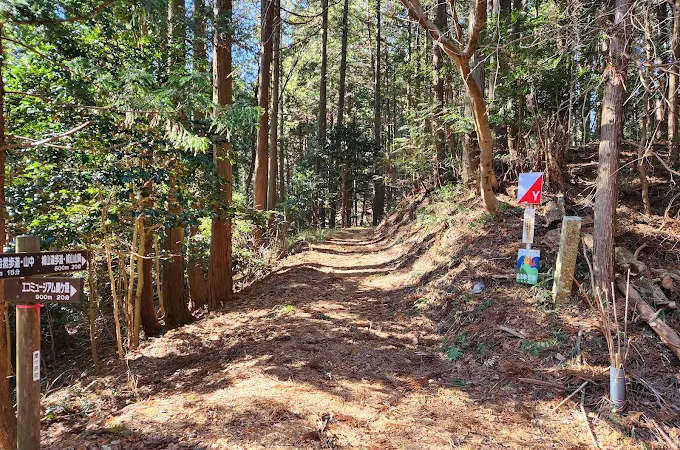
From the Matsuo Mountain Foot Parking Lot to the main enclosure at the summit, it takes about 40 minutes using the well-maintained hiking trail. The trail is relatively well-maintained, and it’s possible to climb in athletic shoes, but since it’s still a mountain trail, wearing trekking shoes is recommended.
The main route used to ascend the castle is the eastern route, gradually gaining altitude while following the ridge. Along the way, you can observe remains such as lower enclosures and moats, experiencing the castle’s defensive system.
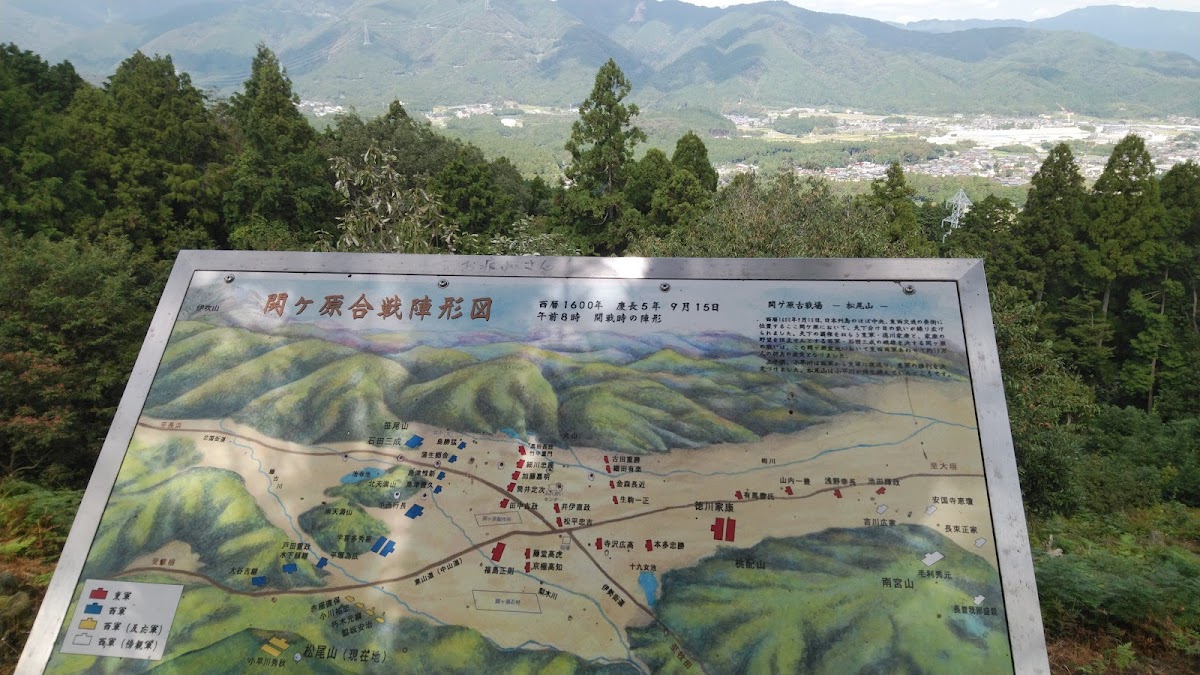
From the mountaintop, you can enjoy a panoramic view of the entire Sekigahara battlefield, including the positions of the Eastern and Western armies, as well as the site of Otani Yoshitsugu’s encampment. On clear days, you can even see Mount Ibuki and the Yoro Mountains, creating a spectacular view.
Points to Note During Your Visit
Observing the Remains
When visiting Matsuo-yama Castle, pay attention to the following remains:
- Earthworks surrounding the main enclosure: Well-preserved, allowing for direct observation of Sengoku period castle construction techniques.
- Masugata Koguchi: The entrance on the south side, showcasing a complex defensive structure.
- Vertical moats: Multiple moats exist on the northern and southern slopes, demonstrating ingenious slope defense techniques.
- Horikiri: A moat that divides the western ridge, clearly remaining.
- Well remains: Remains demonstrating the importance of securing water in mountain castles.
View
The view from the mountaintop is one of Matsuo-yama Castle’s greatest attractions. In addition to offering a panoramic view of the Battle of Sekigahara, you can also see the following historical sites:
- Otani Yoshitsugu’s Camp Site: The Western Army’s camp located northwest of Matsuo Mountain, in the closest position.
- Ishida Mitsunari’s Camp Site: The Western Army’s commander-in-chief’s headquarters, located on Sasao Mountain.
- Tokugawa Ieyasu’s Initial Camp Site: The Eastern Army’s headquarters, located on Momohai Mountain.
- The Center of Sekigahara: The site of the decisive battle where both armies clashed.
From this view, you can truly understand how Kobayakawa Hideaki viewed the battle and how his decision to betray changed the course of the war.
Points to Note When Visiting
- Season: Spring to autumn is the best time to visit, but insect repellent is necessary in summer.
- Clothing: Since you will be walking on mountain paths, comfortable clothing and non-slip shoes are essential.
- Items to Bring: Please carry drinking water, a towel, and rain gear.
- Time: Allow approximately 2 hours for the round trip.
- Weather: Caution is advised in rainy weather as the ground can become slippery.
Nearby Sekigahara Battlefield Historical Sites
When visiting Matsuo-yama Castle, we recommend also visiting the nearby Sekigahara Battlefield historical sites.
Otani Yoshitsugu’s Camp Site
This is the Western Army’s camp site, located northwest of Matsuo-yama, the closest to the mainland. It was the first site to be attacked due to Kobayakawa Hideaki’s betrayal, and Yoshitsugu fought bravely before committing suicide. The site is now a park, and Yoshitsugu’s grave is located there.
Ishida Mitsunari’s Camp Site (Sasao Mountain)
Sasao Mountain, where Ishida Mitsunari, the commander-in-chief of the Western Army, established his headquarters, features a monument marking the camp site and a reconstruction of a horse barricade. You can experience Mitsunari’s perspective on the battlefield.
Sekigahara Battlefield Memorial Museum
This facility, which reopened after renovations in 2020, allows you to learn about the Battle of Sekigahara using the latest exhibition technology. Visiting before Matsuo Mountain Castle will provide a deeper understanding.
Tokugawa Ieyasu’s Initial Camp Site (Momohai Mountain)
This is the location where Tokugawa Ieyasu, the commander-in-chief of the Eastern Army, initially set up his camp. Although Ieyasu later moved to the front lines, he surveyed the entire Sekigahara area from this spot and formulated his strategy.
Matsuo Mountain Castle’s Cultural Property Designation
The Matsuo Mountain Castle site is protected as a Sekigahara Town designated historical site. As an important historical site of the town, preservation and maintenance of the remains are underway, including the maintenance of hiking trails and the installation of information boards.
In recent years, with the growing interest in the Battle of Sekigahara, the number of visitors to Matsuo-yama Castle has increased, and its value as a historical site is being re-recognized.
Various Theories Regarding Matsuo-yama Castle
Toyotomi Hideyori’s Camp Site Theory
Some researchers suggest that Matsuo-yama Castle may have been prepared as a camp site for Toyotomi Hideyori when he marched out for the Battle of Sekigahara. It has been suggested that Ishida Mitsunari’s order to Ito Morimasa to renovate the castle may have been based on a plan to welcome Hideyori to Matsuo-yama.
However, in reality, Hideyori did not move from Osaka Castle, and instead, Kobayakawa Hideaki deployed his forces there. Some believe this situation contributed to Hideaki’s precarious position and ultimately led to his betrayal.
Castle Size and Renovation Period
There is debate regarding the period in which the remaining structures date. The earthworks and square-shaped gates surrounding the main enclosure exhibit characteristics of the late Sengoku period and are thought to be the result of renovations carried out just before the Battle of Sekigahara.
On the other hand, defensive structures such as vertical moats and trenches may have existed from an earlier period, and it is speculated that they were gradually developed during the time of Asai Nagamasa or even earlier.
Matsuo-yama Castle and Kobayakawa Hideaki
Profile of Hideaki
Kobayakawa Hideaki (1582-1602) was born as the nephew of Toyotomi Hideyoshi’s wife, Kita-no-Mandokoro, and was adopted by Hideyoshi. Later, he was adopted by Kobayakawa Takakage and succeeded to the Kobayakawa family. At the time of the Battle of Sekigahara, he was only 19 years old.
Hideaki initially participated on the Western Army’s side, but he was influenced by Tokugawa Ieyasu’s stratagems, and his future was closely watched. By deploying his forces at the strategically important Matsuo-yama, he became a figure of importance to both sides.
The Truth Behind the Betrayal
There are various theories regarding Hideaki’s betrayal. Besides the common theory that Ieyasu’s questioning gun was the direct trigger, there are other theories, such as that he had a secret agreement with Ieyasu beforehand, or that he decided to side with whichever side was advantageous based on the battle situation.
In any case, there is no doubt that Hideaki’s actions—charging from Mount Matsuo towards Otani Yoshitsugu’s camp—determined the outcome of the Battle of Sekigahara. As a result of this betrayal, Hideaki was granted 550,000 koku in Bizen Okayama after the war, but he died suddenly just two years later in 1602 at the young age of 21.
Summary
Matsuo-yama Castle is a historically important castle site, possessing an excellent layout for a mountain castle of the Sengoku period and playing a decisive role in the Battle of Sekigahara, the largest battle in Japanese history.
Built on a mountaintop 293 meters above sea level, the castle boasts well-preserved remains such as earthworks, baileys, vertical moats, and trenches, making it a valuable resource for learning about Sengoku period castle construction techniques. Furthermore, the view from the summit offers a panoramic vista of the entire Sekigahara battlefield, making it an ideal location for imagining the battle’s trajectory.
With its dramatic history from its construction during the Oei era to its renovation by Asai Nagamasa and the betrayal of Kobayakawa Hideaki at the Battle of Sekigahara, Matsuo-yama Castle, as a border castle between Mino and Omi provinces and a place that changed the course of Japanese history, continues to fascinate many history enthusiasts.
Matsuo-yama Castle, relatively easy to access via well-maintained hiking trails, is an important point of interest on a tour of the Sekigahara battlefield. Standing on the summit and gazing upon the view that Kobayakawa Hideaki saw will allow you to experience the weight of history and the reality of the Sengoku period.