
Complete Guide to Mariko Castle: The History and Remains of a Mountain Castle that Flourished as a Strategic Point in Suruga Province
What is Mariko Castle?
Mariko Castle (Mariko-jo) was a Japanese mountain castle located in Suruga Province (present-day Mariko, Suruga Ward, Shizuoka City, Shizuoka Prefecture). It functioned as an important defensive base protecting the western entrance to Suruga Fuchu (present-day central Shizuoka City) for approximately 150 years, from the Muromachi period to the Sengoku period.
The castle was built around the summit of a mountain commonly known as “Sankaku-yama” (Triangle Mountain), sandwiched between deep valleys to the east and west. The main enclosure is located at an altitude of approximately 184 meters. With a relative height of approximately 100 meters, it is known as a mountain castle with a robust defensive structure that takes advantage of the steep terrain.
Alternative Names and Names
Mariko Castle has several alternative names. There are several names for the castle, including Utsuya Castle and Mariko Castle, which are thought to refer to the northern part of the castle, and Mikado Castle and Akamegaya Fort, which are thought to refer to the southern part. These names indicate that the castle’s structure was divided into two areas: the northern and southern parts.
History of Maruko Castle
Construction and Early History
There are various theories regarding the construction date of Maruko Castle, but the most widely accepted theory is that it was built during the Oei era (1394-1428) by Saito Yasumoto (or Saito Hajime). The Saito clan were vassals of the Imagawa clan, the shugo (military governor) of Suruga Province, and they developed Maruko Castle as one of the complexes protecting powerful Suruga Fuchu.
From its initial construction, Maruko Castle was strategically located near Maruko-juku, a key point on the Tokaido road, controlling a crucial transportation hub connecting Suruga and Totomi. This geographical advantage is one reason why the castle continued to be highly valued in later periods.
Maruko Castle under the Imagawa Clan
During the time of Imagawa Ujichika, Maruko Castle came under the direct control of the Imagawa clan. It was seized by the Imagawa as one of the castles protecting Suruga-Fuchu, and Fukushima Awa-no-kami was appointed as its lord.
Under Imagawa rule, Maruko Castle functioned as a defensive stronghold against invasions from the west of Suruga Province. Because of its proximity to the border with Tōtōmi Province, it played a particularly important role as a frontline fort against threats from the west.
It is believed that the castle’s defensive facilities were significantly strengthened during this period, and many of the remaining structures, such as the horizontal and vertical moats, are presumed to have been constructed during the Imagawa era.
Takeda Shingen’s Invasion of Suruga and Yamagata Masakage
The most important turning point in the history of Maruko Castle was the invasion of Suruga by Takeda Shingen during the Eiroku era (around 1568).
In 1568 (Eiroku 11), Takeda Shingen launched a full-scale invasion of Suruga Province. As Imagawa Ujizane’s rule weakened, the Takeda army successively captured strongholds in Suruga. Maruko Castle also fell into the hands of the Takeda during this process, and Shingen considered it crucial as a check against remaining Imagawa forces in western Suruga.
Takeda Shingen appointed Yamagata Masakage, known as one of the Takeda’s Four Heavenly Kings, as the lord of Maruko Castle. Yamagata Masakage was known as one of the Takeda’s most formidable generals, and his deployment to Maruko Castle demonstrates its strategic importance.
Yamagata Masakage used Maruko Castle as a base for the western defense, utilizing it, along with Tanaka Castle, as a strategic base for conquering western Suruga. It is believed that during this period, the castle’s defensive structures were further strengthened, incorporating Takeda-style castle-building techniques.
Maruko Castle After the Fall of the Takeda Clan
After the fall of the Takeda clan in 1582 (Tensho 10), Suruga Province came under the control of Tokugawa Ieyasu. It is believed that Maruko Castle also came under Tokugawa control during this process, but detailed records do not remain.
As Toyotomi Hideyoshi’s unification of Japan progressed, Maruko Castle gradually lost its military importance and is presumed to have been abandoned. The exact date of its abandonment is unknown, but it is thought to have ended its role with the end of the Sengoku period (Warring States period).
Structure and Layout of Maruko Castle
Overall Structure
Maruko Castle is a mountain castle built around the summit of a triangular mountain, sandwiched between large valleys to the east and west. Large and small baileys are arranged in a north-south direction along the ridge of the mountaintop, and the castle has a complex layout with effectively placed horizontal moats, vertical moats, and outworks around the main large baileys.
The castle grounds extend approximately 300 meters from north to south, with the highest point reaching an elevation of about 184 meters and a relative height of about 100 meters from the base. It is characterized by a defensive structure that makes maximum use of the steep terrain.
Structure of the North Castle
The North Castle refers to the northern part of the castle and is also called Utsuya Castle. This area features multiple baileys arranged in a stepped pattern, designed to defend against attacks from the northeast.
The baileys of the North Castle are surrounded by earthen ramparts, and key entrances (koguchi) are provided at strategic locations. These entrances are not simple openings, but rather feature angled shapes and structures that allow for flanking fire, demonstrating ingenuity to make enemy intrusion difficult.
Structure of the South Castle (Triangle Castle)
The South Castle is the southern area, also called Triangle Castle (Mikadojo) or Akamegaya Fort. It consists of a main bailey located at the southern end, surrounded by fortified defensive structures.
The main enclosure was the most important part of the castle, and it is believed to have housed the lord’s residence and command post. An earthen rampart surrounded the main enclosure, and a moat dug further outside.
Defensive System of Moats
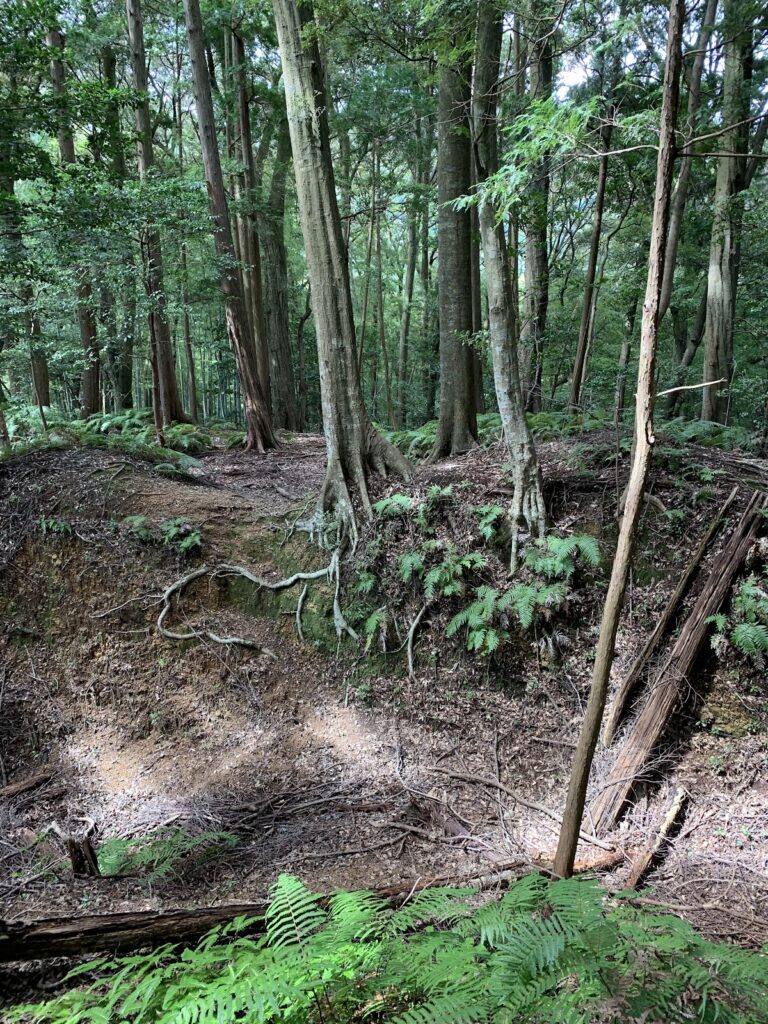
The most distinctive feature of Maruko Castle is the long moat running north-south along the western side of the castle. This moat is significantly large and deep, and remains clearly visible to this day.
The moat features bends and turns designed for flanking fire, allowing for attacks on enemies who entered the moat from the flank. This flanking fire technique represents the pinnacle of castle construction technology during the Sengoku period.
Furthermore, multiple vertical moats were dug into the slope. These vertical moats divided the ridge, hindering enemy lateral movement. These vertical moats were deeply dug along the mountain slope, enhancing their defensive effectiveness.
Crescent Moat and Outwork
Within the castle grounds, a distinctive structure called the crescent moat remains. The crescent moat is a curved moat, a defensive structure built in front of the enclosure. This shape lures the enemy into the moat, allowing for attacks from three sides.
Furthermore, outworks and demaru are strategically placed at key points within the castle. The outworks are small enclosures built in front of the main gate, functioning as bases for sorties and defenses. These structures are thought to show the influence of the Takeda-style castle construction techniques.
Structure of the Main Gate
The main gates of Maruko Castle are not simple openings, but possess a complex structure. Winding passages, earthworks for concealment, and positions for flanking fire are just some of the many features designed to make enemy intrusion difficult.
In particular, the main gates employ a structure called a “staggered gate,” where passages are arranged in a staggered pattern, designed to prevent a direct assault by the enemy.
Current Status and Remains of Maruko Castle
Preservation Status
Maruko Castle ruins are protected as a historical site by Shizuoka City, and the remains are in excellent condition. Because development has not occurred, the castle retains much of its original form, making it a valuable site for learning about the structure of mountain castles from the Sengoku period.
Although the castle site is currently a forest, the main baileys, horizontal moats, vertical moats, and earthworks remain clearly visible. In particular, the large horizontal moat on the west side retains its depth and scale, conveying the imposing appearance of the defensive facilities at the time.
Remains Visible on-site
Upon visiting the site, the following remains can be observed:
Bailey Group: Large and small baileys are arranged in a stepped pattern, running north-south. The flat surfaces of each bailey are clearly defined, allowing one to appreciate the scale at the time.
Main Bailey: Located at the southern end, the main bailey has the largest flat area within the castle and is surrounded by earthworks.
Horizontal Moat: A long horizontal moat running north-south along the west side of the castle remains, measuring 3-5 meters deep and 5-8 meters wide, with bends and turns still visible.
Vertical Moat: Multiple vertical moats dug into the slope remain as deep ditches.
Earthwork: Earthworks built around each enclosure and beside the entrance gates remain, approximately 1-2 meters high.
Crescent Moat: A large crescent moat is well-preserved, allowing for clear observation of its shape.
Access and Visiting
Maruko Castle Ruins are accessible by car from Shizuoka city center in about 20 minutes. From the entrance, it’s a 20-30 minute hike.
While the mountain path is well-maintained, comfortable shoes and clothing are recommended as it is a mountain castle. Particular caution is needed during and after rain, as the ground can become slippery.
From the ruins, you can enjoy a panoramic view of Suruga Bay and Shizuoka city, truly appreciating the castle’s strategic importance in defending Suruga-Fuchu. On clear days, Mount Fuji is also visible, making the view a major highlight.
Historical Significance of Maruko Castle
Key to Suruga-Fuchu Defense
Maruko Castle was a crucial stronghold protecting the western entrance to Suruga-Fuchu, the base of the Imagawa clan. Located at a vital transportation hub along the Tokaido road, it functioned as a frontline fort to prepare for invasions from the Totomi region.
Due to this strategic location, the castle’s importance remained unchanged even as rulers changed from the Imagawa to the Takeda clan, and powerful generals were always stationed there.
Traces of Takeda-style Castle Construction
It is believed that Takeda-style castle construction techniques were applied during the period when Yamagata Masakage was the castle lord. The scale of the existing horizontal moats, the structure of the crescent-shaped moats, and the placement of the barbicans all demonstrate characteristics of Takeda-style castle construction.
The scale and complexity of the moat, in particular, is a typical example of the defensive structures that the Takeda clan valued, making Maruko Castle an important historical site for learning Takeda-style castle construction techniques.
Value in Castle Research
Due to the excellent state of preservation of its remains, Maruko Castle occupies an important position in the study of mountain castles of the Sengoku period. A layout map has also been created, and it is highly regarded by castle researchers and enthusiasts.
The remains show the evolution of castle construction techniques from the Muromachi period to the Sengoku period, making it a valuable resource for studying the history of Japanese castles.
Related Historical Sites in the Surrounding Area
Sunpu Castle
In Suruga-Fuchu, which Maruko Castle defended, lies Sunpu Castle, later built by Tokugawa Ieyasu. Sunpu Castle was renovated as a large-scale flatland castle during the Edo period and became Ieyasu’s residence during his time as retired shogun. Visiting both Maruko Castle and Sunpu Castle provides a comprehensive understanding of the castle history of Suruga Province.
Tanaka Castle
During the Takeda clan era, Tanaka Castle, along with Maruko Castle, functioned as a strategic base for conquering western Suruga Province. Tanaka Castle is a flatland castle with a unique layout circular, contrasting sharply with Maruko Castle. Comparing the two castles allows you to learn about the differences between mountain castles and flatland castles.
Utsuya Pass
Near Maruko Castle lies Utsuya Pass, known since ancient times as a difficult section of the Tokaido road. This pass is an important geographical element in understanding the strategic importance of Maruko Castle.
Points to Note When Visiting Maruko Castle
Tips for Visiting
When visiting Maruko Castle, paying attention to the following points will help you understand the castle’s structure more deeply:
- Western Moat: First, go to the west side of the castle and grasp the overall layout of the long moat. Observing the scale, depth, and bends of the moat will give you a real sense of its function as a defensive structure.
- Layout of the Enclosures: Explore the north-south oriented enclosures in order, observing the elevation differences and layout of each. Considering how the stepped layout served a defensive purpose will deepen your understanding.
- Structure of the Enclosures: Carefully observe the entrances to each enclosure, noting the ingenuity of the bends and flanking fire.
- Crescent-Shaped Moats: The large crescent-shaped moats are a must-see. Their shape and scale offer insights into the characteristics of Takeda-style castle construction.
- Views: Enjoy the views from the main enclosure and appreciate the castle’s strategic location protecting Suruga-Fuchu.
Best Time to Visit
Maruko Castle Ruins can be visited year-round, but the following times are particularly recommended:
Spring (March-May): The season of fresh greenery and mild weather makes it ideal for visiting the castle.
Autumn (October-November): The autumn foliage is beautiful, and the temperature is suitable for hiking. The air is clear, and the views are excellent.
Winter (December-February): The fallen leaves make the ruins easier to see. However, cold weather precautions are necessary.
Summer is hot and there are many insects, so sufficient preparation is necessary if visiting.
Summary
Maruko Castle is an important mountain castle that was highly valued by the Imagawa and Takeda clans, two of the leading daimyo of the Sengoku period, as a strategic point in Suruga Province. Its historical history, from its construction during the Oei era to Takeda Shingen’s invasion of Suruga and the deployment of Yamagata Masakage, speaks to the castle’s high strategic value.
The remains, such as the horizontal moats, vertical moats, baileys, and earthworks, which are still well-preserved, are valuable historical materials that convey the castle-building techniques of the Sengoku period. In particular, the long horizontal moat and large crescent-shaped moat on the west side are highly valued by castle researchers as important remains that demonstrate the characteristics of Takeda-style construction. Mariko Castle, which functioned as a western defensive stronghold for approximately 150 years, is an indispensable historical site when discussing the history of Shizuoka. Visiting the site and experiencing its steep terrain and ingenious defensive structures will give you a real glimpse into the reality of a castle from the Sengoku period.
Maruko Castle ruins are a must-see historical site for history buffs and castle enthusiasts, and a place you should definitely visit when you come to Shizuoka City.