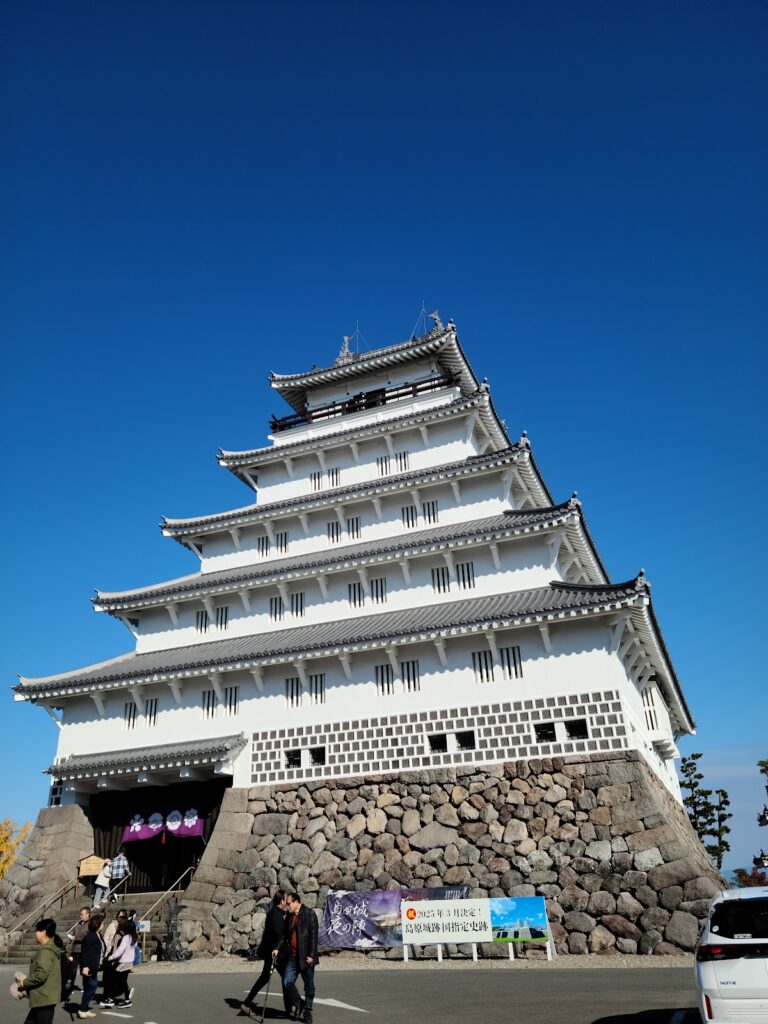
Kushima Castle (Omura City, Nagasaki Prefecture) Complete Guide: A Thorough Explanation from the History of the Coastal Castle to the Present-Day Omura Park
What is Kushima Castle?: The Complete Picture of the Coastal Castle Remaining in Omura City, Nagasaki Prefecture
Kushima Castle is a flatland castle built on a peninsula jutting out into Omura Bay, located in Kushima, Omura City, Nagasaki Prefecture. Also known as “Omura Castle,” it was constructed between 1598 and 1599 by Omura Yoshiaki, the first lord of the Omura Domain.
Taking advantage of its unique location surrounded by the sea on three sides, it functioned as the residence of the 27,000-koku Omura Domain for over 270 years. Currently, it is maintained as Omura Park and is a popular tourist spot, selected as one of “Japan’s Top 100 Cherry Blossom Viewing Spots.”
The castle’s most distinctive features are its structure, which draws seawater from Omura Bay into the moat, and its beautifully fan-shaped stone walls, built under the guidance of Kato Kiyomasa. Although many of the buildings were demolished following the Meiji Restoration’s decree abolishing castles, the stone walls, moats, and remains of the boat storage area still remain in good condition, allowing us to imagine the appearance of the castle as a coastal fortress in its heyday.
History of Kushima Castle: From Construction to the Meiji Restoration
Construction Process and Omura Yoshiaki
The construction of Kushima Castle was based on the strategic judgment of Omura Yoshiaki. Yoshiaki participated in the construction of Nagoya Castle and Katsumoto Castle on Iki Island during Toyotomi Hideyoshi’s invasion of Korea, and also experienced siege warfare in Korea. From this experience, he deeply understood the importance of castles that were easy to defend but difficult to attack.
Construction began at the end of Keicho 3 (1598) and was completed the following year, Keicho 4 (1599). Yoshiaki chose the location of Kushima, surrounded by the sea on three sides, and designed a castle that emphasized maritime traffic. This location selection is believed to have been strategically intended to control a key point in maritime traffic on Omura Bay.
Renovation under the guidance of Kato Kiyomasa
In 1614 (Keicho 19), during the reign of the second lord of the domain, Omura Sumiyori, a large-scale expansion and renovation project was carried out. It is said that during this time, guidance was received from Kato Kiyomasa, a renowned master of castle construction. Kiyomasa’s technical guidance resulted in the beautiful fan-shaped slope (curve) of the stone walls of Kushima Castle, which remains a major highlight of the castle today.
This slope of the stone walls not only provides aesthetic beauty but also serves a practical function to enhance defensive capabilities. The calculated curve, which makes it difficult for attackers to climb while maintaining the strength of the stone walls, demonstrates the high level of Kato Kiyomasa’s castle-building skills.
As the residence of the Omura domain
From its construction until the Meiji Restoration, Kushima Castle functioned as the residence of the Omura clan for over 270 years and twelve generations. The Omura Domain was a small domain with a 27,000 koku (unit of rice production) yield, but it was descended from the Omura Sumitada family, known as a Christian daimyo, and had deep ties to Nagasaki.
Throughout the Edo period, Kushima Castle served as the political and administrative center of the Omura Domain. The castle town also developed, and Omura flourished as a post town on the Nagasaki Kaido (Nagasaki Highway).
Meiji Restoration and Castle Abolition
With the abolition of the feudal domains in 1871 (Meiji 4), the Omura Domain was abolished, and Kushima Castle ceased to function. Due to the Meiji government’s decree to abolish castles, many of the castle buildings were demolished. Some structures, such as the wooden turret, remained, but a main keep was never built.
Currently, the remaining structures mainly consist of stone walls and moats, which are valuable relics that convey the appearance of an Edo-period coastal castle.
Structure and Characteristics of Kushima Castle
Layout as a Hilltop Castle
Kushima Castle is a hilltop castle built on the tip of a peninsula jutting out into Omura Bay. The castle grounds consist of a main keep (Honmaru), second bailey (Ninmaru), and third bailey (Sanmaru), arranged in a stepped layout.
The Honmaru was located at the highest point of the peninsula and housed the lord’s residence. The second and third baileys surrounded the Honmaru and housed the residences of retainers and administrative facilities.
Characteristics as a Coastal Castle
The most distinctive feature of Kushima Castle is that it is a coastal castle surrounded by the sea on three sides. Seawater from Omura Bay was drawn into the castle’s moat, creating a unique structure where the water level rose at high tide and fell at low tide.
This seawater-based moat not only prevented enemy intrusion but also facilitated the entry and exit of ships. A boathouse was located within the castle grounds, allowing for escape by sea or the transport of supplies in emergencies.
Characteristics as a Coastal Castle
The most distinctive feature of Kushima Castle is that it is a coastal castle surrounded by the sea on three sides. Seawater from Omura Bay was drawn into the castle’s moat, creating a unique structure where the water level rose at high tide and fell at low tide.
This seawater-based moat not only prevented enemy intrusion but also facilitated the entry and exit of ships. A boathouse was provided within the castle grounds, designed to allow for escape by sea or the transport of supplies in emergencies.
The Value of the Shipyard Ruins
The remaining shipyard ruins are an important historical site demonstrating the importance of maritime transportation at Kushima Castle. Located on the north side of the castle, the shipyard faced Omura Bay directly. It housed the domain’s official ships and warships, ensuring they could be deployed as needed.
The stone walls of the shipyard ruins are remarkably strong, withstanding erosion from seawater, demonstrating the high level of Edo-period castle construction techniques. Currently, these shipyard ruins are one of the castle’s highlights, attracting many castle enthusiasts.
The Beauty of the Stone Walls
The stone walls, built under the guidance of Kato Kiyomasa, are the greatest highlight of Kushima Castle. In particular, the stone walls around the main keep feature a beautiful fan-shaped slope (curve), creating an elegant curve known as the “fan slope.”
These stone walls exhibit multiple construction methods, including rough-hewn stonework, fitted stonework, and cut stonework, indicating that techniques varied depending on the construction and renovation periods. Observing the stone walls is a valuable opportunity to learn about the history of castle architecture.
Remains of the Large Dry Moat
The remains of a large dry moat also remain within the castle grounds. This dry moat was an important defensive structure separating the main keep and the second bailey, and it reached a depth of approximately 10 meters. Although parts of it have now been filled in, it is a valuable remains that allows us to imagine its former scale.
Kushima Castle Today: As Omura Park
Conversion to Omura Park
Since the Meiji era, the Kushima Castle site has been developed into a park. Currently, it serves as a place of relaxation for citizens as “Omura Park,” preserving the historical value of the castle site while also developing as a tourist destination.
Within the park, in addition to the castle remains, there is also the Omura Shrine. This shrine is built on the site of the castle keep and enshrines the successive lords of the Omura clan.
One of Japan’s Top 100 Cherry Blossom Viewing Spots
Omura Park is nationally renowned as a cherry blossom viewing spot, having been selected as one of “Japan’s Top 100 Cherry Blossom Viewing Spots.” The park boasts approximately 2,000 cherry trees, offering a magnificent cherry blossom spectacle in spring.
Of particular note is the “Omura Cherry,” a nationally designated natural monument. This Omura cherry tree is a rare variety in the world, with double petals ranging from 60 to as many as 200. Because it blooms later than Somei Yoshino cherry trees, visitors can enjoy the blossoms for an extended period, a unique feature of Omura Park.
A Famous Spot for Irises
Besides cherry blossoms, Omura Park is also known as a famous spot for irises. In June, approximately 300,000 irises bloom, and the “Omura Flower Festival” is held. The contrast between the castle ruins’ stone walls and the irises creates a beautiful landscape that captivates visitors.
Highlights of Kushima Castle
Itajiki Yagura (Plain Board Turret)
The Itajiki Yagura (Plain Board Turret) was one of the turrets that once stood within the castle grounds. While it is not a reconstruction, its site offers a panoramic view of Omura Bay, allowing visitors to experience the scenery of yesteryear.
Points to Observe the Stone Walls
When observing the stone walls of Kushima Castle, pay attention to the following points:
- The fan-shaped slope of the main keep’s stone wall: A beautiful curve reflecting the skills of Kato Kiyomasa
- The stone wall of the former boathouse: A strong construction designed to withstand seawater
- Differences in stacking techniques: Changes in techniques depending on the construction period
- Processing of corner stones: Exquisite stonework at the corners
Remains of the Moat
Parts of the moat, which drew in seawater, still remain. At low tide, the bottom of the moat is exposed, allowing for a clearer observation of its structure as a sea castle. Walking along the moat and imagining the defensive system of yesteryear is one way to enjoy the experience.
Omura Shrine
Omura Shrine, located on the site of the castle keep, is a shrine dedicated to the successive lords of the Omura clan. From the shrine grounds, you can see Omura Bay and experience the view that the former castle lords saw. In spring, the Omura cherry blossoms in the shrine grounds bloom beautifully.
The History of Kushima Castle and the Omura Clan
Omura Sumitada, the Christian Daimyo
Omura Yoshiaki, who built Kushima Castle, was the son of Omura Sumitada, known as Japan’s first Christian daimyo. Sumitada was baptized in 1563 and actively promoted the spread of Christianity within his domain. He also opened Nagasaki Port, indicating a deep connection between the Omura clan and Nagasaki.
Relationship with Nagasaki
As a domain adjacent to Nagasaki, the Omura domain was responsible for guarding Nagasaki throughout the Edo period. Guarding Nagasaki, the only gateway to the West under Japan’s isolationist policy, was a crucial role for the Omura Domain. Kushima Castle also functioned as a base for this Nagasaki defense.
Culture of the Omura Domain
Despite being a small domain, the Omura Domain cultivated its own unique culture. Influenced by the Christian era and its interactions with Nagasaki, a distinctive culture influenced by Western culture was formed. Furthermore, its food culture flourished, including Omura sushi and seafood from Omura Bay.
Traces of the Castle Town
Townscape of Omura
The town of Omura, which developed as a castle town of Kushima Castle, still retains traces of its past. Samurai residences, merchant buildings, temples, and shrines are scattered throughout, making it a great place to enjoy a historical stroll.
Nagasaki Highway and Post Town
Omura also prospered as a post town on the Nagasaki Highway. The Nagasaki Kaido was an important road connecting Nagasaki and Kokura, and was also used by the head of the Dutch trading post when he traveled to Edo. Omura-juku had a main inn and a secondary inn, and many travelers passed through.
Cultural Value
City-Designated Historic Site
The Kushima Castle ruins are a designated historic site of Omura City, and their historical value is recognized. The remains, such as the stone walls and moats, are valuable resources for studying Edo period castle architecture.
Designation of Omura Cherry Trees as a Natural Monument
The Omura cherry trees in Omura Park are designated as a national natural monument. These cherry trees are believed to have grown wild in Omura since the Edo period and are a botanically valuable variety.
Access
Access by Train
From JR Omura Line “Omura Station”:
- Approximately 15 minutes on foot
- Approximately 5 minutes by taxi
- Immediately after alighting at “Omura Park” bus stop (Nagasaki Prefectural Bus)
From Nagasaki Airport:
- Approximately 15 minutes by car
- Immediately after alighting at “Omura Park” bus stop (Nagasaki Prefectural Bus) (Approximately 20 minutes total)
Access by Car
- Approximately 10 minutes from Nagasaki Expressway “Omura IC”
- Approximately 15 minutes from Nagasaki Airport
- Approximately 30 minutes from Nagasaki City
Parking: Free parking available at Omura Park (approximately 500 spaces)
*Due to expected congestion during the cherry blossom season, we recommend using public transportation.
Opening Hours and Admission Fee
- Opening Hours: Always open (Omura Shrine is open only during the daytime)
- Admission Fee: Free
- Location: 1-chome, Kushima, Omura City, Nagasaki Prefecture
Nearby Tourist Attractions
Omura City Historical Museum
The historical museum, adjacent to Omura Park, exhibits materials related to the history of the Omura clan and Kushima Castle. You can also see castle models and excavated artifacts, making it an ideal facility for deepening your understanding of Kushima Castle.
Honkoji Street
Honkoji Street, where samurai residences once lined the castle town, still retains the atmosphere of that time. It’s a charming street with cobblestone paths and white-walled fences, perfect for a stroll.
Omura Bay
Omura Bay, viewed from Kushima Castle, is known as a calm inland sea. Many islands are scattered within the bay, allowing you to enjoy the beautiful archipelago scenery.
Best Season to Visit
Spring (Late March to May)
The cherry blossom season is the peak time to visit Kushima Castle. Somei Yoshino cherry blossoms begin to bloom in late March, and Omura cherry blossoms reach their peak in early April. The “Omura Flower Festival” is also held, attracting many tourists.
Early Summer (June)
June, when irises are in full bloom, is also a recommended time to visit. Approximately 300,000 irises adorn the castle ruins, offering a picturesque scene unique to the rainy season.
Autumn (November)
The autumn foliage season is also beautiful. There are fewer tourists than in spring, allowing for a leisurely stroll through the castle ruins.
Winter (December to February)
Winter, with fewer tourists, is an ideal season for carefully observing the remains such as the stone walls. On a clear day, you can see the mountains of Nagasaki across Omura Bay.
How to Enjoy Kushima Castle
For Castle Enthusiasts
Those interested in castles should pay attention to the following points when visiting:
- Observing the Stone Walls: Carefully observe the fan-shaped slope reflecting the techniques of Kato Kiyomasa.
- Exploring the Boat Warehouse Ruins: Valuable remains demonstrating its function as a coastal castle.
- Confirming the Layout: Stroll while confirming the arrangement of the main keep, second bailey, and third bailey.
- The Structure of the Moat: Understand the unique moat system that drew in seawater.
For Families
Kushima Castle Ruins, now developed as Omura Park, is a spot that families can enjoy:
- Viewing Cherry Blossoms and Irises: Enjoy seasonal flowers.
- Picnic in the Plaza: Spread out a lunch on the lawn.
- Learning History: Learn about the castle’s history with your children.
- View of Omura Bay: Relax while gazing at the sea.
For Photography Enthusiasts
Kushima Castle Ruins are also an attractive photography spot:
- Contrast between Cherry Blossoms and Stone Walls: A representative spring photography spot
- Irises and Castle Ruins: A charming early summer scene
- Details of the Stone Walls: Capturing architectural beauty
- Sunset over Omura Bay: The silhouette of the sea and castle ruins
Summary
Kushima Castle is a valuable historical site remaining in Omura City, Nagasaki Prefecture, as a coastal castle. Its unique location on a peninsula jutting out into Omura Bay, the beautiful stone walls designed under the guidance of Kato Kiyomasa, and the remains of a boathouse all convey the characteristics of a coastal castle, making it a valuable historical site.
Kushima Castle, which functioned as the residence of the Omura Domain for over 270 years, is now maintained as Omura Park and is a popular cherry blossom viewing spot, selected as one of “Japan’s Top 100 Cherry Blossom Viewing Spots.” This is an attractive tourist spot where you can enjoy seasonal flowers such as the Omura cherry blossoms (a nationally designated natural monument) and irises.
Kushima Castle Ruins, conveniently located near Nagasaki Airport, is a must-visit place when sightseeing in Nagasaki. Whether you’re a castle enthusiast, a family, or a photography aficionado, Kushima Castle offers a variety of ways to enjoy yourself. Why not experience the history of the Omura domain and the charm of this coastal castle?