Complete Guide to Kaerikumo Castle (Gifu Prefecture): The Truth Behind the Legend of the Phantom Castle and Buried Treasure That Vanished Overnight in the Tensho Earthquake
What is Kaerikumo Castle?: The Castle That Met the Most Dramatic End in Japanese History
Kaerikumo Castle (also known as Kaerikumo-jo or Kiun-jo) was a mountain castle located in Hokiwaki, Shirakawa Village, Ono District, Gifu Prefecture. It flourished as the residence of the Uchigashima clan, who ruled Shirakawa-go, a World Heritage site known for its Gassho-zukuri village. However, on November 29, 1585 (Tensho 13), the Great Tensho Earthquake caused a massive landslide on Mount Kaerikumo, burying the castle and its lord and his family overnight, leaving no trace.
Because of this dramatic end, it is known as the “phantom castle” and the “tragic castle,” and along with the legend of the vast treasure supposedly accumulated by the Uchigashima clan, it is remembered as a unique entity in the history of Japanese castles. The exact location of the castle ruins remains unknown, and this mystery continues to fascinate many history enthusiasts.
History of Kiun Castle: The Rise and Fall of the Uchigashima Clan
Construction and the Rise of the Uchigashima Clan
There are various theories regarding the construction date of Kiun Castle, but it is generally believed to have been built by Uchigashima Tameuji between the Kanshō era (1460-1466) and the Bunmei era (1469-1487). One theory suggests it was built in Kanshō 6 (1465).
The Uchigashima clan were local lords who ruled Ōno District in Hida Province, and are believed to have originally hailed from Mino Province. While based in the mountainous region of Shirakawa-gō, they owned abundant gold and silver mines in the area, accumulating immense wealth. Their wealth was known even in central politics, and records show that they donated a large sum of money to Ashikaga Yoshimasa during the construction of Ginkaku-ji Temple.
Kiun Castle and the Uchigashima Clan in the Sengoku Period
During the Sengoku period, Kiun Castle functioned as one of the important strongholds in Hida Province. The Uchigashima clan ruled this area for generations, solidifying their economic base through the management of the gold mines of Shirakawa-go. At that time, Hida Province was divided among several local lords, and the Uchigashima clan was one of them.
In 1585, when the forces of Kanamori Nagachika invaded Hida from Echizen, the then-lord of the castle, Uchigashima Ujimasa, surrendered without resistance. As a result, Kiun Castle temporarily came under the control of the Kanamori clan, but just a few months after this surrender, they would face their fateful day.
Catastrophic Damage from the Tensho Earthquake
On November 29, 1585 (January 18, 1586 AD), a massive earthquake, estimated to have a magnitude of 7.8 to 8.0, struck the Hokuriku and Tokai regions. This Tensho earthquake (Tensho Earthquake) is believed to have been caused by the simultaneous action of multiple faults, resulting in extensive and devastating damage across a wide area including Hida, Mino, Etchu, Kaga, and Omi provinces.
At Mount Kiun, where Kiun Castle stood, the earthquake’s shaking caused a massive landslide. The current Sanpo-kuzureyama is considered the site of this landslide, with an estimated 3 million cubic meters or more of earth and debris instantly filling the valley. This landslide buried the main keep of Kiun Castle, the castle town, and hundreds, even over a thousand, of the lord Uchigashima Ujizane, his family and retainers, as well as the local inhabitants, resulting in their instantaneous annihilation.
Historical documents such as the *Hoan Nobunaga-ki* describe this disaster as follows: “At Kiun Castle in Hida Province, the castle lord, a man named Uchijima, and several thousand people in the castle town were buried and lost without a trace when the mountain collapsed.”
Description in the Kaizuka Gozasho Nikki
The *Kaizuka Gozasho Nikki* is a valuable historical document that conveys the extent of the damage caused by the Tensho earthquake. This diary was preserved at the Kaizuka Gozasho of Honganji Temple (Kaizuka City, Osaka Prefecture) and records the situation at the time in detail.
According to this diary, the earthquake occurred in the middle of the night (around 10 PM, the hour of the boar), and aftershocks continued until the following morning. Regarding the damage in Hida Province, it is recorded that “Kiun Castle in Hida Province, the lord of the castle, a man named Uchijima, and thousands of people in the castle town were buried and lost without a trace when the mountain collapsed,” indicating that the catastrophic damage to Kiun Castle made a strong impression on people at the time.
Furthermore, records show that castles and settlements in various regions, such as Kibune Castle in Etchu Province (Toyama Prefecture) and Nagahama Castle in Omi Province (Shiga Prefecture), were also damaged, indicating that the Tensho earthquake was a widespread disaster.
Location and Structure of Kiun Castle
Geographical Location
Kiun Castle is believed to have been located at the foot of Mt. Mikatakuzure in the Hokiwaki district of Shirakawa Village, Ono District, Gifu Prefecture. Shirakawa-go is located in a particularly rugged mountainous area of the Hida Mountains, with settlements scattered in a basin-like topography along the Shogawa River.
The exact location of Kiun Castle remains unknown because it was completely buried by a landslide. However, based on the landslide topography of Mt. Mikatakuzure, local legends, and place names, it is presumed to have been located on the western slope of Mt. Kiun (Mt. Mikatakuzure), east of the Hokiwaki settlement.
Estimated Castle Structure
The specific layout and structure of Kiun Castle are unknown due to the loss of remains caused by burial. However, based on the general characteristics of mountain castles in the Hida region during the Sengoku period and the few remaining records, it is presumed to have had the following structure:
- Main Enclosure (Honmaru): The lord’s residence located on the mountainside of Kiunzan.
- Group of Enclosures: Multiple enclosures arranged around the main enclosure.
- Castle Town: Samurai residences and merchant districts formed on the flat land at the foot of the mountain.
- Defensive Facilities: Defensive structures such as moats, earthworks, and stone walls (details unknown).
The Uchigashima clan possessed considerable wealth, so it is believed that the castle was reasonably well-maintained for its time. However, given its nature as a mountain castle in Hida, it is presumed to have retained the form of a medieval mountain castle, different from the early modern castles with large stone walls and keeps.
Current State of Mikata-kuzureyama
Mikata-kuzureyama still bears the traces of the massive landslide caused by the Tensho earthquake. The mountain slopes collapsed on a large scale, and as its name suggests, it is a “mountain that collapsed in three directions,” conveying the ferocity of natural disasters to the present day.
It has also been suggested that the collapsed earth and debris filled the Shogawa River valley, temporarily forming a natural dam. The subsequent collapse may have caused further damage in the downstream areas, indicating the scale of the disaster.
Currently, access to some areas around Mt. Mikata-kuzure is restricted, and safety precautions are being taken due to the unstable terrain caused by the collapse.
Legend of Buried Treasure: The Lost Treasure of the Uchigashima Clan
Legendary Content
Kiun Castle is home to a magnificent treasure legend, considered one of Japan’s three greatest buried treasure legends. It tells of the vast gold and silver treasures accumulated by the Uchigashima clan through their operation of the gold and silver mines in Shirakawa-go, which were buried deep underground along with the castle in a landslide caused by the Tensho earthquake.
According to the legend, the total value of the buried treasure is said to be in the hundreds of billions to trillions of yen in modern value. Specifically, the following treasures are believed to have been found:
- Large quantities of gold and silver ingots
- Coins such as koban and senji
- Gold and silver bars
- Jewelry and works of art
- Masterpieces such as tea ceremony utensils
In particular, given that the Uchigashima clan possessed enough wealth to make donations to the Ashikaga shogunate, it is believed that they undoubtedly possessed a considerable amount of precious metals.
Basis of the Legend
There are several reasons why the buried treasure legend is not merely a fantasy but is told with a certain degree of credibility.
First, it is a historical fact that the Uchigashima clan actually operated a gold mine. Several gold mine sites remain in Shirakawa-go, and it is believed that they produced a considerable amount of gold during the Sengoku period. Records of donations to the construction of Ginkaku-ji Temple by Ashikaga Yoshimasa also support their wealth.
Secondly, it is conceivable that the sudden occurrence of the Tensho earthquake left no time to retrieve the treasure. Due to the earthquake that struck in the middle of the night, the castle and its surrounding town were instantly buried, making it highly likely that the gold and silver treasures were sealed underground.
Furthermore, numerous local folk tales remain, such as “a golden rooster crows” and “something shiny is buried there,” and the belief that some kind of treasure is buried has been passed down through generations.
Attempts at Excavation and Current Status
Attracted by the legend of buried treasure, numerous attempts at excavation have been made from the Edo period to the present day.
Records show that the Kaga Domain and the shogunate showed interest and conducted investigations during the Edo period. Even after the Meiji era, searches by individuals and groups continued intermittently, but none yielded any results.
Even today, while investigations using the latest technologies such as metal detectors and ground-penetrating radar are being attempted, excavation remains extremely difficult for the following reasons:
- Depth of Burial: It is estimated to be covered by tens to over 100 meters of soil and debris.
- Precise Location Unknown: The exact location of the castle has not been determined.
- Unstable Topography: The collapsed terrain remains unstable, making large-scale excavation dangerous.
- Legal Restrictions: Restrictions from the perspective of cultural property protection laws and nature conservation.
- Technical Difficulties: Removing large amounts of soil and debris would require enormous costs and time.
For these reasons, it is believed that the buried treasure still lies dormant deep underground, stimulating the imagination of many as a “phantom treasure.”
Present State of Kiumo Castle: Preservation and Utilization as a Historic Site
Status of Designation as a Historic Site
Kiumo Castle ruins are recognized as a cultural property of Shirakawa Village due to their historical importance. However, because the remains are completely buried, the same kind of historical site development as typical castle ruins has not been carried out.
The area around Mikata-kuzureyama is considered a geologically valuable site as it bears the traces of a large-scale landslide caused by the Tensho earthquake, and its value as a place that conveys lessons from natural disasters is also recognized.
Local Information and Access
The Hokiwaki district of Shirakawa Village, the estimated site of the Kiun Castle ruins, can be accessed via the following routes:
Access by Car
- Approximately 10 minutes from the Shirakawa-go Interchange on the Tokai-Hokuriku Expressway
- Head north on National Route 156, passing through the Shirakawa-go Gassho-zukuri village
Public Transportation
- Approximately 50 minutes by Nohi Bus from Takayama Station, alight at the Hokiwaki bus stop
- Approximately 75 minutes by Hokuriku Railway Bus from Kanazawa Station, alight at the Hokiwaki bus stop
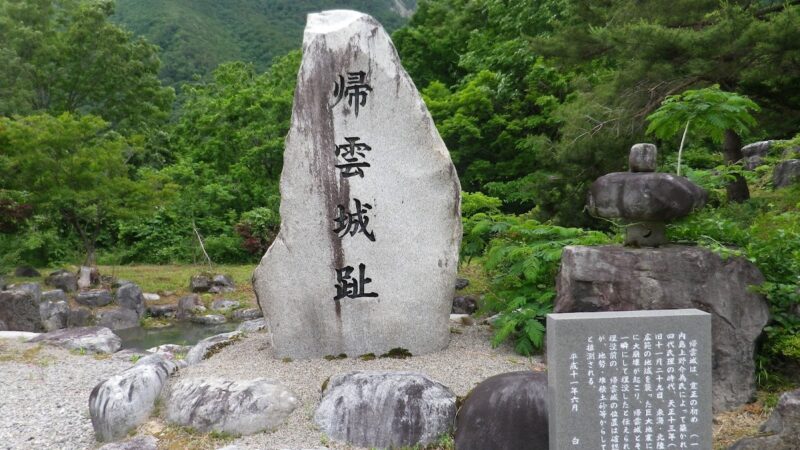
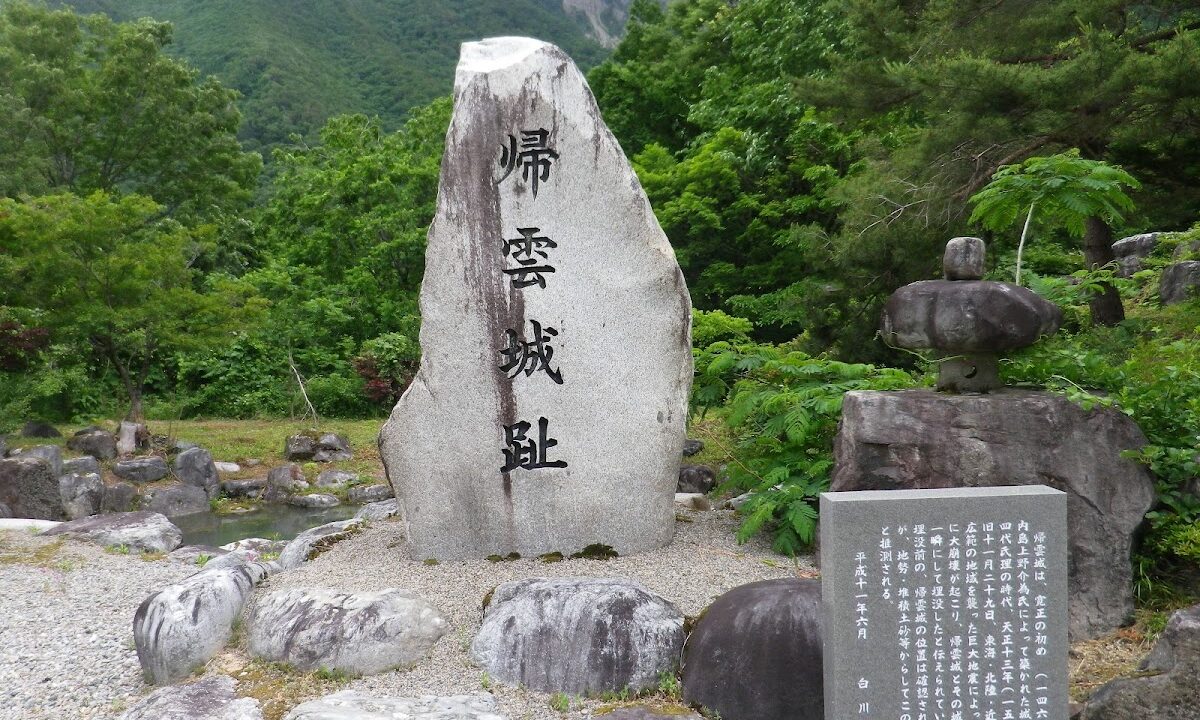
At the site, there are information boards and explanatory signs indicating the Kiun Castle ruins, and you can see the landslide terrain of Mt. Mikata-kuzure from a distance. However, access to the landslide area is restricted due to the danger.
Combining with Shirakawa-go Sightseeing
The Kiun Castle ruins are located just a few minutes’ drive from the Shirakawa-go Gassho-zukuri village, a World Heritage Site, and can be visited in combination with Shirakawa-go sightseeing.
In Shirakawa-go, you can visit traditional gassho-zukuri style buildings, and there are also facilities that introduce the history and culture of Shirakawa-go, such as the “Shirakawa-go Hirase Onsen Shirayumi Ski Resort” and “Shirakawa-go no Yu” hot spring. Learning about the history of Kiun Castle will give you a deeper understanding of Shirakawa-go’s historical background.
Research and Historical Materials on Kiun Castle
Major Historical Materials
Historical materials concerning Kiun Castle and the Uchigashima clan are limited, but descriptions can be found in the following documents:
- “Hoan Nobunaga-ki”: Records the damage to Kiun Castle caused by the Tensho earthquake
- “Kaizuka Gozasho Nikki”: Includes a detailed record of the Tensho earthquake
- “Hishu-shi”: A local history of Hida Province from the Edo period, describing the Uchigashima clan
- “Shirakawa-mura Shi”: A local history detailing the history of Shirakawa Village
- “Uchigashima Ujiri Gunki”: A military chronicle recounting the achievements of the Uchigashima clan (its historical value is debatable)
From these materials, we can learn about the lineage of the Uchigashima clan, an overview of Kiun Castle, and the extent of the damage caused by the Tensho earthquake.
Archaeological Investigation
Due to the depth of burial and the instability of the topography, a full-scale archaeological investigation of the Kiun Castle site has not been conducted. However, archaeological excavations and geological surveys in the surrounding area have yielded the following findings:
- Estimation of the scale and extent of landslides caused by the Tensho earthquake
- Confirmation of medieval gold mine sites in Shirakawa-go
- Investigation of temple sites and burial grounds related to the Uchigashima clan
Future advances in non-destructive testing techniques may allow for the confirmation of underground structures, and new discoveries are anticipated.
Research Books and Papers
Major research works concerning Kiun Castle and the Uchigashima clan include the following:
- Various volumes of “Gifu Prefecture History” edited by the Gifu Prefecture History Compilation Committee
- “Shirakawa Village History” edited by the Shirakawa Village History Compilation Committee
- Various papers by the Hida Historical Society
- Research papers on the Tensho earthquake in the fields of seismology and geology
Through these studies, the historical positioning of Kiun Castle and the actual circumstances of the Tensho earthquake are gradually becoming clearer.
Related Books
Here are some recommended books for learning about Kiun Castle, the Uchigashima clan, and the Tensho Earthquake:
General Public Books
- “The Vanished Castle: The Mystery of Kiun Castle” (Fictitious Title): Explains the entirety of Kiun Castle, including the legend of buried treasure.
- “The Mystery of the Tensho Great Earthquake”: Detailes the damage caused by the Tensho Earthquake and the destruction of Kiun Castle.
- “Mountain Castles of Hida”: Comprehensively introduces medieval castles in the Hida region, and provides detailed information on Kiun Castle.
- “History and Culture of Shirakawa-go”: Explains the role of the Uchigashima clan in the history of Shirakawa-go.
Academic and Specialized Books
- “Comprehensive Survey Report of Medieval Castle Sites in Gifu Prefecture”: A scholarly survey report of medieval castles in Gifu Prefecture.
- “History of the Tensho Great Earthquake”: A specialized book compiling historical materials and research on the Tensho Earthquake.
- “Studies on the Local Lords of Hida Province”: Analyzes the history of local lords in Hida Province, including the Uchigashima clan.
- “Archaeology of Medieval Mines”: Research on medieval mines, including the gold mine ruins of Shirakawa-go.
Related Castle and History Books
- “Castles of Japan: Chubu Region”: Comprehensively introduces castles in the Chubu region.
- “Castles of the Warring States Period”: Explains castle architecture and defensive techniques of the Warring States period.
- “Earthquakes and Japanese History”: Examines the impact of major historical earthquakes on society.
Through these books, you can gain a deep understanding of the historical background of Kumo Castle and the impact of the Tensho Earthquake, a natural disaster, on society during the Warring States period.
Summary: The Lessons of History Told by the Phantom Castle
Kimo Castle is a tragic castle that vanished from history overnight due to the Tensho Earthquake, a natural disaster. The splendor and immense treasures built by the Uchigashima clan are all buried deep underground, and even today, their exact location remains unknown.
However, this “phantom castle” speaks volumes to us: the terror of natural disasters, the transience of human endeavors, and the imagination we must contemplate what has been lost in history. Along with the romance of the buried treasure legend, Kiun Castle continues to hold a special place in the history of Japanese castles.
When visiting Shirakawa-go, a World Heritage site, why not reflect on the history of the Uchigashima clan, who once flourished in this land, and the story of Kiun Castle, which vanished in an instant? Gazing at the landslide landscape of Mount Mikata-kuzure, imagining the disaster that occurred over 400 years ago and the people who lived through it will be a valuable historical experience even for us living today.
Kiun Castle, though its remains are gone, may be a truly “immortal castle,” its story and lessons still living on in our hearts.