Kuji Castle (Kuji City, Iwate Prefecture) Complete Guide: A Sengoku Period Mountain Castle and the History of the Kuji Clan
Kuji Castle ruins are a Sengoku period mountain castle located in the Shinmachi district of Okawame-cho, Kuji City, Iwate Prefecture. Known as the ancestral residence of the Kuji clan, who ruled the Kuji region, it was designated an Iwate Prefecture Historic Site on April 8, 2022. The castle’s structure is well-preserved, making it a valuable resource for the study of medieval castles in the Tohoku region.
History of Kuji Castle and the Kuji Clan
Establishment and Development of the Kuji Clan
The Kuji clan was a family of samurai who ruled the Kuji region from the late Heian period to the Sengoku period. Believed to be descended from the Minamoto clan, they established a power base in this area from the Kamakura period onward. The Kuji clan ruled this land for generations, growing into a powerful local clan.
Construction of Kuji Castle
Kuji Castle is believed to have been built by Kuji Bizen-no-kami Nobuzane, the adopted son of Kuji Shuri-no-suke Harumasa and the 12th head of the family. However, there are various theories regarding the exact construction date, and it is not definitively established. During the Sengoku period, it functioned as the base of the Kuji clan and was the political and military center of the Kuji region.
The Kunohe Masazane Rebellion and Kuji Castle
The most important event in the history of Kuji Castle is the “Kunohe Masazane Rebellion,” which occurred in 1591. The then-lord of the castle, Kuji Bizen-no-kami Naoji, had taken Nakatsukasa Masanori, the third son of Kunohe Nobunaka, as his son-in-law. Due to this marital relationship, Kuji Naoji decided to side with Kunohe Masazane and holed up in Kunohe Castle.
This rebellion is known as the final battle of Toyotomi Hideyoshi’s unification of Japan and symbolized the end of the Sengoku period in the Tohoku region. After the rebellion was suppressed, the Kuji clan lost their territory, and it is believed that Kuji Castle was abandoned.
Structure and Layout of Kuji Castle
Basic Structure of the Castle
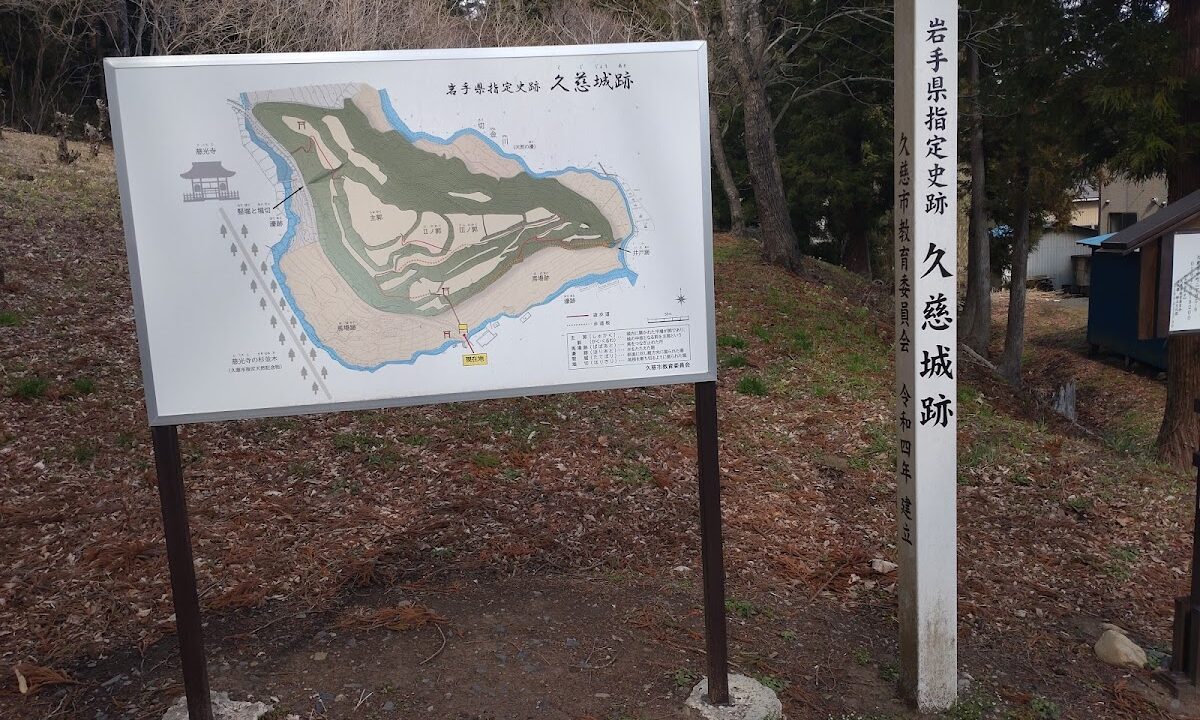
Kuji Castle has the typical form of a medieval mountain castle, characterized by defensive facilities that skillfully utilize the natural terrain. The castle ruins consist of multiple enclosures (kuruwa), and the Shinmachi-kan and Yoka-kan are identified as the main parts.
Shinmachi-kan
Shinmachi-kan was the central enclosure of Kuji Castle and is presumed to have been the residence of the castle lord. The flat terrain remains today, allowing us to imagine the layout of the buildings at the time. Traces of earthworks and moats can be seen around it, indicating that it was a structure with defensive functions.
Yoka-kan
Yoka-kan was an enclosure adjacent to Shinmachi-kan and is thought to have been used as the residence of senior retainers or a garrison for soldiers. These two enclosures worked together to enhance the overall defensive strength of the castle.
Horse Training Ground Remains
The remains of a horse training ground also remain within the castle ruins. In castles during the Sengoku period (Warring States period), the horse training grounds (baba) were important facilities for training samurai. The remains of the horse training grounds at Kuji Castle are relatively well-preserved, offering a glimpse into the lives of the samurai of that time.
Moats and Earthworks
Multiple moats (defensive structures created by cutting through mountain ridges) and earthworks have been identified at Kuji Castle. These were important defensive structures to prevent enemy intrusion and are valuable relics demonstrating the castle-building techniques of the Sengoku period. The depth of the moats and the height of the earthworks provide insight into the level of castle-building technology at the time.
Highlights of Kuji Castle Ruins
Well-Preserved Remains
The greatest appeal of Kuji Castle Ruins is the well-preserved structure of the castle from the Sengoku period. Having escaped the waves of development, the original topography has been preserved almost entirely, earning high praise from castle researchers. Visiting the site allows you to experience the appearance of a Sengoku period castle firsthand.
Aerial Photographs of Kuji Castle Ruins
Aerial photographs of Kuji Castle Ruins clearly reveal the overall layout and ingenious design of the castle grounds. You can understand the complex structure, including the interconnected baileys and defensive lines utilizing the natural terrain, which are difficult to grasp from ground level.
Seasonal Scenery
Kuji Castle Ruins offers beautiful scenery that changes with the seasons. It displays different faces in each season: fresh greenery in spring, deep green in summer, vibrant autumn leaves, and snowy landscapes in winter. It’s a valuable spot where you can enjoy both historical exploration and nature observation.
Kuji Castle’s Gojoin (Castle Seal)
In recent years, the distribution of Gojoin (castle seals) has become popular at castles throughout Japan. Gojoin are stamps obtained as a memento of visiting a castle, modeled after the Goshuin (temple/shrine seals).
Interest in Kuji Castle’s Gojoin is also growing among castle enthusiasts and history buffs. The city of Kuji and the local tourism association are working to raise awareness of the historical value of Kuji Castle, and there is a possibility that castle stamps will be distributed in the future. We recommend checking the latest information on the Kuji City official website or at the tourist information center before your visit.
Visitor Guide: Access and Visiting Information for Kuji Castle Ruins
Access Methods
Access by Car
- Approximately 10 minutes from the center of Kuji City
- Via Prefectural Road from National Route 45
- Parking space is limited, so please be careful.
Public Transportation
- Approximately 15 minutes by taxi from JR Hachinohe Line Kuji Station
- Also accessible from Sanriku Railway Kuji Station
Visiting Information
Kuji Castle Ruins can be freely visited. There are no entrance fees or restrictions on opening hours, but please note the following points as it is a mountain castle:
- Comfortable walking shoes are recommended.
- The ground can be slippery in rainy weather and during winter.
- Insect repellent is recommended (especially in summer).
- Bring your own drinking water.
Estimated Visiting Time
If you want to thoroughly explore the entire castle ruins, please allow approximately 1 to 1.5 hours. If you only want to see the main remains, 30 minutes may suffice.
Kuji City Tourist Information
When visiting Kuji Castle Ruins, we recommend also visiting other tourist spots in Kuji City.
Kuji Amber Museum
Kuji City is known as the largest amber producing area in Japan. At the Kuji Amber Museum, you can learn about the history of amber, mining methods, and beautiful amber products.
Kosode Ama Center
This facility allows you to experience the ama (female diver) culture of Kuji, known as the “northernmost ama.” The ama demonstration (summer only) is a must-see.
Kuji Underground Aquarium Science Museum Moguranpia
This aquarium, which recovered from the Great East Japan Earthquake, is a unique facility located underground. It exhibits marine life from the Sanriku region.
Sanriku Railway
You can enjoy the beautiful scenery of the Sanriku coast by riding the Sanriku Railway, famous as the setting for the drama “Amachan.”
Cultural Value of Kuji Castle Ruins
Designation as an Iwate Prefecture Historic Site
On April 8, 2022, the Kuji Castle Ruins were designated as an Iwate Prefecture Historic Site. This designation was based on the following evaluations:
- Excellent State of Preservation: The castle structure from the Sengoku period remains almost completely intact.
- Historical Significance: The history of the Kuji clan and its role in the Kunohe Masazane Rebellion.
- Academic Value: Valuable material for the study of medieval castles in the Tohoku region.
- Regional Historical Heritage: An important cultural property that tells the history of Kuji City.
Future Preservation and Utilization
With the designation as a prefectural historical site, it is expected that efforts toward the preservation and utilization of the Kuji Castle ruins will be further advanced. Kuji City is working to create an environment where visitors can safely view the site, including the installation of information boards and the development of walking paths.
Sengoku History of the Kuji Region and Surrounding Castles
Relationship with Kunohe Castle
Kuji Castle has a deep relationship with Kunohe Castle. As mentioned above, Kuji Naoharu holed up in Kunohe Castle during the Kunohe Masazane Rebellion, and it is believed that these two castles were also militarily coordinated. Kunohe Castle is also a nationally designated historical site, and visiting both will allow you to gain a deeper understanding of the history of the Kuji region during the Sengoku period.
Relationship with the Nanbu Clan
The Kuji clan maintained a degree of independence despite being under the influence of the Nanbu clan. The history of Kuji Castle provides important clues to understanding the complex power dynamics in the Tohoku region during the Sengoku period.
Points for a Historical Walk at Kuji Castle Ruins
Using Maps
When visiting Kuji Castle Ruins, it is recommended to obtain a map in advance. The Iwate Prefectural Buried Cultural Properties Center and the Kuji City website publish detailed maps of the castle ruins. Checking the locations of the main remains before visiting will allow for a more fulfilling visit.
Photography Tips
While it’s difficult to obtain an aerial view of the castle ruins, the views from each enclosure and the remains such as earthworks and moats are suitable for photography. Especially during the autumn foliage season, you can capture photographs that harmonize historical scenery with natural beauty.
Utilizing Information Boards
Information boards are installed within the castle ruins, providing explanations of each structure and its historical background. Reading these while exploring the site deepens your understanding of Kuji Castle.
Current Status and Future Prospects of Kuji Castle Research
Archaeological Excavations and Research
Multiple surveys have been conducted at the Kuji Castle site, revealing the detailed structure of the castle. However, full-scale archaeological excavations have been limited, and many aspects remain unexplained.
Future academic research is expected to proceed based on the preservation and utilization plan for the site as a prefecturally designated historical site. Archaeological excavations may reveal more concrete details about the Kuji clan’s life and the castle’s functions through the layout of buildings and excavated artifacts.
Local History Education
The Kuji Castle site is also used as a place for local history education. Elementary and junior high schools in Kuji City provide opportunities for students to visit the Kuji Castle site as part of their local history studies. Such initiatives play an important role in passing on the region’s historical heritage to future generations.
Summary: The Charm of Kuji Castle and the Significance of Visiting It
Kuji Castle ruins are a valuable historical site with a well-preserved castle structure from the Sengoku period (Warring States period). This castle occupies an important position within the historical context of the Kuji clan’s history, its connection to the Kunohe Masazane Rebellion, and the end of the Sengoku period in the Tohoku region.
Its designation as an Iwate Prefecture Historic Site officially recognizes its cultural value, and further preservation and utilization are expected. When visiting Kuji City, be sure to visit Kuji Castle ruins and reflect on the history of the Kuji region during the Sengoku period.
Walking through the castle ruins, where the topography of the time remains almost unchanged, allows you to experience living history that cannot be found in textbooks. A stroll while feeling the history of Kuji amidst the beauty of nature in each season will surely leave visitors with a profound impression.