Complete Guide to Kokubuyama Castle (Imabari City, Ehime Prefecture): The Charm of the Kono Clan’s Mountain Castle and the Imabari Domain Lord’s Mausoleum Built on Karakoyama Mountain
Kokubuyama Castle, located in Furukokubu, Imabari City, Ehime Prefecture, is a medieval mountain castle built on Karakoyama Mountain, which rises from 105.3 to 106 meters above sea level. Also known as “Kokufu Castle” and “Karakoyama Castle,” it played an important role as a branch castle of the Kono clan, a powerful local family of Iyo Province. Currently, it is maintained as a park, and the mountaintop offers a spectacular panoramic view of the Imabari Plain, the Geiyo Islands, and the Hiuchi Sea.
This article comprehensively covers information useful for both castle enthusiasts and first-time visitors, from the history of Kokubuyama Castle, its castle structure, highlights, access methods, and surrounding tourist information.
The History of Kokubuyama Castle: From the Kono Clan to the Conquest of Shikoku and its Abandonment
A Mountain Castle Built by the Kono Clan in the Land of the Iyo Provincial Capital
Kokubuyama Castle is located in Furukokubu, Imabari City. As its name suggests, this is a historically important area where the Iyo Provincial Capital is believed to have been located during the Nara period. The Furukokubu area is a very narrow plain, bordered by Karakohama Beach to the east and immediately by Kokubuyama (Karakoyama) to the west.
The exact construction date of Kokubuyama Castle is unclear, but it is believed that the Kono clan, a powerful local family in Iyo Province during the medieval period, built a mountain castle and a residence at the eastern foot of the mountain in this strategically important location. The Kono clan was a leading samurai family in Iyo Province and an important force controlling maritime traffic in the Seto Inland Sea.
Although Karakoyama is a low mountain with an elevation of 105-106m, its relative height is approximately 90m, providing sufficient height to overlook the surrounding plains. Located at the point where the sea meets the plains, this castle played a crucial role in monitoring maritime traffic and controlling a key point on land routes.
The Shikoku Campaign of 1585 and Kokubuyama Castle
The most important event in the history of Kokubuyama Castle is the Shikoku Campaign of 1585. During Toyotomi Hideyoshi’s military campaign to unify Shikoku, Kokubuyama Castle was caught in the crossfire.
At the time, when attacked by the Mori clan, the lord of Kokubuyama Castle reportedly showed a lack of fighting spirit. This response angered Kobayakawa Takakage of the Toyotomi side, leading to an attack by his forces. Kobayakawa Takakage’s army included powerful generals such as Fukushima Masanori and Ogawa Suketada, and faced with an overwhelming difference in military strength, Kokubuyama Castle was forced to surrender.
During the conquest of Shikoku, Kobayakawa Takakage’s advance route involved capturing several castles within Iyo Province, and Kokubuyama Castle was one of its important targets.
Construction of Imabari Castle and Abandonment of Kokubuyama Castle by Todo Takatora
After the conquest of Shikoku, a new system of rule under the Toyotomi regime was established in Iyo Province. Following the Battle of Sekigahara in 1600, Todo Takatora, a trusted confidant of Tokugawa Ieyasu, was appointed to Imabari in Iyo.
Known as a master castle builder, Todo Takatora began construction of Imabari Castle, a new modern castle. Imabari Castle was a flatland castle built on the coast, designed as a sea castle with a moat filled with seawater. With the completion of Imabari Castle, Kokubuyama Castle, a medieval mountain castle, ceased its role and was abandoned.
The construction of Imabari Castle by Takatora symbolized the transition from medieval to early modern castles, and Kokubuyama Castle became a historical site embodying this turning point.
From the Early Modern Period Onward: Karakoyama as the Mausoleum of the Imabari Domain Lords
After the castle was abandoned, Karakoyama came to be used as the mausoleum of the Imabari domain lords in the early modern period. The mausoleum of the Imabari domain lords is located on the mountainside of Karakoyama, and the tombstones are all massive 3.6m tall Hōkyōintō pagodas, designated as a historical site by Ehime Prefecture.
Karakoyama, where the ruins of a medieval mountain castle and the mausoleum of the domain lords coexist, is a valuable historical site that conveys the multi-layered history of Imabari. Currently, it is maintained as a park, serving as a place of relaxation for citizens and a fascinating location for history enthusiasts.
Layout and Structure of Kokubuyama Castle: A Group of Enclosures Extending North-South
A Set Structure of a Mountain Castle and Residence
Kokubuyama Castle is a fortress complex consisting of a mountain castle built on the summit of Mt. Karako and a residence located at the eastern foot of the mountain. This structure is typical of medieval mountain castles, where administrative affairs and daily life were conducted at the residence at the foot of the mountain during peacetime, and the mountain castle was used as a defensive stronghold during wartime.
The mountain castle section features enclosures spread along a ridge extending north-south, with particularly extensive enclosures on the northern ridge. This arrangement is thought to be a defensive design that took into account attacks from the Imabari Plain.
Structure of the Main Enclosure (Honmaru)
The main enclosure (Honmaru) is located on the summit of Mt. Karako, at an elevation of 105.3m. Currently, it is maintained as a park and is a plaza-like area, but in the past, it functioned as the lord’s final defensive base.
The view from the main enclosure is spectacular, offering panoramic views of the Imabari Plain to the northwest, the Geiyo Islands to the north, the Hiuchi Sea below to the east, and Setayama Castle and Einoyama Castle to the south. This excellent visibility was extremely important for military surveillance.
Enclosures and Defensive Structures
Kokubuyama Castle is believed to have had several enclosures (kuruma) along the north-south ridge. Traces of earthworks and moats can be seen at the site, preserving the defensive structure of a medieval mountain castle.
While some stone walls can be seen, it is thought that the defensive structure was primarily based on earthworks rather than full-fledged stone walls. This is characteristic of medieval mountain castles, differing from the high stone walls of early modern castles.
The relative height of approximately 90 meters was a significant obstacle for attackers, and combined with the steep terrain, it created a strong defense.
Relationship with the Karakoyama Tumulus Cluster
The area around Karakoyama is known as the Karakoyama Tumulus Cluster, and numerous remains from the Kofun period (Tumulus period) are scattered throughout. It’s possible that the topography of these tumuli was utilized during the construction of the medieval castle, allowing us to feel the layered history spanning from ancient to medieval and early modern times.
Highlights of Kokubuyama Castle: Castle Remains and Scenic Viewpoints
360-Degree Panoramic View from the Main Enclosure
The greatest highlight of Kokubuyama Castle is undoubtedly the view from the main enclosure (mountaintop). This spot, offering panoramic views of the sea, mountains, and city in all directions, is popular not only with castle enthusiasts but also with hikers and mountain climbers.
- Northwest Direction: A panoramic view of the Imabari Plain and the city. The location of Imabari Castle, built by Todo Takatora, can also be confirmed.
- North: The islands of the Geiyo Islands floating in the Seto Inland Sea are beautifully lined up.
- East: The Hiuchi Sea stretches out below, and the coastline of Karakohama forms a beautiful curve.
- South: The ruins of surrounding mountain castles, such as Setayama Castle and Einoyama Castle, can be seen in the distance.
This excellent view indicates its importance as a military surveillance function.
Traces of Earthworks and Moats
Even now, as a park, traces of earthworks and moats can be seen with careful observation. In particular, remnants of the defensive structure from that time can be seen at the boundaries of the baileys and on the cliffs of the ridges.
The defensive structure, primarily based on earthworks, which is characteristic of medieval mountain castles, shows a different technological system from the stone walls of early modern castles, and is valuable material for learning about the changes in castle history.
Imabari Domain Lord’s Mausoleum (Prefectural Designated Historic Site)
The mausoleum of the Imabari Domain lord, located on the slopes of Mt. Karako, is protected as an Ehime Prefecture designated historic site. The massive 3.6-meter-tall Hōkyōintō pagoda is impressive and conveys the authority of the feudal lord of the early modern period.
The coexistence of the medieval mountain castle ruins and the early modern domain lord’s mausoleum on the same mountain symbolizes the historical layering of Mt. Karako, allowing visitors to feel a connection to history across time.
Hiking Trails and Maintenance Status
Mt. Karako has two trailheads, one on the sea side and the other on the land side, next to Torigoe Pond. The trails are relatively well-maintained, and the summit can be reached in about 30 minutes, making it easily accessible.
As it is developed as a park, information boards and rest areas are installed, creating a comfortable environment for even history novices.
Access, Parking, and Visiting Information
Basic Information
- Location: 3 Furukokubu, Imabari City, Ehime Prefecture (Karakoyama)
- Castle Classification: Hilltop Castle (Set of mountain castle and residence)
- Elevation: 105.3-106m
- Relative Height: Approximately 90m
- Estimated Visiting Time: 30 minutes to 1 hour
- Admission Fee: Free
- Visiting Hours: Always open
Access Methods
Access by Car
- Approximately 15 minutes from Imabari IC
- Access via Prefectural Road from National Route 196
- Search for “Karakoyama Park” or “Furukokubu, Imabari City” in your car navigation system
Access by Public Transportation
- Approximately 20 minutes on foot from JR Yosan Line “Iyo-Sakurai Station”
- Setouchi Bus available (walking distance from the nearest bus stop)
Parking and Restroom Information
There is a parking lot and restrooms near Torigoe Pond, just before the castle entrance. An information board is also installed, allowing you to understand the castle’s overview before visiting.
Parking is free and has space for several regular-sized cars. However, it can get crowded during cherry blossom season and on holidays, so we recommend visiting earlier in the day.
Points to Note When Visiting
- As it is a mountain castle, please wear comfortable shoes and clothing.
- In summer, we recommend bringing insect repellent and drinking water.
- Be careful as the ground can be slippery during and after rain.
- There is little shade at the summit, so don’t forget a hat and sun protection.
- In winter, it can be windy, so please take precautions against the cold.
Castles to Visit Along with Nearby Tourist Spots
Imabari Castle (One of Japan’s Three Great Water Castles)
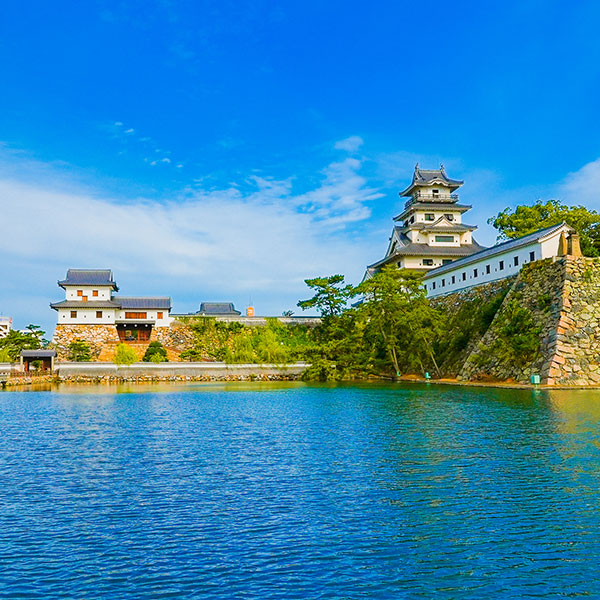
Imabari Castle, built by Todo Takatora, is a modern castle constructed after the abandonment of Kokubuyama Castle. This seaside castle, with its moat filled with seawater, is considered one of Japan’s three greatest water castles. Located about 15 minutes by car from Kokubuyama Castle, it offers a chance to appreciate the contrast between a medieval mountain castle and a modern flatland castle.
Setayama Castle and Einoyama Castle
Setayama Castle and Einoyama Castle, visible to the south from the main enclosure of Kokubuyama Castle, are also mountain castles associated with the Kono clan. A popular mountain castle tour route visits these castles.
Karakohama Beach (Swimming Beach)
Karakohama Beach, located on the east side of Karakoyama Mountain, is a beautiful beach with a stunning coastline. It’s bustling with beachgoers during the summer. A sightseeing plan combining castle visits and beach activities is highly recommended.
Iyo Kokubunji Temple Ruins
The ruins of Iyo Kokubunji Temple, the origin of the old Kokubu place name, are also nearby. This historical site allows visitors to experience the history of the Iyo Provincial Government during the Nara period.
Evaluation and Visitor Records of Kokubuyama Castle
Kokubuyama Castle has an average rating of ★★★☆☆ (3.00) within the castle enthusiast community. With only 47 visitors, it’s considered a hidden gem known only to a select few.
While the average visit time is around 30 minutes, it’s recommended to allow about an hour if you want to carefully observe the remains and enjoy the views.
Although a relatively minor castle, its historical significance is high due to its connection to the Kono clan, its role in the Shikoku campaign, and its relationship with Todo Takatora. It’s an indispensable castle for learning about the medieval history of Iyo Province.
Recommended Points When Visiting Kokubuyama Castle
Best Season
- Spring (Late March to April): Cherry blossom season, with the park’s cherry trees in full bloom.
- Autumn (October to November): Mild weather, ideal for hiking. You can also enjoy the autumn foliage.
- Winter (December to February): The air is clearest and the views are at their most beautiful during this season. However, cold weather gear is essential.
Photo Spots
- Panoramic view of the Imabari Plain and the Geiyo Islands from the main enclosure
- An angle overlooking Karako Beach and the Hiuchi Sea
- The massive Hōkyōintō pagoda at the Imabari Domain Lord’s Mausoleum
- Remains of earthworks and baileys (photos conveying the atmosphere of a medieval mountain castle)
Points for Historical Learning
When visiting Kokubuyama Castle, focusing on the following historical themes will lead to a deeper understanding:
- The Kōno Clan’s Rule of Iyo: The Kōno Clan’s strategy of controlling maritime traffic in the Seto Inland Sea
- The Conquest of Shikoku: The role of Kobayakawa Takakage in Toyotomi Hideyoshi’s unification of Shikoku
- Changes in Castle Construction Techniques: The transition from medieval mountain castles to early modern flatland castles (from Kokubuyama Castle to Imabari Castle)
- The Footsteps of Tōdō Takatora: Takatora’s achievements as a master castle builder
Summary: The Charm and Historical Value of Kokubuyama Castle
Kokubuyama Castle (also known as Karakoyama Castle or Kokufu Castle) in Imabari City, Ehime Prefecture, was a mountain castle built on Karakoyama Mountain (106m above sea level) by the Kono clan and played an important role in the medieval history of Iyo Province. During the Shikoku campaign of 1585, it surrendered after being attacked by Kobayakawa Takakage, and was subsequently abandoned when Todo Takatora built Imabari Castle.
Currently, it is maintained as a park, offering a spectacular view of the Imabari Plain, the Geiyo Islands, and the Hiuchi Sea from the main enclosure. Karakoyama Mountain, where the remains of a medieval mountain castle coexist with the tombs of the Imabari domain lords from the early modern period, is a valuable historical site where one can experience the layered nature of history across different eras.
With parking and restrooms available, and well-maintained hiking trails, it’s a castle site that can be enjoyed by a wide range of visitors, from beginners to advanced castle enthusiasts. Visiting it along with Imabari Castle and other surrounding mountain castles will allow for a deeper understanding of the castle history of Iyo Province.
With its breathtaking views overlooking the sea, mountains, and town, the dramatic history spanning from the Kono clan to Toyotomi Hideyoshi and Todo Takatora, and the transformation of the castle from the medieval to the early modern period, Kokubuyama Castle condenses essential elements for learning about the history of Japanese castles. When you visit Ehime Prefecture, be sure to stop by this hidden gem of a castle.