Kitayama Castle (Uozu City, Toyama Prefecture) Complete Guide | History, Highlights, and Access Information
What is Kitayama Castle?
Kitayama Castle (Kitayama-jo) is a mountain castle from the Sengoku period located in Uozu City, Toyama Prefecture. Also known as Kanayama Castle and Kanayama Valley Castle, it holds a significant place in history as an important military base in Etchu (present-day Toyama Prefecture).
Uozu City is located in the northeastern part of Toyama Prefecture and is characterized by its long, narrow shape facing Toyama Bay. Due to the short distance from the Northern Alps to Toyama Bay and the unique topography where elevation rises rapidly from sea level to mountainous areas of 2000 meters, Kitayama Castle occupied a strategically important position.
Although only some remains today, it is a valuable historical site for castle enthusiasts and history buffs, allowing them to imagine what Etchu was like during the Sengoku period.
Uozu City is located in the northeastern part of Toyama Prefecture and is characterized by its long, narrow shape facing Toyama Bay. ## History of Kitayama Castle
Background and Era of Construction
While there are various theories regarding the exact date of construction of Kitayama Castle, it is generally believed to have been built around the 16th century during the Sengoku period (Warring States period). During this time, Etchu Province was a battleground for the power struggles of multiple Sengoku daimyo, including the Uesugi, Takeda, and Oda clans, and the Toyama Bay coastal region, including Uozu, was a crucial strategic location.
The area around Uozu City was a vital point for transporting goods using the Toyama Bay sea transport system, and also held an important position as a gateway to the inland areas. Kitayama Castle is thought to have been built to take advantage of these geographical conditions, for the purpose of territorial control and defense.
Lords and Changes
It is presumed that Kitayama Castle was ruled by powerful local lords, but detailed records are limited. The history of Etchu Province during the Sengoku period was a turbulent era, from Uesugi Kenshin’s pacification of Etchu, to the subsequent invasion by Oda Nobunaga’s forces, and finally to Toyotomi Hideyoshi’s unification of Japan.
It is believed that Kitayama Castle, too, was affected by the changing of rulers and eventually abandoned during this period of history. It was undoubtedly influenced by battles fought in the surrounding area, such as the Battle of Uozu Castle.
Abandonment and the Present
With the end of the Sengoku period, like many mountain castles, Kitayama Castle ceased its military role and was abandoned. While it gradually faded from people’s memories after the Edo period, recent advances in castle research have led to a re-evaluation of its historical value.
Currently, its remains are being confirmed and preservation efforts are underway by local history enthusiasts and castle researchers.
Structure and Layout of Kitayama Castle
Location and Utilization of Topography
As a mountain castle, Kitayama Castle skillfully utilized the natural terrain. Located in the mountainous area of Uozu City, it was built on high ground overlooking the surrounding area. This location allowed for early detection of approaching enemies and provided a favorable defensive position against attacks.
Located in a position to monitor the road leading from Toyama Bay inland, it is believed to have functioned as a military base controlling a crucial transportation hub.
Characteristics of the Remains
While the remains that can be confirmed today are limited, the following characteristics are observed:
Kuruwa (enclosure): A flat area at the center of the castle where buildings were constructed. Multiple kuruwa have been confirmed at Kitayama Castle, suggesting a layout centered around the main enclosure.
Horikiri (moat): A moat dug to cut across a ridge, an important defensive structure to prevent enemy intrusion. A structure unique to mountain castles, it has also been confirmed at Kitayama Castle.
Dorui (earthen rampart): A defensive wall made by piling up earth, positioned to surround the kuruwa.
These remains have weathered over time, but careful observation allows us to imagine what the castle looked like at the time.
Defensive System
As a mountain castle, Kitayama Castle had a defensive system that made maximum use of the natural terrain. The steep slopes acted as natural fortifications, and by focusing on defending the limited access routes, the castle could be effectively protected even with a small force.
The arrangement of multiple baileys in a stepped pattern demonstrates a multi-layered defense strategy, ensuring that even if the outer fortifications were breached, the next line of defense would stop the enemy.
Highlights of Kitayama Castle
Observation Points for the Remains
The main highlight of a visit to Kitayama Castle is the group of remains that preserve the typical structure of a mountain castle from the Sengoku period. Paying particular attention to the following points will allow you to understand the castle’s history more deeply:
Main Bailey Site: This was the central part of the castle, where the lord’s residence and important facilities were located. Currently, it is a flat area, and traces of earthworks surrounding it can be seen.
Moat: The deep trenches cutting across the ridge speak to the defensive ingenuity of the time. Seeing the moat in person allows you to truly appreciate how they tried to prevent enemy intrusion.
Views: A characteristic of mountain castles is the panoramic view of the surrounding area. On clear days, you can see Toyama Bay and the city of Uozu, demonstrating the castle’s advantageous location for surveillance and defense.
Harmony with the Natural Environment
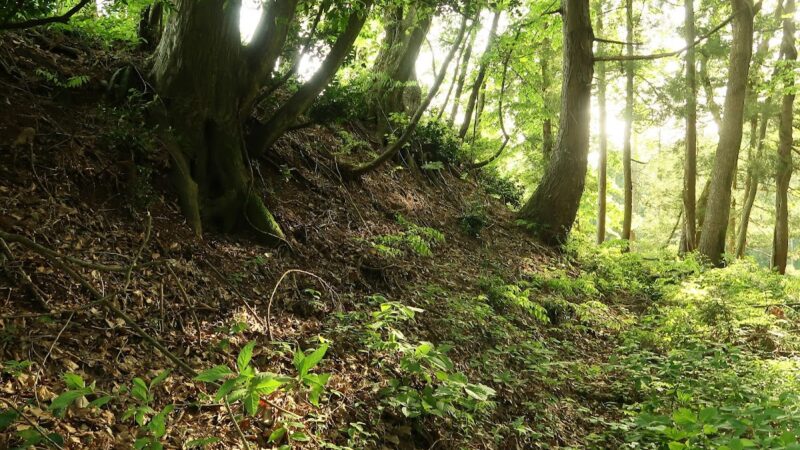
Kitayama Castle Ruins are located in a rich natural environment, allowing visitors to enjoy the scenery of each season. From the fresh greenery of spring to the vibrant autumn foliage, the castle displays different expressions depending on the time of year.
The path to the castle ruins offers a pleasant hiking experience, allowing you to appreciate the local nature. However, as it is a mountain trail, appropriate equipment and preparation are necessary.
A Historical Experience
As you explore the ruins, you can reflect on the history that unfolded in this area during the Sengoku period (Warring States period). Imagining the castle’s history from limited historical materials and considering the lives of the people and battles of that time will be a special experience for history enthusiasts.
Access Information
Location
Address: Uozu City, Toyama Prefecture (Specific street address is not set as it is a castle ruin)
Access by Public Transportation
Access to Kitayama Castle Ruins is inconvenient by public transportation. The nearest station is as follows:
Ainokaze Toyama Railway Uozu Station: Approximately 30 minutes from Toyama Station. You will need to travel by car or taxi from the station.
Due to the distance from Uozu Station to the castle ruins, renting a car is recommended.
Access by Car
Hokuriku Expressway:
- Approximately 15-20 minutes from Uozu IC (may vary depending on road conditions)
- Accessible in about the same amount of time from Namerikawa IC
From central Toyama City, it takes about 30 minutes via National Route 8. However, it is necessary to check in advance whether the paved road continues close to the castle ruins.
Parking Information
Since there is likely no dedicated parking lot for the castle ruins, it is recommended to inquire with the local tourist information center or Uozu City Hall before visiting. Please avoid parking on the street, as this will inconvenience local residents.
Points to Note During Your Visit
- Visiting Hours: As the castle ruins are outdoors, you can generally visit freely, but please descend the mountain before sunset.
- Estimated Time Required: Please allow approximately 30 minutes to 1 hour to view the remains.
- Clothing and Equipment: Since you will be walking on mountain paths, comfortable shoes and clothing are essential. Don’t forget to take precautions against cold or heat depending on the season.
- Safety: Avoid visiting alone; try to travel in groups. Please also check the cell phone signal strength beforehand.
Uozu City Tourist Information
Characteristics of Uozu City
Uozu City, where Kitayama Castle is located, is a city rich in nature, surrounded by the sea and mountains, located in the northeastern part of Toyama Prefecture. Located just a 30-minute drive from Toyama City, Uozu boasts excellent accessibility while retaining its unique culture and tourist attractions.
Uozu City is known for its three major natural wonders: mirages, submerged forests, and firefly squid, making it a popular destination for experiencing rare natural phenomena. Its elongated shape brings a diverse range of natural environments, from the coastline of Toyama Bay to mountainous areas reaching 2000 meters.
Major Nearby Tourist Attractions
Here are some Uozu City tourist spots that can be enjoyed in conjunction with a visit to Kitayama Castle:
Uozu Aquarium: The oldest aquarium on the Sea of Japan coast, exhibiting approximately 330 species and 10,000 specimens of marine life from the deep sea of Toyama Bay to the streams of the Northern Alps. It’s a valuable facility for learning about the region’s abundant marine resources.
Uozu Submerged Forest Museum: Exhibiting a globally rare submerged forest where giant trees, approximately 2000 years old, remain standing. It offers a glimpse into the ancient natural world.
Mirage Land: A popular amusement park for families, featuring a Ferris wheel offering panoramic views of Toyama Bay. Admission is free, making it easy to enjoy.
Sea Station “Shinkiro”: A facility where you can purchase Uozu’s seafood and local specialties, and it’s also convenient for gathering tourist information.
Kitayama Hot Spring: A hot spring located in a mountainous area, said to be effective for postpartum recovery, and has long been cherished by locals. You can relax and unwind in a tranquil atmosphere.
Uozu’s Famous Local Cuisine
Firefly Squid: Famous as a spring delicacy and a specialty of Toyama Bay. It can be enjoyed in various ways, such as sashimi or marinated in soy sauce.
Whelk: A type of whelk caught in Toyama Bay, characterized by its crunchy texture.
Kamaboko: Uozu is also known as the “City of Kamaboko,” with numerous long-established kamaboko shops.
Event Information
Uozu City hosts various events throughout the year:
Tatemono Festival: A traditional festival held every August, where giant lantern-shaped “Tatemono,” reaching up to 16 meters in height, parade along the coast. It is designated as a National Important Intangible Folk Cultural Property.
Mirage Observation Season: The chances of seeing mirages are high in spring (around March to May), attracting many tourists.
Nearby Castles and Historical Sites
Uozu Castle Ruins
Another important castle ruin located within Uozu City. Known for the “Battle of Uozu Castle” in 1582, it is the site of a fierce siege where Uesugi generals were besieged by the Oda army and ultimately fell after a brutal battle. It holds a significant place in Japanese history as an event that occurred around the same time as the Honnoji Incident.
Currently, stone monuments and information boards are erected in the city to preserve its history. Visiting Kitayama Castle in conjunction with Matsukura Castle will allow you to gain a deeper understanding of Uozu’s Sengoku period history.
Matsukura Castle Ruins (Uozu City)
Located in the mountainous area of Uozu City, this mountain castle ruin was one of the important bases in Etchu Province. Like Kitayama Castle, it is a valuable historical site that tells the story of Etchu’s history during the Sengoku period.
Castle Ruins in Neighboring Cities and Towns
Kurobe City: Located east of Uozu City, it contains the ruins of Ikuji Castle, among others.
Namerikawa City: Located west of Uozu City, it contains the ruins of Namerikawa Castle, among others.
By visiting these castle ruins, you can experience the power dynamics and historical flow of Etchu during the Sengoku period.
Practical Guide for Visiting Kitayama Castle
Preparation Before Visiting
Before visiting Kitayama Castle Ruins, we recommend the following preparations:
Information Gathering: Check the latest information on websites such as the Uozu City Tourism Association and Kojodan. Road conditions and the state of the ruins may change depending on the time of year.
Equipment Preparation:
- Trekking shoes or comfortable walking shoes
- Comfortable clothing (long sleeves and long pants recommended)
- Hat, sunscreen
- Drinking water and snacks
- Insect repellent (summer)
- Rain gear (in case of unpredictable weather)
- Map or smartphone with GPS
Checking Your Physical Fitness: Since you will be walking on mountain trails, a certain level of physical fitness is required. If you are not usually active, plan your trip within reasonable limits.
Best Season for Visiting
Spring (April-May): The fresh greenery is beautiful, and the weather is mild, making it a pleasant time for walking. However, the paths may be slippery due to snowmelt.
Autumn (October-November): Enjoy the autumn foliage, and the temperature is moderate, making for a comfortable stroll. There are fewer insects, making it a recommended season.
Summer (June-September): The greenery is lush, allowing you to fully enjoy nature, but heat and insect repellent are essential. Early morning visits are recommended.
Winter (December to March): Snowfall is possible, and visits are not recommended. For safety reasons, please visit during other seasons.
Estimated Time Required
- Travel Time: 15-30 minutes from Uozu Station or Uozu IC to the vicinity of the castle ruins
- Climbing Time: Approximately 15-30 minutes from the trailhead to the main enclosure (depending on trail conditions)
- Viewing Time: 30 minutes to 1 hour for observing the remains
- Descent Time: Approximately 15-20 minutes
Total time, allow 2-3 hours for a comfortable visit.
Photography Tips
To document the castle ruins, it’s recommended to take photos at the following points:
- Details of remains such as moats and earthworks
- Views from the main enclosure (Toyama Bay and Uozu city)
- Panoramic views from a position where you can grasp the entire layout
- Information boards and explanatory signs (useful for organizing information after returning home)
Manners and Precautions
- Consideration for Private Property: Private property may be included around the castle ruins. Always follow signs indicating no entry.
- Protection of Remains: Take care not to damage earthworks or moats, and removing stones or soil is strictly prohibited.
- Take Your Trash Home: To protect the natural environment, always take your trash home.
- No Open Fires: To prevent forest fires, absolutely avoid using open fires.
- Caution Regarding Wildlife: Wild animals such as bears and wild boars may inhabit the area. Carry something that makes noise, such as a bell, to make your presence known while walking.
Accommodation and Surrounding Facilities in Uozu City
Accommodation
There are various types of accommodations in Uozu City:
Hotels: Several business hotels are located around Uozu Station, making it a convenient base for sightseeing.
Ryokan (Japanese Inns): There are ryokans where you can enjoy fresh seafood from Toyama Bay and experience local food culture.
Minshuku (Japanese Inns): Offer a more homey atmosphere and allow you to enjoy interacting with locals.
Tourist Information Centers
Uozu City Tourism Association: You can obtain detailed tourist information and the latest event information. They can also answer specific questions, such as how to access Kitayama Castle.
Umi no Eki “Shinkiro” (Sea Station “Shinkiro”): A wide selection of tourist brochures are available, and souvenirs can also be purchased.
Car Rental
There are car rental companies around Uozu Station, making it convenient to efficiently visit tourist spots in the city, including Kitayama Castle. Advance reservations are recommended.
Historical Value and Future Prospects of Kitayama Castle
Research Progress
In recent years, research and investigation of mountain castles have progressed nationwide, and there is a possibility of new discoveries regarding Kitayama Castle. Continued research by local historians and castle enthusiasts is expected.
Preservation and Utilization
Preserving castle ruins is important for passing on the region’s history to future generations. At the same time, utilizing them as a tourist resource contributes to regional revitalization. Efforts are needed to enhance the value of Kitayama Castle while maintaining an appropriate balance.
Engagement with the Community
Kitayama Castle is an indispensable part of the history of Uozu City. Utilizing it as a place for local school education and lifelong learning can provide an opportunity for local people to take pride in their hometown’s history.
Summary
Kitayama Castle is a mountain castle ruin from the Sengoku period remaining in Uozu City, Toyama Prefecture. While detailed records are limited, the remains allow us to glean insights into the castle construction techniques and defensive ingenuity of the time.
Uozu City, facing Toyama Bay, is an attractive tourist destination with diverse natural environments ranging from the sea to the mountains. A visit to Kitayama Castle offers a chance to enjoy other attractions such as the Uozu Aquarium and the Buried Forest Museum, as well as local delicacies like firefly squid and events like the Tatemono Festival.
While visiting the castle ruins requires proper preparation and equipment, it will be a valuable experience for history buffs and castle enthusiasts to feel firsthand what Etchu Province was like during the Sengoku period. Enjoy the history and nature of Uozu along with the beautiful scenery of Toyama Bay.
Before your visit, please check the latest information and, while prioritizing safety, we hope you will fully savor the historical romance of Kitayama Castle.