Katsunuma Clan Residence Ruins Complete Guide | A Thorough Explanation of the History and Highlights of the Takeda Clan [Koshu City]
Located in Koshu City, Yamanashi Prefecture, the Katsunuma Clan Residence Ruins are the remains of the residence of the Katsunuma clan, who were powerful warlords of the Takeda clan during the Sengoku period. Designated a national historic site on May 28, 1981 (Showa 56), it is now open to the public as a historic park. This article provides a detailed explanation of the Katsunuma Clan Residence Ruins, from its historical background to its highlights and access methods.
What are the Katsunuma Clan Residence Ruins?
The Katsunuma Clan Residence Ruins are the remains of a warlord’s residence from the 15th to 16th centuries, built during the Sengoku period. Built on a river terrace on the right bank of the Hikawa River, at an altitude of approximately 418 meters, it features a robust structure that utilizes the steep cliff as a natural fortress.
Located at 2515-1 Katsunuma, Katsunuma-cho, Koshu City, this site is preserved as a valuable cultural asset that conveys the lifestyle of a Takeda samurai during the Sengoku period. From the site, you can enjoy a panoramic view of the Kofu Basin, the grape trellises beyond the Shin-Iwai Bridge, and the city’s scenery.
History and Genealogy of the Katsunuma Clan
The Katsunuma Clan’s Position within the Takeda Clan
The Katsunuma clan was a powerful branch family of the Takeda clan, descended from Katsunuma Nobutomo, the younger brother of Takeda Nobutora, the father of Takeda Shingen. Nobutomo and his son, Nobumoto, led the Katsunuma forces for two generations, playing a crucial role as the “Goshinrui-shu,” a core group within the Takeda army.
Born as the younger brother of Takeda Nobutora, Nobutomo contributed to the expansion of the Takeda clan’s power from his base in Katsunuma. The Goshinrui-shu was a military group composed of Takeda relatives, and was particularly trusted within the Takeda army.
Records of the Katsunuma Clan’s Activities
The Katsunuma clan’s activities can be learned in detail from the following historical documents:
- Myohoji-ki: An important historical document recording the movements of Kai Province at the time.
- Koyo Gunkan: A military chronicle describing the military and political activities of the Takeda clan.
- Ishibashi Hachiman Shrine’s Ridgepole Inscription: A record of shrine construction in which the Katsunuma clan was involved.
- Iwadono Shichisha Gongen Shrine’s Ridgepole Inscription: A historical document providing evidence of religious activities.
These documents reveal that the Katsunuma clan was not merely a military force, but was also deeply involved in local cultural and religious activities.
The Tragedy of Eiroku 3
The history of the Katsunuma clan came to a sudden end in Eiroku 3 (1560). The Katsunuma clan was destroyed by Takeda Shingen. There are various theories as to why they were purged despite being relatives, but it is believed to have been part of the Takeda clan’s policy of consolidating power.
This incident is a significant historical event illustrating the power struggle within the Takeda clan and reflects the harsh political conditions of the Sengoku period.
Location and Strategic Importance of the Katsunuma Clan Residence Site
Location as a Transportation Hub
The Katsunuma Clan Residence site was located in an extremely important position within the transportation network of the Sengoku period.
East-West Direction: The Koshu Kaido (a major highway from the pre-Keicho era) passed across the river from the residence. This highway was a vital main road connecting Kofu and Edo.
North-South Direction: The Kamakura Waki-Okan (a secondary highway) passed immediately west of the residence, functioning as a transportation route connecting Kamakura and Kai.
By establishing their residence at the intersection of these two major highways, the Katsunuma clan was able to effectively monitor and control transportation.
Military Role
The Katsunuma Clan Residence was not merely a residential facility, but also functioned as an important military base.
- Guarding Musashi and Sagami Provinces: The front line to prepare for invasions from the eastern provinces.
- Communication and Relay Base: A relay point for information transmission and military supplies.
- Defense of the Kofu Basin: An important defensive base protecting the east of Kofu.
The location, utilizing the natural fortifications of the Hikawa River cliffs, was excellent defensively and was easily defended even with a small force.
Structure and Remains of the Manor Site
Overall Layout
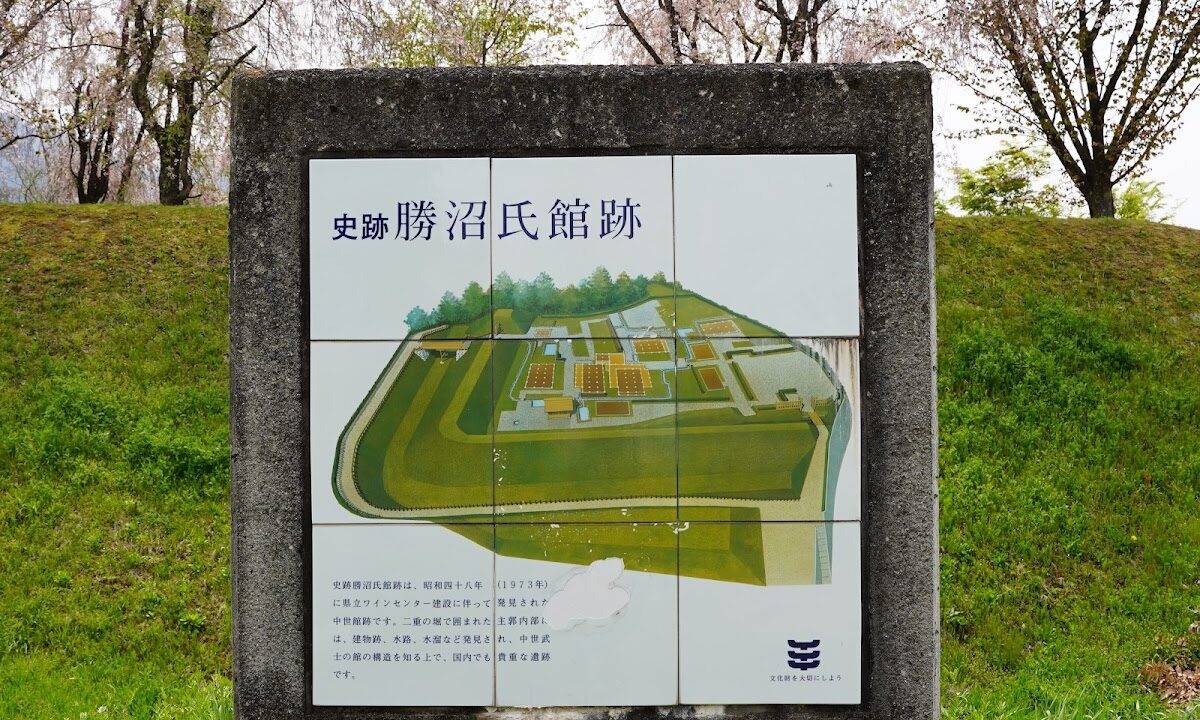
The Katsunuma Clan Manor Site was built skillfully utilizing the topography of the river terrace. The manor is broadly composed of the following sections:
Inner Enclosure (Main Enclosure): The central area where the lord and his family lived. This was the most heavily fortified section.
Outer Enclosure: It is believed that this was where the residences of retainers and servants, as well as warehouses, were located.
Dry Moats and Defensive Facilities
One of the most notable features of the manor site is the deep and wide dry moat. This dry moat was an important defensive structure designed to prevent enemy intrusion, and its scale can still be observed today.
Features of the dry moat:
- Sufficiently deep and wide, making it difficult to cross.
- Also serves to divide multiple sections.
- A valuable historical site demonstrating the castle-building techniques of the Sengoku period.
Earthworks and Foundation Stones
Earthworks: Earthworks, built by piling up earth, remain within the inner enclosure, serving as a defensive wall. Their shape can still be seen today.
Foundation Stones: Foundation stones that supported the building’s pillars have been discovered, providing important clues to estimating the building’s layout at the time. These foundation stones allow us to understand the structure of the Sengoku period warlord’s residence.
Wooden Bridge and Rest Area
Currently, a wooden bridge spans the north side leading to the inner enclosure, serving as the entrance to the historical park. A rest area is located before the bridge, where visitors can obtain brochures. Visitors can learn about the site’s overview here before beginning their tour.
Excavation and Research Results
Multiple archaeological excavations have been conducted at the Katsunuma Clan Residence site, gradually revealing details about the lifestyle of warlords during the Sengoku period.
Excavated Artifacts
The following artifacts have been unearthed during the excavations:
- Ceramics: Tableware used in daily life
- Fragments of Weapons and Armor: Artifacts indicating the site’s nature as a military facility
- Building Components: Clues to the building’s structure
- Daily Life Tools: Tools indicating the lifestyle of the time
These unearthed artifacts are important resources for clarifying the specific daily lives of Sengoku warlords, which cannot be understood from historical documents alone.
Reconstruction of Building Layout
Based on the arrangement of foundation stones and analysis of the topography, the layout of the buildings within the residence is gradually being reconstructed. The arrangement of the main hall, residential buildings, warehouses, etc., has been estimated, revealing a typical form of a Sengoku period warlord’s residence.
Development as a Historical Park
The Katsunuma Clan Residence Site is appropriately preserved as a nationally designated historical site and has been developed as a historical park, open to the public.
Improvement of the Visiting Environment
The following improvements have been made to ensure that visitors can safely and comfortably view the site:
- Installation of Walking Paths: A viewing path that allows visitors to tour the main remains.
- Installation of Information Boards: Explanations of each remains and their historical background.
- Rest Facilities: A rest area that also serves as a pamphlet distribution point.
- Parking: Parking space along the old Koshu Kaido road on the north side of the castle site.
Scenic Spots
The view from the inner enclosure is one of the major attractions of the Katsunuma Clan Residence Site. The grape trellises stretching beyond the Shin-Iwai Bridge and the panoramic view of the Kofu Basin showcase beauty in every season. Especially during the grape harvest season, the landscape of the vast vineyards is breathtaking.
Handling Fallen Trees and Maintenance
Because the historical park is located in a natural environment, fallen trees may occur due to natural disasters such as typhoons. Koshu City strives to maintain the park by promptly carrying out tree removal work to ensure that visitors are not inconvenienced. It is recommended to check the official Koshu City information before visiting to confirm the visiting status.
Highlights and How to Enjoy
Points to Note When Visiting the Ruins
Here are some points to pay attention to when visiting the Katsunuma Clan Residence Ruins.
1. Scale of the Dry Moat
The deep and wide dry moat is a relic that allows you to experience the defensive techniques of the Sengoku period. Looking up from the bottom of the moat, you can feel the high level of its defensive capabilities.
2. Shape of the Earthworks
The earthworks within the main enclosure are well-preserved, making it easy to imagine their appearance at the time. Looking around from the top of the earthworks, you can understand their defensive advantages.
3. Arrangement of Foundation Stones
The foundation stones of the buildings provide clues to the architectural techniques and scale of the buildings at the time. Let’s imagine the building’s layout from the arrangement of the foundation stones.
4. Utilization of Topography
The location, utilizing the steep cliffs of a river terrace, demonstrates the skillful use of natural terrain in castle construction techniques of the Sengoku period.
Surrounding Historical Spots
Near the Katsunuma Clan Residence Ruins, there are several related historical spots.
- Ishibashi Hachiman: A shrine architecture in which the Katsunuma clan was involved
- Iwadono Nanasha Gongen: A historical site showing the Katsunuma clan’s faith
- Old Koshu Kaido: A road that retains the appearance of a historical highway
The Fusion of Wine and History
Katsunuma Town is also known as one of Japan’s leading wine-producing regions. In addition to visiting the residence ruins, you can also enjoy visiting nearby wineries and grape picking. The ability to enjoy historical exploration and local specialties simultaneously is a unique charm of Katsunuma.
Access Information
Access by Train and Bus
Nearest Station: JR Chuo Main Line “Katsunuma Budokyo Station”
Bus: Take the city bus from Katsunuma Budokyo Station
- Grape Course 2
- Wine Course 2
- Get off at the “Iwaibashi” bus stop and it’s a short walk.
City bus schedules may vary depending on the season and day of the week, so we recommend checking the Koshu City official website in advance.
Access by Car
Chuo Expressway: Approximately 10 minutes from Katsunuma IC
Parking: Parking is available along the old Koshu Kaido road north of the castle ruins (free).
For car navigation, please search for “2515-1 Katsunuma, Katsunuma-cho, Koshu City” or “Katsunuma Clan Residence Ruins Historical Park”.
Location
2515-1 Katsunuma, Katsunuma-cho, Koshu City, Yamanashi Prefecture 409-1316
Visitor Information
Opening Hours and Fees
- Opening Hours: Always open (maintained as a historical park)
- Admission Fee: Free
- Closed Days: None (However, temporary access may be restricted due to weather or maintenance work)
Estimated Visiting Time
- Standard Visiting Time: Approximately 30 minutes to 1 hour
- Thorough Visiting Time: Approximately 1 hour to 1 hour 30 minutes
We recommend allocating at least 1 hour if you wish to observe the remains slowly and enjoy the view.
How to Obtain a Brochure
Brochures are available at the rest area before the wooden bridge on the north side leading to the inner enclosure. They contain explanations of the history of the castle site and the remains, so we recommend obtaining one before your visit.
Points to Note When Visiting
- Please refrain from entering areas other than the designated walking paths within the historical site.
- Please be careful not to damage the remains.
- Please take all your trash with you.
- Please be careful as the ground can be slippery during and after rain.
- Insect repellent is recommended in summer, and warm clothing is recommended in winter.
Cultural Value of the Katsunuma Clan Residence Site
Significance as a National Historic Site
The Katsunuma Clan Residence Site was designated a national historic site in 1981 due to its cultural value as follows:
1. A Typical Example of a Warlord’s Residence from the Sengoku Period
It retains the structure of a 15th-16th century warlord’s residence in excellent condition, making it a valuable resource for understanding the castle-building techniques and lifestyles of the time.
2. An Important Historic Site for Takeda Clan Research
As the base of the Katsunuma clan, a powerful branch family of the Takeda clan, it is an indispensable historical site for understanding the power structure and military organization of the Takeda clan.
3. The Importance of Local History
This cultural property symbolizes the history of Koshu City (formerly Katsunuma Town) and is an important element in forming the region’s identity.
Efforts for Preservation and Utilization
Koshu City is working on the appropriate preservation and utilization of the Katsunuma Clan Residence Site.
- Regular Maintenance: Mowing grass, removing fallen trees, etc.
- Updating Information Boards: Recreating explanations that reflect the latest research findings
- Educational Use: Utilizing the site as a place for learning local history in local schools
- Development as a Tourism Resource: Developing tourist courses that combine wine tourism
Combining with Surrounding Sightseeing
Winery Tours
Katsunuma Town is known as one of the birthplaces of Japanese wine, and numerous wineries are scattered throughout the area. In addition to visiting the Katsunuma Clan Residence Site, you can enjoy the following:
- Winery tour and wine tasting
- Enjoying the vineyard scenery
- Dining at a restaurant using local ingredients
Other historical sites in Koshu City
There are many other historical sights in Koshu City.
- Erinji Temple: The family temple of Takeda Shingen
- Daizenji Temple: An ancient temple with a national treasure, the Yakushido Hall
- Former Takano Family Residence: An Edo period private house
Enjoying the four seasons
Spring: The basin landscape dyed pink as peach blossoms bloom
Summer: The contrast between lush green vineyards and the blue sky
Autumn: The grape harvest season, a beautiful time of autumn leaves and fruit
Winter: Views of the snow-covered Southern Alps
Things to know before visiting the Katsunuma Clan Residence Ruins
Checking the latest information
Before visiting, check the latest information on the Koshu City official website and the tourism association website. After typhoons or heavy rains, temporary restrictions on visits may be in place due to fallen trees, etc.
Clothing and Items to Bring
- Comfortable Walking Shoes: Athletic shoes or trekking shoes are suitable for visiting the ruins.
- Hat: Essential during sunny seasons.
- Drinks: Hydration is especially important in summer to prevent heatstroke.
- Camera: For documenting beautiful views and ruins.
Photography
Photography is generally permitted within the historical site, but please note the following:
- Be careful not to damage the ruins.
- Be considerate of other visitors.
- Drone use may require prior permission.
Contact Information
For detailed information and inquiries regarding the Katsunuma Clan Residence Ruins, please contact the following.
Koshu City Tourism and Commerce Division
Phone: 0553-32-2111 (Main)
Koshu City Tourism Association
Website: https://www.koshu-kankou.jp/
Summary
The Katsunuma Clan Residence Ruins are a valuable nationally designated historical site that conveys the history of the Takeda clan. The structure of a samurai residence from the Sengoku period is well-preserved, and the remains such as deep dry moats, earthworks, and foundation stones offer insights into the lifestyle of the time.
The location, utilizing the natural fortifications of the Hikawa River cliffs, its strategic importance as a transportation hub, and its tragic history of being destroyed by Takeda Shingen—all of these factors contribute to the allure of the Katsunuma Clan Residence Ruins.
When visiting Koshu City, be sure to visit this historical site, full of historical romance, along with winery tours and grape picking. The view from the inner enclosure will be a precious opportunity to relive the scenery seen by the samurai of the Sengoku period.
The Katsunuma Clan Residence Site, now developed as a historical park, is a spot that can be enjoyed not only by history buffs but also by families and tourists. Immerse yourself in the atmosphere of the Sengoku period while enjoying Yamanashi’s rich nature and culture.