Katakura Castle: A Complete Guide to the Medieval Mountain Castle in Hachioji City, Tokyo
Located in Katakura-cho, Hachioji City, Tokyo, Katakura Castle is a medieval flatland castle built during the Muromachi period. Currently, it is maintained as Katakura Castle Ruins Park and designated as a Tokyo Metropolitan Historic Site. Built on a hill between the Yudono River and the Hyoe River, this castle, which skillfully utilized the natural terrain as a defensive structure, functioned as an important branch castle of the Hojo clan during the Sengoku period. This article comprehensively introduces information useful for visiting Katakura Castle, including its history, structure, highlights, and access methods.
History of Katakura Castle
Construction and Early History
There are various theories regarding the construction period of Katakura Castle, but it is believed to have been built around the 15th century during the early Muromachi period by the Nagai clan, vassals of the Ogigayatsu Uesugi clan. One theory suggests that the Oe clan or their descendants, the Nagai clan, were the lords of the castle.
The Ogigayatsu Uesugi clan was a branch of the Uesugi clan that wielded considerable power in the Kanto region from the Muromachi period to the Sengoku period, expanding their territory primarily in southern Musashi Province. Katakura Castle was located at the northwestern edge of their sphere of influence and is believed to have functioned as an important base protecting the border region between Musashi and Sagami Provinces.
Changes in the Sengoku Period
With the arrival of the Sengoku period, the area surrounding Katakura Castle became the stage for fierce power struggles. In the 16th century, it became the territory of the Oishi clan, whose main castle was Takiyama Castle. The Oishi clan were powerful local lords in Musashi Province, but they eventually faced the expansion of the Later Hojo clan, based in Sagami Province.
When the Ogigayatsu Uesugi clan was destroyed in the Battle of Kawagoe in 1546, the situation in Musashi Province changed dramatically. The Oishi clan submitted to the Hojo clan, and Hojo Ujiteru, the third son of Hojo Ujiyasu, was adopted by Oishi Sadahisa and entered Takiyama Castle. As a result, Katakura Castle was positioned as a branch castle, playing a part in the Hojo clan’s castle network centered around Takiyama Castle.
Although Hojo Ujiteru later built Hachioji Castle and moved his base there, Katakura Castle continued to function as a defensive base in the Hachioji region. Katakura Castle played a role in monitoring and defending against northern invasions to Takiyama Castle and Hachioji Castle, and held significant strategic value in the Hojo clan’s control of their territory.
Abandoned Castle and Modern Times
In 1590 (Tensho 18), Toyotomi Hideyoshi launched the Odawara Campaign (invasion of the Kanto region). The Later Hojo clan was destroyed in this battle, and it is believed that Katakura Castle was abandoned around this time. After its abandonment, the castle ruins were left neglected for a long period, but the topographical features remained intact throughout the Edo period.
In the Showa era, the historical value of the castle ruins was recognized, and it was designated a historical site by the Tokyo Metropolitan Government. Later, the site was developed into Katakura Castle Ruins Park by Hachioji City, and is now a popular recreational area for citizens and a tourist spot visited by history enthusiasts and castle fans.
Structure
Topographical Features and Layout
Katakura Castle is built on the tip of a hill extending northeastward, overlooking the confluence of two rivers, the Yudono River and the Hyoe River. This location is a typical choice for medieval castles, and it realizes a defensive system that makes maximum use of the natural terrain.
The north, east, and south sides of the castle are steep cliffs of approximately 30 meters, which functioned as natural fortifications. Attackers had to climb these steep slopes, giving the defenders a significant advantage by allowing them to attack from high ground.
On the other hand, since the hills continue to the west, artificial defensive structures were necessary to prevent incursions from this direction. Therefore, a deep dry moat was excavated on the west side, clearly separating the main enclosure and the second enclosure. This dry moat remains remarkably well-preserved today and is one of the most important remains of Katakura Castle.
Structure of the Main Enclosure (Honmaru)
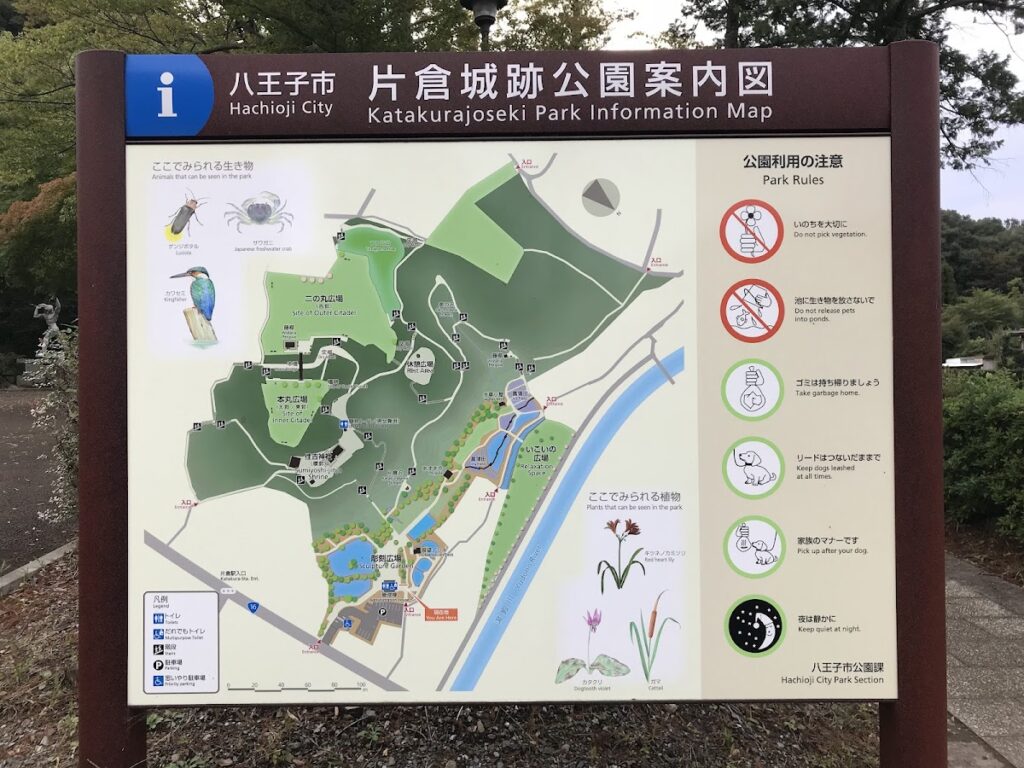
The main enclosure of Katakura Castle is located on a small hill south of the present-day Sumiyoshi Shrine. The main enclosure was the central part of the castle and is believed to have housed the lord’s residence and other important facilities.
An earthen rampart surrounds the main enclosure, and parts of it are still clearly visible today. The rampart served to prevent enemy intrusion and also functioned as a defensive wall against arrows and stones. While the main enclosure is relatively compact, this is a standard size for a medieval hilltop castle.
To the west of the main enclosure is a deep dry moat, beyond which a dirt bridge is located. Crossing this bridge leads to the second enclosure (Ninomaru). The dirt bridge served as both a movement route within the castle and a strategically important defensive point. Attempting to cross the bridge would result in concentrated attacks from the higher ground on both sides, making it difficult to breach.
Second Enclosure (Ninomaru) and Outer Enclosure
The Second Enclosure is located west of the Main Enclosure and is currently developed as the Ninomaru Plaza. The Second Enclosure is the second most important enclosure after the Main Enclosure, and it is presumed to have housed a soldier’s garrison and storage facilities for supplies.
The remains of a dry moat are well-preserved around the Second Enclosure, making it an important point of interest for understanding Katakura Castle’s defensive system. The depth and width of the dry moat give a real sense of how strong the castle’s defenses were.
Further outside, it is believed that there was an outer enclosure, possibly containing the castle town and the residences of retainers. However, much of the remains of the outer enclosure have been lost due to later development, and many aspects of its detailed structure remain unknown.
Watchtower Bases and Defensive Facilities
The remains of watchtower bases have also been confirmed at Katakura Castle. Watchtower bases were elevated platforms for constructing buildings such as watchtowers and armories, and served as important bases for monitoring the surroundings and attacking enemies. Medieval castles were predominantly “earthen castles” lacking stone walls or keeps, and Katakura Castle is a prime example. It utilized advanced civil engineering techniques such as earthworks, dry moats, and steep, artificially carved slopes to enhance its defenses. These remains can still be seen throughout the park, making it an excellent resource for learning about the characteristics of medieval castles.
Highlights of Katakura Castle Ruins Park
Observing Castle Remains
The greatest attraction of visiting Katakura Castle Ruins Park is the opportunity to observe the well-preserved remains of a medieval castle up close. The dry moats around the Ninomaru Plaza, in particular, retain their depth and width, allowing visitors to experience the defensive system of the time.
Walking along the bottom of the dry moat, you’ll be overwhelmed by the height of the steep slopes on either side. You’ll truly understand how difficult it must have been to cross this moat and enter the castle. Furthermore, crossing the earthen bridge allows you to imagine the battle from both the attacker’s and defender’s perspectives, deepening your understanding of medieval battles.
Earthen ramparts remain in various places, and their shape and arrangement allow us to decipher the castle’s defensive plan. For castle enthusiasts, there’s the pleasure of exploring the remains with a map in hand to understand the overall structure of the castle.
Nature in Every Season
Katakura Castle Ruins Park is known not only for its castle ruins but also for its rich natural environment. Especially in spring, the park’s famous cluster of dogtooth violets blooms magnificently. Dogtooth violets are lovely flowers that bloom in early spring, and the sight of their purple petals covering the slopes captivates visitors.
During cherry blossom season, the cherry trees in the park bloom all at once, adding a touch of spring splendor to the castle ruins. It’s a time when the park is bustling with cherry blossom viewers, offering a valuable opportunity to enjoy both history and nature.
In early summer, irises bloom, coloring the wetlands. Furthermore, walking along the forest paths allows you to enjoy forest bathing while listening to the chirping of wild birds. This is a popular spot for families with children, as you can also enjoy insect observation.
Exhibition of Sculptures
Katakura Castle Ruins Park features several sculptures. These contemporary art pieces add new cultural value to the historical castle ruins. Enjoying these sculptures while strolling along the walking paths is one way to appreciate the park.
Sumiyoshi Shrine
Sumiyoshi Shrine is located within the castle ruins. This shrine has a long history as a center of local faith. From the shrine grounds, you can enjoy views of the surrounding landscape, and it’s easy to imagine that the former castle lords also surveyed their territories from this spot.
Access
Access by Train
Katakura Castle Ruins Park is easily accessible by public transport. There are two nearest stations, both within walking distance.
From JR Yokohama Line “Katakura Station”:
This is the closest access route, approximately a 3-minute walk from the west exit of Katakura Station. Exit the station and head west. After passing through a residential area, you’ll quickly arrive at the park entrance. There are signs, so even first-time visitors should be able to find their way without getting lost.
From Keio Takao Line “Keio Katakura Station”:
From Keio Katakura Station, it’s about a 6-minute walk south. This route is also easy to follow, and the path from the station to the park is flat and easy to walk.
Both stations are easily accessible from central Tokyo, and it takes about 40 minutes from Shinjuku Station. It’s a distance that makes it easy to visit on a day trip.
Access by Car
If you’re coming by car, the nearest interchange is the Hachioji Interchange on the Chuo Expressway. From the interchange, it’s about a 15-minute drive via local roads.
Parking Information:
Katakura Castle Ruins Park has its own parking lot. However, during peak seasons such as cherry blossom and dogtooth violet blooming seasons, the parking lot may be full. In such cases, we recommend using public transportation.
For parking hours and fees, we recommend checking the latest information on the Hachioji City official website.
Address and Surrounding Information
Location: 2475 Katakura-cho, Hachioji City, Tokyo, and other locations
Opening Hours: Always open (however, nighttime use is not recommended)
Admission Fee: Free
Inquiries: Hachioji City Water and Greenery Department, Parks Division
The surrounding area is a quiet residential area. When visiting the park, please be considerate of the local residents and observe proper etiquette.
Nearby Castles and Tourist Spots
Takiyama Castle Ruins
If you visit Katakura Castle, you should definitely extend your trip to Takiyama Castle Ruins. Takiyama Castle, the main castle of Katakura Castle, is located about 5 kilometers northwest of Katakura Castle and is an important medieval castle designated as a national historic site.
Takiyama Castle was the base of Hojo Ujiteru and boasts one of the largest scales and defensive capabilities in the Kanto region. The vast castle grounds feature numerous enclosures, including the main keep, second bailey, and third bailey, creating a complex layout. Visiting both Katakura Castle and Hachioji Castle will deepen your understanding of the Hojo clan’s castle system.
Hachioji Castle Ruins
Hachioji Castle, where Hojo Ujiteru moved his base from Takiyama Castle, also has a deep connection to Katakura Castle. Located approximately 7 kilometers southwest of Katakura Castle, Hachioji Castle is also designated a national historic site.
Hachioji Castle was built as a mountain castle, a magnificent fortress centered around the main keep at the mountaintop and the lord’s residence at the foot of the mountain. During Toyotomi Hideyoshi’s Odawara campaign in 1590, a fierce battle took place, and the castle fell. Currently, a guidance facility is available, allowing visitors to tour the site while receiving detailed explanations.
Tourist Attractions in Hachioji City
There are many other tourist attractions in Hachioji City. Mount Takao is a popular mountain for its abundant nature and proximity to central Tokyo. You can easily enjoy hiking there using the cable car or chairlift. Furthermore, the area around Hachioji Station boasts numerous commercial facilities and restaurants, making it convenient to visit before or after exploring the castle ruins.
Points to Note When Visiting Katakura Castle
Clothing and Items to Bring
Katakura Castle Ruins Park is a well-maintained park, but to closely examine the remains, you will need to walk on some uneven terrain. We recommend wearing comfortable shoes and clothing.
Spring and autumn are ideal seasons for sightseeing due to their pleasant weather. However, in summer, be sure to bring insect repellent, and in winter, take precautions against the cold. Bringing a camera or binoculars will enhance your enjoyment of observing the ruins and observing wild birds.
Estimated Visiting Time
A leisurely stroll through the park and viewing the main remains will take approximately 1 to 1.5 hours. If you plan to take photographs or enjoy detailed observation, allow about 2 hours.
During the blooming seasons of dogtooth violets and cherry blossoms, you can enjoy the site even more by taking your time to admire the flowers.
Photography Tips
Katakura Castle Ruins offers plenty of photo opportunities. You can capture the charm of the castle ruins from various perspectives, such as looking up at the cliff face from the bottom of the dry moat, including the earthen bridge in your composition, and the view from the main enclosure.
During the spring season of dogtooth violets and cherry blossoms, photos combining flowers and the castle ruins are popular. Taking photos in the soft light of early morning or evening will result in more atmospheric pictures.
Historical Significance of Katakura Castle
Value in the Study of Medieval Castles in the Kanto Region
Katakura Castle is an important case study for the study of medieval castles in the Kanto region. Many medieval castles remaining in Tokyo have been lost due to development, making examples like Katakura Castle, where the remains are well preserved, invaluable.
Basic defensive structures such as earthworks, dry moats, and cliff faces remain clearly visible, making it a living textbook for learning about the structure and construction techniques of medieval castles. Archaeological excavations have been conducted, and unearthed artifacts have provided insights into the period of the castle’s use and the lifestyle of its inhabitants.
The Hojo Clan’s Castle Network
Katakura Castle did not exist in isolation; it functioned as part of the Hojo clan’s castle network, centered around Takiyama Castle and Hachioji Castle. This network was a system where multiple branch castles were positioned around the main castle, coordinating with each other to defend the territory.
Katakura Castle is thought to have played a role in monitoring invasions from the north and transmitting information via smoke signals in emergencies. Research into such castle networks provides important clues for understanding the military systems and territorial governance of the Sengoku period.
Its Place in Local History
The history of Katakura Castle is also the history of the medieval period of the Hachioji region itself. The transition from the sphere of influence of the Ogigayatsu Uesugi clan to the territory of the Hojo clan reflects the political changes throughout the Kanto region.
For the local people, Katakura Castle symbolizes their local history and is the core of their regional identity. Currently, Katakura Castle Ruins Park is a popular recreational spot for citizens, offering a harmonious blend of historical heritage and modern life.
Summary
Katakura Castle is a valuable medieval castle remaining in Hachioji City, Tokyo. Built during the Muromachi period, it played an important role as a branch castle of the Hojo clan during the Sengoku period. Skillfully utilizing the natural terrain of a hilly area between the Yudono River and the Hyoe River, the remains, including dry moats, earthworks, and watchtower bases, are well-preserved.
Currently, it is maintained as Katakura Castle Ruins Park and protected as a Tokyo Metropolitan Government-designated historical site. Its convenient location, just a 3-minute walk from Katakura Station on the JR Yokohama Line, makes it easily accessible for a day trip from central Tokyo. Beyond observing the castle ruins, it’s an attractive spot where you can enjoy the changing seasons, including spring dogtooth violets and cherry blossoms.
It’s a recommended place for a wide range of people, including those interested in medieval castles, history buffs, and those seeking to refresh themselves in nature. Visiting Katakura Castle along with the nearby Takiyama Castle ruins and Hachioji Castle ruins will deepen your understanding of the Hojo clan’s castle system. Be sure to visit Katakura Castle and experience the romance of medieval history and the rich natural surroundings.