Kaneda Castle: The Complete Picture of Japan’s Oldest Ancient Mountain Castle – A Complete Guide to History, Remains, and Highlights
What is Kaneda Castle? – Japan’s Strongest Ancient Mountain Castle
Kaneda Castle (Kaneda-jo/Kanata-no-ki/Kaneta-no-ki) is a representative ancient mountain castle of Japan, located in Kurose, Mitsushima-cho, Tsushima City, Nagasaki Prefecture. Built on a mountain (276 meters above sea level) jutting out into Asaji Bay in Shimoagata District, Tsushima Province, this castle is classified as a Korean-style mountain castle and is designated as a National Special Historic Site.
Constructed in 667 AD (the 6th year of Emperor Tenji’s reign), this fortress was developed as a frontline defense against invasions from the continent after the defeat at the Battle of Baekgang. Even after more than 1350 years, the original stonework remains in good condition, making it a valuable legacy that conveys ancient Japanese castle-building techniques and national defense systems.
In 2017, it was selected as one of the “Continued Top 100 Japanese Castles,” and is highly regarded by castle enthusiasts and history buffs as “Japan’s strongest castle.”
History of Kaneda Castle – A Fortress Born from a National Crisis
The Battle of Baekgang and the Background of its Construction
The direct trigger for the construction of Kaneda Castle was the Battle of Baekgang, which took place on the Korean Peninsula in 663. In this battle, the combined forces of Japan (Wa) and Baekje suffered a crushing defeat at the hands of the combined forces of Tang China and Silla. This defeat made the threat of invasion of the Japanese archipelago a very real possibility.
According to the *Nihon Shoki* (Chronicles of Japan), Emperor Tenji sought to fundamentally strengthen the national defense system after the defeat at Baekgang. Tsushima was a crucial point for maritime traffic connecting the Korean Peninsula and mainland Japan, and was located on the front lines against invasions by continental powers. Therefore, in 667, he ordered the governor of Tsushima Province to construct Kaneda Castle.
Role in the Ancient National Defense System
Kaneda Castle was not a standalone castle, but was planned as part of the national defense network of the time. During the same period, several ancient mountain castles were built throughout western Japan, including Ono Castle (Fukuoka Prefecture), Ki’i Castle (Saga and Fukuoka Prefectures), and Kikuchi Castle (Kumamoto Prefecture).
Besides Kaneda Castle, Shimizu-yama Castle was also built in the north of Tsushima, completing the island’s overall defense system. Furthermore, soldiers called sakimori were stationed at the castle, maintaining constant vigilance. These sakimori were conscripted from eastern Japan, and their arduous duties are mentioned in poems in the *Manyoshu* (Collection of Ten Thousand Leaves).
Changes from the Medieval Period Onward
After the ancient national defense crisis subsided, the military importance of Kaneda Castle gradually declined. Records become scarce from the Heian period onward, and its actual usage is unclear. However, its sturdy stonework has endured through the ages.
During the Middle Ages, the So clan, who ruled Tsushima, built mountain castles throughout the island, but there is little evidence that Kaneda Castle itself was reused. By the Edo period, it was already recognized as an ancient castle site and was affectionately known locally as “Shiroyama” (Castle Mountain).
Remains of Kaneda Castle – Preserving 1350-Year-Old Technology
Characteristics of the Stone Walls
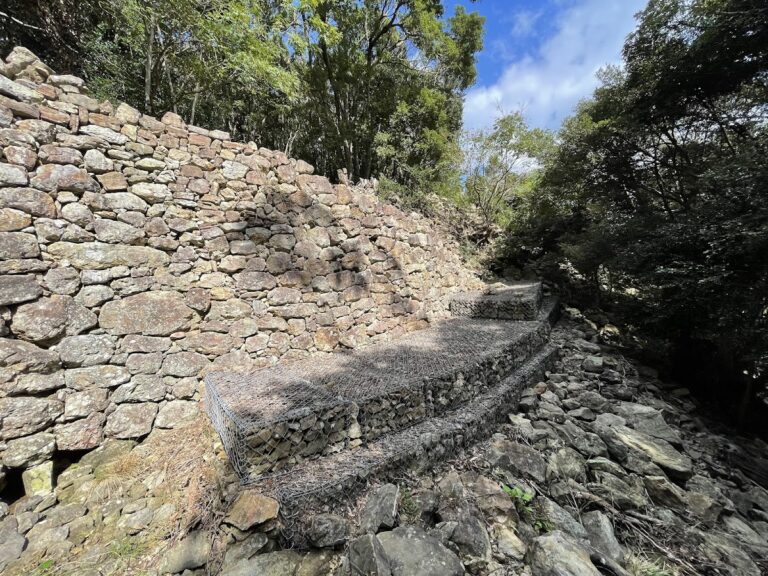
The greatest highlight of Kaneda Castle is undoubtedly the stone walls built over 1350 years ago. The total length is approximately 2.8 kilometers, and they are arranged to surround the ridges and valleys of Shiroyama.
The stone walls incorporate fortification techniques from the Korean Peninsula, employing the “Nozurazumi” technique, which skillfully stacks unprocessed natural stones. Particularly noteworthy is the advanced technique of arranging the stones to suit the steep terrain. The stone material mainly consists of granite quarried around Shiroyama, and some of the stones are over one meter in size.
The height of the stone ramparts varies depending on the location, but in well-preserved sections, some remain over 5 meters high. This suggests that it was an extremely strong defensive structure for its time.
Southeast Corner Stone Ramp – Kaneda Castle’s First Viewpoint
The first major remains encountered when walking along the path to the castle are the Southeast Corner Stone Ramp. This is a representative photo spot for Kaneda Castle, and many visitors are overwhelmed by its grandeur.
The Southeast Corner Stone Ramp offers a spectacular view overlooking Asaji Bay, allowing visitors to truly appreciate the defensive strategy of the time. The graceful curves of the stone ramparts and the landscape of the ria coastline stretching out below convey the image of Tsushima that has remained unchanged for 1350 years.
Castle Gate Remains
It is believed that Kaneda Castle had multiple castle gates, and traces of them can still be seen today. Major gate remains such as the East Gate, West Gate, and South Gate have been confirmed through archaeological excavations.
The East Gate ruins, in particular, are relatively well-preserved, allowing observation of the foundation stones for the gateposts and the structure of the stone walls extending on both sides of the gate. The gate is estimated to be approximately 3-4 meters wide and is thought to have been used for transporting supplies and for soldiers to enter and exit.
Stone Walls on Bingushi Mountain
Stone walls also extend to Bingushi Mountain, north of the castle mountain. These walls are built on a relatively gentle slope, making this a valuable site for observing castle construction techniques under different terrain conditions.
Remains of Facilities within the Castle
It is believed that buildings for garrisoning soldiers and warehouses for storing weapons and food existed within the castle. Excavations have confirmed the remains of foundation stones and pit dwellings, providing important clues about how the ancient mountain castle was operated.
There is a flat area near the summit of the castle mountain, and it has been suggested that this may have functioned as a command post or watchtower. From the summit, one can overlook the entire Asaji Bay, making it an ideal location for early detection of enemy ships from the sea.
Excavated Artifacts – Relics that Tell the Story of Ancient Life
Numerous artifacts have been unearthed from the Kaneda Castle ruins during previous excavations. These artifacts are valuable resources for understanding the lives of the ancient border guards and the functions of the castle.
Pottery
The most abundant artifacts are pottery such as Haji ware and Sue ware. These were everyday items used for cooking, eating, and storage, and tell the story of the daily lives of the border guards. The style of the pottery confirms that the castle was actively used from the late 7th to the 8th century.
Iron Products
Iron products used as weapons and tools have also been unearthed. Iron arrowheads, knives, and nails have been found, supporting the castle’s character as a military facility.
Tiles
Fragments of roof tiles have also been unearthed, indicating that tiles were used in some buildings. The use of roof tiles at this ancient mountain castle suggests the presence of important buildings, possibly including warehouses or command facilities.
Other Artifacts
Carbonized grains and animal bones have also been unearthed, providing clues to the dietary habits of the time. Earthenware believed to have been used in rituals has also been found, suggesting the existence of religious practices within the castle.
Some of these unearthed artifacts are on display at museums and historical sites in Tsushima City, and are open to the public.
Cultural Value and Designation
Special Historic Site Designation
Kaneda Castle Ruins were designated a Special Historic Site by the Japanese government in 1982 (Showa 57). Special Historic Sites are the highest rank of designation given to historical sites of particular importance, and there are only about 60 such sites throughout Japan.
This designation indicates that Kaneda Castle possesses extremely high historical and academic value in the following respects:
- It is a representative historical site demonstrating the national defense system of ancient Japan.
- It is a typical example of a Korean-style mountain castle, preserving the castle-building techniques of the time.
- It is in an extremely good state of preservation, with stonework dating back over 1350 years still existing.
- It is an indispensable historical site for understanding the East Asian situation after the Battle of Baekgang.
Selection as one of the Continued Top 100 Japanese Castles
In 2017, it was selected as one of the “Continued Top 100 Japanese Castles” (number: 185) by the Japan Castle Association. This designation follows the previously selected “Top 100 Japanese Castles,” recognizing castles of high historical and cultural value.
The stamp for the Continued Top 100 Japanese Castles can be obtained at the Tsushima Tourist Information Center Fureai-dokoro Tsushima and the Mitsushima District Community Center in Tsushima City, attracting many castle enthusiasts.
Selected as “Japan’s Strongest Castle”
Featured in television programs and other projects as “Japan’s Strongest Castle,” its robust defensive structure and strategic location have been highly praised. Its layout, utilizing the steep terrain, its location overlooking the sea, and the stonework techniques that have remained intact for over 1350 years truly deserve the title of “strongest.”
Local Information – Access and Visiting Kaneda Castle
Location and Access
Location: Kurose, Mitsushima-cho, Tsushima City, Nagasaki Prefecture
Access Method:
- Approximately 40 minutes by car from Tsushima Airport
- Approximately 30 minutes by car from Izuhara Port
- Accessible by car to the nearest castle entrance parking lot
Public transportation is limited on Tsushima Island, so using a rental car or taxi is recommended. There are several parking spaces at the castle entrance.
Climbing Route and Estimated Time
From the castle entrance to the castle ruins, you will need to walk along a mountain trail. If you plan to visit the main sights, please allow approximately 2-3 hours for the round trip.
Castle Ascent Route:
- Start from the castle entrance parking lot.
- Arrive at the southeast corner stone wall in approximately 20-30 minutes.
- Reach the summit of Shiroyama Mountain in another 30 minutes.
4.Circulate while viewing the stone walls and remains at various points.
The path is well-maintained, but as it is a mountain trail, the following equipment is recommended:
- Trekking shoes or athletic shoes
- Comfortable clothing
- Drinking water
-Hat and sunscreen (summer)
- Rain gear (in case of unstable weather)
Precautions for Visiting
- As this is a special historical site, climbing on the stone walls or damaging the remains is strictly prohibited.
- There are areas with poor cell phone reception.
- Toilets are only available near the castle entrance.
- Be careful of wasps and venomous snakes in summer.
- If the weather deteriorates, do not force yourself to continue and turn back.
Best Season
Kaneda Castle is open to visitors year-round, but the best times to visit are:
- Spring (March-May): The weather is mild and the fresh greenery is beautiful.
- Autumn (October-November): The autumn foliage and crisp air create a magnificent landscape.
- Winter (December-February): Fewer visitors, allowing for a peaceful and historical experience.
Summer (June-September) is hot and humid, with many insects, so thorough preparation is necessary.
Nearby Attractions
When visiting Kaneda Castle, we recommend also visiting the following facilities:
- Tsushima Museum: Exhibits on the history of Kaneda Castle and Tsushima
- Banshoin Temple: The family temple of the So clan, a national historical site
- Shimizuyama Castle Ruins: Another ancient mountain castle
- Asaji Bay: Spectacular views of the ria coast
- Kanaishi Castle Ruins: The medieval residence of the So clan
The Charm of Kaneda Castle – Why You Should Visit
Experience Ancient Japan’s National Defense
Kaneda Castle is a valuable place where you can actually see and experience historical facts such as the “Battle of Baekgang” and “Sakimori” (border guards) that you learn about in textbooks. By touching the stonework that is over 1350 years old, you can feel firsthand the sense of crisis and determination of the ancient people to protect their country.
Fusion with Spectacular Scenery
From the ruins, you can enjoy a panoramic view of the complex ria coast of Asaji Bay and the mountains of Tsushima stretching out beyond. The landscape, a fusion of historical value and natural beauty, offers an unparalleled sense of awe.
Excellent State of Preservation
While ancient mountain castle ruins exist throughout Japan, examples with stone walls as well-preserved as Kaneda Castle are rare. While well-maintained, it hasn’t been excessively restored, giving it a unique and valuable appearance that allows visitors to experience its original form.
##A Holy Site for Castle Enthusiasts
Kaneda Castle, known as one of the “Continued Top 100 Japanese Castles” and “Japan’s Strongest Castle,” is a “holy site” that castle enthusiasts nationwide aspire to visit at least once. Located on the remote island of Tsushima, visiting requires time and effort, but the sense of accomplishment is all the more special.
Academic Significance of Kaneda Castle
Importance in Ancient Mountain Castle Research
Kaneda Castle occupies an extremely important position in the study of ancient mountain castles in Japan. As a typical example of a Korean-style mountain castle, it is recognized for its academic value in the following respects:
- Elucidation of Castle Construction Techniques: Specific examples of stonework techniques introduced from the Korean Peninsula
- Research on Defense Systems: Analysis of the castle’s layout utilizing the terrain
- National Defense System of Ancient States: Understanding the military organization and defense strategy of the Ritsuryo state
- Context of East Asian History: Japan’s position in East Asian international relations in the 7th century
Progress of Excavation and Research
Kaneda Castle has been continuously excavated since the 1970s. Recent investigations have included precise surveying using GPS and drones, revealing a more detailed overall picture of the castle.
Furthermore, analysis of excavated artifacts has yielded new insights into the period when the castle was functional and the living conditions of the border guards. Further discoveries are expected through continued research.
Preservation and Utilization of Kaneda Castle
Preservation and Development Project
Tsushima City and Nagasaki Prefecture are actively working to preserve and utilize Kaneda Castle, a Special Historic Site. Planned projects include preventing the collapse of the stone walls, improving the access roads, and installing information boards.
The development work is being carried out carefully under the guidance of the Agency for Cultural Affairs to avoid compromising the value of the ruins. The policy is to preserve the castle’s original as much as possible, without excessive appearance restoration.
Utilization as a Tourism Resource
Kaneda Castle is positioned as one of the important pillars of Tsushima tourism. As a historical site symbolizing the history of Tsushima, a “border island,” it is being utilized to attract tourists from both Japan and abroad.
In particular, the development of tourism programs targeting history enthusiasts, castle fans, and trekking enthusiasts is underway. Guided tours by local guides are also being conducted, providing opportunities to gain a deeper understanding of Kaneda Castle.
Utilization in Education
Local elementary and junior high schools are conducting local history lessons using Kaneda Castle as a subject. Visiting the ruin castles and learning about local history fosters a sense of local pride among children and students.
Furthermore, the castle accepts visits and training programs from schools and research institutions nationwide, serving as a “living teaching material” for ancient history education.
Summary – The Historical Weight Conveyed by Kaneda Castle
Kaneda Castle is not merely an ancient ruin. It is a fortress built by ancient Japan, facing a national crisis during the Battle of Baekgang, as a testament to the nation’s survival. The stone walls, still standing strong after more than 1350 years, are a testament to the technological prowess of the people of that time and their strong will to protect their country.
Standing on Tsushima, a border island, Kaneda Castle reminds us of Japan’s constant presence within East Asian international relations. Located just 50 kilometers from the Korean Peninsula, this island has served as a bridge connecting Japan and the continent from ancient times to the present day.
As a special historical site and “Japan’s strongest castle,” Kaneda Castle will continue to fascinate many people. When you visit Tsushima, be sure to stop by this place where you can feel the weight of history. Standing on Shiroyama Hill overlooking Asaji Bay and gazing at the same view that the border guards of 1350 years ago saw, you will surely feel that history is still alive.
Kaneda Castle is an important heritage site indispensable for understanding Japanese history and a valuable cultural asset that should be passed on to future generations. It is our responsibility, as those living in the present, to correctly understand its value and pass it on to future generations.