
Complete Guide to Kannoyama Castle (Motome Castle) | From Kenji Yanagimoto’s Residence to Mitsuhide Akechi’s Base – History, Remains, and Access Information
What is Kannoyama Castle? – A Sengoku Period Mountain Castle Built at a Strategic Point in Tanba
Kanoyama Castle (Kanonoyama-jo) is a Sengoku period mountain castle located in Miyagawa, Miyamae-cho, Kameoka City, Kyoto Prefecture. It has several other names, including Motome Castle, Kannoji Castle, Kanno Castle, Kannoyama Old Castle, Honme Castle, and Honmen Castle, and is known as a multi-bailey style mountain castle built on a steep mountain with an elevation of 359m and a relative height of 230m.
The castle’s location was extremely important as a control point for the San’in Road, and it functioned as a strategic point protecting the western side of Tanba Kameyama. Even today, remains such as earthworks, stone walls, baileys, and dry moats remain well-preserved in the area behind Kinrinji Temple, and it is attracting attention from castle researchers as one of the largest mountain castles in the Tanba region. Around Kinrinji Temple, a sacred site of Tendai Esoteric Buddhism, there are numerous temple ruins, including those of Gokurakubo, Takenakabo, Hozobo, and Higashiyanagibo, forming a unique landscape that utilizes large and unusual rock formations. Therefore, the boundary between temple facilities and castle remains is not always clear, but this is also a distinctive feature of Kamioyama Castle.
History of Kamioyama Castle – The Hatano Clan and Akechi Mitsuhide’s Conquest of Tanba
Construction during the Daiei Era and Yanagimoto Kenji
The history of Kamioyama Castle begins with the suicide of Kozai Motomori in 1526 (Daiei 6) by Hosokawa Takakuni. When Hosokawa Takakuni, believing the slander of Hosokawa Tadakane, forced Kozai Motomori to commit suicide, Motomori’s brother, Hatano Tanemichi, holed up in Yagami Castle, and Yanagimoto Kenji took refuge in Kamioyama Castle, both rebelling against Hosokawa Takakuni.
Yanagimoto Kenji was the son of Hatano Hidenaga and the younger brother of Hatano Tanemichi. The Hatano clan was a powerful daimyo family representing Tanba Province during the Sengoku period, and Yanagimoto Kenji ruled western Tanba from his base at Kamioyama Castle. He was also known as Yanagimoto Danjo and played a crucial role within the Hatano clan.
A Base for Akechi Mitsuhide’s Invasion of Tanba and the Capture of Yagami Castle
In the Tensho era, Akechi Mitsuhide, acting on orders from Oda Nobunaga, launched a full-scale invasion of Tanba. In 1579 (Tensho 7), the Hatano brothers, Hideharu and Hidehisa, lords of Yagami Castle, surrendered to Akechi Mitsuhide. It is believed that Kamioyama Castle played a vital role as a relay base during the attack on Yagami Castle in this Tanba campaign.
According to legend, the surrendered Hatano Hideharu was temporarily brought from Yagami Castle to Kamioyama Castle (Honme Castle). Afterward, Hatano Hideharu was sent to Azuchi Castle, where he is said to have been executed. Some historical records suggest that the castle lord at this time was Nonoguchi Nishizobo, making it highly probable that the castle was operated under the command of Akechi Mitsuhide.
Transition from the Late Medieval to the Early Modern Period
While the detailed history of Kamioyama Castle after the pacification of Tanba is unclear, after Akechi Mitsuhide was killed in the Honnoji Incident, the Tanba region was incorporated under the Toyotomi regime. It is presumed that Kamioyama Castle, as a mountain castle, was abandoned during the transition to early modern castles, but historical records regarding the exact date of its abandonment are scarce, and further research is needed.
Layout and Structure of Kamioyama Castle – Characteristics of a Renkuruwa-style Mountain Castle
Overall Layout and Scale
Kamioyama Castle is a Renkuruwa-style mountain castle spanning approximately 400m east-west and 100m north-south. The castle complex consists of numerous baileys along the ridge behind Kinrinji Temple. Some sources indicate an elevation of 434m, suggesting it was a complex fortress utilizing multiple peaks.
The baileys are arranged in a stepped fashion along the ridge, centered around the main bailey, each clearly demarcated by earthworks and steep slopes. The 230m elevation difference provided a significant defensive advantage, making it a formidable stronghold difficult for attackers to conquer.
Main Bailey and Bailey Group
The main bailey is located at the highest point of the castle and is surrounded by earthworks. The main bailey offers excellent views of the surrounding area, including the Sasayama Road and the Tanba-Kameyama area. While relatively compact, the main bailey is of a standard size for a mountain castle of the Sengoku period.
Several baileys are arranged around the main bailey, each functioning as an independent defensive unit. The baileys are separated by steep slopes and dry moats, demonstrating ingenious methods to prevent enemy intrusion. The trenches cutting across the ridges were particularly crucial for defense and can still be clearly seen today.
Characteristics of Stone Walls and Stone Walls
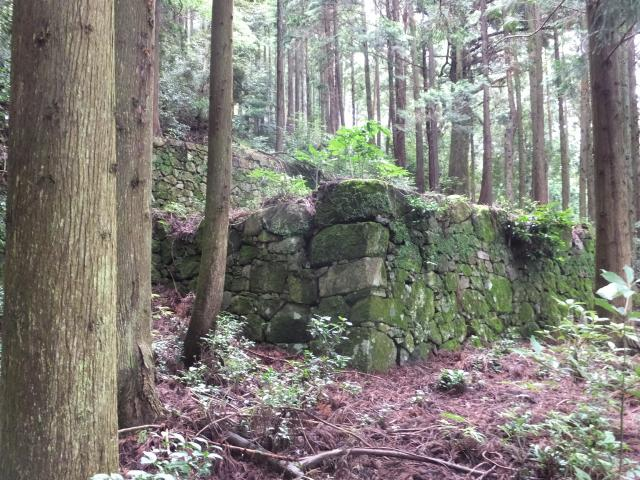
A major characteristic of Kamioyama Castle is the stone walls and stone walls remaining in various places. While the use of stone walls is limited in mountain castles in the Tanba region, stone masonry can be seen at the edges of the baileys and around the entrance gates of Kamioyama Castle. These stone walls were constructed using the nozurazumi technique, making them valuable relics demonstrating Sengoku period stonework techniques.
Regarding the stone walls remaining around Kinrinji Temple, it is difficult to determine whether some are related to temple facilities or castle remains, but there are also stone walls clearly positioned for defensive purposes. The use of large and unusual stones in the stonework creates a unique landscape that takes advantage of the location as a sacred site of Tendai Esoteric Buddhism.
Entrance and Defensive Structures
The entrance to the castle, known as the “koguchi,” is heavily fortified with earthworks and stone walls. The entrance to the main enclosure, in particular, has a complex, winding structure designed to prevent easy enemy intrusion. A small enclosure is positioned in front of the entrance, serving to intercept intruders.
The dry moat is constructed to cut off the ridgeline, and its depth varies, reaching several meters in its deepest points. The bottom of the moat also features a vertical moat descending the slope, serving to prevent enemy flank movement.
Wells and Living Facilities
Despite being a mountain castle, traces of a well have been found at Kamioyama Castle. While constructing a well on a high mountaintop is technically difficult, this remains are noteworthy as they demonstrate the importance of securing a water source in preparation for a long siege. Further detailed investigations are needed to determine the exact location and size of the well.
Flat areas, believed to be building remains, have also been identified within the enclosures, suggesting the presence of living spaces, warehouses, and other facilities. However, there are limitations to what can be confirmed at the surface, and archaeological excavations may reveal more detailed structures.
Relationship between Kinrinji Temple and Kamioyama Castle – A Sacred Site of Tendai Esoteric Buddhism
History of Kinrinji Temple
Kinrinji Temple is an ancient temple said to have been founded by the monk Saigan during the Enryaku era (782-806). It flourished as a sacred site of Tendai Esoteric Buddhism, and at its peak, numerous temple buildings stood there. It is believed that the main hall was constructed in 1559, and the current main hall houses Kongo Rikishi statues, which are designated cultural properties of Kameoka City.
Around Kinrinji Temple, many traces of former temple buildings remain, including the sites of Gokurakubo, Takenakabo, Hozobo, and Higashiyanagibo. The stone walls of these temple buildings still remain, evoking the prosperity of the past. As a training ground for Tendai Esoteric Buddhism and a center of faith, Kinrinji Temple wielded significant influence in the region.
The Complex Characteristics of Temples and Castles
The relationship between Kamioyama Castle and Kinrinji Temple is a prime example of the close connection between temples and castles in the medieval period. The integration of the religious authority of the temple and the military functions of the castle created a stronger base of control.
In many places, it is difficult to distinguish between the leveled ground where Kinrinji Temple’s temple buildings are located and the castle’s baileys, suggesting the possibility of an organic connection between the two. Here, we see a characteristic feature of medieval castles: temple facilities functioning as defensive strongholds during wartime and being used as a place for religious activities during peacetime.
Kinrinji Temple Today
Currently, Kinrinji Temple also serves as a trailhead to the Kamioyama Castle ruins. It is possible to access Kinrinji Temple, located on the mountainside, by car, and from there, a hiking trail of approximately 20 minutes leads to the main bailey. You can enjoy exploring the castle ruins in conjunction with visiting the main hall of Kinrinji Temple and the Kongo Rikishi statues.
Highlights of Kamioyama Castle – Remains that can be seen on site
Earthworks and Cut Slopes
The first thing you’ll notice when visiting Kamioyama Castle is the earthworks surrounding each enclosure. Earthworks about 1-2 meters high encircle the edges of the enclosures, forming a clear defensive line. The earthworks are well-preserved, allowing you to imagine what the castle looked like when it was built.
The cut slopes between the enclosures are also clearly visible, providing a good understanding of the defensive structure utilizing the difference in elevation. The angle of the cut slopes is steep, making them difficult to climb.
Stone Walls and Stone Fortifications
The stone walls remaining in various places are a major highlight of Kamioyama Castle. In particular, the stonework around the entrance gates is a valuable remains that allows you to observe the stonework techniques of the Sengoku period up close. The stone walls built using the Nozurazumi method, where natural stones are piled up as they are, give a simple yet powerful impression.
The stone walls around Kinrinji Temple are also impressive. The way in which stone walls associated with temple facilities and castle walls coexist speaks to the complex nature of this castle.
Dry Moats and Moats
The moats that cut across the ridge are important defensive structures. The moats, several meters deep, are still clearly visible and are essential for understanding the castle’s defensive structure. Walking along the bottom of the moats allows you to appreciate their scale and defensive effectiveness.
Arrangement of Enclosures
The arrangement of the enclosures, which are continuous from the main enclosure, shows a typical structure of a mountain castle with a series of enclosures. By observing the size, shape, and arrangement of each enclosure, you can understand the skillful design of the castle’s layout. The views from the enclosures are also magnificent, offering a panoramic view of the Tanba mountains.
Access Information – How to Get to Kamioyama Castle
Access by Car
Kamioyama Castle is most easily accessible by car. From the Kameoka Interchange on the Kyoto Expressway, head northwest on National Route 372 (Sasayama Road) towards Miyamae-cho. Follow the signs for Kinrinji Temple and ascend the mountain road to reach the Kinrinji Temple parking lot. From the parking lot, it’s approximately a 20-minute walk to the main keep.
The mountain road has some narrow sections, so please drive carefully. In particular, there are places where passing oncoming vehicles is difficult, so please drive cautiously.
Access by Public Transportation
If using public transportation, the nearest station is Kameoka Station on the JR Sanin Main Line. From Kameoka Station, take a bus towards Miyamae-cho and walk from the nearest bus stop. However, since bus services are limited, it is recommended to check the timetable in advance.
It takes more than 30 minutes to walk from the bus stop to Kinrinji Temple, so plan accordingly and allow ample time.
Precautions for Visiting the Castle
Kamioyama Castle is a full-fledged mountain castle, and appropriate preparation is necessary for the climb. Please note the following:
- Clothing: Wear comfortable clothing and hiking boots or trekking shoes.
- Equipment: Bring drinking water, a towel, insect repellent, and work gloves.
- Season: There are many insects in summer, and there is a possibility of snow and ice in winter. Spring to early summer and autumn are the best seasons to visit.
- Time: Allow about 1 hour for the round trip from Kinrinji Temple to the main enclosure, or about 2 hours if you want to thoroughly explore the remains.
- Weather: The ground can be slippery in rainy weather, so we recommend visiting on a sunny day.
Nearby Tourist Attractions – Highlights of Kameoka City
Yagami Castle Ruins
Yagami Castle Ruins, deeply connected to Kamioyama Castle, is a representative mountain castle of Tanba located in Sasayama City. It flourished as the base of the Hatano clan, and fierce battles took place there during Akechi Mitsuhide’s invasion of Tanba. Visiting both Kamioyama Castle and Yagami Castle together will provide a deeper understanding of the overall Tanba campaign.
Kameoka Castle Ruins (Kameyama Castle Ruins)
Kameoka Castle (Kameyama Castle), built by Akechi Mitsuhide after the pacification of Tanba, is now largely lost, but some of the stone walls remain. It is located in the city center of Kameoka and is easily accessible.
Tanba Kokubunji Temple Ruins
These are the ruins of Kokubunji Temple, the central temple of ancient Tanba Province. Remains such as foundation stones remain, allowing visitors to experience the history of Tanba from ancient times.
Hozugawa River Boat Trip
The Hozugawa River boat trip, a famous tourist attraction in Kameoka, is a popular activity that allows visitors to enjoy the beauty of the Hozukyo Gorge from a boat. It offers a different kind of charm than visiting castle ruins.
Historical Significance and Evaluation of Kamioyama Castle
Kamioyama Castle is an important castle for understanding the military and political situation in the Tanba region during the Sengoku period. As a castle that demonstrated the sphere of influence of the Hatano clan, and as a strategic base in Akechi Mitsuhide’s conquest of Tanba, this castle played a crucial role.
The castle remains, such as earthworks, stone walls, baileys, and dry moats, are well-preserved, making it a valuable example for learning about the structure of Sengoku period mountain castles. The presence of stone walls, in particular, is rare for mountain castles in the Tanba region, increasing its value in castle research.
Furthermore, its complex location alongside the ancient temple Kinrinji is an interesting example of the connection between religion and military power in the medieval period. It suggests that the spiritual authority of the temple and the physical power of the castle were combined to form a base for regional control. Currently, Kamioyama Castle is maintained by local preservation societies and is known as a hidden gem of a castle, attracting history enthusiasts and castle fans. Further research and appropriate preservation activities are expected to lead to a wider recognition of the castle’s historical value.
Summary – The Value of Visiting Kamioyama Castle
Kamioyama Castle (Honme Castle) is a valuable Sengoku period mountain castle ruin remaining in Kameoka City, Kyoto Prefecture. Built as the residence of Yanagimoto Kenji, and playing a crucial role in Akechi Mitsuhide’s invasion of Tanba, this castle, situated at an altitude of 359m and a relative height of 230m, remains many structures to this day as a formidable stronghold.
Defensive facilities such as earthworks, stone walls, baileys, and dry moats are well-preserved, allowing visitors to learn firsthand about the structure of Sengoku period mountain castles. Its complex location alongside Kinrinji Temple, a sacred site of Tendai esoteric Buddhism, is also a significant feature of this castle.
Accessible by car to Kinrinji Temple, the castle is relatively easy to visit, with the main keep just a 20-minute walk from there. For those interested in the history of Tanba and fans of mountain castles, Kamioyama Castle is a must-see historical site.
Kamioyama Castle is connected to two important figures in Sengoku period history: the Hatano clan and Akechi Mitsuhide. Walking through this historical setting allows you to experience a sense of presence and the weight of history that you can’t get from textbooks. Be sure to visit this hidden gem of a castle at least once.
